
RFID In Pharmaceuticals Market Report Scope and Overview:
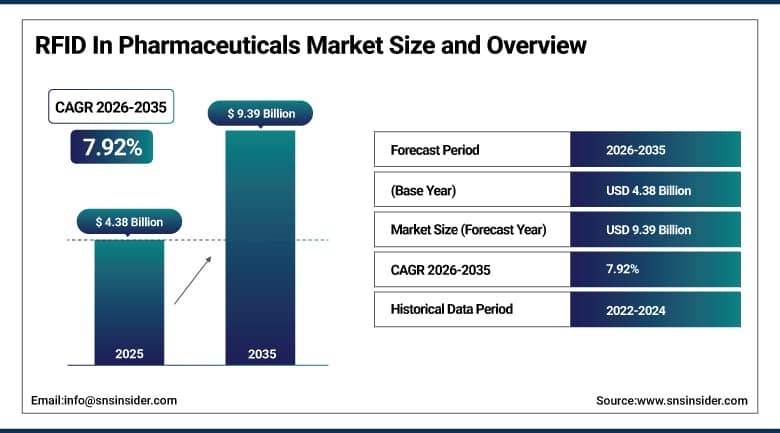
The RFID In Pharmaceuticals Market was valued at USD 4.38 Billion in 2025 and is projected to reach USD 9.39 Billion by 2035, registering a CAGR of 7.92% from 2026 to 2035.
The RFID In Pharmaceuticals Market is steadily reshaping pharmaceutical supply chains by moving drug identification from line-of-sight barcode scanning toward automatic, item-level radio-frequency capture across manufacturing, distribution, hospital pharmacy and retail. The market is characterized by full enforcement of the U.S. Drug Supply Chain Security Act and the EU Falsified Medicines Directive, rapid growth of temperature-sensitive biologics that require continuous condition monitoring, and hospital adoption of RFID-enabled medication kits and cabinets that cut waste and stockouts. Significant growth is being witnessed in RFID middleware and retail and e-pharmacy channels, considering that drug makers, distributors and providers continue investing in real-time traceability, authentication and inventory intelligence.
Avery Dennison launched a sterilization-compatible RFID inlay portfolio in March 2026, including AD Minidose U9 Steri, AD Accessory U9 Steri and AD Shelter Steri, engineered to withstand autoclave and ethylene oxide sterilization and extending item-level RFID traceability to sterile and device-adjacent pharmaceutical workflows.
To Get More Information On RFID In Pharmaceuticals Market - Request Free Sample Report
RFID In Pharmaceuticals Market Trends:
-
Rising DSCSA and EU FMD enforcement continues pushing pharma supply chains toward automated item-level verification.
-
Growing use of sensor-enabled RFID tags continues extending traceability into cold-chain condition monitoring.
-
Expanding point-of-manufacture tagging continues reducing downstream RFID tagging labour in hospitals.
-
Increasing integration of RFID data with EPCIS and cloud analytics continues turning reads into supply chain intelligence.
-
Rising adoption of chipless and sterilization-ready tags continues widening RFID use on vials, syringes and harsh environments.
U.S. RFID In Pharmaceuticals Market Outlook:
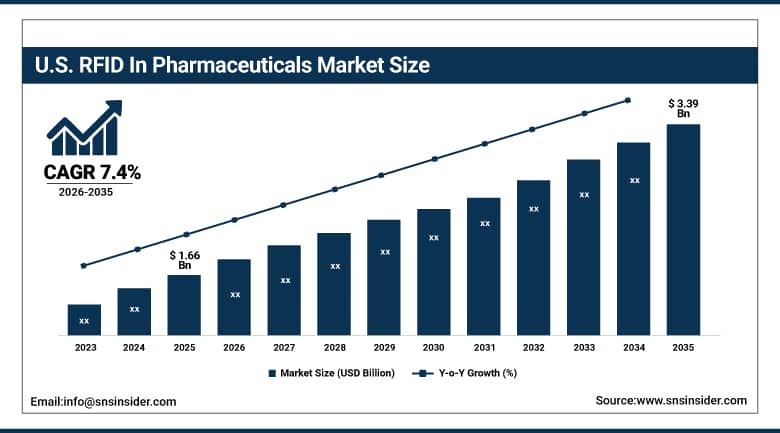
The U.S. RFID In Pharmaceuticals Market was valued at approximately USD 1.66 billion in 2025 and is projected to reach approximately USD 3. 39 billion by 2035, registering a CAGR of approximately 7.4% from 2026 to 2035.
Demand across the United States continued to be shaped by the Drug Supply Chain Security Act, which requires interoperable, electronic, package-level tracing of prescription drugs, together with high biologic and specialty drug volumes and widespread hospital pharmacy automation. Rising use of RFID-tagged medication kits, smart cabinets and point-of-manufacture tagging continued reinforcing the country's position as the largest national market. Growing direct-to-patient and specialty pharmacy distribution added further layers of sustained domestic demand, with manufacturers, distributors and health systems increasingly prioritizing RFID data that feeds EPCIS-based compliance and inventory analytics.
Zebra Technologies and Texas Children's Hospital publicized results from an RFID-enabled medication management deployment in April 2026, with Texas Children's reporting USD 14 million in annual medication cost savings through RFID printing and UHF RFID mobile reading that reduced waste, improved inventory accuracy and cut stockouts.
RFID In Pharmaceuticals Market Segment Analysis:
-
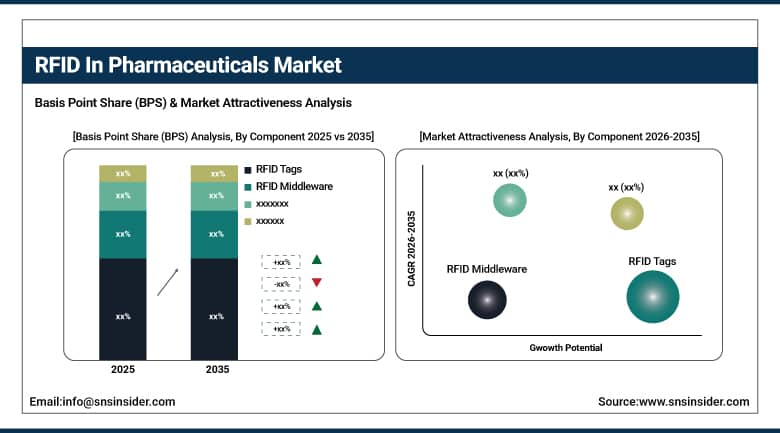
By Component, RFID Tags segment dominated the RFID In Pharmaceuticals Market in 2025 with 45% share; RFID Middleware segment is the fastest growing segment with a CAGR of approximately 9.6%.
-
By Type, Chipped RFID segment dominated the RFID In Pharmaceuticals Market in 2025 with 71% share; Chipless RFID segment is the fastest growing segment with a CAGR of approximately 9.7%.
-
By Application, Drug Tracing & Authentication Systems segment dominated the RFID In Pharmaceuticals Market in 2025 with 52% share; Drug Quality & Condition Monitoring segment is the fastest growing segment with a CAGR of approximately 10.1%.
-
By End User, Drug Manufacturers segment dominated the RFID In Pharmaceuticals Market in 2025 with 48% share; Retail & E-Pharmacies segment is the fastest growing segment with a CAGR of approximately 10.2%.
By Component: RFID Tags Lead, Middleware Grows Fastest
The RFID Tags segment dominated the RFID In Pharmaceuticals Market in 2025, driven by the very large volumes of passive HF, UHF and NFC labels and inlays applied to cartons, vials, syringes and medication kits. Tags are consumed with every serialized unit, creating recurring demand that scales with pharmaceutical production. Falling tag prices and new pharma-grade designs for curved, liquid-filled and sterilized containers reinforced this segment's position as the largest contributor to total market revenue throughout the base year.
The RFID Middleware segment is the fastest growing in the RFID In Pharmaceuticals Market owing to rising demand for software that filters tag reads, generates EPCIS events, triggers exception alerts and feeds compliance and inventory dashboards. Pharmaceutical companies increasingly want actionable supply chain intelligence rather than raw data. Integration of RFID into enterprise supply chain and hospital inventory platforms is accelerating this segment's growth trajectory. Growing cloud-based subscription models further support middleware adoption.
By Type: Chipped RFID Leads, Chipless RFID Grows Fastest
The Chipped RFID segment dominated the RFID In Pharmaceuticals Market because silicon-based UHF and HF tags offer global standards support, unique serial numbers, reliable read performance and wide regulatory acceptance for serialized pharmaceutical products. Chipped tags are embedded across packaging lines, distribution centres and hospital systems. Their established ecosystem of readers, printers and software reinforced this segment's dominant contribution to total market revenue throughout the base year.
The Chipless RFID segment is the fastest growing as lower-cost tags without integrated circuits gain interest for anti-counterfeiting and difficult-to-tag items such as foil blisters and vial stoppers. Chipless designs can perform better near metal and liquids and can be printed directly onto packaging. Rising focus on cost per unit in emerging markets continues attracting investment in chipless approaches. Hybrid designs combining chipless security features with conventional tags further support adoption.
By Application: Drug Tracing & Authentication Leads, Quality & Condition Monitoring Grows Fastest
The Drug Tracing & Authentication Systems segment dominated the RFID In Pharmaceuticals Market because serialization and verification rules under DSCSA and the EU FMD require unique identification and traceability of saleable units across the supply chain. RFID supports automated aggregation, shipment verification, saleable-returns checks and counterfeit detection at high speed. Continued compliance investment by manufacturers and distributors reinforced this segment's dominant contribution to total market revenue throughout the base year.
The Drug Quality & Condition Monitoring segment is the fastest growing due to rapid expansion of temperature-sensitive biologics, vaccines and cell and gene therapies that must remain within narrow environmental limits. Sensor-enabled RFID tags record temperature, humidity and shock data along each shipment leg and support audit-ready provenance records. Rising spoilage costs and EPCIS 2.0 support for sensor data continue attracting investment in condition-monitoring RFID. Growing direct-to-patient delivery further accelerates demand.
By End User: Drug Manufacturers Dominate, Retail & E-Pharmacies Grow Fastest
The Drug Manufacturers segment dominated the RFID In Pharmaceuticals Market because manufacturers apply tags at the point of packaging to meet serialization requirements and to support downstream hospital and distributor workflows. Point-of-manufacture tagging by suppliers such as Fresenius Kabi reduces the need for hospitals to tag products themselves. Continued investment in packaging line upgrades reinforced this segment's dominant contribution to total market revenue throughout the base year.
The Retail & E-Pharmacies segment is the fastest growing as omnichannel pharmacies, mail-order and direct-to-patient services adopt RFID to verify authenticity, track high-value prescriptions and confirm last-mile delivery. Hospitals & Clinics also adopt RFID for medication kits, crash carts and controlled substances, while Wholesale & Distribution Centres and CROs/CMOs invest to secure their roles in increasingly digital supply chains. Growing consumer demand for assured authenticity continues accelerating retail adoption.
Regional Analysis:
|
Region |
Major Country |
Share within Region, 2025 (%) |
|---|---|---|
|
North America |
United States |
88.90% |
|
Europe |
Germany |
25.80% |
|
Asia Pacific |
China |
36.40% |
|
Middle East and Africa |
Saudi Arabia |
30.20% |
|
Latin America |
Brazil |
45.60% |
North America RFID In Pharmaceuticals Market Insights
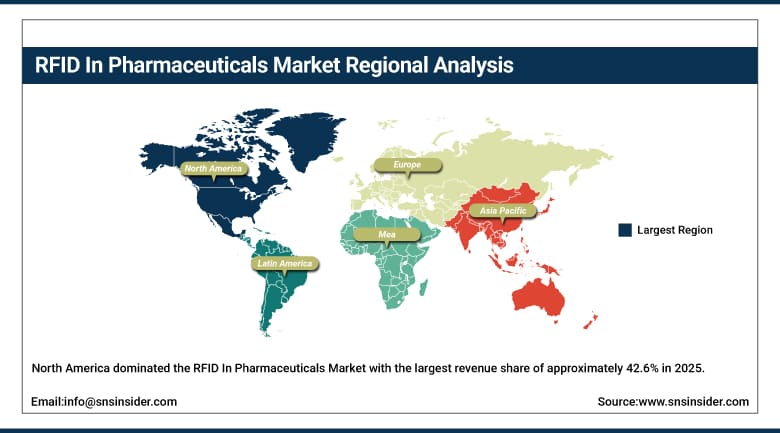
North America dominated the RFID In Pharmaceuticals Market with the largest revenue share of approximately 42.6% in 2025. Full DSCSA enforcement, large pharmaceutical manufacturing and distribution networks, high hospital pharmacy automation and the presence of leading RFID and supply chain software vendors continued reinforcing this dominant regional position. Point-of-manufacture tagging and RFID-enabled medication kits have become common in U.S. health systems. Growing specialty and biologic drug volumes further reinforced this region's leadership position.
The United States accounted for the substantial majority of regional revenue, anchored by DSCSA compliance, strong hospital RFID adoption and large wholesale distributors. Canada and Mexico added further demand by aligning export supply chains with U.S. traceability expectations, and that combined strength kept the region the largest addressable market for pharmaceutical RFID vendors through the forecast period. Continued investment in cold-chain monitoring reinforced sustained demand.
Get Customized Report as Per Your Business Requirement - Enquiry Now
Europe RFID In Pharmaceuticals Market Insights
Europe held a meaningful share of global revenue, supported by the EU Falsified Medicines Directive, which requires safety features and verification of most prescription medicines, and by a strong base of high-value pharmaceutical manufacturing. While the FMD unique identifier is carried on a 2D barcode, RFID is increasingly used alongside it to automate operations. Growing biologic production and sustainability initiatives, including reusable packaging, further reinforced regional demand.
Germany continued to lead demand at roughly 25.80% of European revenue, supported by its large pharmaceutical industry and domestic RFID labelling expertise from companies such as Schreiner MediPharm. Switzerland, Ireland, France and the UK contributed substantial additional demand through manufacturing hubs and hospital adoption, and continued European investment in traceability should keep regional demand for pharmaceutical RFID climbing through the forecast period. Additional demand from Italy, Spain and the Nordic countries reinforced broader regional market strength.
Asia Pacific RFID In Pharmaceuticals Market Insights
Asia Pacific is advancing at the fastest pace, growing at a CAGR of approximately 8.7% from 2026 to 2035. This growth is driven by large-scale pharmaceutical manufacturing in China and India for export markets, growing biologic production in Japan, South Korea and Singapore, and national track-and-trace initiatives, with new manufacturing facilities and cold-chain networks continuing to broaden the region's addressable base well beyond its traditional smaller footprint. Regulatory harmonization under PIC/S GMP further supports cross-border adoption.
China held a substantial share of regional revenue, supported by its large drug manufacturing base and national traceability system. India and Japan contributed meaningful additional demand, with India's generic exporters tagging products for Western buyers and Japan's biologic cold chains both reinforcing the region's position as the fastest-growing market tracked in this report. South Korea, Singapore and Australia contributed smaller but steadily growing regional demand throughout the period.
MEA and Latin America RFID In Pharmaceuticals Market Insights
The Middle East and Africa and Latin America both showed steady growth, driven by national drug track-and-trace programmes, efforts to combat counterfeit medicines and growing local pharmaceutical manufacturing across both areas. Counterfeit drugs are a significant problem in parts of Africa and Latin America, increasing the value of authentication technologies. Growing cold-chain investment for vaccines and biologics further reinforced adoption.
Saudi Arabia led Middle East and Africa demand, supported by its national drug track-and-trace system and pharmaceutical localization goals under Vision 2030, while the UAE contributed through advanced logistics hubs. In Latin America, Brazil accounted for the largest share of regional revenue, with its drug traceability regulations and large pharmaceutical market continuing to anchor regional demand for pharmaceutical RFID. Mexico and Argentina contributed additional demand through expanding pharmaceutical manufacturing and distribution.
Market Dynamics:
Growth Drivers: Serialization Regulations and Cold-Chain Biologics Expansion
The industry is driven by stringent drug safety and anti-counterfeiting regulations such as DSCSA and the EU FMD, increasing complexity of global pharmaceutical supply chains with many hand-offs, and rapid growth of temperature-sensitive biologics and specialty therapies. As manufacturers, distributors and providers seek faster, error-free verification and real-time visibility, demand for RFID tags, readers and middleware continues rising across the pharmaceutical value chain. Growing hospital automation and omnichannel pharmacy models further reinforce this sustained industry-wide demand driver.
Falling RFID tag costs and improved read accuracy continue reinforcing this driver, as pharma-grade tags for vials, syringes and sterilized packaging reduce technical barriers. Growing integration of RFID data with EPCIS, ERP and cloud analytics continues turning tag reads into actionable intelligence, and that combination of regulation, biologics growth and technology keeps demand rising at a steady, sustained pace. Expanding point-of-manufacture tagging is further widening the addressable user base.
Restraints: High Integration Costs and RF Performance Limitations
High initial system integration and validation expenses continue posing a restraint on faster market-wide expansion, as full pharmaceutical deployments require ERP links, electronic record validation and staff training. Annual support costs add to total cost of ownership, which is a hurdle for mid-sized firms. Many dispensers and smaller trading partners remain at different levels of readiness.
Limited radio-frequency performance around metal equipment and liquid-filled containers continues posing a further restraint, as read rates can fall sharply in production environments. Data security, privacy and fragmented global standards also complicate deployments. Because DSCSA and FMD do not mandate RFID specifically, some companies continue relying on barcodes alone.
Opportunities: Automated Verification at Scale and Sensor-Enabled Cold Chains
Converting barcode-based serialization programmes into bulk, automated RFID verification at distribution and returns processing nodes represents a significant opportunity, as trading partners seek to reduce manual scanning and data reconciliation. Vendors positioned early in validated, configurable middleware and cloud repositories stand to capture meaningful share as compliance programmes mature. Mixed readiness across dispensers continues creating demand for bridging solutions.
Sensor-enabled RFID for temperature-controlled logistics offers a second substantial opportunity, as biologics, vaccines and cell and gene therapies require continuous condition monitoring and audit-ready provenance. Vendors combining sensor tags, connectivity and analytics stand to capture meaningful share as cold-chain spoilage costs rise. Continued growth of pharmaceutical manufacturing across Asia and specialty drug distribution worldwide is further accelerating adoption.
Recent Developments:
-
May 2026: Schreiner MediPharm and HERMA announced an integrated RFID labelling solution for pharmaceutical vials, addressing read performance on curved, liquid-filled containers and supporting item-level traceability at the point of packaging.
-
May 2026: The U.S. FDA's DSCSA stabilization period for enhanced drug distribution security was tracked as ending on May 27, 2026, increasing pressure on trading partners to support unit-level verification and EPCIS-based electronic data exchange.
-
February 2026: p-Chip Corporation signed a licensing agreement to integrate its p-Chip Light Activated Microtransponders into the RxERP platform for DSCSA-aligned chain-of-identity controls, following a January 2026 end-to-end digital traceability trial with Choice One Rx co-sponsored by Avantor.
RFID In Pharmaceuticals Market key players are:
-
Avery Dennison Corporation
-
Zebra Technologies Corp.
-
Impinj Inc.
-
CCL Industries (Smartrac)
-
Fresenius Kabi
-
Checkpoint Systems Inc.
-
NXP Semiconductors
-
SATO Holdings Corp.
-
Schreiner MediPharm
-
Tageos SAS
-
GAO RFID Inc.
-
Invengo Technology Pte Ltd
-
Honeywell International Inc.
-
Siemens (SIMATIC RFID)
-
Bluesight (Kit Check)
-
Paragon ID (RFiD Discovery)
-
Turck Vilant Systems
-
p-Chip Corporation
RFID In Pharmaceuticals Market Report Scope:
| Report Attributes | Details |
|---|---|
| Market Size in 2025 | USD 4.38 Billion |
| Market Size by 2035 | USD 9.39 Billion |
| CAGR | CAGR of 7.92% From 2026 to 2035 |
| Base Year | 2025 |
| Forecast Period | 2026-2035 |
| Historical Data | 2022-2024 |
| Report Scope & Coverage | Market Size, Segments Analysis, Competitive Landscape, Regional Analysis, DROC & SWOT Analysis, Forecast Outlook |
| Key Segments | • By Component (RFID Readers, Handheld Readers, Fixed Readers, RFID Tags, Passive (HF, UHF, NFC), Active & BAP (Battery-Assisted Passive), RFID Middleware) • By Type (Chipped RFID, Chipless RFID) • By Application (Drug Tracing & Authentication Systems, Drug Quality & Condition Monitoring, Other Applications) • By End User (Drug Manufacturers, Wholesale & Distribution Centres, Hospitals & Clinics, Retail & E-Pharmacies, Contract Research / Manufacturing Organisations (CROs/CMOs)) |
| Regional Analysis/Coverage | North America (US, Canada), Europe (Germany, UK, France, Italy, Spain, Russia, Poland, Rest of Europe), Asia Pacific (China, India, Japan, South Korea, Australia, ASEAN Countries, Rest of Asia Pacific), Middle East & Africa (UAE, Saudi Arabia, Qatar, South Africa, Rest of Middle East & Africa), Latin America (Brazil, Argentina, Mexico, Colombia, Rest of Latin America). |
| Company Profiles | Avery Dennison Corporation, Zebra Technologies Corp., Impinj Inc., CCL Industries (Smartrac), Fresenius Kabi, Checkpoint Systems Inc., NXP Semiconductors, SATO Holdings Corp., Schreiner MediPharm, Tageos SAS, GAO RFID Inc., Invengo Technology Pte Ltd, Honeywell International Inc., Siemens (SIMATIC RFID), Bluesight (Kit Check), Paragon ID (RFiD Discovery), Turck Vilant Systems, p-Chip Corporation |
Frequently Asked Questions
Key players include Avery Dennison, Zebra Technologies, Impinj, CCL Industries (Smartrac), Fresenius Kabi, Checkpoint Systems, NXP Semiconductors, and SATO Holdings.
Key opportunities include automated bulk verification for DSCSA compliance, sensor-enabled cold-chain RFID, chipless anti-counterfeiting tags, and point-of-manufacture tagging.
The market is driven by serialization regulations such as DSCSA and the EU FMD, supply chain complexity, growth of temperature-sensitive biologics, and hospital pharmacy automation.
The RFID Tags segment dominated the RFID In Pharmaceuticals Market, accounting for approximately 45% market share.
The North America region dominated the RFID In Pharmaceuticals Market in 2025 with approximately 42.6% share, driven by full DSCSA enforcement, large pharmaceutical supply chains, and high hospital RFID adoption.
