
Humanitarian Logistics Market Report Scope & Overview:
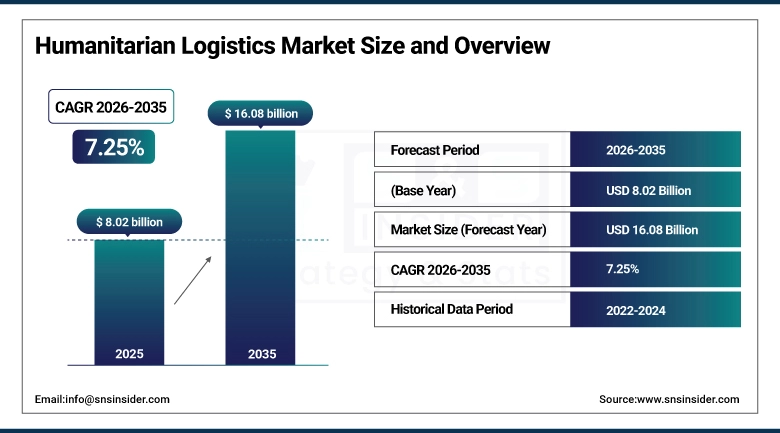
The Humanitarian Logistics Market size was valued at USD 8.02 Billion in 2025 and is projected to reach USD 16.08 Billion by 2035, growing at a CAGR of 7.25% during 2026-2035.
The Humanitarian Logistics Market is witnessing growth owing to the rise in the occurrence of natural calamities, the effects of global warming, and the humanitarian crisis faced by the world. The need for efficient disaster relief, emergency relief, and supply chain operations is fueling the market, along with the growth in the use of logistics technologies, government and non-government efforts, and the rise in international funding.
To Get more information on Humanitarian Logistics Market - Request Free Sample Report
Key Humanitarian Logistics Market Trends
-
Digitalization and smart logistics adoption with AI, IoT, and data analytics improving real-time tracking, coordination, and decision-making in disaster response operations.
-
Growing focus on last-mile delivery efficiency to reach remote and disaster-affected areas quickly using innovative solutions like drones and mobile distribution hubs.
-
Rising collaboration among governments, NGOs, military, and private logistics providers to enhance coordination, resource sharing, and overall response effectiveness.
-
Increasing emphasis on sustainability through eco-friendly transport, optimized routing, and use of renewable energy in humanitarian logistics operations.
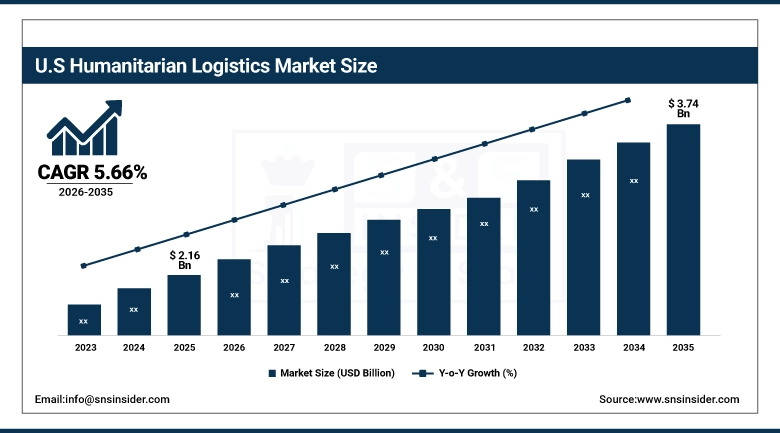
The U.S. Humanitarian Logistics Market size was valued at USD 2.16 Billion in 2025 and is projected to reach USD 3.74 Billion by 2035, growing at a CAGR of 5.66% during 2026-2035. The U.S. holds a 78.64% share within the North America region. USAID's Bureau for Humanitarian Assistance, which manages most U.S. government emergency response, obligated over USD 4.5 billion in humanitarian assistance funding in FY2024 most of which flows through logistics contracts with commercial operators, NGOs, and UN agencies.
Humanitarian Logistics Market Growth Drivers:
-
Rising Disasters, Global Aid Demand, and Technology Advancements Driving Growth in Humanitarian Logistics Market
The Humanitarian Logistics Market is influenced by factors like an increase in the occurrence of natural disasters, climate changes, and humanitarian crises. An increase in aid funding and rapid response needs worldwide is also a major factor for market growth. In addition, technological innovations, coordination between governments and NGOs, and increased attention to last-mile operations have increased efficiency in operations, thus propelling market growth.
Humanitarian Logistics Market Restraints:
-
Infrastructure Challenges, Funding Constraints, and Operational Complexities Limiting Growth in Humanitarian Logistics Market Globally
The Humanitarian Logistics Market has some restraining factors, such as poor infrastructure in disaster-prone and remote locations, which creates difficulties in delivering aid materials in a timely manner. Moreover, there is limited funding support from governments and organizations, which affects the efficiency of operations. Furthermore, there are difficulties in coordinating operations with various stakeholders, which creates problems in security situations, thereby restraining the growth of the Humanitarian Logistics Market.
Humanitarian Logistics Market Opportunities:
-
Advancing Technology Integration, Global Partnerships, and Sustainable Solutions Creating New Opportunities in Humanitarian Logistics Market
The Humanitarian Logistics Market offers tremendous opportunities through the adoption of cutting-edge technologies such as AI, drones, and blockchain for better tracking and increased efficiency. The increasing number of public-private partnerships and collaborations among global organizations are helping to mobilize resources and respond to situations effectively. Moreover, the growing emphasis on sustainable logistics and investments in resilient infrastructure are creating new opportunities for innovation and future market growth.
Humanitarian Logistics Market Segment Analysis
-
By Service Type, Transportation & Freight Management dominated with 36.42% in 2025, and IT & Supply Chain Management Solutions are expected to grow at the fastest CAGR of 9.88% from 2026 to 2035.
-
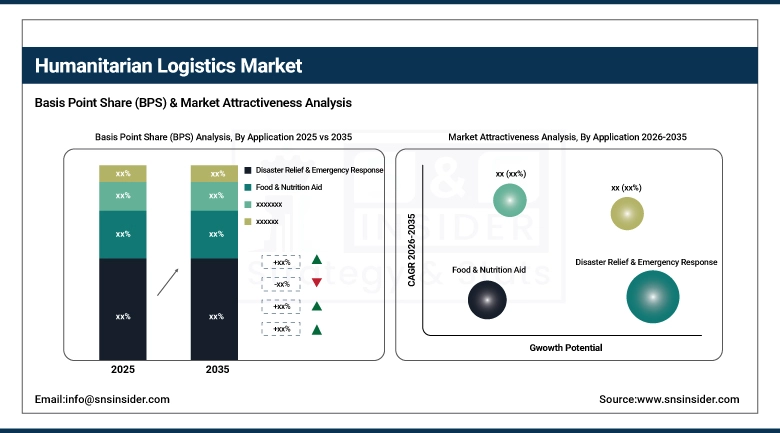
By Application, Disaster Relief & Emergency Response dominated with 38.57% in 2025, and Healthcare & Medical Supplies are expected to grow at the fastest CAGR of 8.90% from 2026 to 2035.
-
By End User, Government & Public Sector Agencies dominated with 31.84% in 2025, and Private Sector & CSR Initiatives are expected to grow at the fastest CAGR of 9.29% from 2026 to 2035.
-
By Mode / Channel, Road & Land Transport dominated with 34.72% in 2025, and Multi-Modal & Integrated Supply Chains are expected to grow at the fastest CAGR of 9.37% from 2026 to 2035.
By Application, Disaster Relief & Emergency Response Dominates While Healthcare and Medical Supplies Grows Fastest in Humanitarian Logistics Market 2026 to 2035
Disaster relief and emergency response operations are the main application, and this is because disaster relief operations require immediate logistics support. The mobilization and distribution of relief items are among the main logistics operations in disaster relief. However, the application of healthcare and medical supply logistics is gaining momentum, especially in the mobilization and distribution of vital drugs and vaccines, especially in the case of global health emergencies.
By Service Type, Transportation & Freight Management Leads While IT & Supply Chain Management Solutions Set for Fastest Growth in Humanitarian Logistics Market 2026 to 2035
Transportation and freight management services are the largest segment in the humanitarian logistics market, as the efficient movement of goods is vital in emergency situations. On the other hand, IT and supply chain management solutions are witnessing significant growth, and this is because the need for real-time visibility, coordination, and optimization is being achieved through the use of advanced technologies, thereby creating efficiency in the operations.
By End User, Government and Public Sector Agencies Lead While Private Sector and CSR Initiatives Poised for Fastest Growth Through 2035
Government and public sector organizations are also dominating the market, considering they play a vital role in disaster management, funding, and coordination of relief activities. This helps them deploy resources on a large scale through a structured framework. However, there has been a growing trend in terms of private sector involvement and corporate social responsibility, with organizations contributing logistics, funding, and innovative ideas to support and enhance disaster response activities.
By Mode and Channel, Road and Land Transport Leads While Multi-Modal and Integrated Supply Chains Show Fastest Growth in Humanitarian Logistics Market
Road and land transport have been seen to be the most utilized mode of transportation in humanitarian logistics due to its ease of accessibility and flexibility in reaching affected areas. However, it is considered crucial for last-mile delivery and distribution. There is an increased importance of multi-modal and integrated supply chains, where all modes of transportation like air, sea, and land are utilized for efficient, effective, and timely operations, especially for complex humanitarian operations.
Humanitarian Logistics Market Regional Analysis:
North America Humanitarian Logistics Market Insights
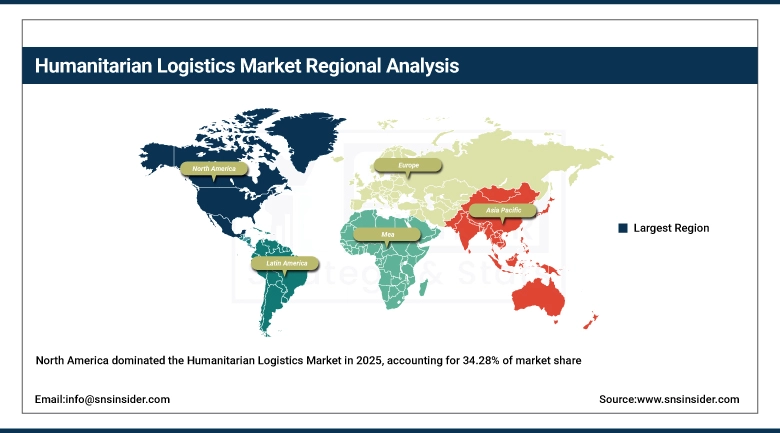
North America dominated the global Humanitarian Logistics Market in 2025 with a 34.28% share valued at USD 2.75 Billion, growing at a CAGR of 6.14% through 2035. Two distinct demand structures sit under that number. The first is international humanitarian response the United States is the single largest sovereign donor to the global humanitarian system, and the logistics contracts that USAID's Bureau for Humanitarian Assistance funds globally are procured largely from North American-headquartered commercial logistics firms. The second is domestic emergency response through FEMA, which activated 99 major disaster declarations in 2024 alone. Hurricane Helene's landfall in late September 2024, which caused catastrophic flooding across the Appalachian Mountains of North Carolina, Virginia, and Tennessee, generated a domestic humanitarian logistics operation that moved hundreds of thousands of waters, food, and shelter units across severed road networks.
Get Customized Report as per Your Business Requirement - Enquiry Now
U.S. Humanitarian Logistics Market Insights
The United States Humanitarian Logistics Market is driven by strong government support, advanced infrastructure, and active participation from NGOs and private organizations. Frequent natural disasters and global relief involvement increase demand for efficient logistics solutions. Adoption of digital technologies and focus on rapid response, coordination, and supply chain optimization further strengthen market growth and operational effectiveness.
Europe Humanitarian Logistics Market Insights
Europe held 26.17% of the global market at USD 2.10 Billion in 2025, CAGR 6.48% through 2035. ECHO the European Commission's Humanitarian Aid Office is the world's second-largest humanitarian donor, and its funding flows primarily through NGO and UN implementing partners that run their own logistics networks. The Ukraine conflict, active since February 2022 and continuing through 2025, has generated a humanitarian logistics operation on European soil on a scale not seen since World War II more than 6.3 million Ukrainian refugees in Europe by early 2024, with in-country assistance operations running simultaneously across frontline and non-frontline oblasts.
Germany Humanitarian Logistics Market Insights
Germany dominated the Humanitarian Logistics Market in Europe in 2025. The country has good infrastructure, well-developed logistics networks, and high government support for disaster response programs. Germany is also actively involved in international humanitarian response efforts. The presence of major logistics companies and non-governmental organizations is another factor that contributed to the high demand for effective supply chain management. Moreover, the emphasis on sustainability and technology is also helping Germany to lead the market.
Asia Pacific Humanitarian Logistics Market Insights
Asia Pacific is the fastest-growing regional market at 9.56% CAGR through 2035, valued at USD 1.73 Billion in 2025. The region generates the world's highest frequency of climate-related disasters: seven of the ten most disaster-prone countries by number of events are in Asia Pacific. Bangladesh alone faces multiple cyclones, river floods, and drought events in a typical year. The Philippines averaged 20 typhoons annually over the last decade. Indonesia sits across a seismically active zone that produced three major earthquakes requiring humanitarian response in the 2022-2024 period. What's changed is the quality of national disaster management agency capability in countries like the Philippines (NDRRMC), India (NDMA), and Indonesia (BNPB), all of which have professionalized their logistics response functions and are procuring platform tools and commercial logistics partnerships that didn't exist in their operational models five years ago.
China Humanitarian Logistics Market Insights
China held the dominant position in the Humanitarian Logistics Market in 2025, supported by its extensive logistics infrastructure, large-scale manufacturing capabilities, and strong government involvement in disaster management. The country’s ability to mobilize resources quickly during emergencies, along with increasing investments in technology-driven logistics solutions and regional humanitarian initiatives, contributed significantly to its market leadership.
Latin America (LATAM) and Middle East & Africa (MEA) Humanitarian Logistics Market Insights
Latin America held a 9.74% share at USD 0.78 Billion in 2025, CAGR 6.54% through 2035. The region's humanitarian logistics demand concentrates in Venezuela's migration crisis (still displacing over 7 million people with most crossing into Colombia, Peru, Chile, and Ecuador), Central American food security responses in the Dry Corridor, and recurring hurricane response along the Caribbean coast from Honduras to Cuba. Haiti's compounding political collapse and gang violence through 2024 presented one of the most difficult access environments for humanitarian logistics anywhere in the Western Hemisphere, requiring airlift as the primary supply mode after road networks became effectively impassable for aid convoys. The Middle East & Africa held 8.18% at USD 0.66 Billion, CAGR 7.97%, growing faster than North America and Europe. Sudan's crisis alone 25 million people requiring humanitarian assistance, the world's largest internal displacement situation by mid-2024 has concentrated logistics investment in Chad, Egypt, South Sudan, and Ethiopia border hubs. Yemen operations remain active after a decade of conflict.
Competitive Landscape for Humanitarian Logistics Market:
DHL Group, which is based in Bonn, Germany, runs the world's largest commercial logistics network. Through the GoHelp program, a structured partnership with UNHCR, WFP, and UNICEF, DHL has made humanitarian logistics a part of its core business. The program sends DHL Disaster Response Teams to major crises within 72 hours of activation.
-
In 2024, DHL GoHelp deployed Disaster Response Teams to four separate crisis activations including the Sudan response, where DHL teams managed freight clearance and warehousing operations at Port Sudan that processed more than 30,000 metric tons of humanitarian cargo for the WFP logistics cluster during the peak of the Darfur displacement response.
World Food Programme (WFP), technically a UN agency rather than a commercial firm but the world's largest humanitarian logistics operator, headquartered in Rome, manages the United Nations Humanitarian Response Depot network, the Logistics Cluster that coordinates multi-agency response in major crises, and a direct procurement and transport operation that moved USD 2.6 billion of food and logistics operations in 2023.
- In 2024, WFP's Logistics Cluster managed 28 active operations globally, including the Gaza response where it coordinated cargo movements through the Cyprus Maritime Corridor the first humanitarian sea corridor in the Eastern Mediterranean in decades under conditions that required daily renegotiation of access and security protocols to keep the supply line operational.
Humanitarian Logistics Market Key Players:
Some of the Humanitarian Logistics Market Companies are:
-
DHL Group
-
Kuehne+Nagel
-
UPS
-
FedEx
-
A.P. Moller – Maersk
-
DP World
-
Agility Logistics
-
DB Schenker
-
CEVA Logistics
-
Bolloré Logistics
-
World Food Programme (WFP)
-
International Committee of the Red Cross (ICRC)
-
International Federation of Red Cross and Red Crescent Societies (IFRC)
-
UNICEF
-
Médecins Sans Frontières (MSF)
-
CARE International
-
Oxfam International
-
Save the Children
-
G5 Logistics
-
Skylink Distribution
| Report Attributes | Details |
|---|---|
| Market Size in 2025 | USD 8.02 Billion |
| Market Size by 2035 | USD 16.08 Million |
| CAGR | CAGR of 7.25% From 2026 to 2035 |
| Base Year | 2025 |
| Forecast Period | 2026-2035 |
| Historical Data | 2022-2024 |
| Report Scope & Coverage | Market Size, Segments Analysis, Competitive Landscape, Regional Analysis, DROC & SWOT Analysis, Forecast Outlook |
| Key Segments | • By Service Type (Transportation & Freight Management, Warehousing & Inventory Management, Distribution & Relief Operations, and IT & Supply Chain Management Solutions) • By Application (Disaster Relief & Emergency Response, Food & Nutrition Aid, Healthcare & Medical Supplies, and Shelter & Infrastructure Support) • By End User (Government & Public Sector Agencies, Non-Governmental Organizations (NGOs), International Relief Organizations (e.g., UN, Red Cross), and Private Sector & Corporate Social Responsibility (CSR) Initiatives) • By Mode / Channel (Air Logistics, Road & Land Transport, Sea & Maritime Logistics, and Multi-Modal & Integrated Supply Chains) |
| Regional Analysis/Coverage | North America (US, Canada), Europe (Germany, UK, France, Italy, Spain, Russia, Poland, Rest of Europe), Asia Pacific (China, India, Japan, South Korea, Australia, ASEAN Countries, Rest of Asia Pacific), Middle East & Africa (UAE, Saudi Arabia, Qatar, South Africa, Rest of Middle East & Africa), Latin America (Brazil, Argentina, Mexico, Colombia, Rest of Latin America). |
| Company Profiles | DHL Group, Kuehne+Nagel, UPS, FedEx, A.P. Moller – Maersk, DP World, Agility Logistics, DB Schenker, CEVA Logistics, Bolloré Logistics, World Food Programme (WFP), International Committee of the Red Cross (ICRC), International Federation of Red Cross and Red Crescent Societies (IFRC), UNICEF, Médecins Sans Frontières (MSF), CARE International, Oxfam International, Save the Children, G5 Logistics, Skylink Distribution |

Frequently Asked Questions
North America dominated the Humanitarian Logistics Market in 2025 with a 34.28% share.
Transportation & Freight Management dominated the Humanitarian Logistics Market with a 36.42% share in 2025.
The key drivers of the Humanitarian Logistics market are record levels of forced displacement reaching 117.3 million people globally in 2024, rising frequency of climate-related disaster activations in Asia Pacific and Latin America, professionalization of commercial logistics partnerships through standby agreements with DHL, Maersk, and Agility, digital supply chain platform adoption reducing operational costs, and expanding UAV last-mile delivery infrastructure closing access gaps in conflict and flood-affected zones.
The Humanitarian Logistics Market size was USD 8.02 Billion in 2025 and is expected to reach USD 16.08 Billion by 2035.
The Humanitarian Logistics Market is expected to grow at a CAGR of 7.25% from 2026-2035.
