
Image Signal Processor Market Report Scope & Overview:
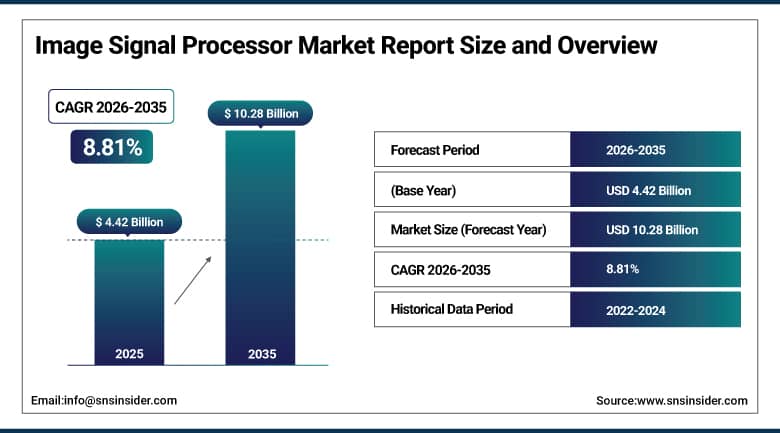
The Image Signal Processor Market size was valued at USD 4.42 Billion in 2025 and is expected to reach USD 10.28 Billion by 2035, growing at a CAGR of 8.81% from 2026-2035.
Image signal processors are specialised chips or embedded processing blocks that convert raw, unprocessed data streaming from a camera's image sensor into a clean, usable digital image, performing functions including demosaicing, noise reduction, auto-exposure, auto-focus, and increasingly AI-based computational photography enhancement. Every device with a camera, from smartphones through security cameras, automotive vision systems, and machine vision equipment, depends on an image signal processor to turn raw sensor output into something genuinely useful. Growth is supported by continued advancement in CMOS sensor resolution and speed, rapid expansion of camera-based automotive safety systems, and rising demand for advanced smartphone photography capability that continues to push processor makers toward increasingly sophisticated multi-camera and sensor-fusion architectures. Edge AI integration is reshaping the category, as vision system-on-chips increasingly combine traditional image processing with on-device artificial intelligence acceleration for real-time enhancement and recognition tasks.
In 2026, Sony Semiconductor Solutions and Taiwan Semiconductor Manufacturing Company signed a non-binding memorandum of understanding to form a strategic partnership for the development and manufacturing of next-generation image sensors, with the companies subsequently entering a definitive agreement to establish a joint venture, Advanced Vision Semiconductor Manufacturing Corporation, in Kumamoto Prefecture, Japan, with volume production expected to begin in 2029.
To Get More Information On Image Signal Processor Market - Request Free Sample Report
Image Signal Processor Market Trends
-
Rising integration of AI-based computational photography and real-time image enhancement algorithms.
-
Growing adoption of multi-camera and sensor-data fusion architectures across smartphones and vehicles.
-
Expanding deployment of edge AI-enabled vision system-on-chips combining processing and inference.
-
Increasing demand for low-power processor architectures suited to wearables and compact devices.
-
Rising camera-based automotive safety system adoption driving specialised automotive-grade ISP demand.
-
Growing strategic partnership activity between image sensor and semiconductor foundry companies.
U.S. Image Signal Processor Market Overview
The U.S. Image Signal Processor Market was valued at USD 1.29 Billion in 2025 and is expected to reach USD 2.59 Billion by 2035, growing at a CAGR of 7.20% from 2026-2035.
The U.S. Image Signal Processor Market benefits from strong smartphone and consumer electronics demand, rapid growth in camera-based automotive safety systems, and the presence of leading chip designers headquartered in the country that continue to compete intensely on computational photography and on-device AI capability. Rising adoption of advanced driver assistance systems and autonomous driving features continues to expand demand for automotive-grade image signal processors capable of handling multiple simultaneous camera feeds under demanding thermal and reliability conditions. The video surveillance market is projected to grow at roughly 12 percent annually, further reinforcing demand for image signal processors capable of delivering clear, detailed images in security and monitoring applications. Leading semiconductor companies continue to expand automotive and industrial vision system-on-chip portfolios, positioning themselves to capture demand across an increasingly broad range of camera-equipped devices beyond traditional consumer electronics.
In September 2026, Qualcomm launched its Snapdragon 8 Elite Gen 6 and Snapdragon 8 Gen 5 mobile platforms at Snapdragon Summit 2026, both built with upgraded imaging and on-device AI capability, with the first devices powered by the new chips expected from Xiaomi, OnePlus, iQOO, Honor, and Samsung starting in October 2026.
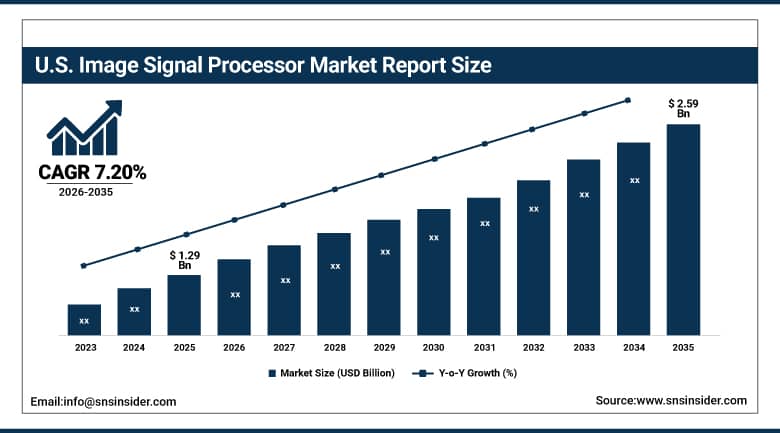
Image Signal Processor Market Segment Analysis
-
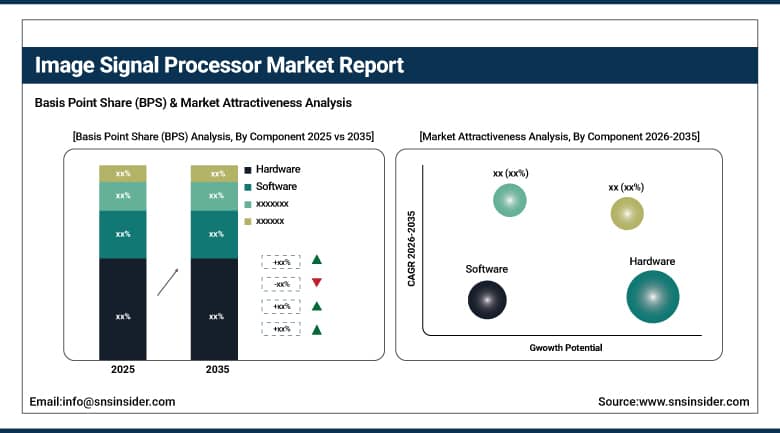
By Component, the Hardware segment dominated the market with a 58.60% share in 2025, while the Software segment is the fastest growing with a CAGR of 10.20% during 2026-2035.
-
By Image Type, the 2D segment dominated the market with a 64.60% share in 2025, while the 3D segment is the fastest growing with a CAGR of 10.80% during 2026-2035.
-
By Industry Vertical, the Consumer Electronics segment dominated the market with a 46.60% share in 2025, while the Automotive segment is the fastest growing with a CAGR of 11.80% during 2026-2035.
-
By Application, the Smartphones & Tablets segment dominated the market with a 42.60% share in 2025, while the Automotive Cameras segment is the fastest growing with a CAGR of 11.60% during 2026-2035.
By Component, Hardware Dominates the Market and Software Grows Fastest
Hardware dominated the market in 2025. The physical image signal processor chip or embedded processing block remains the essential foundation of every camera system, and this fundamental hardware requirement continues to anchor hardware as the largest component category, supported by continued volume growth across smartphones, automotive cameras, and security devices.
Software is projected to be the fastest-growing component over the forecast period. Rising demand for AI-based computational photography algorithms, real-time enhancement software, and licensable image processing pipelines continues to expand the value captured through software layers that run atop underlying hardware, positioning software for sustained above-market growth relative to the broader hardware-dominated component mix.
By Image Type, 2D Dominates the Market and 3D Grows Fastest
Image processing based on 2D images was the dominant segment in 2025. The vast majority of cameras, including those used on smartphones and regular surveillance cameras, will continue to use traditional 2D image processing capabilities, keeping this segment the largest image category in the overall market.
3D image processing was expected to be the fastest-growing image category over the forecast period. With increasing use of depth detection in augmented reality applications, facial recognition, and automotive perception systems, there was growing demand for signal processing capabilities for structured light, time of flight, and stereoscopic imaging, which made the 3D image processing category poised to grow at an above-market rate against the backdrop of the 2D-oriented image type mix.
By Industry Vertical, Consumer Electronics Dominates the Market and Automotive Grows Fastest
Consumer electronics dominated the market in 2025. The sheer global production volume of smartphones, tablets, and digital cameras continues to anchor this vertical as the largest source of image signal processor demand, reinforced by continued consumer expectation of ever-improving photography capability across successive device generations.
Automotive is projected to be the fastest-growing industry vertical over the forecast period. Rapid expansion of camera-based advanced driver assistance systems and autonomous driving features continues to require specialised, automotive-qualified image signal processors capable of reliably handling multiple simultaneous camera feeds, positioning automotive for sustained above-market growth relative to the broader consumer-electronics-dominated vertical mix.
By Application, Smartphones & Tablets Dominates the Market and Automotive Cameras Grows Fastest
Smartphones and tablets dominated the market in 2025. The enormous global volume of smartphones produced annually, combined with continued multi-camera system adoption across virtually every price tier, continues to anchor this application as the largest source of image signal processor demand across the broader market.
Automotive cameras are projected to be the fastest-growing application over the forecast period. Expanding regulatory mandates for driver assistance and safety camera systems, combined with rising consumer expectation of surround-view and parking assistance capability, continues to drive sustained above-market growth for automotive camera applications relative to the broader smartphone-dominated application mix.
Regional Analysis
|
Region |
Major Country |
Share within Region, 2025 |
|---|---|---|
|
North America |
United States |
84.60% |
|
Europe |
Germany |
27.60% |
|
Asia Pacific |
China |
39.60% |
|
Latin America |
Brazil |
27.60% |
|
Middle East & Africa |
United Arab Emirates |
24.60% |
North America Image Signal Processor Market Insights
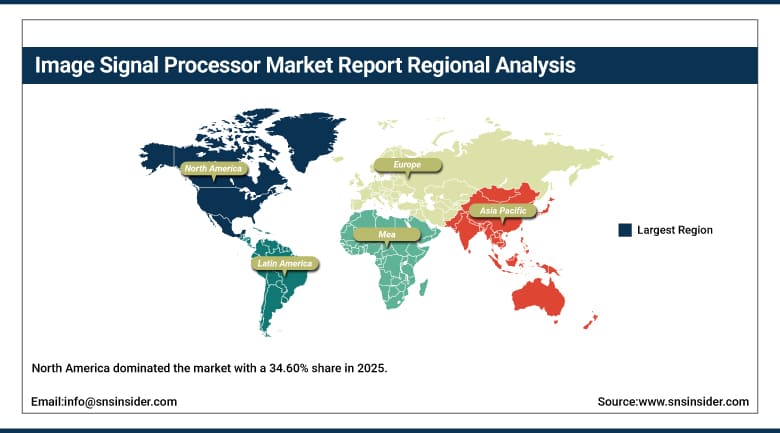
North America dominated the market with a 34.60% share in 2025. Strong consumer electronics demand, rapid growth in camera-based automotive safety systems, and the presence of leading chip design companies headquartered within the region continue to anchor this leadership position across both consumer and automotive applications.
Canada contributes additional regional demand through its own electronics and automotive manufacturing sectors. Continued investment in AI-based imaging capability and automotive-grade processor development is expected to keep North America in the lead through the forecast period, even as growth in percentage terms trails faster-scaling Asia Pacific markets.
Get Customized Report as Per Your Business Requirement - Enquiry Now
Asia Pacific Image Signal Processor Market Insights
Asia Pacific is projected to be the fastest-growing region over the forecast period. Rapidly expanding smartphone and consumer electronics manufacturing, combined with growing domestic semiconductor design capability, continues to accelerate regional adoption of advanced image signal processing technology across both established and emerging device categories.
China anchors regional demand through its substantial electronics manufacturing base and rapidly growing domestic semiconductor industry. Japan and South Korea contribute additional regional depth through established image sensor and processor design expertise, while India's expanding electronics assembly sector continues to add meaningful incremental regional growth.
Europe Image Signal Processor Market Insights
Europe is an important contributor to the world market with the presence of Germany as a major manufacturer of automobiles along with increasing use of cameras in advanced driver assistance systems. The region’s extensive knowledge of automobile engineering ensures continuous demand for automotive image signal processors.
The United Kingdom, France, and Italy add consistent regional demand as national automakers and electronics manufacturers continue extending advanced imaging technology adoption. Continued regional investment in automotive safety technology is expected to sustain steady growth across the broader European market.
MEA & Latin America Image Signal Processor Market Insights
The Middle East & Africa region is supported by growing security and surveillance infrastructure investment across the United Arab Emirates and Saudi Arabia, where rising smart city and public safety initiatives continue to expand regional demand for advanced camera and imaging technology.
Latin America is anchored by Brazil, where a growing domestic electronics assembly sector sustains steady demand for image signal processing technology. Mexico contributes further incremental growth given its integration into North American electronics and automotive supply chains.
Market Dynamics
Growth Drivers: Smartphone Camera Innovation and Automotive Safety Systems
Advancements in imaging technologies stand as the primary growth driver, as innovations in CMOS sensor technology continue enhancing image quality and processing speed, driving growing demand for high-performance image signal processors capable of handling increasingly complex algorithms and delivering superior results across smartphones, cameras, and surveillance systems.
Expansion of automotive applications represents a second major driver, as the industry's shift toward enhanced safety and increasingly autonomous driving capability continues to expand demand for camera-based systems that depend on reliable, automotive-qualified image signal processors. Growing deployment of security and surveillance infrastructure worldwide further reinforces sustained demand across an expanding range of applications.
Restraints: Semiconductor Supply Constraints and Design Complexity
Semiconductor supply constraints remain a genuine restraint, as advanced image signal processors require leading-edge manufacturing capacity that continues to face periodic capacity limitations, particularly during periods of surging AI accelerator and high-performance computing demand competing for the same fabrication resources.
Rising design complexity presents a further restraint, as integrating AI acceleration, multi-camera fusion, and increasingly sophisticated computational photography capability into a single processor continues to require substantial engineering investment and extended development cycles, adding cost and time-to-market pressure across the industry.
Opportunities: Edge AI Integration and Automotive-Grade Processor Development
Continued integration of edge AI capability represents a substantial opportunity, as processor makers that can deliver genuinely capable on-device inference alongside traditional image processing stand to capture demand from device makers seeking real-time enhancement and recognition capability without relying on cloud connectivity.
Continued development of automotive-grade, multi-camera fusion processors offers a further avenue for growth, as manufacturers that can deliver reliable, automotive-qualified image signal processors capable of handling the demanding thermal and safety requirements of advanced driver assistance and autonomous driving systems are positioned to capture substantial new demand from this rapidly expanding vertical.
Recent Developments:
-
2025: Samsung Electronics unveiled its Galaxy S25 smartphone lineup powered by Qualcomm's Snapdragon 8 Elite mobile platform across the entire series, a strategic shift from its prior dual-sourcing approach with its own Exynos processors.
-
2025: Qualcomm launched its Snapdragon 8 Elite Gen 5 mobile platform, featuring upgraded imaging and computational photography capability for next-generation flagship smartphones.
-
2026: Qualcomm launched its Snapdragon 8 Elite Gen 6 and Snapdragon 8 Gen 5 mobile platforms at Snapdragon Summit 2026, both built for on-device generative AI with upgraded imaging capability.
-
2026: Sony Group Corporation and Taiwan Semiconductor Manufacturing Company entered a definitive agreement establishing Advanced Vision Semiconductor Manufacturing Corporation, a joint venture with Sony contributing approximately 465 billion yen, targeting volume production of next-generation smartphone image sensors by 2029.
Image Signal Processor Companies are
-
Samsung Electronics Co., Ltd.
-
Qualcomm Incorporated
-
Apple Inc.
-
MediaTek Inc.
-
onsemi
-
STMicroelectronics N.V.
-
Texas Instruments Incorporated
-
Ambarella, Inc.
-
Fujitsu Limited
-
Renesas Electronics Corporation
-
NXP Semiconductors N.V.
-
Advanced Micro Devices, Inc. (Xilinx)
-
GoPro, Inc.
-
Canon Inc.
-
Nikon Corporation
-
Himax Technologies, Inc.
-
Socionext Inc.
-
Intel Corporation
Image Signal Processor Market Report Scope:
| Report Attributes | Details |
|---|---|
| Market Size in 2025 | USD 4.42 Billion |
| Market Size by 2035 | USD 10.28 Billion |
| CAGR | CAGR of 8.81% From 2026 to 2035 |
| Base Year | 2025 |
| Forecast Period | 2026-2035 |
| Historical Data | 2022-2024 |
| Report Scope & Coverage | Market Size, Segments Analysis, Competitive Landscape, Regional Analysis, DROC & SWOT Analysis, Forecast Outlook |
| Key Segments | • By Component (Hardware, Software, Services) • By Image Type (1D, 2D, 3D) • By Industry Vertical (Consumer Electronics, Automotive, Security & Surveillance, Manufacturing, Healthcare, Others) • By Application (Smartphones & Tablets, Automotive Cameras, Machine Vision, Security & Surveillance) |
| Regional Analysis/Coverage | North America (US, Canada), Europe (Germany, UK, France, Italy, Spain, Russia, Poland, Rest of Europe), Asia Pacific (China, India, Japan, South Korea, Australia, ASEAN Countries, Rest of Asia Pacific), Middle East & Africa (UAE, Saudi Arabia, Qatar, South Africa, Rest of Middle East & Africa), Latin America (Brazil, Argentina, Mexico, Colombia, Rest of Latin America). |
| Company Profiles | Sony Group Corporation, Samsung Electronics Co., Ltd., Qualcomm Incorporated, Apple Inc., MediaTek Inc., OmniVision Technologies, Inc., onsemi, STMicroelectronics N.V., Texas Instruments Incorporated, Ambarella, Inc., Fujitsu Limited, Renesas Electronics Corporation, NXP Semiconductors N.V., Advanced Micro Devices, Inc. (Xilinx), GoPro, Inc., Canon Inc., Nikon Corporation, Himax Technologies, Inc., Socionext Inc., Intel Corporation |

Frequently Asked Questions
Key players include Sony Group Corporation, Samsung Electronics Co., Ltd., Qualcomm Incorporated, Apple Inc., and MediaTek Inc., among other semiconductor and imaging technology companies.
Continued integration of edge AI capability and continued development of automotive-grade, multi-camera fusion processors represent the primary opportunities.
Growth is primarily driven by advancements in imaging technologies, combined with expansion of camera-based automotive safety applications.
By Component, Hardware dominated the market with a 58.60% share in 2025, reflecting its role as the essential physical foundation of every camera system.
North America dominated the market with a 34.60% share in 2025, supported by strong consumer electronics demand and leading chip design companies.
