
Indoor Air Quality Monitor Market Report Scope & Overview:
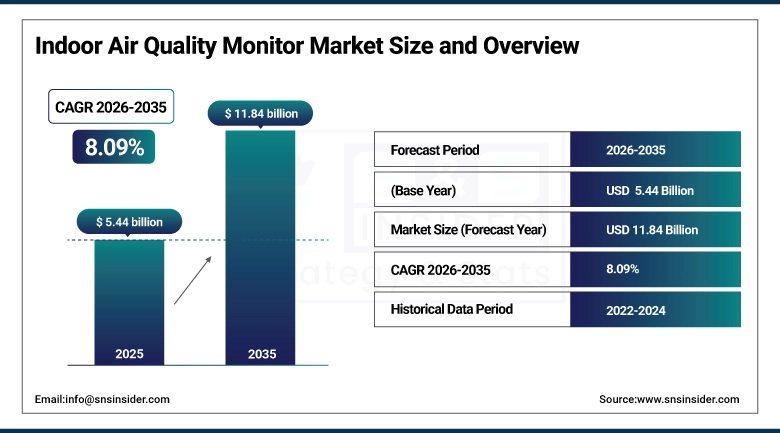
The Indoor Air Quality Monitor Market size was valued at USD 5.44 Billion in 2025 and is projected to reach USD 11.84 Billion by 2035, growing at a CAGR of 8.09% during 2026–2035.
The Indoor Air Quality (IAQ) Monitor Market is witnessing consistent growth with more and more people realizing the impact of air pollution on their well-being. Such products detect air quality in terms of particulate matter, carbon dioxide, or volatile organic compounds. Their demand is on the rise in residential, commercial, or industrial setups with more and more people wanting to live or work in environments with good air quality. Such products have also been benefiting from technology’s advancement in sensors.
Indoor Air Quality Monitor Market Size and Forecast:
-
Market Size in 2025: USD 5.44 Billion
-
Market Size by 2035: USD 11.84 Billion
-
CAGR: 8.09% during 2026–2035
-
Base Year: 2025
-
Forecast Period: 2026–2035
-
Historical Data: 2022–2024
To Get more information on Indoor Air Quality Monitor Market - Request Free Sample Report
Indoor Air Quality Monitor Market Key Trends:
-
Increasing integration of IAQ monitors with smart home and building automation systems
-
Rising demand for real-time air quality monitoring with mobile app connectivity
-
Growing adoption of portable and wearable air quality monitoring devices
-
Advancements in sensor technology improving accuracy and multi-pollutant detection
-
Increasing focus on health, wellness, and indoor environmental quality standards
U.S. Indoor Air Quality Monitor Market Size Outlook:
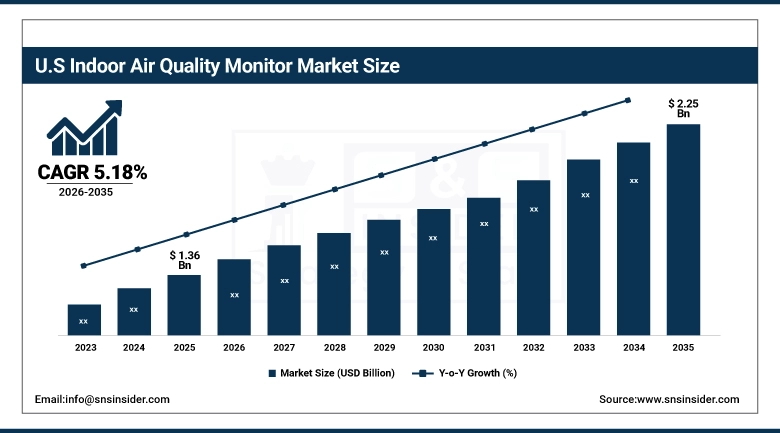
The U.S. Indoor Air Quality Monitor Market has been valued at USD 1.36 Billion in 2025 and is expected to reach USD 2.25 Billion in 2035, growing at a CAGR of 5.18% from 2026 to 2035. Growth is driven by increasing awareness of indoor air pollution and its health impacts, along with stringent government regulations and standards. Rising adoption of smart home technologies and IoT-enabled monitoring devices further supports demand. Additionally, growing concerns about respiratory diseases and workplace safety are encouraging widespread use across residential and commercial environments.
Indoor Air Quality Monitor Market Key Drivers:
-
Rising health awareness and increasing indoor pollution concerns drive demand for IAQ monitoring solutions.
The major factor that is contributing to the growth of the Indoor Air Quality Monitor market is the increase in awareness about the impact of indoor air quality on human health. Some of the impacts include respiratory and cardiovascular diseases. The increase in urbanization is also contributing to the growth of the market, as there is an increase in the amount of pollution in the air. This is also due to the increase in industrialization. The increase in smart home technology is also contributing to the growth of the market.
Indoor Air Quality Monitor Market Key Restraints:
-
High costs and accuracy limitations of monitoring devices hinder widespread adoption.
There are several challenges to the market, which can affect the growth of the market. For instance, the high cost of IAQ monitors, which can be a restraint in developing countries, can impede the growth of the market. Moreover, there are challenges with inexpensive IAQ monitors, such as accuracy, reliability, and calibration, which can affect consumer confidence. Lack of awareness in some countries, as well as a lack of regulations for IAQ monitoring, are some of the challenges to the market.
Indoor Air Quality Monitor Market Key Opportunities:
-
Smart technologies and expanding applications create significant growth opportunities.
The integration of IAQ monitors with smart home technologies and building automation systems is creating new business opportunities. The advancements in sensor technologies, artificial intelligence, and data analytics are providing better and more precise air quality information. The increasing demand in emerging economies and the expanding scope of application in the healthcare sector, education sector, and commercial sector are providing new business opportunities.
Indoor Air Quality Monitor Market Segments:
-
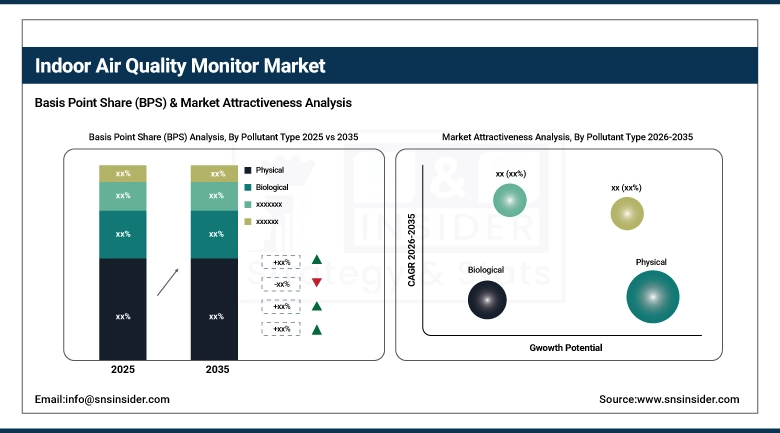
By Pollutant Type: In 2025, Physical Pollutants dominated with 46% share; Chemical Pollutants fastest growing segment during 2026–2035
-
By Product Type: In 2025, Fixed monitors dominated with 58% share; Portable monitors fastest growing segment during 2026–2035
-
By Technology: In 2025, Electrochemical Sensors dominated with 41% share; Laser-Based Sensors fastest growing segment during 2026–2035
-
By End-User: In 2025, Commercial Buildings dominated with 49% share; Residential fastest growing segment during 2026–2035
By Pollutant Type: Physical Pollutants Dominate, Chemical Pollutants Fastest-Growing
The segment is dominated by physical pollutants due to the rising concerns about particulate matter (PM2.5 and PM10). This is affecting the respiratory system of people. With the increasing levels of urban pollution and the visibility of particulate pollution, the adoption of devices that monitor physical pollutants is rising.
The segment of chemical pollutants is the fastest-growing due to the rising awareness about the impact of harmful gases, which include VOCs, carbon monoxide, and nitrogen dioxide. This is because the detection of invisible gases is critical in smart buildings and industrial environments.
By Product Type: Fixed Monitors Dominate, Portable Monitors Fastest-Growing
Fixed monitors account for the majority of the market share due to their monitoring capabilities. They have been widely accepted in building management systems in commercial and industrial environments. Their reliability in providing long-term air quality data makes them popular.
Portable monitors have experienced significant growth in recent times. This is attributed to the increase in demand for air quality monitoring among consumers. Their portability is also contributing to their growth in residential environments.
By Technology: Electrochemical Sensors Dominate, Laser-Based Sensors Fastest-Growing
Electrochemical sensor type leads in popularity due to their high precision in detecting gases such as carbon monoxide and nitrogen dioxide, making them suitable for both residential and industrial use.
Laser-based sensors is the fastest-growing due to their high precision in detecting fine particulate matter, with technological developments and the increasing demand for accurate monitoring contributing to their popularity.
By End-User: Commercial Buildings Dominate, Residential Fastest-Growing
Commercial buildings are the most popular segment, as offices, schools, and healthcare facilities are increasingly incorporating IAQ monitors for safety and regulatory compliance.
Residential segment growth is led by increasing consumer awareness of indoor air quality and health. The emergence of smart homes and affordable indoor air quality monitors is boosting this segment.
Indoor Air Quality Monitor Market Regional Analysis:
North America Indoor Air Quality Monitor Market Insights:
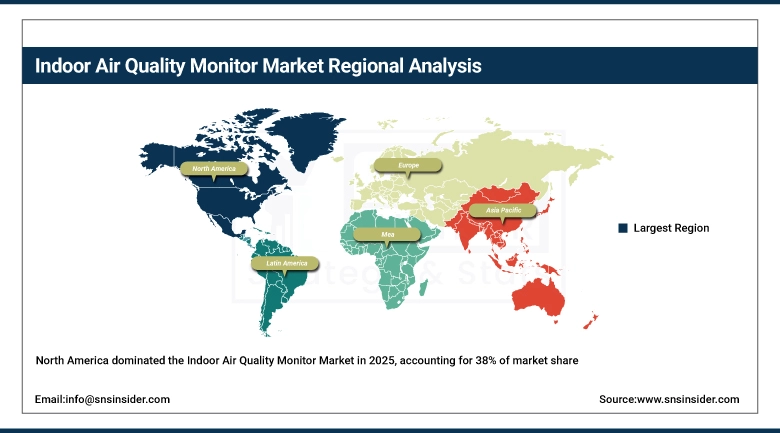
North America has the maximum share in the Indoor Air Quality Monitor Market, which is around 38% in 2025. This is because the region has high awareness about indoor air pollution, strict regulations, and the adoption of smart home technology. Moreover, the region has the best presence of key players in the market and has the best infrastructure to support real-time solutions. Additionally, the region is witnessing increased health concerns and cases of respiratory problems, which is further adding to the market growth.
Get Customized Report as per Your Business Requirement - Enquiry Now
Europe Indoor Air Quality Monitor Market Insights:
Europe Indoor Air Quality Monitor Market is growing at a steady pace, driven by environmental regulations that have become increasingly stringent. Sustainability is also playing an important role in fueling demand in the European market. Moreover, there is an increase in awareness regarding the impact of indoor air pollution on human health. The focus on building more green buildings in Europe is also contributing to the growth of the indoor air quality monitoring market. Furthermore, there is an increase in the development of smart building technologies, which is also contributing to the growth of the European indoor air quality monitoring market.
Asia-Pacific Indoor Air Quality Monitor Market Insights:
Asia-Pacific region is the fastest-growing market for Indoor Air Quality Monitor Market, owing to factors such as rapid urbanization, increasing levels of air pollution, and awareness of the importance of maintaining healthy lifestyles. The increase in industrial activities coupled with the expansion of construction activities has significantly affected indoor air quality, thus increasing the market for indoor air quality monitors. Moreover, an increase in disposable income levels coupled with smart home technologies is also driving the market for Indoor Air Quality Monitor Market.
Latin America Indoor Air Quality Monitor Market Insights:
Latin America’s Indoor Air Quality Monitor Market is growing at a gradual rate due to increased urbanization levels in the region. Moreover, people have become more aware of the impact of air pollution on their health. The increase in industrial activities in the region is also contributing positively to the growth of the market. The economic conditions in Latin America have also improved, which is further contributing to the growth of the market. Moreover, there is an increased focus on smart technologies in the region, which is also contributing to the growth of the market.
Middle East & Africa (MEA) Indoor Air Quality Monitor Market Insights:
Middle East & Africa (MEA) Indoor Air Quality Monitor Market is growing at a moderate pace due to increased construction activities and emphasis on indoor environmental quality in commercial buildings. The awareness about health hazards due to poor air quality is also contributing to growth in this market. Furthermore, the MEA region is witnessing increased adoption in industries like healthcare, hospitality, and commercial buildings. The government is also focusing on developing smart cities in the MEA region, which is further driving growth in this market.
Indoor Air Quality Monitor Market Competitive Landscape:
Honeywell International Inc. was founded in 1906 and is a multinational conglomerate headquartered in the United States. The company operates across various sectors including building technologies, aerospace, and performance materials, offering advanced solutions for indoor air quality monitoring. Honeywell provides a range of IAQ sensors and smart monitoring systems used in residential, commercial, and industrial environments to ensure safety, comfort, and regulatory compliance. The company has a strong global presence with operations in numerous countries and a broad customer base.
-
In June 2024, Honeywell introduced advanced indoor air quality monitoring solutions integrated with IoT-enabled platforms to provide real-time air quality data and improve building safety and efficiency.
Siemens AG was founded in 1847 and is a global technology company based in Germany. Siemens is a leading provider of automation, digitalization, and smart infrastructure solutions, offering advanced indoor air quality monitoring systems as part of its building management portfolio. Siemens products include smart sensors, HVAC control systems, and integrated IAQ solutions used across commercial and industrial sectors. Siemens AG operates in more than 190 countries and has over 300,000 employees worldwide.
-
In May 2024, Siemens enhanced its smart building solutions by integrating advanced air quality monitoring capabilities into its building automation systems to support healthier and energy-efficient indoor environments.
Indoor Air Quality Monitor Companies are:
-
Honeywell International Inc.
-
3M Company
-
Emerson Electric Co.
-
TSI Incorporated
-
Thermo Fisher Scientific Inc.
-
Teledyne Technologies Incorporated
-
IQAir
-
Awair Inc.
-
Vaisala Oyj
-
Sensirion AG
-
Bosch Sensortec GmbH
-
Amphenol Corporation
-
Testo SE & Co. KGaA
-
Horiba, Ltd.
-
Kanomax USA, Inc.
-
PCE Instruments
-
FLIR Systems (Teledyne FLIR)
-
Dyson Ltd.
| Report Attributes | Details |
|---|---|
| Market Size in 2025 | USD 5.44 Billion |
| Market Size by 2035 | USD 11.84 Billion |
| CAGR | CAGR of 8.09% From 2026 to 2035 |
| Base Year | 2025 |
| Forecast Period | 2026-2035 |
| Historical Data | 2022-2024 |
| Report Scope & Coverage | Market Size, Segments Analysis, Competitive Landscape, Regional Analysis, DROC & SWOT Analysis, Forecast Outlook |
| Key Segments | • By Pollutant Type (Biological, Physical, Chemical) • By Product Type (Portable, Fixed) • By Technology (Electrochemical Sensors, Metal Oxide Semiconductor Sensors, Non-Dispersive Infrared (NDIR) Sensors, Laser-Based Sensors, Others) • By End User (Residential, Commercial Buildings, Industrial, Government Buildings) |
| Regional Analysis/Coverage | North America (US, Canada), Europe (Germany, UK, France, Italy, Spain, Russia, Poland, Rest of Europe), Asia Pacific (China, India, Japan, South Korea, Australia, ASEAN Countries, Rest of Asia Pacific), Middle East & Africa (UAE, Saudi Arabia, Qatar, South Africa, Rest of Middle East & Africa), Latin America (Brazil, Argentina, Mexico, Colombia, Rest of Latin America). |
| Company Profiles | Honeywell International Inc., Siemens AG, 3M Company, Emerson Electric Co., TSI Incorporated, Thermo Fisher Scientific Inc., Teledyne Technologies Incorporated, Aeroqual Limited, IQAir, Awair Inc., Vaisala Oyj, Sensirion AG, Bosch Sensortec GmbH, Amphenol Corporation, Testo SE & Co. KGaA, Horiba, Ltd., Kanomax USA, Inc., PCE Instruments, FLIR Systems (Teledyne FLIR), Dyson Ltd. |
Frequently Asked Questions
The Indoor Air Quality Monitor Market is expected to grow at a CAGR of 8.09% during 2026–2035.
The market was valued at USD 5.44 Billion in 2025 and is projected to reach USD 11.84 Billion by 2035.
The key drivers of the Indoor Air Quality Monitor Market include rising health awareness, increasing indoor pollution levels, smart home adoption, stringent regulations, and growing demand for real-time air quality monitoring solutions.
The Physical Pollutants segment dominated during the projected period.
North America dominated the Indoor Air Quality Monitor Market in 2025.
