
Inkjet Printers Market Report Scope & Overview:
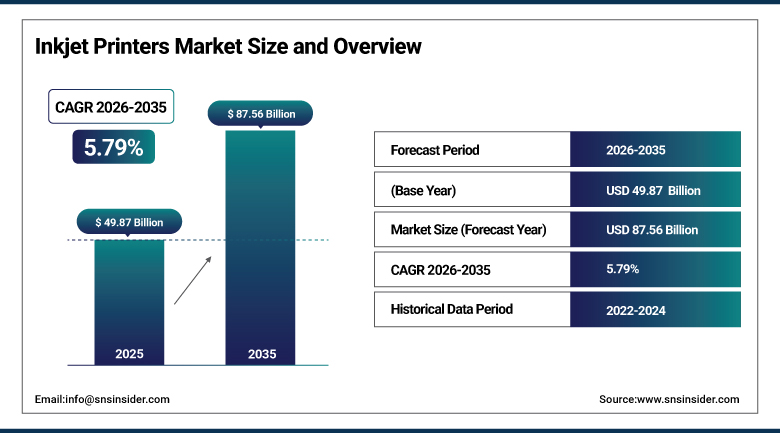
The Inkjet Printers Market was valued at USD 49.87 Billion in 2025 and is expected to reach USD 87.56 Billion by 2035, growing at a CAGR of 5.79% from 2026-2035.
The Inkjet Printers Market covers machines that form images by firing microscopic droplets of liquid ink from nozzles onto paper, film, textiles, ceramics, packaging and other substrates. Products range from household multifunction devices and desktop photo printers to wide-format signage printers, label presses, textile lines and high-speed production presses. The technology lets users print without plates or toner, switch between jobs quickly and print variable content, which suits short runs and personalization. Home and office volumes are tempered by paperless habits, but industrial applications in packaging, labeling, textiles and signage are expanding faster, and new water-based and UV-cured inks are widening the range of materials that can be decorated through 2035. Early adopters report faster job turnaround and lower waste.
⮞Cepi, the European paper industry association, reported on 2 July 2026 that European graphic paper output fell 7.3% in 2025, a reminder of how paperless habits are reshaping traditional printing demand.
To Get more information Inkjet Printers Market - Request Free Sample Report
Inkjet Printers Market Trends
-
Refillable ink tank printers with low cost per page are gaining share in homes, schools and small offices.
-
Single pass piezo printheads are moving into labels, cartons and flexible packaging, replacing analog presses on short runs.
-
Direct-to-garment, direct-to-film and dye sublimation lines are expanding digital textile printing for fashion and home furnishings.
-
Water-based and low migration inks with LED curing are lowering energy use and meeting packaging safety rules.
-
Artificial intelligence tools are being added for nozzle monitoring, color management and fleet-wide production analytics.
U.S. Inkjet Printers Market Outlook
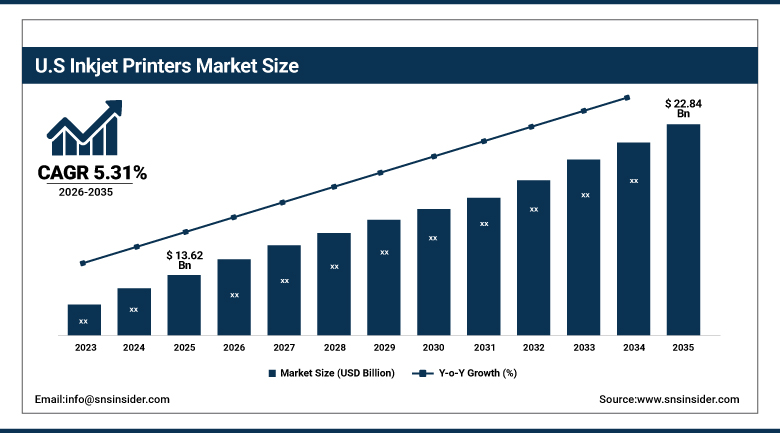
The U.S. Inkjet Printers Market was valued at USD 13.62 Billion in 2025 and is expected to reach USD 22.84 Billion by 2035, growing at a CAGR of 5.31% from 2026-2035.
The U.S. Inkjet Printers Market is the largest national market in North America, supported by a large installed base of home and small office printers, a strong commercial print and sign industry, and demand from e-commerce fulfillment, labeling and packaging converters. Schools, small businesses and remote workers sustain consumables-led revenue, while subscription ink programs are changing how households buy supplies. Production inkjet presses are being adopted by commercial printers and direct mail houses for variable data work, and wide-format systems serve retail graphics and event displays. Established manufacturers maintain large sales and service networks in the country, and investment in digital packaging lines supports growth through 2035. Photo and craft hobbyists add a steady base of consumables buyers.
⮞The U.S. Census Bureau reported on 18 August 2026 that e-commerce accounted for 17.1% of total U.S. retail sales in the second quarter of 2026, supporting demand for labels and shipping cartons.
Inkjet Printers Market Segment Analysis
-
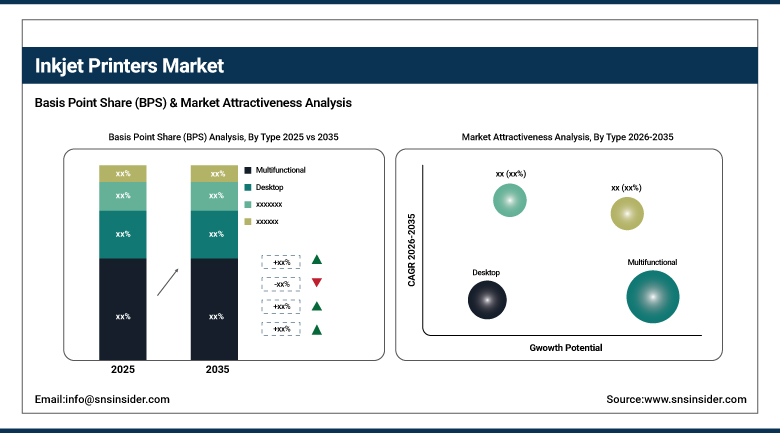
By Type, the Multifunctional segment dominated the Inkjet Printers Market with approximately 38.64% share in 2025, while the Industrial Inkjet segment is the fastest growing with a CAGR of approximately 9.38%.
-
By Technology, the Drop on Demand segment dominated the Inkjet Printers Market with approximately 63.47% share in 2025 and is also the fastest growing with a CAGR of approximately 6.84%.
-
By Ink Type, the Aqueous segment dominated the Inkjet Printers Market with approximately 52.18% share in 2025, while the UV-Cured segment is the fastest growing with a CAGR of approximately 8.12%.
-
By End Use, the Industrial segment dominated the Inkjet Printers Market with approximately 36.92% share in 2025, while the Textile segment is the fastest growing with a CAGR of approximately 7.65%.
By Type, Multifunctional Dominates the Inkjet Printers Market and Industrial Inkjet Grows Fastest
Multifunctional inkjet printers account for approximately 38.64% of the Inkjet Printers Market in 2025 because households, students and small offices want one device that prints, copies and scans. Refillable ink tank models and low cost cartridges have lowered running costs, while wireless connectivity, mobile printing apps and duplex capability suit remote work. Retail availability through electronics chains and online marketplaces gives the type very wide reach. Vendors also bundle supply subscriptions that renew ink automatically, which stabilizes revenue per device. The large installed base ensures recurring ink purchases even when hardware replacement cycles lengthen.
Industrial inkjet printers are the fastest growing type, advancing at a CAGR of approximately 9.38% through 2035. Manufacturers use them to print codes, graphics and functional patterns directly onto products, tiles, glass, cartons and electronics, replacing plates, screens and pre-printed stock. Single pass printheads reach conveyor speeds, and inline systems add variable data such as serial numbers and personalization. Shorter product lifecycles and traceability rules push brand owners toward digital decoration. Falling printhead costs and better ink reliability help small converters invest, so adoption is spreading beyond large plants.
⮞The U.S. Bureau of Labor Statistics reported in March 2026 that 22.6% of employed workers teleworked or worked at home for pay, sustaining demand for home office printers.
By Technology, Drop on Demand Dominates the Inkjet Printers Market and Also Grows Fastest
Drop on demand technology holds approximately 63.47% share in 2025 because it fires droplets only when an image calls for them, using thermal or piezoelectric actuators, and so powers nearly all home, office, wide-format and textile printers. The method wastes little ink, produces fine detail and supports many ink chemistries, from dye and pigment to solvent and UV-curable. Printhead makers have raised nozzle counts and refined droplet size control, which improves photo quality and speed. A broad supplier base for printheads and a mature ecosystem of drivers and software make it the default choice for most equipment designers.
The same technology is also the fastest growing, with a CAGR of approximately 6.84% during 2026-2035, as single pass piezo arrays move into packaging, labels and commercial printing. Compared with continuous systems used for coding, drop on demand heads deliver higher resolution graphics across a wide web. Water-based and UV inks are being formulated for the heads to reach food packaging and flexible film. Artificial intelligence tools that monitor nozzle health and adjust jetting in real time reduce waste. Printers moving away from analog flexo and offset for short runs are a major buyer group. Equipment makers also license printheads to partners.
⮞FESPA reported on 16 June 2026 that its Global Print Expo in Barcelona drew 24,798 total attendees across co-located events, including 15,495 unique visitors from 126 countries.
By Ink Type, Aqueous Dominates the Inkjet Printers Market and UV-Cured Grows Fastest
Aqueous inks dominate with approximately 52.18% share in 2025, since dye and pigment inks in water carriers are used by almost every household and office printer and by many large-format poster and photo machines. They are low in odor, safe to handle and compatible with paper and coated media. Pigmented versions give water and fade resistance for documents and archival prints. Environmental rules favor water-based chemistry, and manufacturers continue to improve drying speed and adhesion on films and textiles. The very high volume of cartridges and ink tanks sold each year keeps this segment ahead.
UV-cured inks are the fastest growing group, with a CAGR of approximately 8.12% through 2035, because they cure instantly under LED lamps and bond to plastics, glass, metal and rigid boards without a drying stage. Sign makers, label converters and industrial decorators value the scratch resistance and the ability to print on heat-sensitive materials. Low migration formulations are opening food packaging uses. LED curing consumes less power than mercury lamps, and compact units allow desktop flatbed systems. Personalized gifts and promotional items give small businesses a route into UV printing.
⮞FINAT reported in July 2025 that, in a survey of 71 member companies, 72% of label converters saw no decline in consumer demand in the first quarter of 2025.
By End Use, Industrial Dominates the Inkjet Printers Market and Textile Grows Fastest
Industrial applications, which include packaging, labeling, publishing and product decoration, account for approximately 36.92% of the market in 2025. Production inkjet presses print books, direct mail, transactional documents and folding cartons, while coding and marking systems label products on lines for food, beverage and pharmaceutical goods. Brand owners value short runs, version changes without plates and traceability data. Industrial buyers purchase costly equipment and continuing ink supplies under service contracts, so the segment generates the largest revenue per installed unit. Growth in parcels and online retail sustains demand for printed cartons and shipping labels.
Textile printing is the fastest growing end use, expanding at a CAGR of approximately 7.65% during 2026-2035. Digital direct-to-fabric and dye sublimation transfer lines allow fashion and home furnishing brands to run small batches, change designs quickly and avoid the water and chemical load of screen printing. Sportswear, soft signage and custom apparel are strong categories. Fashion cycles are shortening, and brands want to produce closer to the customer. Roll-to-roll machines with many printheads reach high square meter output, and direct-to-film systems add flexible options for small shops.
⮞The International Cotton Advisory Committee reported on 1 September 2026 that knit and woven garments made up nearly 60% of world textile exports in 2025.
Regional Analysis
|
Region |
Major Country |
Share within Region, 2025 (%) |
|---|---|---|
|
North America |
United States |
79.62% |
|
Asia Pacific |
China |
41.17% |
|
Europe |
Germany |
28.35% |
|
Latin America |
Brazil |
49.26% |
|
Middle East & Africa |
United Arab Emirates |
30.48% |
North America Inkjet Printers Market Insights
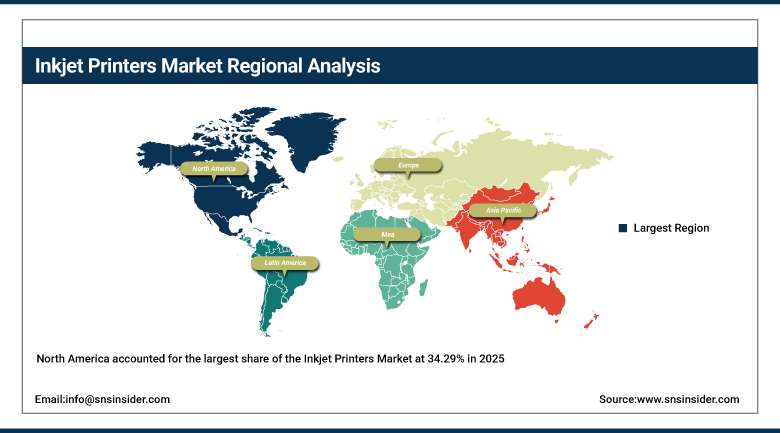
North America accounted for the largest share of the Inkjet Printers Market at 34.29% in 2025, with the United States representing about 79.62% of regional demand and Canada adding the balance. The region has a large installed base of home and office printers, a strong commercial print and sign industry and early adoption of subscription ink programs. Packaging converters and direct mail houses are investing in production inkjet presses, while retail chains use wide-format graphics for promotions. Established manufacturers maintain extensive sales, service and supply networks, and distribution through office retailers and online channels keeps consumables moving.
E-commerce fulfillment creates steady demand for labels and cartons, and food and beverage producers use coding systems on high-speed lines. Education and small business customers favor ink tank printers for their low running costs. Apparel decorators, promotional product companies and sign shops in Texas, Florida and California use direct-to-garment and UV flatbed machines. Canada contributes through packaging, outdoor advertising and a growing custom apparel sector, and growth in the region proceeds at a steady CAGR of 5.31% through 2035. Managed print contracts also persist.
⮞The Pitney Bowes Parcel Shipping Index reported in July 2025 that U.S. parcel volume reached 22.4 billion shipments in 2024, up 3.4%.
Get Customized Report as per Your Business Requirement - Enquiry Now
Asia Pacific Inkjet Printers Market Insights
Asia Pacific held approximately 30.17% of the Inkjet Printers Market in 2025 and is the fastest growing region, with a CAGR of 7.46% during 2026-2035. China, Japan, India, South Korea and Southeast Asia combine large populations with major electronics, textile, ceramic and packaging industries. Most printers and many printheads are made in the region, which supports cost competitive supply and rapid innovation. Rising household incomes and school enrollment increase demand for home devices, while expanding retail and e-commerce markets require more labels, boxes and signage.
China is the largest country market, with strong local suppliers of wide-format and textile printers and major ceramic tile and garment clusters in Guangdong and Zhejiang. Japan contributes technology leadership in printheads and inks. India is expanding quickly through packaging, textile exports and small print shops, supported by lower cost ink tank printers. Vietnam, Bangladesh and Indonesia are growing garment centers that are adopting digital textile lines to meet shorter orders. Australia and New Zealand add demand through signage and wide-format graphics.
⮞China's State Post Bureau reported in December 2025 that express delivery volume reached 145.08 billion parcels in January-September 2025, up 17.2% year on year.
Europe Inkjet Printers Market Insights
Europe accounted for approximately 22.40% of the Inkjet Printers Market in 2025, led by Germany, the United Kingdom, France and Italy. The region has leading makers of industrial and production inkjet systems, printheads and inks, as well as a dense network of commercial printers, label converters and ceramic tile producers. Environmental rules push users toward water-based and low-migration inks, recyclable substrates and energy efficient curing. Office printing has declined with digital workflows, yet specialty applications in packaging, textiles and decor keep unit demand healthy.
Italy and Spain are centers for ceramic decoration, with digital tile printers now nearly universal. Germany and the Netherlands are strong in packaging and wide-format. Printed textile clusters in northern Italy and Turkey adopt digital lines for fast fashion and home goods. Retailers expect sustainable packaging, which encourages short run digital production with less waste. The Nordic countries and Poland show growing interest in photo and craft printing for consumers. Aging print company owners also drive consolidation, leading to investments in efficient digital presses.
⮞Eurostat reported in February 2026 that 78% of EU internet users aged 16 to 74 bought or ordered goods or services online in 2025.
MEA & Latin America Inkjet Printers Market Insights
The Middle East and Africa and Latin America together account for approximately 13.14% of the Inkjet Printers Market in 2025, with Latin America at 6.66% and the Middle East and Africa at 6.48%. In the Middle East, Saudi Arabia and the United Arab Emirates invest in retail, hospitality and exhibition graphics, and they import wide-format and packaging printers. Africa is a smaller market where South Africa, Nigeria, Kenya and Egypt purchase printers for schools, small businesses and local packaging. Distributors and financing arrangements are critical because equipment is largely imported and buyers are price sensitive.
Latin America is led by Brazil and Mexico, which have large consumer bases, textile and apparel clusters, ceramic tile production and expanding packaging industries. Brazil supports digital textile and tile decoration, and Mexico benefits from nearshoring of electronics and apparel assembly. Argentina, Colombia and Chile add demand for signage and office printers. Currency swings can affect equipment imports, so buyers prefer financing and entry-level ink tank models. Growth in online retail drives labels and shipping cartons, while public campaigns create seasonal demand for large-format printing.
⮞Saudi Arabia's General Authority for Statistics reported in January 2026 that 71% of individuals purchased goods or services online, according to its 2025 ICT survey.
Market Dynamics
Growth Drivers: Short-Run Packaging and Textile Customization Drive Growth in the Inkjet Printers Market
Demand for short-run, personalized printing is the strongest force behind the Inkjet Printers Market. Brands launch more product variants, seasonal editions and regional versions, and they want small batches without the setup costs of plates and screens. Inkjet presses and label lines print variable text, graphics and codes in a single pass, shortening lead times and lowering inventory of pre-printed stock. Online retail adds shipping cartons and labels that carry unique data. Textile and home decor producers likewise move toward made-to-order production, and digital printing provides the flexibility to respond quickly to changing fashion.
Sustainability expectations add momentum. Digital printing uses ink only where needed, avoids the large water consumption of screen dyeing and reduces waste from unsold stock. Printhead durability, higher jetting speeds and improved inks narrow the cost gap with analog processes, so more jobs cross the break-even run length. Software that automates color management, job scheduling and maintenance reduces the skills needed to operate systems. Financing and pay-per-print contracts further reduce entry barriers for small converters and print shops, widening the customer base.
⮞Abit, the Brazilian textile and apparel association, reported on 22 August 2025 that Brazilian textile output rose 11.4% in the first half of 2025.
Restraints: Paperless Workflows and High Ink Costs Restrain Growth in the Inkjet Printers Market
Declining paper use is the main restraint on the Inkjet Printers Market. Digital documents, cloud storage and electronic signatures reduce home and office printing volumes, and organizations manage costs by consolidating fleets and capping print quotas. Lower page counts weaken ink and cartridge sales, which supply a large part of manufacturer profit. Mail volumes also shrink as bills and statements move online, limiting transactional printing. Schools provide tablets and online assignments, reducing student printing. These trends make growth in the consumer and office segments flat or negative in mature economies.
Cost and supply controversies add pressure. Users criticize high cartridge prices, firmware that blocks third-party ink and subscription models that disable printers when payments lapse, and regulators and consumer groups have started to scrutinize these practices. Competition from laser printers in heavy-duty offices, together with refurbished and low-cost clone products, keeps prices under pressure. Industrial buyers face long qualification times, expensive printheads and ink compatibility issues. Component shortages or tariffs on electronics can raise equipment prices and slow replacement cycles.
⮞The USPS Office of Inspector General projected on 2 June 2025 that combined First-Class and Marketing Mail would fall 29% from 98.2 billion pieces in 2025 to 70.1 billion in 2035 in its baseline scenario.
Opportunities: Sustainable Packaging and Digital Decoration Create Opportunities in the Inkjet Printers Market
Sustainable packaging rules create a significant opportunity. Regulations require recyclable and lower-waste packaging, and brand owners are redesigning cartons, films and labels with water-based, low migration and de-inkable inks. Digital printing supports mono-material packs, lightweight designs and smaller print runs that reduce obsolescence. Converters that install inkjet lines can offer fast design changes, seasonal campaigns and regional versions without large inventories. Suppliers with food-safe inks and certified printheads can win long-term supply contracts and charge premiums for compliance expertise and technical support.
Further openings lie in ceramic and glass decoration, building materials, electronics printing, pharmaceutical packaging and direct-to-garment services for small brands. Three-dimensional surface effects, functional coatings and conductive inks extend inkjet beyond graphics. Artificial intelligence enables predictive maintenance, color matching and automated job handling, and cloud platforms connect fleets of printers for remote monitoring. Ink subscription models, refill kits and managed print services provide recurring revenue. Emerging markets with growing school enrollment and small business formation offer volume for low-cost ink tank printers.
⮞The European Commission's Packaging and Packaging Waste Regulation began applying on 12 August 2026, requiring all packaging in the European Union to be recyclable by 2030.
Recent Developments:
-
2026: Brother launched the Business Smart MFC-J6760DW and MFC-J6960DW A3 wireless inkjet all-in-ones. They use pigment ink and the piezo MAXIDRIVE printhead, print up to 31 pages per minute, and are also offered through an ink subscription.
-
2026: Durst announced Kyveris, an artificial intelligence production-intelligence platform marking its 90th anniversary. It combines files, machines, software and data from thousands of installed systems, with a first showcase planned at FESPA 2026.
-
2026: Canon unveiled the varioPRESS iV7 B2+ sheetfed inkjet press in the U.S., rated at up to 8,700 B2 sheets per hour. General availability in the U.S. is expected in the first quarter of 2027.
-
2026: Epson launched the SureColor F20030 76-inch industrial dye-sublimation textile printer in Southeast Asia. It carries eight PrecisionCore MicroTFP printheads and is rated at up to 306 square meters per hour.
Inkjet Printers Market Key Players are:
-
HP Inc.
-
Canon Inc.
-
Seiko Epson Corporation
-
Brother Industries, Ltd.
-
Kyocera Corporation
-
Xerox Holdings Corporation
-
Konica Minolta, Inc.
-
FUJIFILM Holdings Corporation
-
Durst Group
-
Mimaki Engineering Co., Ltd.
-
Roland DG Corporation
-
MUTOH Holdings Co., Ltd.
-
Xaar plc
-
Eastman Kodak Company
-
Videojet Technologies, Inc. (Danaher Corporation)
-
Linx Printing Technologies Ltd.
Inkjet Printers Market Report Scope:
| Report Attributes | Details |
|---|---|
| Market Size in 2025 | USD 49.87 Billion |
| Market Size by 2035 | USD 87.56 Billion |
| CAGR | CAGR of 5.79% From 2026 to 2035 |
| Base Year | 2025 |
| Forecast Period | 2026-2035 |
| Historical Data | 2022-2024 |
| Report Scope & Coverage | Market Size, Segments Analysis, Competitive Landscape, Regional Analysis, DROC & SWOT Analysis, Forecast Outlook |
| Key Segments | • By Type (Multifunctional, Desktop, Large Format, Inkjet Press, Industrial Inkjet, Textile, and Others) • By Technology (Continuous Inkjet, Drop on Demand, UV Inkjet, and Others) • By Ink Type (Aqueous, UV-Cured, Solvent, Latex, and Dye Sublimation) • By End Use (Consumer, Education, Industrial, Textile, Pharmaceutical, and Others) |
| Regional Analysis/Coverage | North America (US, Canada), Europe (Germany, UK, France, Italy, Spain, Russia, Poland, Rest of Europe), Asia Pacific (China, India, Japan, South Korea, Australia, ASEAN Countries, Rest of Asia Pacific), Middle East & Africa (UAE, Saudi Arabia, Qatar, South Africa, Rest of Middle East & Africa), Latin America (Brazil, Argentina, Mexico, Colombia, Rest of Latin America). |
| Company Profiles | HP Inc., Canon Inc., Seiko Epson Corporation, Brother Industries, Ltd., Kyocera Corporation, Xerox Holdings Corporation, Konica Minolta, Inc., FUJIFILM Holdings Corporation, Durst Group, Mimaki Engineering Co., Ltd., Roland DG Corporation, MUTOH Holdings Co., Ltd., Xaar plc, Eastman Kodak Company, Videojet Technologies, Inc. (Danaher Corporation), Linx Printing Technologies Ltd. |

Frequently Asked Questions
The key players in the Inkjet Printers Market include HP Inc., Canon Inc., Seiko Epson Corporation, Brother Industries, Ltd., Kyocera Corporation, among others.
Key opportunities include sustainable packaging with water-based and low migration inks, ceramic and glass decoration, and managed print and ink subscription services.
The major growth factor is demand for short-run, personalized printing in packaging, labels and textiles, where inkjet avoids plates and screens and supports variable data.
The Multifunctional segment dominated the Inkjet Printers Market with approximately 38.64% share in 2025, because households and small offices want one device that prints, copies and scans.
North America dominated the Inkjet Printers Market with a 34.29% share in 2025, driven by a large installed printer base, commercial print and sign industries, and packaging converters in the United States.
