
Insulated Concrete Form (ICF) Market Report Scope & Overview:
The Insulated Concrete Form (ICF) Market size is valued at USD 1.66 Billion in 2025 and is projected to reach USD 3.20 Billion by 2035, growing at a CAGR of 6.77% during 2026-2035.
The Insulated Concrete Form (ICF) Market analysis highlights the adoption of energy effective and sustainable construction methods and is propelled by green building initiatives. It emphasizes the benefits of using ICF systems, such as better insulation, diminished carbon footprint and quicker construction periods.
ICF walls provide R-values of 20–25+, reducing heating and cooling energy use by up to 50% compared to traditional wood-frame construction
Market Size and Forecast:
-
Market Size in 2025: USD 1.66 Billion
-
Market Size by 2035: USD 3.20 Billion
-
CAGR: 6.77% from 2026 to 2035
-
Base Year: 2025
-
Forecast Period: 2026–2035
-
Historical Data: 2022–2024

To Get More Information On Insulated Concrete Form (ICF) Market - Request Free Sample Report
Insulated Concrete Form (ICF) Market Trends
-
Increasing use of ICF in green construction, supported by increase in demand for energy efficient and environmentally friendly building solutions.
-
Wider use of advanced materials such as graphite-enhanced EPS to enhance R-value and structural strength for ICFs.
-
Digitalization trend in ICF manufacturing that will see more and more automation and 3D printing technologies integrated into processes to improve precision, speed and reduce cost.
-
Growing residential use of ICF due to awareness among consumers about energy efficiency, noise reduction and disaster resistant properties of these buildings.
-
Rise in government-driven incentives for sustainable construction has augmented the commercial, and infrastructure development projects, thereby driving ICF usage.
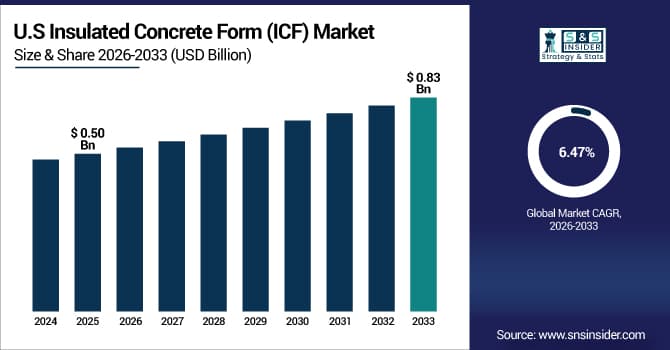
The U.S. Insulated Concrete Form (ICF) Market size is valued at USD 0.50 Billion in 2025 and is projected to reach USD 0.83 Billion by 2035, growing at a CAGR of 6.47% during 2026-2035. Insulated Concrete Form (ICF) Market growth is driven by rising interest in energy-efficient and more disaster-proof construction. Growing green building certifications and tougher energy codes stimulate ICF use in both residential and commercial projects.
Insulated Concrete Form (ICF) Market Growth Drivers:
-
Rising Demand for Energy-Efficient, Sustainable, and Disaster-Resilient Construction Solutions Globally
Rising focus on green building concept coupled with stringent energy efficiency codes is boosting the uptake of insulated concrete forms. ICFs lead to dramatically lowered heating and cooling costs, durability beyond compare, and insulation far superior to that provided by traditional concrete. Due to the increased focus on green certifications, such as LEED and BREEAM at the government and developer level, ICF systems are becoming popular with residential, commercial and institutional construction projects – consequently driving worldwide market growth.
Buildings with ICF walls reduce annual heating and cooling costs by 30–50%, translating to $200–$500+ in yearly savings per household
Insulated Concrete Form (ICF) Market Restraints:
-
High Initial Installation Costs and Limited Skilled Workforce for ICF Construction Deployment
Although ICF structure systems are expected to pay for the increased investment over time through reduced energy use and maintenance costs, they do have a higher initial cost compared with most forms of conventional construction. The high degree of skill required as well as physical installation equipment raises labor costs which can challenge penetration in emerging markets. There are also regional differences in building codes, and small-scale builders may not be aware of best practices. These considerations combined restrict the mass uptake of ICF technology, particular among low price-sensitive construction markets.
Insulated Concrete Form (ICF) Market Opportunities:
-
Expansion of Smart and Green Cities Driving Demand for Advanced Insulated Construction Systems
The growth and the government’s smart city push, are driving significant opportunities for ICF application in sustainable infrastructure. Contractors are using more ICFs than ever, for their advantages in energy conserving, earthquake resisting and noise reducing. Thanks to 3D printing, automation and using things like recycled materials, manufacturers are in position to keep up with changing demands for sustainability. These advances are intended to lay the groundwork for new applications of ICF in home, commercial and public infrastructure construction throughout the world.
Over 150 smart city projects globally (including NEOM, Singapore, and U.S. DOE Communities) mandated high-performance building envelopes in 2024, with ICFs selected for 35% of public infrastructure builds.
Insulated Concrete Form (ICF) Market Segment Analysis
-
By Material, Polystyrene Foam led the Insulated Concrete Form (ICF) market with a 48.60% share in 2025, while Recycled Materials was the fastest-growing segment, recording a CAGR of 9.40%.
-
By Application, the Residential segment dominated the market with a 52.30% share in 2025, whereas the Commercial segment showed the highest growth potential, expanding at a CAGR of 9.10%.
-
By Type, Expanded Polystyrene (EPS) led the market with a 46.80% share in 2025, while Polyurethane Foam emerged as the fastest-growing type, achieving a CAGR of 8.70%.
-
By Construction Method, Vertical ICF Systems held the largest market share of 43.50% in 2025, whereas Grid ICF Systems exhibited the fastest growth, with a CAGR of 8.90%.
By Material, Polystyrene Foam Leads Market While Recycled Materials Registers Fastest Growth
Polystyrene Foam segment dominate the market due to provide both excellent thermal insulation and strength, while still be light weight and cheap. It is used in residential and commercial construction for increased energy efficiency, structural integrity, acoustical performance and sound control. But recycled materials are becoming the fastest-growing segment due to sustainability targets and green building criteria. Growing innovation in green ICF materials and government support for low-carbon building is pushing this trend toward sustainable options.
By Application, Residential Dominate While Commercial Shows Rapid Growth
The residential application segment dominates the market due to on the back of growing consumer preference for energy efficient, hurricane -resistant, and sustainable homes. ICF construction provides better insulation but also with a high level of soundproofing which is good for very hot and cold regions. Meanwhile, there is increasing demand for commercial sector as builders use ICF construction on office buildings, hotels and institutional structures to comply with tough energy codes. Growing awareness of lifecycle cost savings and green certifications also provide incentive for ICF use in residential and commercial applications worldwide.

By Type, Expanded Polystyrene (EPS) Lead While Polyurethane Foam Registers Fastest Growth
Expanded Polystyrene (EPS) ICFs dominate the market due to being the cheapest, efficient and easiest to install. The most commonly used material for walls and foundations by far is EPS as it is durable and can be designed in any flexibility. While, polyurethane foam are growing fastest due to their high thermal resistance, moisture barrier and physical properties. Increasing need for energy-efficient buildings and developments in foam chemistry are driving sales of polyurethane systems across high-end residential as well as commercial applications globally.
By Construction Method, Vertical ICF Systems Lead While Grid ICF Systems Grow Fastest
Vertical ICF lead the market in 2025 due to their ease and low cost of application and large-scale wall construction are the most common types available in the market. They make for easy mounting and fit effortlessly into multiple architectural plans. While, Grid ICF Systems, are growing most rapidly, based on their strength and flexibility as well as load distribution efficiency. Increase in adoption of hybrid and modular construction methods, coupled with growing need for building earthquake-resistance and energy-efficient structures are among the factor driving utilization of grid ICF systems in contemporary construction.
Insulated Concrete Form (ICF) Market Regional Analysis:
North America Insulated Concrete Form (ICF) Market Insights
In 2025 North America dominated the Insulated Concrete Form (ICF) Market and accounted for 41.65% of revenue share, this leadership is due to the increasing adoption in energy-efficient buildings such as residential & commercial buildings. The area is aided by good building codes, tech innovation and a strong demand for sustainable buildings. Increasing consciousness of disaster endurance (especially in hurricane and tornado areas) encourages ICF use.

Get Customized Report as Per Your Business Requirement - Enquiry Now
U.S. Insulated Concrete Form (ICF) Market Insights
The U.S. continues to grow quickly, driving pace ICFs' acceptance as well. Favorable government policies encouraging sustainable building drive the market. ICFs are increasingly used by housing and commercial developers, attracted to the product's proven insulation strengths and its strong construction integrity.
Asia-Pacific Insulated Concrete Form (ICF) Market Insights
Asia-Pacific is expected to witness the fastest growth in the Insulated Concrete Form (ICF) Market over 2026-2035, with a projected CAGR of 7.30% due to burgeoning urbanization, growing infrastructure projects and trends toward environmentally sustainable building and construction practices. For instance, ICFs are gaining popularity in China, Japan, South Korea and Australia for high performing buildings. Increasing awareness towards green certification programs and carbon reduction is also accelerating the product adoption.
China Insulated Concrete Form (ICF) Market Insights
In China Large construction activities and focus on the sustainable development of cities are driving ICF market growth. To meet its carbon neutrality targets, the government is incentivizing use of ICFs and other energy-efficient materials. Rise in high rise construction of residential buildings and smart city initiatives also supplement the market growth.
Europe Insulated Concrete Form (ICF) Market Insights
In 2025, Europe emerged as a promising region in the strict energy efficiency legislation and green building codes. The market in Germany, France, the U.K., Italy etc. is however showing higher adoption of ICF within sustainable architecture. The European Green Deal and targets to reduce CO2 spurs demand for sustainable construction materials. More and more ICF renovations of old buildings for energy savings & comfort.
Germany Insulated Concrete Form (ICF) Market Insights
Germany is at the forefront of Europe’s ICF market due to its keen focus on environmental sustainability and building performance requirement. Adoption is expanding to residential and commercial construction work alike. ICF’s are becoming very popular when it comes to extra benefits such as thermal insulation and noise prevention.
Latin America (LATAM) and Middle East & Africa (MEA) Insulated Concrete Form (ICF) Market Insights
The Insulated Concrete Form (ICF) Market is experiencing moderate growth in the Latin America (LATAM) and Middle East & Africa (MEA) regions, due to rapid urbanization, and the need for low-cost energy efficient houses. In LATAM, Brazil and Mexico drive adoption for quick construction expansion and the advantages associated with benefitting from climate adaptive features. MEA is where Gulf region, sustainable infrastructure and green city vision meet. Increasing recognition of thermal performance and structural durability encourages ICFs.
Insulated Concrete Form (ICF) Market Competitive Landscape:
Tremco CPG plays a key role in the Insulated Concrete Form (ICF) market with its advanced building envelope solutions. The company focuses on integrating waterproofing, insulation, and sealant technologies into ICF construction systems. Its sustainable products support energy-efficient and durable structures in both residential and commercial sectors. Tremco CPG’s commitment to innovation aligns with global green building standards. Continuous R&D investments enhance its portfolio of eco-friendly ICF materials.
-
In February 2025, Tremco CPG expanded its ICF and building envelope product line by integrating advanced waterproofing and insulation systems tailored for sustainable construction. The company also launched regional training programs to promote green building practices among contractors and architects.
RPM International Inc. is a major contributor to the ICF market through its diverse range of construction materials. The company’s focus lies in developing high-performance coatings, sealants, and insulation systems for modern building solutions. It emphasizes sustainability by introducing energy-saving and low-carbon ICF-compatible materials. RPM’s strong distribution network supports its growing presence across North America and Europe. The firm continues to expand its offerings through strategic acquisitions and product innovation.
-
In April 2025, RPM International Inc. announced a strategic acquisition of a specialty insulation materials firm to strengthen its ICF solutions portfolio. The move aims to enhance the company’s energy-efficient construction offerings and expand its North American market presence.
Quad-Lock Building Systems is recognized for its efficient and customizable ICF solutions for sustainable construction. The company designs wall and foundation systems that improve thermal efficiency and structural strength. Its products are widely used in residential, commercial, and institutional projects worldwide. Quad-Lock emphasizes ease of installation and design flexibility to meet modern architectural needs. The brand’s commitment to green building practices drives its growing global adoption.
-
In January 2025, Quad-Lock Building Systems introduced its new Quad-Lock Pro Series—a high-strength, lightweight ICF system designed for faster installation and improved thermal efficiency. The company also partnered with green builders to promote sustainable construction practices globally.
Airlite Plastics Company, through its Fox Blocks division, is a leading ICF manufacturer focused on energy-efficient construction. The company offers durable, lightweight, and high-performance ICF systems designed to reduce carbon emissions. Fox Blocks products are widely used in sustainable and disaster-resilient buildings. The firm leverages automation and recycled materials to enhance cost-efficiency and environmental performance. Its continuous innovation positions it as a leader in green construction technologies.
-
In March 2025, Fox Blocks (a division of Airlite Plastics Company) launched a next-generation ICF product featuring enhanced fire resistance and recycled content. The company continues to invest in automation and digital design tools to improve production efficiency and customization capabilities. Fox Blocks is expanding its distributor network in Europe and Latin America.
Insulated Concrete Form (ICF) Market Key Players:
-
Tremco CPG
-
Quad-Lock Building Systems
-
Airlite Plastics Company & Fox Blocks
-
BASF SE
-
Logix Brands Ltd.
-
Polycrete International
-
LiteForm
-
Rastra
-
SuperForm
-
ROCKWOOL A/S
-
Beco Products Ltd
-
Mikey Block’s
-
BuildBlock Building Systems
-
Amvic Inc.
-
IntegraSpec
-
Durisol
-
Insul-Deck
-
GreenBuilt ICF
| Report Attributes | Details |
|---|---|
| Market Size in 2025 | USD 1.66 Billion |
| Market Size by 2035 | USD 3.20 Billion |
| CAGR | CAGR of 6.77% From 2026 to 2035 |
| Base Year | 2025 |
| Forecast Period | 2026-2035 |
| Historical Data | 2022-2024 |
| Report Scope & Coverage | Market Size, Segments Analysis, Competitive Landscape, Regional Analysis, DROC & SWOT Analysis, Forecast Outlook |
| Key Segments | • By Type (Expanded Polystyrene (EPS), Polyurethane Foam, Cement-Bonded Wood Fiber, Cellular Concrete, and Others) • By Application (Residential, Commercial, Industrial, Institutional, and Infrastructure) • By Material (Polystyrene Foam, Polypropylene Foam, Cementitious Mixes, Recycled Materials, and Others) • By Construction Method (Vertical ICF Systems, Horizontal ICF Systems, Grid ICF Systems, Post & Lintel ICF Systems, and Panel ICF Systems) |
| Regional Analysis/Coverage | North America (US, Canada), Europe (Germany, UK, France, Italy, Spain, Russia, Poland, Rest of Europe), Asia Pacific (China, India, Japan, South Korea, Australia, ASEAN Countries, Rest of Asia Pacific), Middle East & Africa (UAE, Saudi Arabia, Qatar, South Africa, Rest of Middle East & Africa), Latin America (Brazil, Argentina, Mexico, Colombia, Rest of Latin America). |
| Company Profiles | Tremco CPG, RPM International Inc., Quad-Lock Building Systems, Airlite Plastics Company & Fox Blocks, BASF SE, Logix Brands Ltd., Polycrete International, LiteForm, Rastra, SuperForm, ROCKWOOL A/S, Beco Products Ltd, Mikey Block’s, Nudura Corporation, BuildBlock Building Systems, Amvic Inc., IntegraSpec, Durisol, Insul-Deck, GreenBuilt ICF. |
Frequently Asked Questions
North America dominated the Insulated Concrete Form (ICF) Market in 2025.
The Expanded Polystyrene (EPS) segment dominated during the projected period.
Growth is driven by rising demand for energy-efficient, sustainable, and disaster-resilient building solutions drives the growth of the Insulated Concrete Form (ICF) market.
The market is valued at USD 1.66 Billion in 2025 and is projected to reach USD 3.20 Billion by 2035.
The Insulated Concrete Form (ICF) Market is expected to grow at a CAGR of 6.77% during 2026–2035.
