
IT Service Management Market Report Scope & Overview:
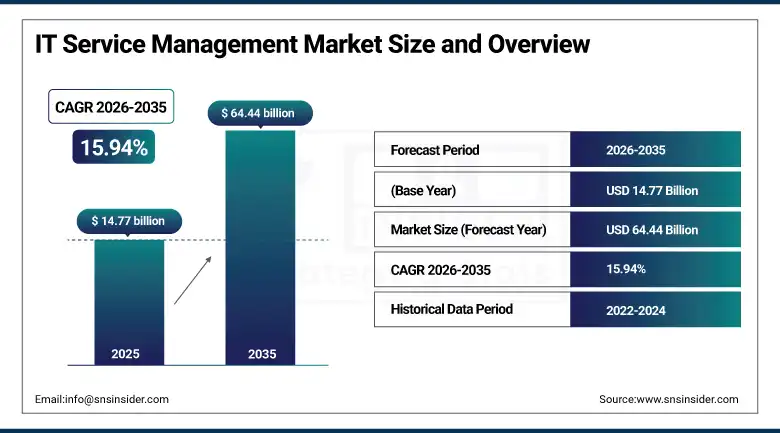
The IT Service Management Market was valued at USD 14.77 Billion in 2025 and is expected to reach USD 64.44 Billion by 2035, growing at a CAGR of 15.94% from 2026–2035.
The global IT service management market is growing rapidly as companies in all industries understand the fact that ITSM platforms are not just back office utilities anymore but are crucial pieces of the digital operations infrastructure of the company because the effectiveness of this ITSM platform will decide the efficiency of every business activity performed through IT services. The ITSM platform manages every phase of the IT service life cycle starting from the detection of incidents, change management, to catalog governance, asset management, and problems management. Today's investment in ITSM is based on artificial intelligence automation of tier one services, self-service portals, and integration with DevOps, SecOps, and enterprise service management.
ServiceNow launched its AI-powered Now Assist capabilities across its full ITSM platform suite in 2024, enabling intelligent incident summarisation, automated resolution recommendations, and natural language query processing for service desk agents that reduced average incident handle time by up to 35% for enterprise pilot customers. The deployment demonstrated the measurable productivity return that AI integration delivers in ITSM workflows and established generative AI capability as a primary differentiator in enterprise ITSM platform evaluation criteria.
IT Service Management Market Size and Forecast
-
Market Size in 2026E: USD 17.13 Billion
-
Market Size by 2035: USD 64.44 Billion
-
CAGR: 15.94% from 2026 to 2035
-
Fastest Growing Region: Asia Pacific
-
Largest Region: North America
To Get more information On IT Service Management Market - Request Free Sample Report
IT Service Management Market Trends
-
Rising demand for streamlined IT operations and digital workflow automation is driving the IT service management (ITSM) market.
-
Growing adoption across BFSI, healthcare, telecom, retail, and government sectors is boosting market growth.
-
Expansion of cloud computing, hybrid IT environments, and remote work infrastructure is fueling ITSM deployment.
-
Increasing focus on service efficiency, incident management, and improved end-user experience is shaping adoption trends.
-
Advancements in AI-driven automation, predictive analytics, and self-service platforms are enhancing operational capabilities.
U.S. IT Service Management Market Outlook
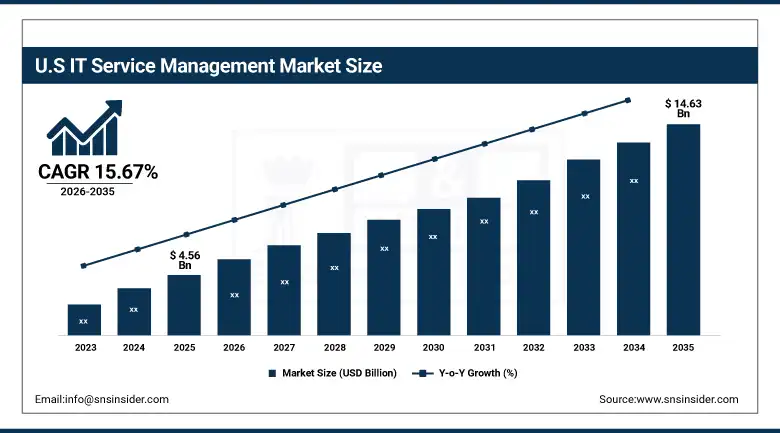
The U.S. IT Service Management Market was valued at approximately USD 4.56 Billion in 2025 and is expected to reach approximately USD 14.63 Billion by 2033, growing at a CAGR of approximately 15.67%.
The United States is the world’s largest ITSM market, due to its presence of the headquarter offices of the major players who provide the most advanced platforms in the market including ServiceNow, BMC Software, Ivanti, and Jira Service Management of Atlassian that collectively constitute the benchmarks of global ITSM platform standards. The U.S. enterprises’ need for IT operations in highly sophisticated cloud computing infrastructures along with the stringent compliance issues and higher-than-normal spending on IT services per employee make for the perfect business climate for deploying advanced ITSM platforms.
ServiceNow’s fiscal year 2024 revenue grew 22% year-over-year to exceed USD 10 billion, making it the first pure-play ITSM and enterprise service platform company to reach this revenue milestone. The performance validated the commercial maturity of the ITSM SaaS market and demonstrated that enterprise customers are willing to consolidate multiple operational management functions onto single integrated platforms whose AI capabilities and workflow breadth justify the investment.
IT Service Management Market Segment Analysis
-
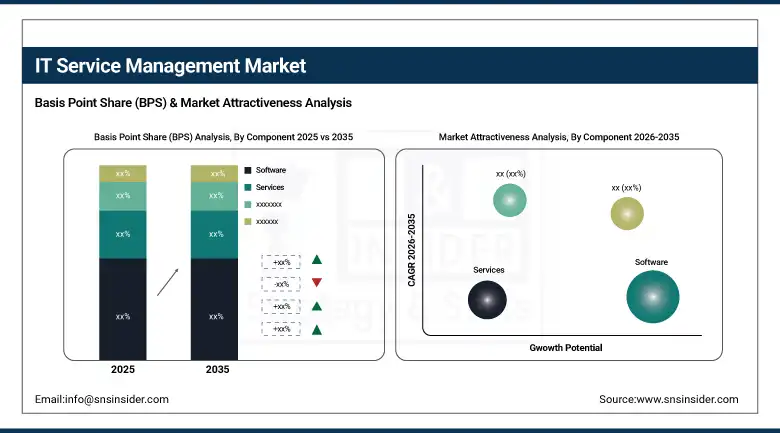
By Component, Software segment dominated the IT Service Management Market in 2025 with 69% share; Services segment is the fastest growing segment.
-
By Deployment, Cloud segment dominated the IT Service Management Market in 2025 with 63% share; Cloud segment is the fastest growing segment.
-
By Organisation Size, Large Enterprises segment dominated the IT Service Management Market in 2025 with 68% share; Small & Medium Enterprises segment is the fastest growing segment.
-
By End User, IT & Telecom segment dominated the IT Service Management Market in 2025 with 27% share; Healthcare segment is the fastest growing segment.Top of Form
By Component, software segment dominated the it service management market, services segment is the fastest growing
Bottom of Form
The Software segment dominated the IT Service Management Market in 2025 as companies are increasingly adopting ITSM software in their business environments. Enterprises are increasingly opting for ITSM software solutions to enhance efficiency, minimize downtime, and drive their digital transformation agenda. The incorporation of new technologies such as artificial intelligence, machine learning, and analytics capabilities into ITSM software is boosting the uptake of ITSM solutions. Also, there is an increasing demand for centralized IT operations management and enhanced customer service delivery, which has been bolstering the dominance of this segment in the market.
The Services segment is the fastest growing in the IT Service Management Market because companies are increasingly requiring consulting, implementation, integration, maintenance, and managed services to optimize their ITSM solutions. Organizations require customized expertise to deploy ITSM solutions tailored to the specific needs of enterprises. The increasing use of cloud-based solutions, ITSM software updates, and adoption of automated ITSM processes via artificial intelligence and machine learning is driving the demand for professional services.
By Deployment, cloud segment dominated the it service management market, cloud segment is also the fastest growing
The Cloud segment dominated the IT Service Management Market in 2025 owing to the growing preference among businesses for efficient, adaptable, and economical methods of deployment that facilitate automated workflows, accessibility at a distance, and lower infrastructure management expenses. Digital transformation processes, the growth of hybrid work, and the increased use of SaaS solutions drove up the pace of implementation of cloud ITSM solutions. Furthermore, the cloud is the fastest-growing segment, as more and more companies migrate to cloud-based infrastructure to enable operational flexibility, AI automation, collaboration in real-time, as well as simplified deployment and continuous software updates.
By Organisation Size, large enterprises segment dominated the it service management market, small & medium enterprises segment is the fastest growing
The Large Enterprises segment dominated the IT Service Management Market in 2025 as these enterprises have highly complicated IT infrastructure, which needs sophisticated monitoring, automation, and service management solutions. Large enterprises have abundant financial capacities and make consistent investments towards scalable and efficient IT service management solutions. Further, the increasing adoption of artificial intelligence-powered service desks, hybrid cloud technologies, and enterprise-level workflow automation solutions fuel the growth of the segment. Besides, the stringent need for regulatory compliance and uninterrupted digital operations play an important role in the segment's leadership.
The Small & Medium Enterprises segment is the fastest growing in the IT Service Management Market because of growing digital transformation activities amongst small-sized companies and increasing demand for cost-effective cloud-based IT service management solutions. Many SMEs are adopting service management software to enhance their operational efficiency, decrease operational costs, and develop more effective means for customers' support. Subscription-based business models and easy installation of IT service management solutions contribute to the rapid adoption amongst SMEs. Further, cyber-security threats and remote work trends boost the segment's growth.
Regional Analysis
|
Region |
Major Country |
Share within Region, 2025 (%) |
|---|---|---|
|
North America |
United States |
83.4% |
|
Europe |
Germany |
22.3% |
|
Asia Pacific |
India |
32.6% |
|
Middle East & Africa |
UAE |
38.4% |
|
Latin America |
Brazil |
44.2% |
North America IT Service Management Market Insights
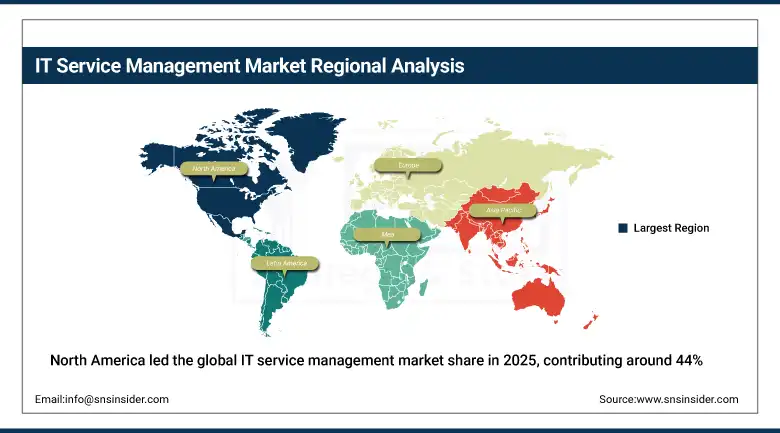
North America led the global IT service management market share in 2025, contributing around 44% of the global revenues, where the U.S. held about 83.4% of the revenue share in the North American market. This domination of North America in the ITSM market is backed by the presence of many of the leading players in ITSM platforms, the highest per-capita enterprise IT spending, and the advanced nature of the cloud services industry, on the basis of which the SaaS model of ITSM depends. The 22% growth in ServiceNow’s revenues to USD 10 billion and BMC Software’s continued success with its enterprise customers indicate North America’s market maturity as the top ITSM market in the world.
Canada contributes approximately 16.6% of North American revenues through a sophisticated enterprise technology market whose financial services, telecommunications, and public sector organisations generate consistent ITSM demand aligned with U.S. platform adoption trends and whose regulatory environment for financial services and healthcare creates compliance-driven ITSM specification requirements that sustain premium platform investment.
Get Customized Report as per Your Business Requirement - Enquiry Now
Europe IT Service Management Market Insights
Europe represents the second biggest ITSM market globally, with regulatory compliance being created by GDPR regulations on data localization, the obligations to govern AI-enabled decision-making systems under the EU AI Act, and continuous improvements in NIS2 requirements related to operational resilience, making the overall regulatory compliance motive behind investments in ITSM sustainable regardless of the discretionary budgeting cycles associated with IT. The share of revenues that comes from Germany represents around 22.3% due to the large number of global industrial companies, highly developed approach towards IT operations management, and presence of SAP, which can be used as an anchor for implementing ITSM.
The EU’s Digital Decade policy framework, targeting 75% of EU enterprises using cloud services and AI solutions by 2030, creates a structural institutional motivation for the ITSM modernisation investment that achieves these adoption targets.
According to the European Commission Digital Economy and Society Index (DESI), more than 80% of EU enterprises had achieved at least a basic level of digital intensity, while cloud computing adoption among enterprises exceeded 45%, significantly increasing demand for ITSM platforms capable of managing hybrid IT environments, incident resolution, and service orchestration.
Asia Pacific IT Service Management Market Insights
Asia Pacific represents the most rapidly growing regional market for IT Service Management (ITSM) on account of the phenomenal digitalization of businesses in India, China, Japan, South Korea, and Southeast Asia, whereby the IT investment within the combined firms is generating adoption rates of ITSM at a level far in excess of those seen in the markets of North America and Europe. India makes up about 32.6% of the total revenue generated by Asia Pacific through its massive IT services industry, where the same implements its ITSM solutions within its global delivery systems as well as for foreign business clients requiring the same.
MEA & Latin America IT Service Management Market Insights
The Middle East and Africa and Latin America are growing IT service management markets due to investments from governments in digitization initiatives, the growth in enterprises’ technology usage, and the introduction of global SaaS IT service management platforms in regional countries. The United Arab Emirates is taking a major share of the MEA IT service management services market revenue at around 38.4%. This can be attributed to the Dubai Smart City initiative, digital infrastructure for financial services in ADGM, and the Emirates Group enterprises IT operation that requires ITSM solutions.
Brazil leads Latin American revenues at approximately 44.2% of the regional total through its large private sector financial services and technology enterprise base, government digital services modernisation investment, and the growing presence of ServiceNow, BMC, and regional ITSM specialists whose commercial operations serve the Brazilian enterprise market’s growing demand for cloud-based operational management platforms.
Market Dynamics
Growth Drivers: Integration of Artificial Intelligence and Automation Tools in IT Service Management is Enhancing Operational Efficiency
Organizations have started incorporating AI, machine learning, and automation into their ITSM platforms for improving workflow efficiency, forecasting incidents, and reducing response time. The analytics generated by AI can help in obtaining insight about the performance of IT, making it easier to resolve issues proactively. Automations make it easier to eliminate redundant and laborious work from the processes and help avoid errors made during service operations. BFSI organizations, healthcare companies, and IT firms have already started implementing AI-based ITSM solutions to improve service performance. This is one of the major factors driving market growth.
Restraints: High Implementation and Maintenance Costs of IT Service Management Solutions are Limiting Market Penetration
The Enterprise implementation of ITSM involves substantial expense in terms of professional services and changes in organizational management, which lengthens the time for return on investment and creates risks that CIOs have to weigh against expected benefits. Major ITSM projects, including process reengineering, data migration, integrating with existing monitoring and security software, as well as end-user training, generally require 12-24 months before all the projected operational improvements can be fully realized, posing a need for executive patience that conflicts with alternative digital investments that promise quicker ROI. The shortage of skills in managing ITSM platforms, developing workflows and integration, contributes to longer project times and higher cost than the cost of the license.
Opportunities: Enterprise Service Management expansion, AIOps integration, and digital government investments accelerating global ITSM adoption growth
The evolution of enterprise service management from its IT base into other departments such as HR, facility management, procurement, and legal constitutes the most lucrative opportunity for growth in platform revenue generation by ITSM vendors in the short run. Corporations that have already invested in and implemented ServiceNow or BMC systems for managing IT-related services continue to expand these systems into other functions within their corporations that face the same business challenges as IT service management. Every extension adds revenue from each customer without having to generate new customers.
Recent Developments:
-
2024: ServiceNow launched its AI-powered Now Assist capabilities across its full ITSM platform suite in 2024, enabling intelligent incident summarisation, automated resolution recommendations, and natural language query processing that reduced average incident handle time by up to 35% in enterprise pilot deployments, establishing generative AI as a primary competitive differentiator in enterprise ITSM platform evaluation.
-
2024: BMC Software expanded its Helix ITSM platform with enhanced AIOps integration and predictive service management capabilities in 2024, enabling enterprise customers to transition from reactive incident response toward proactive IT operations management through AI-driven anomaly detection and automated remediation workflows across hybrid cloud environments.
-
2025: Freshworks enhanced its Freshservice ITSM platform with Freddy AI capabilities in 2025, targeting mid-market and SME enterprise customers with AI-powered incident auto-categorisation, recommended resolution articles, and automated ticket routing that delivers enterprise-grade ITSM AI functionality at the accessible pricing that SME IT operations budgets can accommodate without specialist implementation investment.
IT Service Management Market Key Players
-
ServiceNow
-
Atlassian
-
BMC Software
-
Ivanti
-
Microsoft
-
Broadcom
-
Kaseya + Datto
-
Freshworks
-
Zoho (ManageEngine)
-
SolarWinds
-
TeamDynamix
-
IBM
-
EasyVista
-
TOPdesk
-
SysAid
-
Cherwell (Ivanti)
-
InvGate
-
Alemba
-
Access Group
-
Aranda Software
IT Service Management Market Report Scope:
| Report Attributes | Details |
|---|---|
| Market Size in 2025 | USD 14.77 Billion |
| Market Size by 2035 | USD 64.44 Billion |
| CAGR | CAGR of 15.94% From 2026 to 2035 |
| Base Year | 2025 |
| Forecast Period | 2026-2035 |
| Historical Data | 2022-2024 |
| Report Scope & Coverage | Market Size, Segments Analysis, Competitive Landscape, Regional Analysis, DROC & SWOT Analysis, Forecast Outlook |
| Key Segments | • By Component (Software, Services) • By Deployment (Cloud, On-Premises) • By Organisation Size (Large Enterprises, Small & Medium Enterprises) • By End User (IT & Telecom, BFSI, Healthcare, Retail, Manufacturing, Government, Others) |
| Regional Analysis/Coverage | North America (US, Canada), Europe (Germany, UK, France, Italy, Spain, Russia, Poland, Rest of Europe), Asia Pacific (China, India, Japan, South Korea, Australia, ASEAN Countries, Rest of Asia Pacific), Middle East & Africa (UAE, Saudi Arabia, Qatar, South Africa, Rest of Middle East & Africa), Latin America (Brazil, Argentina, Mexico, Colombia, Rest of Latin America). |
| Company Profiles | ServiceNow, Atlassian, BMC Software, Ivanti, Microsoft, Broadcom, Kaseya + Datto, Freshworks, Zoho (ManageEngine), SolarWinds, TeamDynamix, IBM, EasyVista, TOPdesk, SysAid, Cherwell (Ivanti), InvGate, Alemba, The Access Group, Aranda Software |
Frequently Asked Questions
North America dominated the IT Service Management Market in 2025, holding approximately 44% of global revenues, with the United States accounting for approximately 83.4% of North American revenues.
Cloud deployment dominated the IT Service Management Market with 63% share in 2025, and it is also the fastest-growing deployment model globally.
Digital transformation, AI automation, and cloud SaaS delivery accelerating enterprise-wide ITSM modernisation and scalable service management adoption.
The IT Service Management Market was valued at USD 14.77 Billion in 2025.
The IT Service Management Market is expected to grow at a CAGR of 15.94% from 2026 to 2035.
