
Lighting Control System Market Report Scope & Overview:
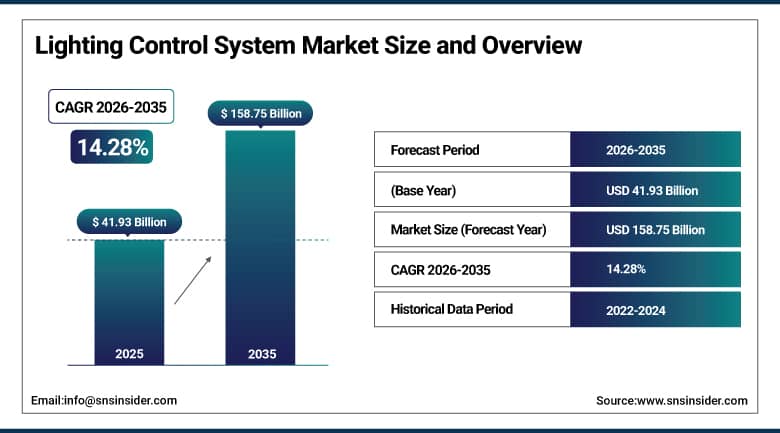
The Lighting Control System Market was valued at USD 41.93 Billion in 2025 and is expected to reach USD 158.75 Billion by 2035, growing at a CAGR of 14.28% from 2026–2035.
The global lighting control system market is growing at an exceptional and commercially broad-based pace. The market is driven by increasing adoption of smart lighting solutions across all sectors, rising smart lighting integration rates in residential, commercial, and industrial buildings, and advancements in wireless connectivity, AI-driven automation, and IoT-based controls enhancing efficiency and flexibility. Governments worldwide are promoting smart city initiatives and offering incentives for sustainable lighting solutions, further propelling market growth. Energy efficiency regulation requiring building commissioning and daylight harvesting implementation creates compliance-driven investment that sustains above-average commercial building lighting control system procurement.
In 2024, Signify (Philips Hue) launched its next-generation Interact cloud-based lighting management platform with enhanced AI-powered occupancy prediction and energy analytics for commercial buildings, enabling facility managers to reduce lighting energy consumption by up to 80%. The platform’s machine learning capability progressively improves its occupancy prediction accuracy as it learns building usage patterns, creating energy savings that compound over time and create measurable ROI that sustains premium system investment.
To Get More Information On Lighting Control System Market - Request Free Sample Report
Lighting Control System Market Trends:
-
AI-powered adaptive lighting control systems enable occupancy-based automation, improving energy efficiency through predictive intensity and color adjustment.
-
Human-centric lighting adoption is increasing as circadian rhythm-based lighting improves productivity in offices, education, and healthcare environments.
-
DALI-2 and DALI+ standardization enhances interoperability, reducing system integration costs across multi-vendor lighting control ecosystems.
-
Smart city lighting deployments are expanding, enabling remote monitoring, dimming, and fault detection in large-scale municipal infrastructure projects.
-
Building management system integration using BACnet and MQTT supports unified automation and contributes to green building certification compliance.
U.S. Lighting Control System Market Outlook
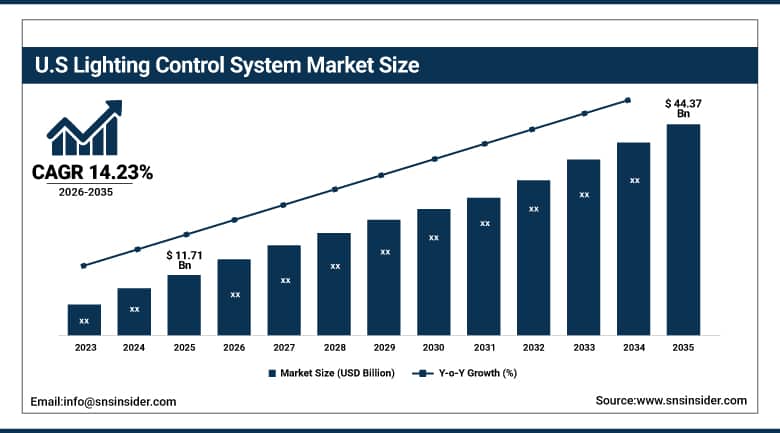
The U.S. Lighting Control System Market was valued at approximately USD 11.71 Billion in 2025 and is expected to reach approximately USD 44.37 Billion by 2035, growing at a CAGR of approximately 14.23%.
The U.S. is the most commercially sophisticated lighting control system market within North America’s dominant revenue position. Acuity Brands, Lutron Electronics, Eaton's Lighting division, Leviton, and Signify's U.S. operations collectively define the North American lighting control commercial landscape. The DOE's building energy efficiency programme, ASHRAE 90.1's mandatory lighting controls requirement for commercial buildings, and California Title 24's advanced lighting control mandate collectively create regulatory compliance motivation that sustains structured commercial building lighting control system procurement. The extraordinary pace of U.S. office building, hospital, school, and retail facility construction creates new installation procurement that compounds with the existing building retrofit market.
Lutron Electronics launched its Vive Hub 2.0 wireless lighting control platform for commercial buildings in 2024, featuring enhanced Bluetooth mesh network coverage, occupancy sensor integration, and cloud-based energy. The wireless architecture’s elimination of control circuit wiring reduces installation labour cost by up to 40% relative to wired DALI or 0-10V dimming systems, creating economic accessibility for retrofit projects whose control wiring installation cost historically created payback period barriers.
Lighting Control System Market Segment Analysis
-
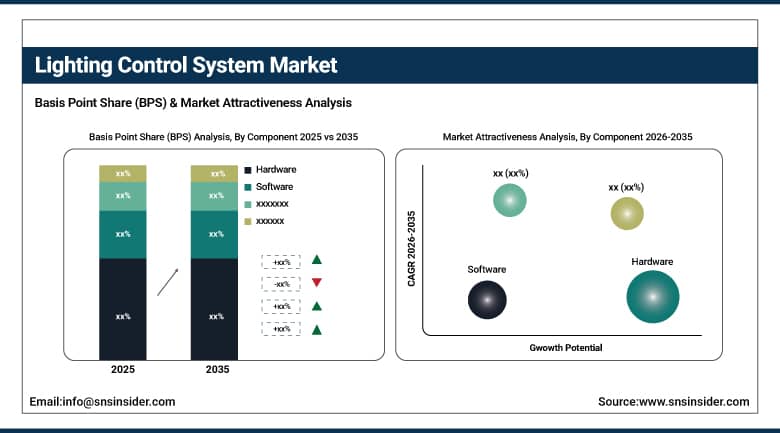
By Component, the hardware segment dominated the lighting control system market in 2025, while the software segment is the fastest growing.
-
By Technology, the wired segment dominated the lighting control system market with approximately 62% share in 2025, while the wireless segment is the fastest growing.
-
By Application, the indoor segment dominated the lighting control system market with approximately 67% share in 2025, while the outdoor segment is the fastest growing.
-
By End User, the commercial buildings segment dominated the lighting control system market with approximately 45% share in 2025, while the residential segment is the fastest growing.
By Component, hardware dominates, software grows fastest
Hardware retained the dominant component position in the lighting control system market in 2025. Each new commercial building constructed with ASHRAE 90.1-compliant lighting controls, each LED retrofit project incorporating occupancy sensors and dimming, and each smart home installation adding connected lighting creates hardware procurement whose combined commercial scale sustains the component category’s dominance. The trend toward integrated smart luminaires combining LED driver, wireless controller, and sensor in a single device creates premium hardware specifications whose per-unit commercial value sustains hardware revenue growth above installation unit growth rates.
Software is the fastest-growing component because AI-driven lighting management platform’s ability to create measurable energy savings, occupancy analytics, and maintenance cost reduction. Each commercial building management platform that integrates lighting control data with HVAC, access control, and energy metering creates software ecosystem value whose IT procurement channel creates premium license relationships that sustain above-average software segment revenue growth. Signify’s Interact, Acuity Brands’ atrius, and Lutron’s Vive commercial management platforms collectively define the enterprise software procurement that sustains the segment’s fastest-growing status.
By Technology, wired dominates, wireless grows fastest
Wired lighting control retained the dominant technology position with approximately 62% of the lighting control system market in 2025. DALI-2’s industry-standard digital addressable lighting interface protocol, whose open standard architecture enables multi-manufacturer component integration with consistent control behavior, creates the most commercially versatile wired control infrastructure for large commercial and industrial lighting installations. Wired control’s superior cybersecurity profile relative to wireless alternatives creates preference in security-sensitive facilities including government buildings, financial institutions, and critical infrastructure whose IT security policy constrains wireless IoT device deployment.
Wireless lighting control is the fastest-growing technology because the retrofit market’s installation economics strongly favor wire-free systems. Each wireless lighting control retrofit project that saves 40%+ of the control wiring installation cost creates payback period improvement that accelerates building owner investment decision timing. Lutron’s Vive Hub 2.0’s 2024 launch demonstrates the commercial direction of wireless commercial lighting control toward above-average installation growth as payback economics improve with wireless system maturity.
By Application, indoor dominates, outdoor grows fastest
Indoor lighting control retained the dominant application position with approximately 67% of the lighting control system market in 2025. The extraordinary commercial and residential building stock’s interior lighting requirement creates aggregate indoor lighting control procurement that substantially exceeds outdoor alternatives by installed value. Commercial office’s occupancy-based task lighting control, retail’s merchandise accent lighting management, healthcare’s circadian lighting prescription, and residential’s smart home scene control collectively represent diverse indoor lighting control applications whose combined procurement defines the market’s commercial character.
Outdoor lighting control is the fastest-growing application because smart city infrastructure investment is creating large-scale municipal procurement for connected street lighting whose remote dimming schedule management, fault detection, and adaptive brightness control create operational savings that sustain infrastructure investment. The commercial car park’s occupancy-based lighting control and sports stadium’s broadcast-quality dynamic lighting management create additional outdoor application categories whose premium specification sustains above-market revenue contribution.
By End User, commercial dominates, residential grows fastest
Commercial buildings retained the dominant end-user position with approximately 45% of the lighting control system market in 2025. ASHRAE 90.1’s mandatory occupancy sensor and daylight harvesting requirements for commercial buildings, LEED and BREEAM certification’s lighting control prerequisites, and the commercial building owner’s energy cost reduction motivation collectively create non-discretionary lighting control system investment that sustains above-average commercial procurement through economic cycles. The commercial building’s professional procurement process creates above-average willingness to invest in premium wireless and AI-powered systems.
Residential is the fastest-growing end user because smart home automation’s extraordinary consumer adoption, voice assistant integration with Amazon Alexa and Google Home platforms, and energy management consumer demand create above-average residential lighting control procurement growth. Each new smart speaker installation creates a natural expansion opportunity for voice-controlled lighting whose scene, scheduling, and away/home mode create consumer experience that sustains premium Philips Hue, Lutron Caseta, and LIFX residential system specification.
Regional Analysis:
|
Region |
Major Country |
Share within Region, 2025 (%) |
|---|---|---|
|
North America |
United States |
87.4% |
|
Europe |
Germany |
22.3% |
|
Asia Pacific |
China |
44.8% |
|
Middle East & Africa |
UAE |
38.4% |
|
Latin America |
Brazil |
44.2% |
North America Lighting Control System Market Insights
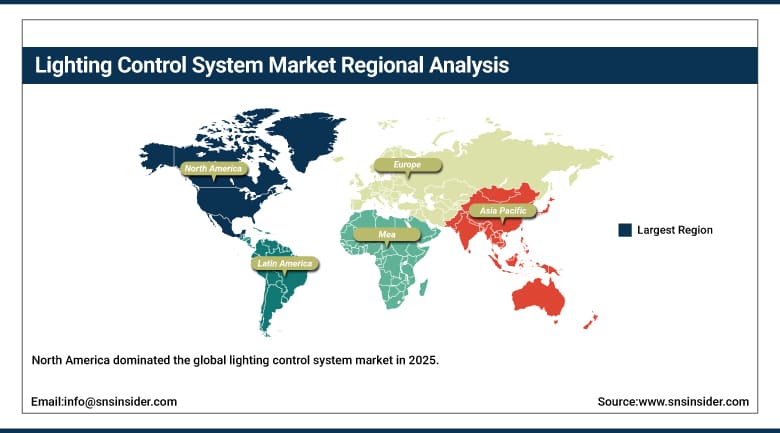
North America dominated the global lighting control system market in 2025 through its combination of stringent energy efficiency building codes, the most commercially advanced smart building infrastructure, and the presence of Acuity Brands, Lutron Electronics, Eaton, Leviton, and Signify’s commercial operations. The United States accounts for approximately 87.4% of North American revenues through ASHRAE 90.1’s mandatory commercial lighting control requirement, the LEED certification programme’s market penetration, and the extraordinary pace of commercial building construction and retrofit investment.
Canada contributes approximately 12.6% of North American revenues through its national building energy code’s lighting control requirements, the commercial building sector’s smart building investment, and the smart city programme’s outdoor lighting control deployment.
Get Customized Report as Per Your Business Requirement - Enquiry Now
Europe Lighting Control System Market Insights
Europe is a technically sophisticated lighting control system market where EU Energy Performance of Buildings Directive’s nearly-zero energy building standard, DALI standard’s European development origin, and the Ecodesign Directive’s lighting efficiency requirements create structured compliance-driven procurement. Germany accounts for approximately 22.3% of European revenues through its advanced commercial building engineering, OSRAM and TRILUX’s domestic commercial presence, and the industrial manufacturing sector’s energy efficiency investment.
The United Kingdom, France, and the Netherlands are significant secondary markets where progressive building energy codes, the commercial real estate sector’s BREEAM certification investment, and smart city outdoor lighting programmes create consistent above-average per-building lighting control system specification.
Asia Pacific Lighting Control System Market Insights
Asia Pacific is the fastest-growing regional lighting control system market, driven by China’s smart city programme’s extraordinary municipal street lighting investment, India’s EESL LED street lighting programme creating large-scale government procurement, Southeast Asia’s commercial building construction boom, and Japan and South Korea’s advanced building automation adoption. China accounts for approximately 44.8% of Asia Pacific revenues through its government’s smart city infrastructure investment, the extraordinary commercial and residential construction volume, and the domestic lighting control manufacturer development.
India’s UJALA programme and Smart Cities Mission create structured government lighting control procurement whose large-scale LED and connected lighting deployment sustains above-average Asia Pacific emerging market growth. Southeast Asia’s commercial building construction boom creates new installation demand that compounds with the progressive adoption of building energy efficiency standards.
MEA & Latin America Lighting Control System Market Insights
UAE leads MEA revenues at approximately 38.4% through its extraordinary commercial and hospitality building construction, smart city Dubai initiative’s connected infrastructure investment, and the premium building specification culture whose above-average lighting control system investment per building creates commercial concentration. Brazil leads Latin American revenues at approximately 44.2% through its commercial building sector, the government’s Procel programme’s energy efficiency incentive, and the growing smart home market.
Saudi Arabia’s NEOM and Vision 2030’s smart city infrastructure create significant MEA secondary market procurement, and South Africa’s commercial building sector creates additional regional lighting control demand.
Market Dynamics:
Growth Drivers: Energy efficiency regulation creating compliance procurement and smart city investment driving outdoor lighting control deployment
Energy efficiency building codes are the lighting control system market’s most commercially certain structural growth driver. ASHRAE 90.1’s commercial building mandatory lighting control requirements, California Title 24’s advanced lighting control mandate, and EU EPBD’s nearly-zero energy building standard collectively create legally mandated lighting control system investment whose compliance character creates procurement independent of discretionary building improvement investment cycles. Each new commercial building permit that triggers ASHRAE 90.1 compliance creates structured occupancy sensor, daylight harvesting, and scheduling control procurement whose value scales with building floor area. The commercial real estate market’s LEED and BREEAM certification premium, whose energy performance prerequisite creates lighting control investment motivation beyond regulatory minimum compliance, sustains premium system specification.
OECD’s estimate that urban LED street lighting control can reduce municipal energy cost by 50-70% creates compelling ROI that sustains infrastructure investment across municipal budget cycles. China’s smart city programme, India’s EESL municipal LED programme, and EU smart city initiatives collectively create the most commercially significant public sector lighting control procurement globally.
Restraints: Cybersecurity vulnerability of connected lighting IoT infrastructure and installation complexity in retrofit projects
Connected lighting control systems’ IoT device proliferation creates cybersecurity attack surface expansion whose vulnerability to network intrusion creates IT security concerns in enterprise commercial buildings and critical infrastructure facilities. Each lighting control gateway or connected luminaire that accesses the building’s IP network creates a potential intrusion entry point whose security management requires IT infrastructure investment that increases total system cost. Enterprise IT security policy’s increasing requirement for IoT device certification and network segmentation creates procurement compliance overhead.
Retrofit project installation complexity in occupied commercial buildings whose operational continuity requirements limit construction access windows and whose existing infrastructure creates constraint on control system architecture choices moderates market growth relative to the new construction opportunity.
Opportunities: Matter protocol smart home standardization and AI occupancy analytics premium service
Matter protocol smart home standardization represents the most commercially transformative near-term residential lighting control opportunity whose cross-manufacturer device interoperability eliminates the fragmentation that historically created consumer specification hesitation. Each Matter-certified lighting control device that works seamlessly with Amazon, Apple, and Google smart home platforms creates a consumer experience simplification whose commercial impact is accelerating residential smart home lighting adoption. The Connected Home over IP standard’s broad manufacturer adoption creates a residential lighting control market whose standardization creates consumer confidence that sustains premium product investment.
Each commercial building management platform that deploys AI occupancy analytics creates annual subscription revenue whose value scales with building size and creates commercial relationships that sustain multi-year revenue streams independent of hardware replacement cycles.
Recent Developments:
-
2026: Siemens expanded Enlighted IoT lighting controls with workplace occupancy intelligence improving space utilization and energy efficiency in offices.
-
2026: Lutron introduced advanced wireless lighting control systems enabling scalable retrofit solutions across residential and commercial infrastructure projects.
-
2025: Signify expanded Interact smart lighting platform with AI-based occupancy analytics for commercial buildings and smart city applications.
Lighting Control System Market key players are:
-
Acuity Brands Inc.
-
Signify N.V. (Philips Hue/Interact)
-
Lutron Electronics Co. Inc.
-
Eaton Corporation (Cooper Lighting)
-
Leviton Manufacturing Company Inc.
-
OSRAM Licht AG (ams-OSRAM)
-
Legrand S.A.
-
Honeywell International Inc.
-
Siemens AG (Desigo CC)
-
Johnson Controls International
-
Schneider Electric SE
-
Cree Lighting
-
Helvar Ltd.
-
TRILUX GmbH & Co. KG
-
Tridonic GmbH & Co. KG
-
Hubbell Incorporated
-
Zumtobel Group AG
-
LSI Industries Inc.
-
Daintree Networks (CommScope)
-
ABB Ltd.
Lighting Control System Market Report Scope:
| Report Attributes | Details |
|---|---|
| Market Size in 2025 | USD 41.93 Billion |
| Market Size by 2035 | USD 158.75 Billion |
| CAGR | CAGR of 14.28% From 2026 to 2035 |
| Base Year | 2025 |
| Forecast Period | 2026-2035 |
| Historical Data | 2022-2024 |
| Report Scope & Coverage | Market Size, Segments Analysis, Competitive Landscape, Regional Analysis, DROC & SWOT Analysis, Forecast Outlook |
| Key Segments | • By Component (Hardware, Software, Services) • By Technology (Wired, Wireless, Hybrid) • By Application (Indoor, Outdoor) • By End User (Commercial Buildings, Residential Buildings, Industrial Facilities, Municipal & Street Lighting, Healthcare, Others) |
| Regional Analysis/Coverage | North America (US, Canada), Europe (Germany, UK, France, Italy, Spain, Russia, Poland, Rest of Europe), Asia Pacific (China, India, Japan, South Korea, Australia, ASEAN Countries, Rest of Asia Pacific), Middle East & Africa (UAE, Saudi Arabia, Qatar, South Africa, Rest of Middle East & Africa), Latin America (Brazil, Argentina, Mexico, Colombia, Rest of Latin America). |
| Company Profiles | Acuity Brands Inc., Signify N.V. (Philips Hue/Interact), Lutron Electronics Co. Inc., Eaton Corporation (Cooper Lighting), Leviton Manufacturing Company Inc., OSRAM Licht AG (ams-OSRAM), Legrand S.A., Honeywell International Inc., Siemens AG (Desigo CC), Johnson Controls International, Schneider Electric SE, Cree Lighting, Helvar Ltd., TRILUX GmbH & Co. KG, Tridonic GmbH & Co. KG, Hubbell Incorporated, Zumtobel Group AG, LSI Industries Inc., Daintree Networks (CommScope), ABB Ltd. |
Frequently Asked Questions
The Lighting Control System Market is expected to grow at a CAGR of 14.28% from 2026 to 2035.
The Lighting Control System Market was valued at USD 41.93 Billion in 2025.
Increasing adoption of smart lighting solutions driven by energy efficiency building codes creating compliance-driven commercial building procurement, and smart city initiatives.
Hardware dominated the market in 2025 as the physical foundation of every lighting control installation, while the Software segment is the fastest growing.
North America dominated the market in 2025.
