
LLM Firewall Market Report Scope & Overview:
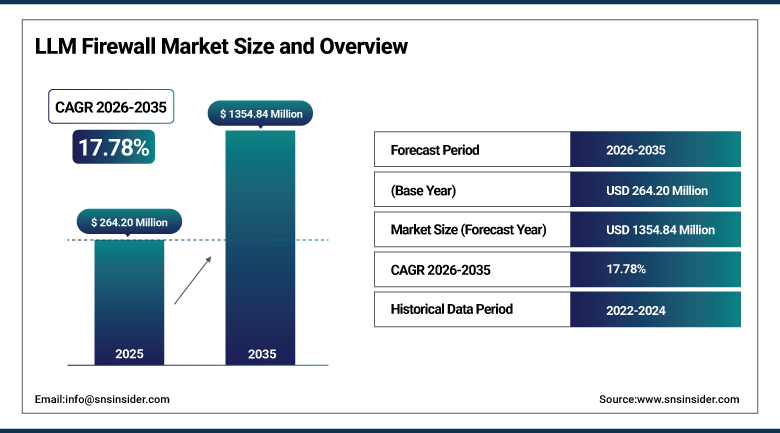
The LLM Firewall Market was valued at USD 264.20 Million in 2025 and is expected to reach USD 1354.84 Million by 2035, growing at a CAGR of 17.78% from 2026–2035.
The LLM firewall market is experiencing strong growth due to increasing demand for secure, reliable, and controlled deployment of large language models across enterprise applications. The rapid adoption of generative AI, conversational AI, retrieval-augmented generation (RAG), AI copilots, and agentic AI systems is increasing the need for specialized security solutions that protect LLM applications from emerging threats. Growing concerns related to prompt injection, jailbreak attacks, sensitive data leakage, malicious outputs, model misuse, and insecure tool calls are driving organizations to deploy LLM firewall technologies. Enterprises are focusing on strengthening AI governance, protecting proprietary and personally identifiable information, improving output safety, and maintaining compliance with evolving AI security requirements. The integration of LLM firewalls with AI gateways, application security platforms, cloud environments, API security, and security operations is further supporting adoption. Advances in real-time monitoring, threat detection, prompt filtering, output validation, behavioral analysis, and AI-powered security controls are enhancing the ability of organizations to secure LLM applications across diverse enterprise environments.
In June 2026, Citadel AI launched Citadel Radar, an AI firewall and monitoring solution designed to evaluate prompts and responses from generative AI applications, helping enterprises detect, control, and monitor AI-related risks while supporting AI governance.
To Get more information LLM Firewall Market - Request Free Sample Report
LLM Firewall Market Trends
- Increasing adoption of artificial intelligence (AI), generative AI, and AI agents is driving the LLM firewall market.
- Growing demand for protection against prompt injection, prompt leakage, data exposure, malicious inputs, and other AI-specific security threats is accelerating market growth.
- Expanding adoption of LLM firewall solutions for prompt filtering, data privacy, security monitoring, and AI governance is enhancing market demand.
- Rising investments in enterprise AI infrastructure, cloud-based AI platforms, AI security, and responsible AI frameworks are supporting market innovation.
- Increasing deployment of LLM firewall solutions across IT & telecommunications, BFSI, healthcare, manufacturing, retail, and government sectors is strengthening market growth.
The U.S. LLM Firewall Market Outlook
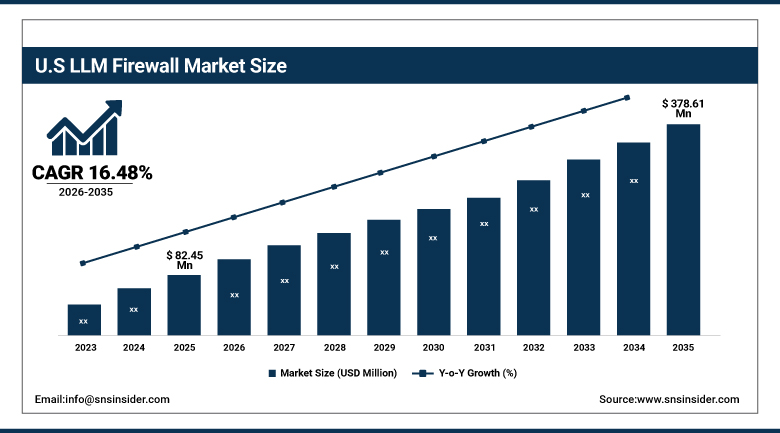
The U.S. LLM Firewall Market was valued at USD 82.45 Million in 2025 and is expected to reach around USD 378.61 Million by 2035, growing at a CAGR of 16.48% from 2026–2035.
The U.S. LLM firewall market is growing steadily due to the rapid adoption of generative AI, large language models, AI copilots, retrieval-augmented generation, and agentic AI across enterprises. The expansion of AI-powered applications in financial services, healthcare, technology, government, retail, and other industries is increasing demand for security solutions that protect LLM applications from emerging threats. Growing concerns regarding prompt injection, jailbreak attacks, sensitive data leakage, malicious outputs, insecure tool calls, and unauthorized model access are driving organizations to implement dedicated LLM security controls. Companies are investing in real-time prompt filtering, output validation, threat detection, data protection, AI application monitoring, and security governance to strengthen the security of enterprise AI deployments. Integration with cloud platforms, API gateways, application security infrastructure, and security operations environments is further supporting adoption. The increasing emphasis on responsible AI, data privacy, compliance, and secure deployment of AI applications is expected to further support market growth in the U.S.
In January 2026, aiFWall emerged from stealth with an AI firewall designed to protect AI deployments by filtering both inputs and outputs, including malicious prompts, harmful content, toxicity, and bias. The company made a basic version of its firewall available for free, highlighting growing demand for dedicated security layers around enterprise AI and LLM applications.
LLM Firewall Market Segment Analysis
- By Component, software dominated the LLM Firewall Market with a 62.84% share in 2025, while services are projected to be the fastest-growing segment, registering a 33.13% CAGR during 2025–2035.
- By Deployment Mode, on-premises deployment dominated the LLM Firewall Market with a 57.37% share in 2025, while cloud deployment is projected to be the fastest-growing segment, registering a 31.92% CAGR during 2025–2035.
- By Security Function, prompt injection & jailbreak prevention dominated the LLM firewall market with a 24.68% share in 2025, while agent & tool-call security is projected to be the fastest-growing segment, registering a 18.81% CAGR increase in market share during 2025–2035.
- By Application, enterprise security dominated the LLM Firewall Market with a 21.55% share in 2025, while cloud security is projected to be the fastest-growing segment, registering a 32.12% CAGR during 2025–2035.
- By Enterprise Size, large enterprises dominated the LLM Firewall Market with a 68.73% share in 2025, while small & medium enterprises (SMEs) are projected to be the fastest-growing segment, registering a 31.08% CAGR during 2025–2035.
- By End-User Industry, BFSI dominated the LLM Firewall Market with a 24.68% share in 2025, while retail & e-commerce is projected to be the fastest-growing segment, registering a 29.14% CAGR during 2025–2035.
By Component, software dominated the LLM firewall Market, while services are expected to grow fastest.
Software has been a key contributor in terms of market share in the LLM Firewall Market in 2025 since software solutions that are designed to detect prompt injection, prevent prompt leakage, sanitize prompts, ensure data security and LLM monitoring have become increasingly popular in recent years. These software solutions help companies enhance the security, privacy, reliability and compliance of their LLM-based applications. Increasingly popular use of generative AI, LLMs, and AI agents is increasing the need for LLM firewalls that can be integrated into enterprise-level AI applications. Growing awareness about AI-specific cyber threats, data exposure risks, responsible AI usage and regulations compliance is boosting the software segment's growth.
It is estimated that the services segment will experience the fastest growth rate over the forecasted period. This is due to the increasingly important role played by consulting, implementation, integration, customization, monitoring and managed security services for LLM firewalls.
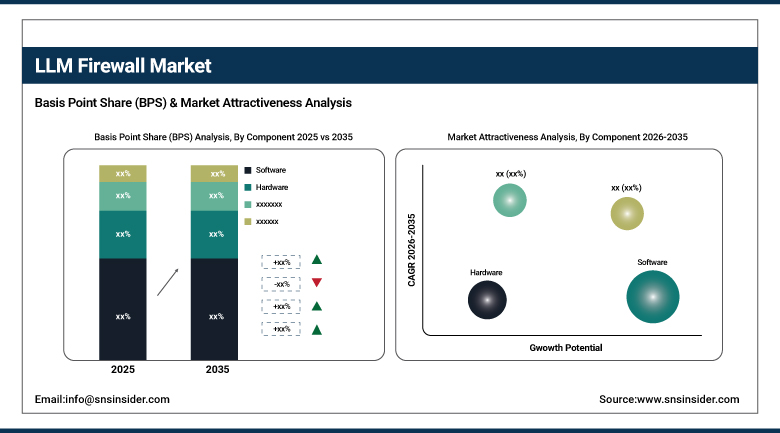
By Deployment Mode, on-premises deployment dominated the LLM firewall market, while cloud deployment is expected to grow fastest.
The on-premises deployment segment held the highest market share in the LLM firewall Market in 2025, owing to the preference among organizations with strict security and privacy requirements, as well as those needing more control over the management of LLM traffic, sensitive data, security policy, and firewall infrastructure. Enterprises functioning within highly regulated industry verticals such as BFSI, healthcare, government, and others dealing with sensitive information are increasingly deploying on-premises LLM firewalls to limit the exposure of their data.
Cloud deployment is set to record the fastest growth during the forecast period on account of the rising use of cloud-based AI infrastructure, generative AI, and AI agents. The cloud deployment type includes the deployment of LLM firewall as a SaaS-based solution, which allows easy scalability and management of security and integrates well with the AI environment.
By Application, enterprise security dominated the LLM firewall market, while cloud security is expected to grow fastest.
Enterprise security occupied the highest market share in the LLM firewall Market in 2025 as there was an increasing requirement of securing enterprise LLM application against any injection, leakage of prompts, sensitive data, malicious input/output, and unauthorized access. There is an increasing adoption of LLM firewalls by enterprises to set up security around AI applications, to monitor the interaction, and filter out the malicious content, thereby reducing the risk involved in the increasing adoption of Generative AI and AI agents. Increasing adoption of LLMs in businesses is driving the adoption of LLM security.
Cloud Security is anticipated to witness high growth rate during the forecast period backed by the exponential growth in AI applications, LLMs, and deployment of AI agents based on clouds. The rising need to provide security for cloud-based LLM communication and safeguard sensitive enterprise data, due to the growing number of organizations that execute their AI workloads on clouds, is going to fuel the adoption of cloud security solutions in the LLM Firewall market.
Regional Analysis
|
Region |
Major Country |
Share within Region, 2025(%) |
|---|---|---|
|
North America |
United States |
89.16% |
|
Europe |
Germany |
28.85% |
|
Asia Pacific |
China |
43.92% |
|
Middle East & Africa |
Saudi Arabia |
28.24% |
|
Latin America |
Brazil |
47.58% |
North America LLM firewall market insights
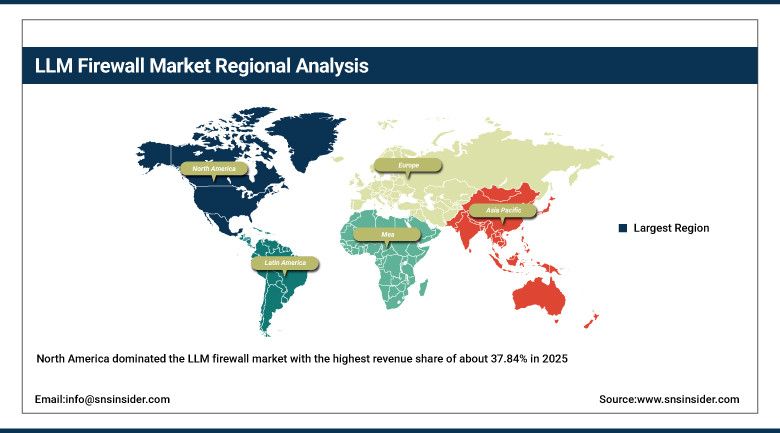
North America dominated the LLM firewall market with the highest revenue share of about 37.84% in 2025, supported by its advanced artificial intelligence ecosystem, strong presence of cloud service providers, cybersecurity companies, enterprise software firms, and technology companies. The region has been an early adopter of generative AI, large language models, AI applications, and cloud-based enterprise technologies. Significant investments in AI security, cloud computing, responsible AI, and enterprise digitalization are increasing demand for solutions that protect LLM applications from emerging security threats. Furthermore, the presence of leading AI and cybersecurity technology providers, strong research and development capabilities, and increasing enterprise adoption of AI security solutions are strengthening North America's market position.
Get Customized Report as per Your Business Requirement - Enquiry Now
Europe LLM firewall market insights
The European market for LLM firewall is witnessing high growth owing to the rising importance of AI security, responsible AI, data security, and regulatory compliance. The changing regulations, along with the security and privacy issues associated with AI applications, are prompting organizations to deploy specialized LLM firewall solutions. Enterprises from sectors such as healthcare, manufacturing, automotive, BFSI, retail, and government are deploying more AI applications, leading to an increasing need for protection from prompt injection, data leakage, malicious inputs, and unauthorized access.
Growing spending on enterprise AI, cloud computing, cybersecurity, and digital transformation is also helping fuel market growth. In 2025, Germany holds the largest market share in Europe owing to its industrial base, adoption of AI-based enterprise applications, and increasing importance of cybersecurity and data security.
Asia Pacific LLM firewall market insights
Asia Pacific is expected to grow at the fastest CAGR of about 20.30% from 2026–2035, driven by rapid digital transformation, expanding artificial intelligence adoption, and increasing deployment of cloud-based and enterprise AI applications. Countries including China, Japan, South Korea, India, Singapore, and other Southeast Asian economies are investing substantially in generative AI, large language models, cloud computing, and AI-enabled digital platforms. The expansion of LLMs, AI copilots, retrieval-augmented generation, and agentic AI is creating increasing demand for security solutions that protect enterprise AI applications from prompt injection, jailbreak attacks, sensitive data leakage, malicious outputs, and unauthorized tool interactions. In addition, growing adoption of e-commerce, digital banking, healthcare technology, enterprise software, and AI-powered customer services is increasing the use of LLM-based applications across the region.
Middle East & Africa and Latin America LLM firewall market insights
LLM Firewall Market in MEA is growing consistently owing to rising investments in artificial intelligence, cloud computing, smart city development, cybersecurity, and digital transformation in enterprises. AI application implementations in BFSI, healthcare, telecommunication, energy, and government verticals have increased the need for LLM firewalls to improve AI security, ensure data protection and responsible deployment of AI solutions. The market in Saudi Arabia held the leading position in the region in 2025, propelled by national AI policies, digital transformation plans, and increasing investments in cloud computing and artificial intelligence technology.
The LLM Firewall Market in Latin America is showing consistent growth with the increasing use of business solutions based on artificial intelligence, cloud computing, and enterprise automation. Digital transformation, AI security, responsible AI and AI governance are helping in the implementation of LLM firewalls solutions. The market share in Brazil was the highest in Latin America in 2025, aided by its huge number of enterprises, rapidly developing AI environment, and growing implementation of AI solutions in BFSI, healthcare, manufacturing, retail, and other industries.
Market Dynamic
Growth Driver: Rising adoption of generative AI and AI security driving LLM firewall Market growth
One of the factors contributing to the growth of the LLM firewall market is the quick uptake of artificial intelligence (AI), generative AI, LLMs, and AI-powered enterprise applications. With the increase in the usage of LLMs and AI agents for automating processes in enterprises, engaging with customers, developing software, and making decisions, there is an increasing need for security for these applications from prompt injections, prompt leaks, sensitive data exposure, malicious prompts, and harmful results. The LLM firewall market offers a solution to the organizations for securing their AI interactions through policy enforcement, prompt and response filtering, and data protection. Moreover, the increase in spending on enterprise AI infrastructure, cloud-based AI platforms, AI security, responsible AI, and AI governance is boosting the market.
Restraints: Increasing LLM complexity and integration challenges may restrict LLM firewall Market growth
Even in the presence of several growth opportunities, the LLM firewall market is likely to encounter certain challenges posed by the rising complexity in LLMs, multimodal AI, AI agents, and changing attack techniques. Companies may face difficulties when it comes to detecting and remedying sophisticated prompt injections, data leakage, manipulation of AI models, and other AI-based attacks. It will be necessary for companies to integrate LLM firewalls into their cybersecurity framework, AI pipeline, cloud platform, and enterprise apps, and all of these will call for some serious investments on part of enterprises. Moreover, evolving data privacy regulations, differing AI security standards, performance issues, and shortage of AI security professionals are expected to inhibit market growth.
Opportunities: Growing focus on AI security and regulatory compliance creating new growth opportunities
A lot of opportunity is surfacing in the LLM Firewall Market owing to rising awareness related to AI security, responsible AI, enterprise AI governance, and regulations. Organizations need solutions that can ensure continuous monitoring of LLM conversations, prompt injection detection, protection against prompt leakage, malicious content filtering, sensitive data protection, and AI security policy enforcement within the organization. The rise and development of AI regulations along with industry security standards have led organizations to develop better control around the use of enterprise AI. Furthermore, developments in generative AI security, AI agents, automated threat detection, prompt filtering, data loss prevention, and continuous runtime monitoring will open new avenues in the LLM firewall market.
Recent Developments
- 2022: NVIDIA advanced the development of programmable AI safety and security controls for large language model applications, establishing the foundation for runtime guardrails that can control model inputs, outputs, and interactions with external resources.
- 2023: NVIDIA introduced NeMo Guardrails as an open-source toolkit for adding programmable guardrails to LLM-based conversational applications. The technology enabled developers to implement controls for harmful content, topic restrictions, dialogue behavior, and other LLM safety requirements independently of the underlying model.
- 2024: Cloudflare announced the development of Firewall for AI, a dedicated protection layer designed to identify and block attacks targeting LLM applications before they reach the underlying models. The solution addressed threats including prompt injection, data leakage, model abuse, and resource-exhaustion attacks.
- 2025: Cloudflare expanded Firewall for AI through an open beta focused on discovering LLM-powered applications and detecting personally identifiable information. The company subsequently added unsafe-content moderation, enabling real-time detection and blocking of harmful prompts and topics at the network edge without requiring changes to application code.
LLM Firewall Market key players are:
- NVIDIA Corporation
- Microsoft Corporation
- Google LLC
- IBM Corporation
- Amazon Web Services, Inc. (AWS)
- Palo Alto Networks, Inc.
- Cisco Systems, Inc.
- Cloudflare, Inc.
- Fortinet, Inc.
- Check Point Software Technologies Ltd.
- Akamai Technologies, Inc.
- F5, Inc.
- Zscaler, Inc.
- CrowdStrike Holdings, Inc.
- Netskope, Inc.
- Imperva, Inc.
- Protect AI
- Lakera
- Robust Intelligence
- HiddenLayer
LLM Firewall Market Report Scope:
| Report Attributes | Details |
|---|---|
| Market Size in 2025 | USD 264.20 Million |
| Market Size by 2035 | USD 1354.84 Million |
| CAGR | CAGR of 17.78% From 2026 to 2035 |
| Base Year | 2025 |
| Forecast Period | 2026-2035 |
| Historical Data | 2022-2024 |
| Report Scope & Coverage | Market Size, Segments Analysis, Competitive Landscape, Regional Analysis, DROC & SWOT Analysis, Forecast Outlook |
| Key Segments | • By Component (Software, Hardware, Services) • By Deployment Mode (Cloud, On-Premises) • By Security Function (Prompt Injection & Jailbreak Prevention, Sensitive Data Leakage Prevention, Toxic & Harmful Content Detection, Malicious Code & URL Detection, Hallucination & Groundedness Control, Agent & Tool-Call Security, Prompt Filtering & Sanitization, Others) • By Application (Enterprise Security, Cloud Security, Network Security, Data Privacy) • By Enterprise Size (Large Enterprises, Small & Medium Enterprises (SMEs)) • By End-User Industry (BFSI, Healthcare, IT & Telecommunications, Government, Retail & E-commerce, Media & Entertainment, Others) |
| Regional Analysis/Coverage | North America (US, Canada, Mexico), Europe (Eastern Europe [Poland, Romania, Hungary, Turkey, Rest of Eastern Europe] Western Europe] Germany, France, UK, Italy, Spain, Netherlands, Switzerland, Austria, Rest of Western Europe]), Asia Pacific (China, India, Japan, South Korea, Vietnam, Singapore, Australia, Rest of Asia Pacific), Middle East & Africa (Middle East [UAE, Egypt, Saudi Arabia, Qatar, Rest of Middle East], Africa [Nigeria, South Africa, Rest of Africa], Latin America (Brazil, Argentina, Colombia, Rest of Latin America) |
| Company Profiles | NVIDIA Corporation, Microsoft Corporation, Google LLC, IBM Corporation, Amazon Web Services, Inc. (AWS), Palo Alto Networks, Inc., Cisco Systems, Inc., Cloudflare, Inc., Fortinet, Inc., Check Point Software Technologies Ltd., Akamai Technologies, Inc., F5, Inc., Zscaler, Inc., CrowdStrike Holdings, Inc., Netskope, Inc., Imperva, Inc., Protect AI, Lakera, Robust Intelligence, HiddenLayer |
Frequently Asked Questions
Key players in the LLM Firewall Market include NVIDIA, Microsoft, Google, IBM, Palo Alto Networks, Cisco Systems, Inc., Cloudflare, Inc., AWS, and Fortinet, Inc., among others.
Key opportunities include the expansion of generative AI, LLM applications, AI agents, cloud computing, RAG systems, and enterprise AI security adoption.
The market is primarily driven by increasing LLM adoption and growing concerns regarding prompt injection, jailbreak attacks, sensitive data leakage, malicious outputs, and AI application security.
The Prompt Injection & Jailbreak Prevention segment dominated the LLM Firewall Market, accounting for approximately 24.68% market share in 2025.
North America dominated the LLM Firewall Market in 2025 with a 37.84% share, supported by its advanced AI ecosystem, strong technology and cybersecurity infrastructure, and high enterprise adoption of generative AI and LLM applications.
