
Micro Lending Market Report Scope & Overview:
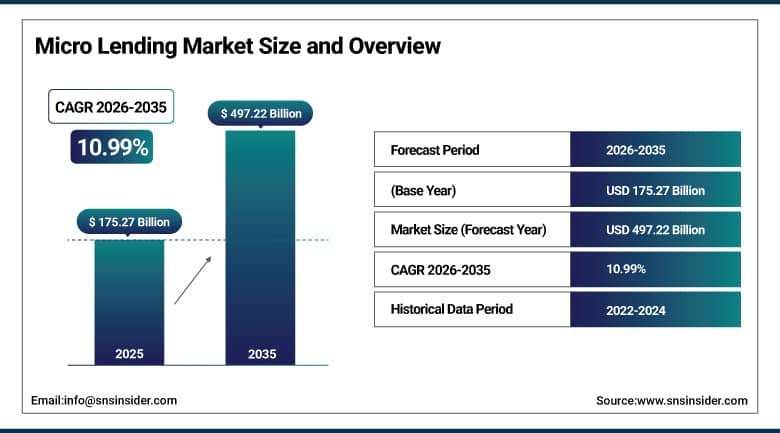
The Micro Lending Market was valued at USD 175.27 Billion in 2025 and is expected to reach USD 497.22 Billion by 2035, growing at a CAGR of 10.99% from 2026 to 2035.
The Micro Lending Market is growing steadily owing to the rising demand for financial services among marginalized sections of society, micro-entrepreneurs, and small business owners. Increased efforts towards financial inclusion, development of digital lending platforms, and the adoption of mobile banking solutions have increased the availability of loans in developing countries. The use of AI and analytics is allowing faster approvals of loan applications while lowering the risk of lending. Moreover, government-backed micro-financing schemes, increased entrepreneurship, women entrepreneurship, and fintech lenders are contributing towards the uptake of micro-lending solutions.
In 2024, digital micro-lending served over 220 million previously unbanked users globally, with 65% of borrowers in emerging markets citing flexible repayment terms as a key factor, while government-backed initiatives drove a 35% year-over-year increase in first-time loan access.
To Get More Information On Micro Lending Market - Request Free Sample Report
Micro Lending Market Trends
-
Increasing demand for accessible credit among underserved individuals and small businesses keeps expanding the market's addressable borrower base worldwide.
-
Rising adoption of digital lending platforms, mobile banking, and fintech solutions is enhancing both the reach and operational efficiency of micro lending.
-
Supportive government policies and favorable regulatory frameworks continue driving adoption of microloans across both emerging and developed markets.
-
Growing awareness of flexible repayment options is helping more first-time borrowers feel comfortable accessing microcredit for the first time.
-
The broader focus on financial inclusion, entrepreneurial development, and economic empowerment is accelerating overall market growth across virtually every region.
The U.S. Micro Lending Market Outlook
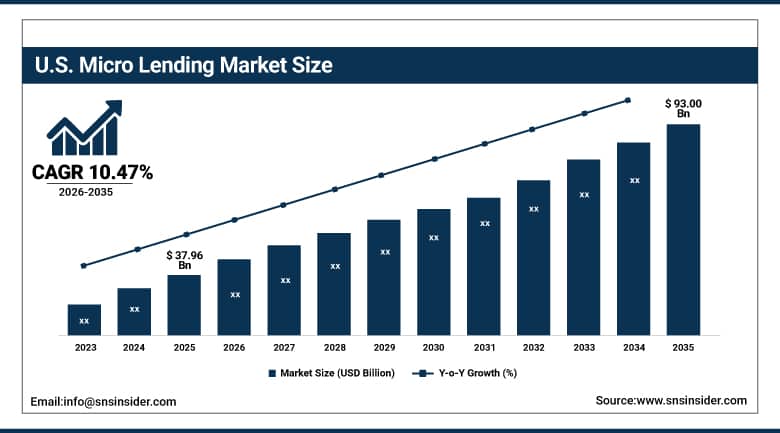
The U.S. Micro Lending Market was valued at approximately USD 37.96 Billion in 2026 and is expected to reach approximately USD 93.00 Billion by 2035, growing at a CAGR of approximately 10.47%.
Growth in the U.S. market is being driven by rising demand for accessible credit among small businesses and underserved individuals, along with increased adoption of digital lending platforms, fintech solutions, and flexible repayment options. Supportive regulatory policy keeps further enhancing financial inclusion and market expansion across American lending institutions. Increasing financial inclusion initiatives and government support are driving growth in micro lending, enabling access to small loans for underserved and low-income populations across the country, and governments, financial institutions, and NGOs are actively promoting financial inclusion to provide underserved populations with access to credit, savings, and other essential financial services.
Muthoot Microfin's co-lending partnership model with major banking institutions, of the kind seen in similar arrangements internationally, illustrates how U.S. fintech lenders and traditional banks are increasingly structuring partnerships specifically to expand affordable credit access to underserved small business owners without either party bearing the full underwriting risk alone.
Micro Lending Market Segment Analysis
-
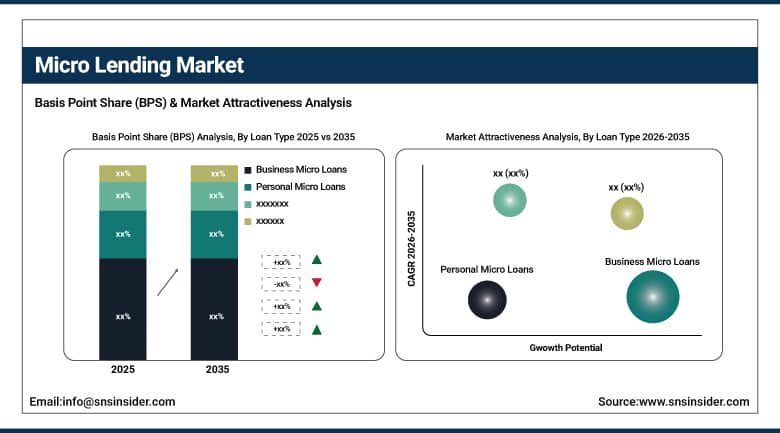
By Loan Type, Business Micro Loans segment dominated the market in 2025 with 34% share; Personal Micro Loans segment is the fastest growing segment.
-
By Provider, Microfinance Institutions (MFIs) segment dominated the Micro Lending Market in 2025 with 38% share; FinTech Lenders segment is the fastest growing segment.
-
By Borrower Type, Micro-Entrepreneurs segment dominated the market in 2025 with 36% share; Women-Led Enterprises segment is the fastest growing segment.
-
By End-Use Industry, Retail & Trade segment dominated the market in 2025 with 31% share; Agriculture segment is the fastest growing segment.
By Loan Type, Business Micro Loans segment dominates the Micro Lending Market, Personal Micro Loans segment expected to grow fastest
The Business Micro Loans segment dominated the Micro Lending Market in 2025 as small businesses and micro-enterprises have an ever-increasing need for small scale financing to help finance their working capital, inventories and business expansion. The limited availability of traditional bank credit has made micro loans popular among entrepreneurs. Government programs that encourage small business growth, increased entrepreneurialism and flexible financing needs have further strengthened the predominance of the micro lending business segment.
The Personal Micro Loans segment is the fastest-growing due to the growing need for rapid and easy funding for health care, educational, household purposes and emergencies. Digital micro-lending sites have enabled people to get short term funding quickly and easily. Increased efforts towards financial inclusion, use of mobile banking facilities and flexible repayment terms are leading to fast growth in this segment.
By Provider, Microfinance Institutions (MFIs) segment dominates the Micro Lending Market, FinTech Lenders segment expected to grow fastest
The Microfinance Institutions (MFIs) segment dominated the Micro Lending Market in 2025 due to their widespread presence amongst underserved communities, particularly in developing countries. Microfinance institutions offer small loans to people and small business owners that do not have access to banking facilities through their simple lending system. The community-based approach to lending, simpler lending process, and initiatives by governments for financial inclusion helped these organizations hold dominance in the market.
The FinTech Lenders segment is the fastest-growing owing to the rise in the adoption of digital lending platforms and loan applications using smartphones and AI technologies for evaluating the creditworthiness of the borrower. Fintech firms help in achieving fast approvals, automate the lending process, and help borrowers in accessing micro loans from their smartphones easily. Increasing penetration of smartphones and advancements in alternate lending practices will fuel the growth of this segment.
By Borrower Type, Micro-Entrepreneurs segment dominates the Micro Lending Market, Women-Led Enterprises segment expected to grow fastest
The Micro-Entrepreneurs segment dominated the Micro Lending Market in 2025 owing to the increasing requirement of funds by the self-employed professionals and small enterprise owners for their activities. Micro entrepreneurs have the necessity of credit to help them in acquiring equipments, managing cash flows, expanding business and enhancing production rates. The increase in the number of informal businesses, entrepreneurial activities and financial inclusion campaigns has increased the demand for micro loans and made micro-entrepreneurs as the biggest borrowing segment in the market.
The Women-Led Enterprises segment is the fastest-growing owing to the rising number of financial aid programs, government programs and lending schemes meant for the empowerment of women entrepreneurs. Micro loans provide women-led companies with the ability to get funds, expand and participate in the economic activities. The increased interest in gender-inclusive finances, digital lending facilities and community lending model is contributing significantly to the fast growth of this borrower segment.
By End-Use Industry, Retail & Trade segment dominates the Micro Lending Market, Agriculture segment expected to grow fastest
The Retail & Trade segment dominated the Micro Lending Market in 2025 attributed to the fact that small retailers and traders usually need to arrange affordable financing for inventory control and growth, along with other activities related to their work. Micro loans give an easy way to get working capital for those businesses that experience difficulties getting funding from banks. The development of small commerce and local businesses contributes to high demand for micro lending, providing the segment with its leadership.
The Agriculture segment is the fastest-growing owing to increasing demand for easy access to money by small farmers and farm workers for buying seeds, tools, fertilizer, and increasing productivity. Microfinance serves to fill the credit gap in rural regions, which lack traditional financial services. The growing support from the government in agricultural finance, rural lending online, and financial inclusion programs is contributing to greater use of microfinancing.
Regional Analysis
|
Region |
Major Country |
Share within Region, 2025 (%) |
|---|---|---|
|
Asia Pacific |
India |
33.60% |
|
North America |
United States |
80.40% |
|
Europe |
Germany |
23.75% |
|
Middle East & Africa |
UAE |
24.90% |
|
Latin America |
Brazil |
37.55% |
Asia Pacific Micro Lending Market Insights
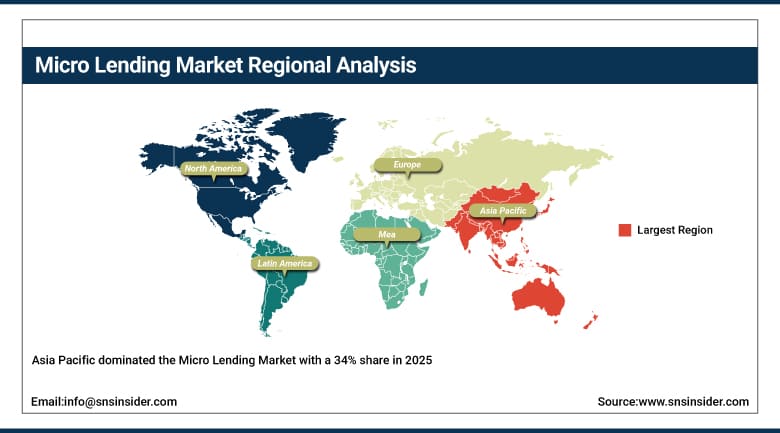
Asia Pacific dominated the Micro Lending Market with a 34% share in 2025, owing to high presence of unbanked population, financial inclusion policies of the governments in these regions, and quick adoption of digital lending solutions. Additionally, the Asia Pacific region would be leading the market with the fastest CAGR of 12.62%, attributable to growing microfinance institutions, increasing need for affordable lending solutions, and advances in technology which have made the provision of loaning services smooth and cost-effective.
The country leading the market within the region is India, as it contributes about 33.60% of the revenue generated in the region owing to government programs such as Pradhan Mantri MUDRA Yojana which aims at extending loans to small-scale entrepreneurs. Other countries contributing significantly include China, Bangladesh, and Indonesia. The extensive borrower population in the South and Southeast Asia region is responsible for Asia Pacific's fast growth forecast.
Get Customized Report as Per Your Business Requirement - Enquiry Now
North America Micro Lending Market Insights
North America captured considerable market share in the Micro Lending Market in 2025 due to robust financial infrastructure, high-end technology-driven digital lending systems, and regulatory support in the region. Growing inclination toward financial inclusion, use of online and mobile micro-lending products, and collaboration between fintech companies and banking institutions have all contributed to the strong positioning of North America in the micro lending industry.
The US contributes nearly 80.40% to the revenue generation in the region due to rising demand for credit in the small business sector and among underserved customers, along with increasing adoption of digital lending systems and fintech services. North America becomes an integral region due to the growing contribution of Canada to regional demand by the provision of microloans by financial institutions in the country.
Europe Micro Lending Market Insights
Europe captured a notable share of the Micro Lending Market in 2025, driven by well-developed financial infrastructure, supportive regulatory frameworks, and increasing adoption of digital micro-lending solutions across the region's major economies. Growing government-backed financial inclusion programs, rising use of online lending platforms by SMEs and individuals, and expanding awareness of alternative credit options continue strengthening Europe's position in the market.
Germany leads regional demand at roughly 23.75% of European revenue, supported by its strong SME sector and well-established digital lending infrastructure. The UK and France contribute substantial additional demand, and continued government-backed financial inclusion programs should keep European demand for micro lending climbing steadily through the forecast period.
MEA & Latin America Micro Lending Market Insights
The Middle East & Africa and Latin America together showed steady growth in the Micro Lending Market in 2025, driven by increasing demand for accessible credit, expanding SME sectors, and improving financial infrastructure across both regions. As mobile banking and digital lending infrastructure keeps improving across these markets, micro lending is proving to be an efficient way to extend formal credit access to populations that traditional banking has historically underserved.
The UAE leads Middle East & Africa demand at roughly 24.90% of regional revenue, supported by growing government focus on financial inclusion and expanding fintech infrastructure. Saudi Arabia and South Africa contribute further regional demand through their own financial-inclusion programs. In Latin America, Brazil accounts for approximately 37.55% of regional revenue, with the country's expanding SME sector and growing digital lending adoption continuing to anchor regional demand for micro lending.
Market Dynamics
Growth Drivers: Financial inclusion initiatives and digital lending expansion
Increasing demand for accessible credit among underserved individuals and small businesses sits at the core of this market's steady growth. Rising adoption of digital lending platforms, mobile banking, and fintech solutions keeps enhancing reach and efficiency, letting lenders serve borrowers in geographies where building out traditional branch infrastructure would simply never be economically viable. Supportive government policies, favorable regulatory frameworks, and growing awareness of microloans and flexible repayment options continue reinforcing this driver across both emerging and developed markets alike.
The broader focus on financial inclusion, entrepreneurial development, and economic empowerment is adding further momentum, as governments, financial institutions, and NGOs actively promote financial inclusion to provide underserved populations with access to credit, savings, and other essential financial services. In 2024, digital micro-lending served over 220 million previously unbanked users globally, and government-backed initiatives drove a 35% year-over-year increase in first-time loan access, a clear signal of how much unmet demand still remains for the market to capture.
Restraints: Credit risk and regulatory complexity across jurisdictions
Micro lending inherently carries elevated credit risk, since borrowers frequently lack the credit history, collateral, or formal income documentation that traditional underwriting depends on. Lenders operating at scale across this borrower population face genuine default risk, and managing that risk while still keeping loans affordable and accessible requires sophisticated, often costly risk-assessment infrastructure that smaller lenders may struggle to build and maintain.
Navigating inconsistent regulatory frameworks across different jurisdictions adds a further layer of restraint, particularly for lenders operating across multiple countries or regions with meaningfully different consumer-protection and lending regulations. Compliance costs and the operational complexity of adapting lending products to each market's specific regulatory requirements can meaningfully slow expansion, particularly for smaller fintech lenders without dedicated compliance teams.
Opportunities: AI-driven credit scoring and agricultural finance expansion
Continued advancement of AI-driven credit assessment techniques represents a genuinely significant opportunity for micro lending providers, as machine learning models increasingly let lenders evaluate borrowers who lack traditional credit history using alternative data sources like mobile payment patterns and transaction history. Vendors that can build genuinely accurate, low-cost credit scoring for thin-file borrowers stand to capture meaningful new market share as this technology continues maturing.
Expanding agricultural finance represents a second substantial opportunity, as rising demand for crop financing, equipment loans, and working capital support for farmers keeps opening up new lending categories beyond micro lending's traditional retail and trade stronghold. As government initiatives and financial inclusion programs continue extending formal credit access into rural, agriculture-dependent communities, lenders positioned early in this expanding category stand to capture a genuinely underserved and rapidly growing borrower base.
Recent Developments:
-
2024: Muthoot Microfin began disbursing loans through a new co-lending partnership with the State Bank of India, aimed at providing affordable credit to rural entrepreneurs, particularly women-led small businesses.
-
2024: The Asian Development Bank and Ngern Tid Lor signed a USD 150 million loan agreement to support micro, small, and medium-sized enterprises in Thailand, with a particular focus on women-led agricultural businesses.
-
2025: Banco do Brasil launched a new micro-lending program aimed at supporting rural entrepreneurs and smallholder farmers with more accessible credit solutions.
Micro Lending Market key players are:
-
Grameen Bank
-
BRAC
-
FINCA International
-
Kiva
-
CreditAccess Grameen Limited
-
Bandhan Bank Ltd
-
Bajaj Finserv
-
Bluevine
-
Equitas Small Finance Bank
-
ESAF Small Finance Bank
-
Fusion Micro Finance
-
Svatantra Microfin
-
MIBANCO
-
Banco do Nordeste do Brasil SA
-
Advans International
-
HOPE International
-
Akhuwat Foundation
-
Arohan Financial Services Ltd
-
Ujjivan Small Finance Bank
-
BSS Microfinance Limited
Micro Lending Market Report Scope:
| Report Attributes | Details |
|---|---|
| Market Size in 2025 | USD 175.27 Billion |
| Market Size by 2035 | USD 497.22 Billion |
| CAGR | CAGR of 10.99% From 2026 to 2035 |
| Base Year | 2025 |
| Forecast Period | 2026-2035 |
| Historical Data | 2022-2024 |
| Report Scope & Coverage | Market Size, Segments Analysis, Competitive Landscape, Regional Analysis, DROC & SWOT Analysis, Forecast Outlook |
| Key Segments | • By Provider (Microfinance Institutions (MFIs), Banks, FinTech Lenders, Credit Unions, Peer-to-Peer Lending Platforms) • By Loan Type (Personal Micro Loans, Business Micro Loans, Emergency Loans, Education Loans, Housing Improvement Loans) • By Borrower Type (Individuals, Micro-Entrepreneurs, SMEs, Self-Help Groups (SHGs), Women-Led Enterprises) • By End-Use Industry (Retail & Trade, Agriculture, Manufacturing, Services, Handicrafts & Cottage Industries) |
| Regional Analysis/Coverage | North America (US, Canada), Europe (Germany, UK, France, Italy, Spain, Russia, Poland, Rest of Europe), Asia Pacific (China, India, Japan, South Korea, Australia, ASEAN Countries, Rest of Asia Pacific), Middle East & Africa (UAE, Saudi Arabia, Qatar, South Africa, Rest of Middle East & Africa), Latin America (Brazil, Argentina, Mexico, Colombia, Rest of Latin America). |
| Company Profiles | Grameen Bank, BRAC, FINCA International, Kiva, CreditAccess Grameen Limited, Bandhan Bank Ltd, Bajaj Finserv, Bluevine, Equitas Small Finance Bank, ESAF Small Finance Bank, Fusion Micro Finance, Svatantra Microfin, MIBANCO, Banco do Nordeste do Brasil SA, Advans International, HOPE International, Akhuwat Foundation, Arohan Financial Services Ltd, Ujjivan Small Finance Bank, BSS Microfinance Limited |
Frequently Asked Questions
The Micro Lending Market is expected to grow at a CAGR of 10.99% from 2026 to 2035.
The Micro Lending Market was valued at USD 175.27 Billion in 2025.
The major growth factor is increasing demand for accessible credit among underserved individuals and small businesses, along with rising adoption of digital lending platforms and fintech solutions.
The Microfinance Institutions (MFIs) segment dominated the Micro Lending Market.
Asia Pacific dominated the Micro Lending Market in 2025 with a 34% share of total global market revenue.
