
Micro-mobility Battery Market Report Scope & Overview:
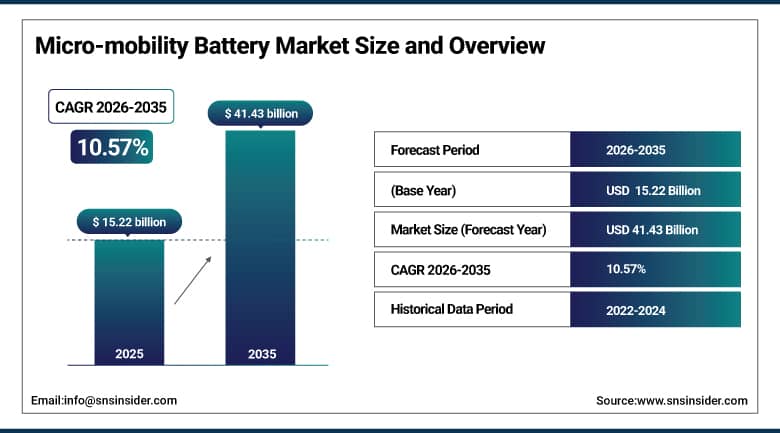
The Micro-mobility Battery Market size was valued at USD 15.22 Billion in 2025 and is projected to reach USD 41.43 Billion by 2035, growing at a C AGR of 10.57% during 2026-2035.
The Micro-mobility Battery Market is expanding at a strong pace through the forecast period, driven by the rapid global proliferation of electric two-wheelers, shared scooter fleets, and personal electric mobility devices that each depend on rechargeable battery packs as their primary energy storage component. Urban mobility transformation across developed and emerging economies is generating consistent demand for higher-performance, longer-range, and lighter-weight battery solutions as consumers, fleet operators, and city authorities seek alternatives to car-based short-distance travel that can operate economically in dense urban environments.
Market Size and Forecast:
-
Market Size in 2025: USD 15.22 Billion
-
Market Size by 2035: USD 41.43 Billion
-
CAGR: 10.57% From 2026 to 2035
-
Base Year: 2025
-
Forecast Period: 2026-2035
-
Historical Data: 2022-2024
To Get More Information On Micro-mobility Battery Market - Request Free Sample Report
Key Micro-mobility Battery Market Trends
-
Rapid shift toward high-energy density Lithium-ion batteries driven by longer range and lightweight requirements
-
Increasing adoption of battery swapping technology to reduce downtime in shared micro-mobility fleets
-
Growing demand for fast-charging solutions to enhance user convenience and fleet efficiency
-
Rising integration of smart battery management systems (BMS) for safety, performance optimization, and lifecycle tracking
-
Expansion of sustainable and recyclable battery materials aligned with environmental regulations and circular economy goals
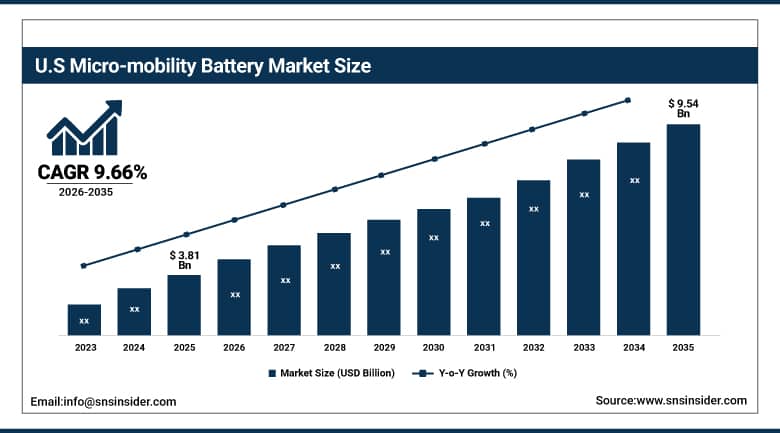
The U.S. Micro-mobility Battery Market size was valued at USD 3.81 Billion in 2025 and is projected to reach USD 9.54 Billion by 2035, growing at a CAGR of 9.66% during 2026-2035. The U.S. market is the dominant national market within North America, anchored by a well-developed shared micro-mobility infrastructure in major urban centers including New York, San Francisco, Chicago, and Washington D.C., combined with strong consumer demand for personal e-bikes in suburban and recreational cycling markets where longer-range medium and high-capacity battery packs are the primary product specification consideration.
Micro-mobility Battery Market Growth Drivers:
-
Rapid Urbanization, Electrification Policies, and Shared Mobility Expansion Accelerating Global Battery Demand
The growth of the market for micro-mobility batteries is driven mainly by the factors of fast urbanization and high levels of traffic congestion witnessed in major metropolitan cities. The implementation of stringent environmental emissions standards along with various incentives provided by governments to encourage electric mobility usage has resulted in the higher adoption of scooters and bicycles. The ongoing innovation and development of the lithium-ion battery technology through improvements in energy density, lifespan, and quick charging times have helped improve vehicle efficiency and user satisfaction. Further, the emergence of micro-mobility solutions and their increased availability due to investment from venture capitalists is creating bulk requirements for batteries.
Micro-mobility Battery Market Restraints:
-
High Initial Costs, Safety Risks, and Raw Material Dependency Hindering Market Expansion Globally
There are some significant barriers in the market owing to the fact that the advanced battery technology such as Lithium-ion has a high upfront cost, making the product costly to produce. Moreover, safety is another factor that poses a challenge due to issues such as overheating and thermal runaway, and risk of fire, which is a crucial issue given that the target environment is mostly populated areas. Another barrier is that there is no charging infrastructure available in developing countries, thus hampering its acceptance in the market.
Micro-mobility Battery Market Opportunities:
-
Battery Innovation, Swapping Ecosystems, and Sustainable Solutions Unlocking Long-Term Market Potential Worldwide
Many growth opportunities are being created through constant innovation in the space of battery technology such as solid-state batteries that offer safety and efficiency gains. Battery swapping facilities have made tremendous improvements in fleet management services as they allow for reduced downtimes. Battery recycling and reuse are increasingly becoming popular and offering business prospects and sustainability benefits for companies. Moreover, the rise of micromobility adoption in developing countries, combined with the concept of the smart city, can be highly beneficial for market participants through revenue generation.
Micro-mobility Battery Market Segment Analysis
-
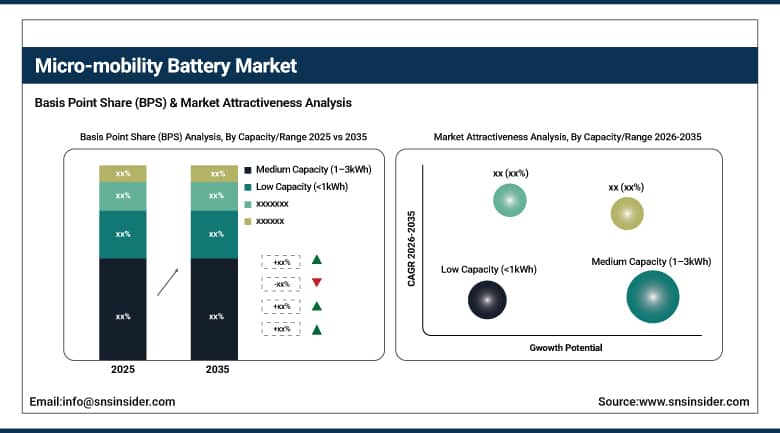
By Capacity/Range, Medium Capacity (1-3 kWh) dominated with 47.11% in 2025, and High Capacity (>3 kWh) is expected to grow at the fastest CAGR of 11.09% from 2026 to 2035.
-
By Battery Type, Lithium-Ion (Li-ion) dominated with 45.23% in 2025, and Nickel-Metal Hydride (NiMH) is expected to grow at the fastest CAGR of 11.67% from 2026 to 2035.
-
By Vehicle Application, E-Scooters dominated with 38.45% in 2025, and Shared Micro-mobility Fleets are expected to grow at the fastest CAGR of 13.03% from 2026 to 2035.
-
By Sales Channel, OEM (Original Equipment Manufacturer) dominated with 52.14% in 2025, and Aftermarket/Replacement is expected to grow at the fastest CAGR of 11.47% from 2026 to 2035.
By Capacity/Range, Medium Capacity Leads and High Capacity Shows Fastest Growth in Micro-mobility Battery Market 2026 to 2035
The most prominent type in the market is the medium capacity battery because of the perfect combination between price, weight, and performance that makes them ideal for most city transportation. The medium capacity battery is extensively utilized in e-scooters and e-bikes when range and efficiency are not extremely required. The fastest growing type is the high capacity battery owing to the rising need for range and performance, especially in high-end micro mobility and commercial fleets.
By Battery Type, Lithium-Ion Leads Micro-mobility Battery Market While NiMH Set for Fastest Growth 2026 to 2035
The lithium-ion battery technology has become prevalent within the micro-mobility battery space due to its energy density, light weight, durability, and quick charging properties, which make it an apt choice for electric scooters and bicycles. The popularity of lithium-ion batteries is reinforced by consistent technological innovation and price reductions. On the other hand, Nickel-Metal Hydride (NiMH) batteries have become the most rapidly growing sector due to their enhanced safety features, eco-friendliness, and economic benefits.
By Vehicle Application, E-Scooters Lead Micro-mobility Battery Market While Shared Fleets Show Fastest Growth 2026 to 2035
E-Scooters have emerged as a key player in the market because they are commonly used for urban short-haul travel purposes owing to their affordable nature, convenience, and large-scale availability through shared mobility programs. The compactness and convenience offered by e-scooters have made them an appealing option for dense metropolitan areas. However, the micro-mobility shared fleet is witnessing a rapid growth rate because of high investment levels and increasing demand from consumers toward rental mobility options.
By Sales Channel, OEM Leads and Aftermarket/Replacement Shows Fastest Growth in Micro-mobility Battery Market 2026 to 2035
OEMs hold dominance in the market because the majority of batteries used by micro-mobility vehicles are factory-installed. The relationship between battery providers and vehicle manufacturers plays a pivotal role in maintaining OEM dominance. However, the fastest growing part of the market is the replacement batteries sector. The main reason behind it is that batteries have a limited life and require replacing periodically. There are several factors that contribute to an increase in demand for replacement batteries.
Micro-mobility Battery Market Regional Analysis
North America Micro-mobility Battery Market Insights
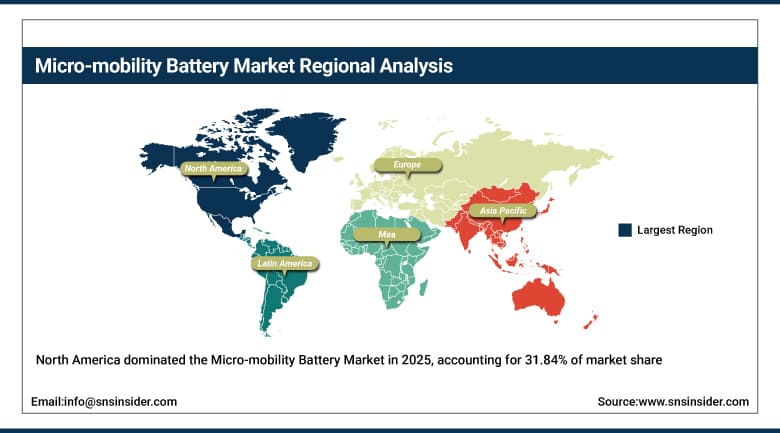
North America held a 31.84% share of the global Micro-mobility Battery Market in 2025 at USD 4.84 Billion, growing at a CAGR of 9.89% through 2035. The region's market is anchored by a well-established shared micro-mobility infrastructure in major coastal and Sunbelt cities, a growing personal e-bike market in suburban and recreational cycling segments, and an increasingly sophisticated regulatory framework around battery safety certification and end-of-life management that is raising product quality standards across the market. U.S. federal infrastructure investment in urban mobility and cycling infrastructure under recent transportation legislation is supporting long-term demand growth by improving the physical environment for micro-mobility use in cities where road safety concerns have historically limited adoption rates below the levels seen in European peer markets.
Get Customized Report as Per Your Business Requirement - Enquiry Now
U.S. Micro-mobility Battery Market Insights
The United States dominated North America's micro-mobility battery market at 78.56%, USD 3.81 Billion in 2025. The U.S. is the primary driver of North American demand, with New York, San Francisco, Los Angeles, Chicago, and Washington D.C. representing the five largest shared micro-mobility deployment markets by fleet size and battery procurement volume. The U.S. aftermarket is also the most commercially developed within the region, with a growing ecosystem of independent battery replacement and refurbishment service providers serving the expanding installed base of personal e-bikes whose owners are seeking lower-cost battery service options than OEM dealer channels provide.
Europe Micro-mobility Battery Market Insights
Europe held 24.12% at USD 3.67 Billion in 2025, growing at a CAGR of 10.98% through 2035. Europe's micro-mobility battery market is distinguished by the high penetration of personal e-bikes in the Netherlands, Germany, France, and Belgium, where cycling is a primary commuter transport mode and the e-bike market is both large in absolute unit terms and concentrated in the premium and mid-premium segments where medium and high capacity battery packs are standard specifications. The EU Battery Regulation, which imposes mandatory recycled content, carbon footprint declaration, and end-of-life recovery requirements on batteries placed on the European market, is raising compliance costs for battery manufacturers but also creating a regulatory differentiation advantage for producers with established sustainable sourcing and circular economy credentials. Germany's e-bike manufacturing industry, anchored by brands including Bosch eBike Systems, Shimano STEPS, and a large ecosystem of branded vehicle OEMs, makes the country the most significant national market within the region by battery demand volume.
Germany Micro-mobility Battery Market Insights
Germany was the leading national market for micro-mobility batteries in Europe in 2025, driven by the country's high e-bike adoption rate among commuters and recreational cyclists, the presence of Bosch eBike Systems' battery and drive unit manufacturing operations in Stuttgart that make Germany both the largest consumer and an important production center for premium e-bike battery systems, and the commercial presence of VARTA's battery manufacturing operations that supply both OEM and aftermarket segments of the European micro-mobility battery market.
Asia Pacific Micro-mobility Battery Market Insights
Asia Pacific is the fastest-growing region at a CAGR of 11.52% through 2035, valued at USD 5.18 Billion in 2025 and projected to reach USD 15.38 Billion by 2035. China is the dominant national market within the region and globally by far the largest producer and consumer of micro-mobility batteries, with CATL, BYD, and EVE Energy among the largest cell manufacturers supplying the enormous domestic two-wheeler electrification market where hundreds of millions of electric bikes and scooters operate on roads that have no equivalent scale in any other geography. India's rapidly growing domestic e-scooter market, propelled by government subsidy programs under the FAME scheme and domestic manufacturers including Ola Electric, Ather Energy, and TVS iQube, is generating fast-growing battery demand that domestic cell manufacturers are beginning to serve with India-assembled battery packs. Japan and South Korea host several of the world's most technically advanced battery manufacturers, including Panasonic Energy, Samsung SDI, LG Energy Solution, and Toshiba, whose research and development investments in next-generation cell chemistries will shape the global micro-mobility battery technology roadmap through the forecast period.
China Micro-mobility Battery Market Insights
China has been dominating the APAC market for batteries in micro-mobility vehicles owing to the robust manufacturing landscape, availability of batteries, production of e-scooters and e-bikes, supportive government policies towards electric mobility, and presence of key battery manufacturers.
Latin America (LATAM) and Middle East & Africa (MEA) Micro-mobility Battery Market Insights
Latin America was valued at USD 0.89 Billion in 2025 and is growing at a CAGR of 10.15% through 2035, with Brazil and Mexico representing the two largest national markets driven by growing urban e-scooter adoption in major cities and an expanding personal e-bike market among urban and suburban consumers seeking alternatives to congested public transport and car-based commuting. Brazil's shared micro-mobility infrastructure in Sao Paulo, Rio de Janeiro, and Curitiba has attracted investment from international fleet operators, generating battery procurement demand from fleet service providers as well as vehicle OEMs. Middle East and Africa was valued at USD 0.63 Billion in 2025 and is growing at the slowest regional CAGR of 3.92% through 2035, with demand concentrated in Gulf urban mobility deployments and South African city-based micro-mobility services, while the broader regional market remains at an early adoption stage relative to Asia Pacific and European peers.
Competitive Landscape for Micro-mobility Battery Market:
LG Energy Solution, headquartered in Seoul, South Korea, is one of the world's largest lithium-ion battery manufacturers and a significant supplier to the micro-mobility battery market through its cylindrical cell production that is widely used in e-bike battery pack assembly by European and North American OEMs. LG Energy Solution's 21700 and 18650 cylindrical cell formats are among the most commonly specified cell types in premium e-bike battery systems, and the company's production capacity expansion investments at its manufacturing facilities in Poland, the United States, and South Korea are positioning it to serve growing European and North American e-bike and shared micro-mobility fleet battery demand with locally produced cells that reduce supply chain length and carbon footprint relative to Asian-only sourcing.
-
In 2024, LG Energy Solution announced a partnership with a leading European e-bike OEM to supply high-cycle-count cylindrical cells specifically engineered for shared fleet battery applications, with the cells featuring enhanced electrolyte formulations designed to extend calendar life in the high-ambient-temperature storage conditions that characterize shared e-scooter fleet operations in Mediterranean and Middle Eastern city deployments.
CATL, headquartered in Ningde, China, is the world's largest lithium-ion battery manufacturer by production volume and holds a commanding position in the micro-mobility battery supply chain through its dominance of the Chinese electric two-wheeler market and its growing supply relationships with e-scooter and e-bike OEMs in Europe, North America, and Southeast Asia.
- In 2024, CATL launched a micro-mobility specific battery pack system featuring a modular architecture designed for rapid field replacement in shared scooter fleet applications, with integrated battery management system hardware that enables real-time state-of-health monitoring through fleet management software platforms, reducing unplanned battery failure incidents that had previously been a significant operational cost driver for shared fleet operators.
Micro-mobility Battery Market Key Players:
-
LG Energy Solution
-
Panasonic Energy
-
Samsung SDI
-
SEGWAY
-
EMBS
-
CM Batteries
-
AQUEOUSS
-
Maxvolt Energy
-
DNK Power
-
ELB Energy
-
BYD
-
CATL
-
Toshiba
-
GS Yuasa
-
A123 Systems
-
Johnson Controls
-
Saft
-
VARTA
-
SK Innovation
-
EVE Energy
| Report Attributes | Details |
|---|---|
| Market Size in 2025 | USD 15.22 Billion |
| Market Size by 2035 | USD 41.43 Billion |
| CAGR | CAGR of 10.57% From 2026 to 2035 |
| Base Year | 2025 |
| Forecast Period | 2026-2035 |
| Historical Data | 2022-2024 |
| Report Scope & Coverage | Market Size, Segments Analysis, Competitive Landscape, Regional Analysis, DROC & SWOT Analysis, Forecast Outlook |
| Key Segments | • By Battery Type (Lithium-Ion (Li-ion), Lithium Polymer (Li-Po), Lead-Acid, Nickel-Metal Hydride (NiMH), and Others (e.g., Solid-State)) • By Vehicle Application (E-Scooters, E-Bikes, E-Skateboards & Hoverboards, E-Motorcycles, and Shared Micro-mobility Fleets) • By Capacity/Range (Low Capacity (<1 kWh), Medium Capacity (1-3 kWh), and High Capacity (>3 kWh)) • By Sales Channel (OEM (Original Equipment Manufacturer), Aftermarket/Replacement, and Fleet Service Providers) |
| Regional Analysis/Coverage | North America (US, Canada), Europe (Germany, UK, France, Italy, Spain, Russia, Poland, Rest of Europe), Asia Pacific (China, India, Japan, South Korea, Australia, ASEAN Countries, Rest of Asia Pacific), Middle East & Africa (UAE, Saudi Arabia, Qatar, South Africa, Rest of Middle East & Africa), Latin America (Brazil, Argentina, Mexico, Colombia, Rest of Latin America). |
| Company Profiles | LG Energy Solution, Panasonic Energy, Samsung SDI, SEGWAY, EMBS, CM Batteries, AQUEOUSS, Maxvolt Energy, DNK Power, ELB Energy, BYD, CATL, Toshiba, GS Yuasa, A123 Systems, Johnson Controls, Saft, VARTA, SK Innovation, EVE Energy. |

Frequently Asked Questions
Asia Pacific led the Micro-mobility Battery Market in 2025.
Lithium-Ion (Li-ion) dominated the Micro-mobility Battery Market with a 45.23% share in 2025.
Key drivers include rapid global adoption of electric scooters and e-bikes, expansion of shared micro-mobility fleet services, declining lithium battery cell costs, and urban electrification policies supporting two-wheeler and personal electric mobility transitions.
The Micro-mobility Battery Market size was USD 15.22 Billion in 2025 and is projected to reach USD 41.43 Billion by 2035.
The Micro-mobility Battery Market is expected to grow at a CAGR of 10.57% from 2026-2035.
