
Micro Nuclear Reactors (MNRs) Market Report Scope and Overview:
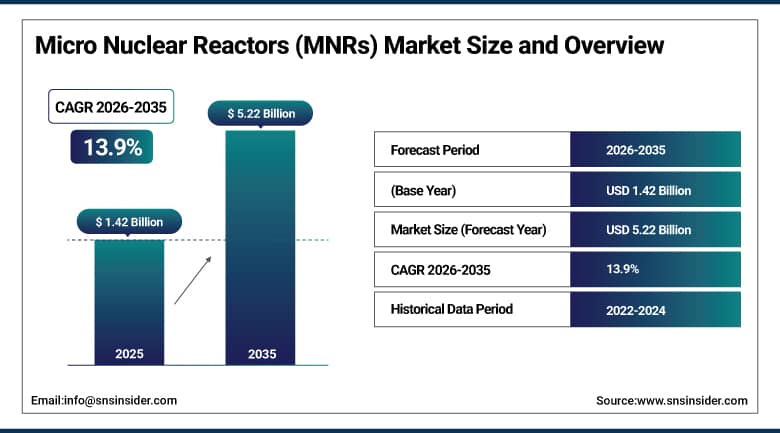
The Micro Nuclear Reactors (MNRs) Market was valued at USD 1.42 Billion in 2025 and is projected to reach USD 5.22 Billion by 2035, registering a CAGR of 13.9% from 2026 to 2035.
The Micro Nuclear Reactors (MNRs) Market is witnessing the development of small, modular reactors that are able to supply less than 20 MW of electricity in an uninterrupted manner through the use of nuclear energy and process heat. The market is driven by increasing investments by the governments and private firms in the areas of high-temperature, molten salt, and liquid metal reactors; regulatory involvement in licensing advanced reactors; and growing need for power generation by mining sites, military bases, remote regions, and data centers.
This upsurge has come about as a result of large sums of money invested in reactors, by developers of reactors, national laboratories and manufacturers of components that make up reactors in order to be ready for increased demand.
To Get More Information On Micro Nuclear Reactors (MNRs) Market - Request Free Sample Report
Micro Nuclear Reactors (MNRs) Market Trends
-
Expanding TRISO fuel particle production capacity strengthens high-temperature microreactor commercialization pathways.
-
Growing molten salt reactor demonstration activity accelerates adoption of inherently low-pressure, passively safe designs.
-
Rising defense sector interest in transportable microreactors strengthens off-grid, mission-critical power resilience.
-
Increasing data center and hyperscale computing demand widens commercial offtake pathways for compact reactor platforms.
-
Growing regulatory engagement on advanced reactor licensing continues shortening microreactor commercialization timelines.
U.S. Micro Nuclear Reactors (MNRs) Market Outlook
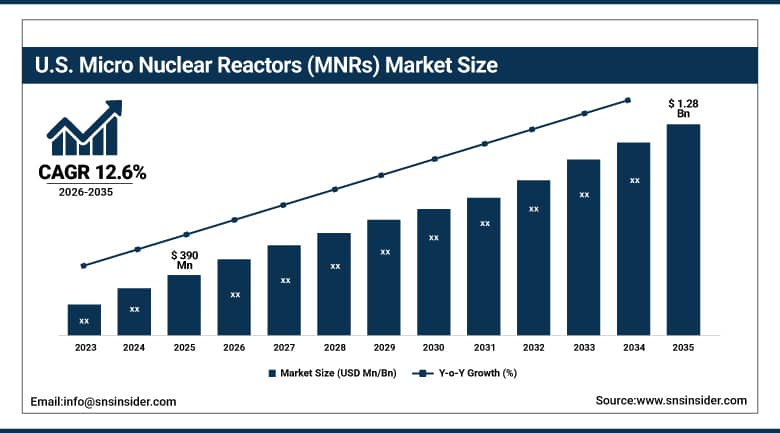
The U.S. Micro Nuclear Reactors Market was valued at approximately USD 390 Million in 2025 and is projected to reach approximately USD 1.28 Billion by 2035, registering a CAGR of approximately 12.6% from 2026 to 2035.
The demand for domestically made microreactor systems in the U.S. has been fueled by the interest shown by the Department of Defense to demonstrate mobile reactors, increased test capacity at Idaho National Laboratory for advanced reactor fuel, and an increasing number of licensing applications for advanced reactors being considered by the Nuclear Regulatory Commission.
High-temperature and molten salt reactors' prototype deployment within major U.S. companies has solidified the nation’s place as the biggest purchaser of microreactor components in the world, driven by growing demand among miners, data centers, and off-grid industries for reliable and carbon-free base load power.
Micro Nuclear Reactors (MNRs) Market Segment Analysis
-
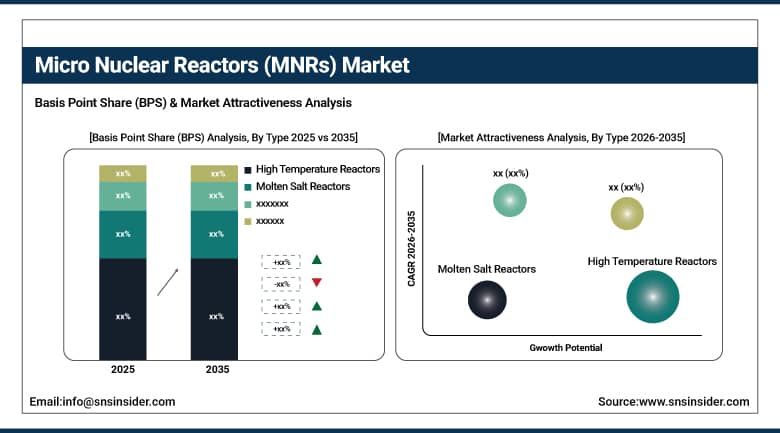
By Type, High Temperature Reactors segment dominated the Micro Nuclear Reactors Market in 2025 with 42.6% share; Molten Salt Reactors segment is the fastest growing segment.
-
By Application, Industrial segment dominated the market in 2025 with 34.8% share; Commercial segment is the fastest growing segment.
By Type, High Temperature Reactors Dominate, Molten Salt Reactors Grow Fastest
The High Temperature Reactors dominated the Micro Nuclear Reactors Market in 2025 owing to their capability to function at more than 700 degrees Centigrade along with thermal efficiencies of more than 45%. The use of helium as coolant and TRISO fuel particles in the reactors makes them an attractive choice for industries that require not only energy but also high-quality process heat from a single compact source. X-energy has been strengthening the position of this market segment with the scaling up of TRISO fuel particle production for its Xe-100 reactor model, whereas Ultra Safe Nuclear Corporation is making further progress with its MMR platform.
Molten Salt Reactors are anticipated to be the fastest-growing reactor type from 2020 to 2035 owing to the nature of being inherently low pressure and safer in terms of passive safety features compared to pressurized reactors. Kairos Power has been making progress in building its demo reactor named Hermes in Tennessee while Seaborg Technologies is developing its molten salt reactor that will be small in size. The increased understanding of molten salts by regulators along with advancements in processing fuel salt is predicted to boost the use of molten salt micro-reactors by industries and utilities.
By Application, Industrial Leads, Commercial Applications Grow Fastest
The industrial application accounted for the largest market share in the Micro Nuclear Reactors Market in 2025 owing to the increasing adoption of micro reactors in mining operations, chemical plants, and other industrial operations looking for an alternative to expensive diesel generators as well as stable and low-carbon energy and process heat supply. Industries that consume loads continuously in excess of a few MWs have been increasingly looking into adopting micro nuclear reactors to minimize logistical costs and emission exposure. The Aurora powerhouse of Oklo Inc. at Idaho National Laboratory supports this segment.
Commercial uses, particularly data centers, are expected to experience the fastest growth rate of all end-use segments due to the growing strain that hyperscale computing and AI loads put on electricity-restricted power grids. The company NuScale Power has strengthened its position in this regard by conducting microgrid integration studies for data centers that seek to purchase clean electricity from small reactors. Due to the growing interest of tech companies to enter into agreements directly with innovative reactor manufacturers in anticipation of rising demand, commercial uses will experience the fastest growth of all sectors up to 2035.
Regional Analysis:
|
Region |
Major Country |
Share within Region, 2025 (%) |
|---|---|---|
|
North America |
United States |
74.50% |
|
Europe |
United Kingdom |
28.40% |
|
Asia Pacific |
China |
39.20% |
|
Middle East and Africa |
Saudi Arabia |
30.50% |
|
Latin America |
Brazil |
33.70% |
North America Micro Nuclear Reactors (MNRs) Market Insights
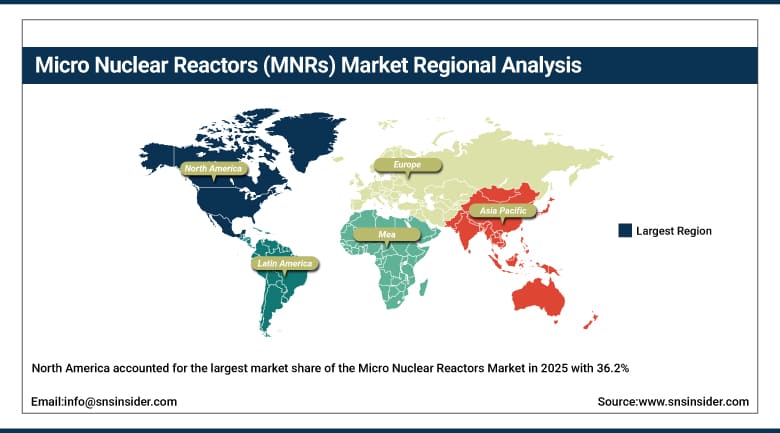
North America accounted for the largest market share of the Micro Nuclear Reactors Market in 2025 with 36.2% owing to heavy government investment in nuclear innovation programs, clear regulatory process through Nuclear Regulatory Commission, and the presence of the most advanced microreactor producers globally. The interest of the U.S. Department of Defense in mobile and installation reactors for demonstration programs, together with the testing of advanced reactor fuels at the Idaho National Laboratory, has strengthened North America's position in both defense and commercial pathways to microreactors in the United States and Canada.
The US made up 74.50% of North America's total revenue in the Micro Nuclear Reactors Market during 2025 owing to constant advancements made by Oklo, X-energy, Kairos Power, and Westinghouse, as well as Nuclear Regulatory Commission involvement in the licensing of advanced reactors. Canada supported demand in the region in terms of Nuclea Energy's Morpheus microreactor project and the acquisition of Moltex Energy's advanced reactor and fuel recycling technologies, making North America the world's most dominant region in microreactors.
Get Customized Report as Per Your Business Requirement - Enquiry Now
Europe Micro Nuclear Reactors (MNRs) Market Insights
Europe held a notable portion of the Micro Nuclear Reactors Market across the globe in 2025 due to national decarbonization efforts, growing initiatives for advanced nuclear research and investments being made by governments into the manufacturing of small and micro reactors through factories. The UK, France, and Germany together constitute most of the regional development efforts, where public-private partnerships are focusing more on the application of industrial heating and remote power generation.
United Kingdom accounted for about 28.40% of total revenue of the Micro Nuclear Reactors Market in Europe in 2025 due to increased government investment in the factory manufacturing of micro and small modular reactors parts by Rolls-Royce SMR, along with ongoing activities of U-Battery group, which is backed by Urenco. Germany and France were instrumental in increasing the regional demand by carrying out collaboration with research institutions and running pilot projects on decarbonization of industries.
Asia Pacific Micro Nuclear Reactors (MNRs) Market Insights
The Asia Pacific region is expected to demonstrate the highest growth in terms of Micro Nuclear Reactors Market share in comparison with all other regions, recording a forecasted CAGR of 17.8% during the period from 2026 to 2035, due to industrialization, growing demand for electricity, and government funding in the advanced nuclear technology in China, Japan, and South Korea. Rural electrification projects and increasing government funding in clean and dispatchable power infrastructure will keep the region ahead in the race.
According to forecasts, China captured about 39.20% of the Micro Nuclear Reactors Market revenue share of Asia Pacific in 2025, owing to its increasing research efforts within the nation in micro-reactors aimed at remote mining and industry electricity generation. Advanced reactor research by Japan in the Asia Pacific region has helped increase regional demand for micro nuclear reactors due to energy security concerns after the imports, while increased investments by South Korea in small reactors have helped boost the region's production capacity and research capability.
MEA and Latin America Micro Nuclear Reactors (MNRs) Market Insights
The Micro Nuclear Reactors Market in the Middle East, Africa, and Latin America was growing steadily in 2025 due to rising governmental interest in diversifying energy sources, needs for desalination of water, and growing collaboration of utilities from both areas with foreign nuclear reactor manufacturers. Adoption of compact nuclear solutions has become strategically important for both regions because governments want to have dependable alternative to diesel-powered generators.
In the Middle East and Africa, Saudi Arabia dominated the regional revenue generation due to the country's sovereign energy diversification initiatives and the growth of interest in desalination via microreactor use. The UAE on its part has been supporting the development in this industry through advanced nuclear research in the region. As for Latin America, Brazil has accounted for the largest regional share owing to rising interest in remote industry and mining electrification.
Market Dynamics:
Growth Drivers: Rising Demand for Reliable Off-Grid Carbon-Free Power Across Defense, Industrial, and Remote Applications
The market for Micro Nuclear Reactors is being fueled by the rising requirement for constant carbon-free energy generation in areas where regular grid connectivity cannot be guaranteed or simply doesn’t exist, like in mines, military facilities, and other secluded areas. The difference between renewables that are subject to weather conditions and the microreactors lies in providing the baseload of energy for an extended period of time, without the need for any refueling, thus appealing significantly to governmental and defense entities. The rise of energy demand and dependency on diesel fuel is contributing to increased funding of the demo programs for microreactors.
Greater involvement of regulators, with an increased number of applications for licensing of advanced reactors being evaluated by nuclear regulators in the US, UK, and Canada, is aiding market growth through reduced commercialization timelines for vendors with robust safety propositions. The ongoing investments by industrial purchasers and technology companies who wish to ensure carbon-free energy before the demand rises from data centers and electrification are increasing the industry’s overall readiness levels, while the increased involvement of venture capitalists and government grants is fueling high microreactor investment momentum during the forecast period.
Restraints: Complex Regulatory Approvals and Constrained Advanced Fuel Supply
Regulatory and licensing structures that are complex are some of the key challenges that have constrained growth in the Micro Nuclear Reactors Market because approval processes of advanced reactors in some countries are still not adequately developed, and there are multi-year delays associated with their demonstration projects. The issue of licensing uncertainties still represents one of the biggest hurdles that have been identified by developers of advanced nuclear energy technologies in achieving commercial success, as considerable costs must be incurred early on in developing safety cases and engaging in regulatory processes prior to generating any revenues from commercial units.
Restricted global availability of high-assay low-enriched uranium fuel is yet another barrier, considering the restricted capabilities in terms of enrichment facilities and specific fuel requirements, which increase both cost and lead times associated with the development of new reactors dependent on innovative fuels like TRISO particles. The solution to these barriers is to invest in the development of enrichment capabilities and fuel qualification testing, which is a costly process and prevents demonstration reactors from reaching standardization and commercial manufacturing stage.
Opportunities: Industrial Decarbonization, Hydrogen Production, and Data Center Power Demand
Growth in the decarbonization of the industry presents a huge chance for the development of the Micro Nuclear Reactors Market because there is a need for a constant source of high temperature energy for heavy industries like steel-making, chemicals, and hydrogen fuel generation. The high temperature microreactors that can produce energy of more than 700 degrees Celsius (like X-energy's Xe-100) have been receiving a lot of investments from the industrial sector due to their capability of helping in decarbonization through nuclear hydrogen production.
The second significant opportunity lies in the growing electricity requirements for data centers and AI, where hyperscale tech companies within grids facing power constraints look into deploying microreactors to provide reliable and zero-carbon electricity. The research on grid connectivity by NuScale Power in partnership with data centers, as well as ongoing developments by Oklo towards the commercialization of fuel at its Aurora powerhouse facility, are some examples of how the delivery of microreactors is increasingly being met with commercial interest from the tech sector.
Recent Developments:
-
2026: Nuclea Energy agreed to acquire Moltex Energy's advanced nuclear technology portfolio, including its SSR-W and WATSS fuel-recycling technologies, to complement its lead-cooled Morpheus microreactor program.
-
2026: Westinghouse Electric Company advanced its eVinci microreactor demonstration program, targeting more than eight years of continuous off-grid operation without refueling for remote and defense applications.
-
2026: X-energy expanded TRISO fuel particle production capacity to support commercialization of its Xe-100 high-temperature gas-cooled microreactor design.
-
2026: Oklo Inc. advanced construction planning for its Aurora powerhouse microreactor at Idaho National Laboratory, targeting commercial fuel loading and grid interconnection.
-
2026: Rolls-Royce SMR received expanded UK government funding to accelerate factory-based manufacturing of its micro and small modular reactor components.
Micro Nuclear Reactors (MNRs) Market key players are:
-
Oklo Inc.
-
Westinghouse Electric Company
-
X-energy, LLC
-
NuScale Power Corporation
-
Kairos Power LLC
-
Rolls-Royce SMR Limited
-
Seaborg Technologies ApS
-
Ultra Safe Nuclear Corporation
-
BWX Technologies, Inc.
-
GE Hitachi Nuclear Energy
-
Holtec International
-
Terrestrial Energy Inc.
-
Radiant Industries, Inc.
-
Last Energy, Inc.
-
Deep Fission, Inc.
-
Blykalla (Blue Energy AB)
-
U-Battery (Urenco Group)
-
Newcleo S.p.A.
-
Nuclea Energy Inc.
-
TerraPower, LLC
Micro Nuclear Reactors (MNRs) Market Report Scope:
| Report Attributes | Details |
|---|---|
| Market Size in 2025 | USD 1.42 Billion |
| Market Size by 2035 | USD 5.22 Billion |
| CAGR | 11.6% from 2026 to 2035 |
| Base Year | 2025 |
| Forecast Period | 2026-2035 |
| Historical Data | 2022-2024 |
| Report Scope & Coverage | Market Size, Segments Analysis, Competitive Landscape, Regional Analysis, DROC & SWOT Analysis, Forecast Outlook |
| Key Segments | •By Type, High Temperature Reactors segment dominated the Micro Nuclear Reactors Market in 2025 with 42.6% share; Molten Salt Reactors segment is the fastest growing segment. •By Application, Industrial segment dominated the market in 2025 with 34.8% share; Commercial segment is the fastest growing segment. |
| Regional Analysis/Coverage | North America (US, Canada), Europe (Germany, UK, France, Italy, Spain, Russia, Poland, Rest of Europe), Asia Pacific (China, India, Japan, South Korea, Australia, ASEAN Countries, Rest of Asia Pacific), Middle East & Africa (UAE, Saudi Arabia, Qatar, South Africa, Rest of Middle East & Africa), Latin America (Brazil, Argentina, Mexico, Colombia, Rest of Latin America). |
| Company Profiles |
Oklo Inc., Westinghouse Electric Company, X-energy, LLC, NuScale Power Corporation, Kairos Power LLC, Rolls-Royce SMR Limited, Seaborg Technologies ApS, Ultra Safe Nuclear Corporation, BWX Technologies, Inc., GE Hitachi Nuclear Energy, Holtec International, Terrestrial Energy Inc., Radiant Industries, Inc., Last Energy, Inc., Deep Fission, Inc., Blykalla (Blue Energy AB), U-Battery (Urenco Group), Newcleo S.p.A., Nuclea Energy Inc., TerraPower, LLC |

Frequently Asked Questions
Key players in the Micro Nuclear Reactors (MNRs) Market include Oklo Inc., Westinghouse Electric Company, X-energy, NuScale Power, Kairos Power, and Rolls-Royce SMR, among others.
Key opportunities in the Micro Nuclear Reactors (MNRs) Market include industrial decarbonization and hydrogen production applications, along with growth in data center power demand and expansion of defense sector offtake agreements.
The market is driven by rising demand for reliable off-grid carbon-free electricity, growing government and defense investment in demonstration reactors, and increasing regulatory engagement supporting advanced reactor licensing.
The High Temperature Reactors segment dominated the Micro Nuclear Reactors (MNRs) Market, accounting for approximately 42.6% market share.
The North America region dominated the Micro Nuclear Reactors (MNRs) Market in 2025 with a 36.2% share, driven by strong federal funding for demonstration reactors and an established advanced reactor licensing pathway.
