
Nuclear Fuels Market Report Scope and Overview:
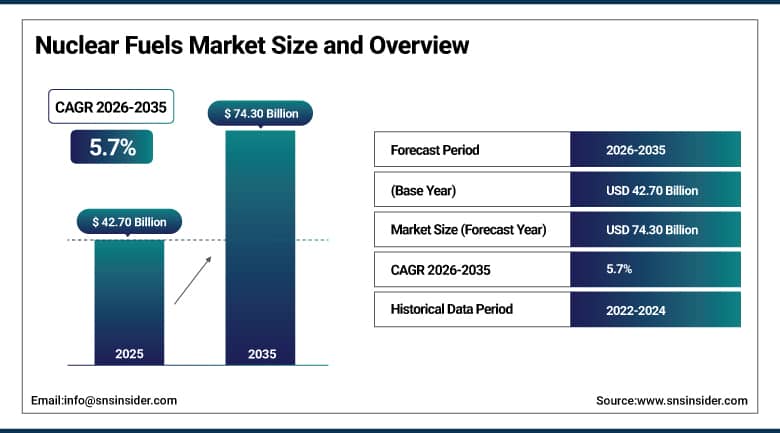
The Nuclear Fuels Market was valued at USD 42.70 Billion in 2025 and is projected to reach USD 74.30 Billion by 2035, registering a CAGR of 5.7% from 2026 to 2035.
The Nuclear Fuels Market is shaping the future of low-carbon baseload power generation through the supply of enriched uranium, mixed oxide fuel, and high-assay low-enriched uranium to reactor fleets worldwide. The market is characterized by the increase in reactor life extension approvals, the rise in construction of new pressurized water and small modular reactors, growing investment in domestic enrichment capacity, and its application in fuel cycle security, defense stockpiling, and clean energy transition strategies. The rise in enrichment capacity expansions and fuel fabrication investments has been experienced due to the heavy investments being made by fuel cycle companies, national governments, and utility operators to enhance domestic fuel security and satisfy the rising nuclear demand.
In September 2026, Orano and Korea Hydro & Nuclear Power have signed a letter of intent to increase cooperation in the field of uranium enrichment and the front end of the nuclear fuel cycle, which is associated with diversification of nuclear fuel supplies in the West.
To Get More Information On Nuclear Fuels Market - Request Free Sample Report
Nuclear Fuels Market Trends
-
Expanding HALEU enrichment capacity investment continues strengthening domestic fuel security for advanced reactor deployment.
-
Growing reactor life extension approvals continues sustaining long-term reload fuel demand among aging utility fleets.
-
Rising small modular reactor commercialization continues creating new specialized fuel qualification and supply requirements.
-
Increasing government-backed enrichment funding continues reducing import dependence on foreign-origin enriched uranium supply.
-
Growing utility interest in fuel recycling and MOX conversion continues supporting closed fuel cycle adoption.
U.S. Nuclear Fuels Market Outlook
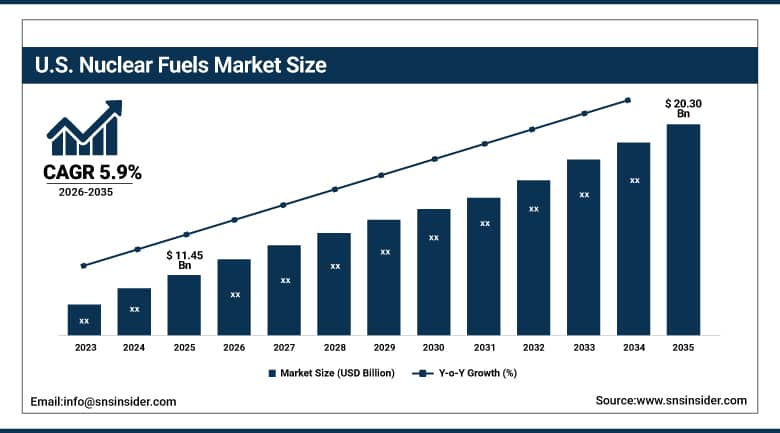
The U.S. Nuclear Fuels Market was valued at approximately USD 11.45 Billion in 2025 and is projected to reach approximately USD 20.30 Billion by 2035, registering a CAGR of approximately 5.9% from 2026 to 2035.
The demand in the U.S. was also driven due to huge investment made in domestic enrichment capacity expansion, extensive development of HALEU production infrastructure that supports next-generation reactor fuel qualification, and high demand for reliable fuel supply chains among utilities operating aging pressurized water and boiling water reactor fleets. Deployment of new centrifuge cascades and government-backed enrichment contracts across major fuel suppliers played an important role in enhancing the status of the U.S. as the largest market for nuclear fuels worldwide. In addition to this, applications of nuclear fuel in defense stockpiling, small modular reactor programs, and reactor life extension projects were supporting the high domestic demand for this technology.
In September 2026, BWX Technologies, Inc., through its defense fuel programs, kept building its contribution to the U.S. nuclear fuel supply chain. The company had been awarded a USD 1.5 billion NNSA contract to help develop uranium enrichment capability in the United States, which would enhance America’s attempt at lowering its dependence on imported nuclear fuel.
Nuclear Fuels Market Segment Analysis
-
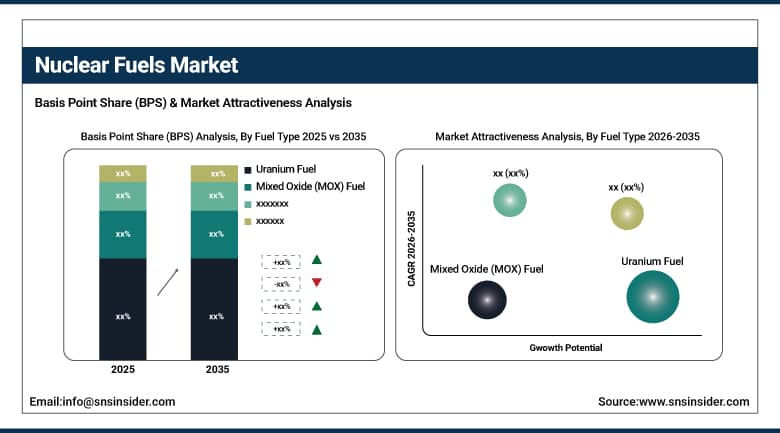
By Fuel Type, Uranium Fuel segment dominated the Nuclear Fuels Market in 2025 with 71% share; HALEU segment is the fastest growing segment, registering a CAGR of 8.2% from 2026 to 2035.
-
By Reactor Type, Pressurized Water Reactor segment dominated the market in 2025 with 58% share; Small Modular & Advanced Reactors segment is the fastest growing segment, registering a CAGR of 8.5% from 2026 to 2035.
-
By Fuel Cycle, Open (Once-Through) Fuel Cycle segment dominated the market in 2025 with 81% share; Closed (Reprocessing) Fuel Cycle segment is the fastest growing segment, registering a CAGR of 7.6% from 2026 to 2035.
-
By End Use, Commercial Power Utilities segment dominated the market in 2025 with 87% share; Defense & Government Programs segment is the fastest growing segment, registering a CAGR of 7.9% from 2026 to 2035.
By Fuel Type, Uranium Fuel Leads While HALEU Emerges as the Fastest-Growing Segment
Uranium fuel, including natural and low-enriched uranium utilized in pressurized water, boiling water, and heavy water reactors, became the leader in the Nuclear Fuels Market in 2025 because of its function as a base material in practically all commercial reactors that exist in the world. Utility companies have been using enriched uranium fuel assemblies for decades for baseload power generation purposes; thus, the number of installed reactors in several hundred globally ensures consistent demand for new fuel assemblies due to their replacement irrespective of possible increases in the capacity of reactors in the near term. Major producers like Cameco Corporation, Kazatomprom, and Orano SA have been increasing their capacities of uranium production, processing, and enrichment according to their contracts with utilities, and at the same time, long-term agreements have ensured fuel security between governments and producers.
High-Assay Low-Enriched Uranium is projected to register the fastest growth rate of all fuel types within the Nuclear Fuels Market as advanced and small modular reactor developers move from design certification toward commercial fuel loading. Centrus Energy's HALEU production cascade at its Piketon, Ohio facility, supported by a USD 900 Million contract with the U.S. Department of Energy, illustrates how government-backed capacity expansion is accelerating the availability of this specialized fuel category. Reactor developers including X-energy and TerraPower have signed enrichment and supply agreements to secure HALEU feedstock for their Xe-100 and Natrium demonstration projects, and this growing pipeline of advanced reactor commitments is expected to keep HALEU demand growing considerably faster than conventional low-enriched uranium fuel through the forecast period.
By Reactor Type, Pressurized Water Reactors Dominate While Small Modular Reactors Gain Fastest Traction
The Pressurized Water Reactor is expected to capture the largest market share in terms of type of reactor used in the Nuclear Fuels Market in 2025 owing to the predominance of Pressurized Water Reactors in North America, Europe, and Asia Pacific regions. The large number of Pressurized Water Reactors available around the globe coupled with fuel assemblies designed by companies like Westinghouse Electric Company and Framatome SAS provides for a constant need of enriched fuel every eighteen to twenty-four months. In addition, utilities running these reactors have taken efforts towards obtaining license extensions and power uprates resulting in extended life spans of these reactors which further strengthens the recurring need for fuel from this reactor segment.
Small Modular and Advanced Reactors are expected to witness the fastest growth rates across all reactor types discussed in the Nuclear Fuels Market report as they continue to look at smaller and manufactured reactors as additions to their existing aged large reactors. These include the likes of the X-energy Xe-100 and TerraPower Natrium reactor projects which use specific fuel types such as HALEU and TRISO particle fuels. These reactors continue to make progress with license applications and construction being supported by private sector fuel partners and government-led demonstrations programs. The scalable nature, shorter construction time, and capacity of small modular reactors to operate in proximity to industries and data centers is spurring fuel producers to set up specific production lines for these reactors.
By Fuel Cycle, Open Fuel Cycle Remains Dominant While Closed Cycle Recycling Expands Fastest
Open Fuel Cycle was the largest market segment in the Nuclear Fuel Market in 2025 with most operational utilities, especially in the United States and many other Asia Pacific countries, opting to use the fuel once before moving on to its interim storage in dry casks instead of reprocessing it. By doing so, the utility companies can avoid the extra expense and regulatory process of setting up their own reprocessing facilities which makes this option the simpler path and thus a popular one for utility companies with pressurized and boiling water reactors. The lack of large-scale reprocessing facilities in most countries around the globe has made the once through fuel cycle the most common fuel cycle.
The Closed, or Reprocessing, Fuel Cycle is expected to expand at the fastest rate within the Nuclear Fuels Market as countries with established recycling infrastructure look to reduce spent fuel inventories and extract additional energy value from used fuel assemblies. Orano SA's La Hague reprocessing complex in France and Japan's Rokkasho reprocessing facility remain central to this segment, converting recovered plutonium and uranium into mixed oxide fuel for use in domestic reactor fleets. Renewed government interest in fuel recycling as a waste-management and resource-efficiency strategy, combined with rising uranium feedstock costs, is expected to support continued investment in reprocessing capacity and mixed oxide fuel fabrication capabilities through the forecast period.
By End Use, Commercial Power Utilities Dominate While Defense & Government Programs Gain Fastest Momentum
The Commercial Power Utilities segment constituted the largest share of the Nuclear Fuels Market in 2025, constituting the vast majority of the total global consumption of fuel as reactors operated by utilities represent the key drivers of the demand for enriched uranium, MOX, and HALEU fuels. The utilities from North America, Europe, and Asia Pacific are still signing multiyear contracts for the procurement of fuel from the existing fuel suppliers to ensure reliable scheduling of fuel reloading and to mitigate risks from price fluctuations in the raw materials market, thus emphasizing the significance of this end-use segment in the overall fuel value chain.
The Defense & Government Programs are expected to be the fastest growing segments in terms of end-use category in the Nuclear Fuels Market due to the fact that national governments, especially the US, are pumping huge amounts of money into re-establishing their own enrichment capabilities and ensuring their strategic fuel reserves. The HALEU procurements done by the US Department of Energy for Centrus Energy and the capacity build-up undertaken by Urenco USA are indicative of an increasing drive towards reducing dependence on foreign-enriched uranium, not only in terms of national security but also for demonstrating advanced reactors.
Regional Analysis:
|
Region |
Major Country |
Share within Region, 2025 (%) |
|---|---|---|
|
North America |
United States |
79.40% |
|
Europe |
France |
34.60% |
|
Asia Pacific |
China |
42.30% |
|
Middle East and Africa |
United Arab Emirates |
31.80% |
|
Latin America |
Brazil |
68.50% |
North America Nuclear Fuels Market Insights
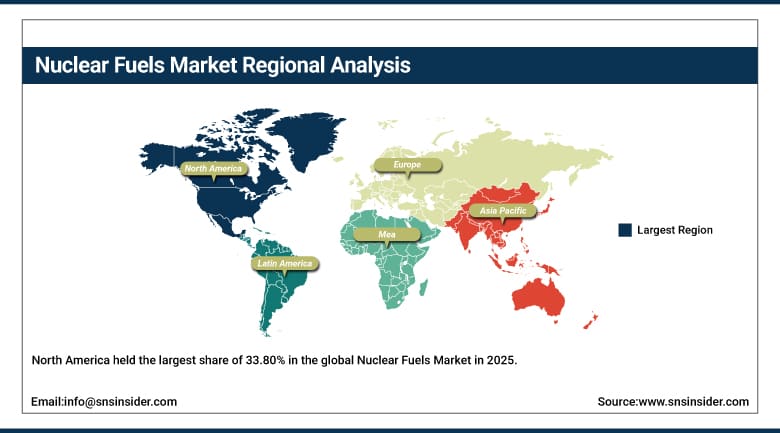
North America held the largest share of 33.80% in the global Nuclear Fuels Market in 2025. The growth was driven by robust utility investment in reactor life extension and uprate programs, substantial federal funding directed toward rebuilding domestic uranium enrichment capability, and the presence of several fuel fabricators and enrichment companies expanding capacity to reduce reliance on foreign-origin supply. The close collaboration between fuel cycle companies operating in the domestic environment and the long-term reload commitments of utility operators also helped the region maintain its dominant position within the global nuclear fuel supply chain, particularly as concerns around fuel security and geopolitical supply disruption continued to shape procurement strategy across the region's operating reactor fleet.
The U.S. held major share of the total revenue share of North America largely on account of the strong presence of Westinghouse Electric Company and Centrus Energy's domestic enrichment and fabrication platforms, along with Urenco USA's expanding centrifuge capacity in New Mexico supporting utilities across the country. Expansion of federal HALEU procurement programs and growing corporate interest in advanced reactor deployment for industrial and data center power supply helped Canada and the broader region make substantial contributions toward North America's dominance in the market, supported further by CANDU reactor fuel demand from domestic heavy water reactor operators.
Get Customized Report as Per Your Business Requirement - Enquiry Now
Europe Nuclear Fuels Market Insights
Europe maintained a sustainable market share in the worldwide revenue of the Nuclear Fuels Market due to the region's long-standing commitment to nuclear power as a share of its electricity mix, significant investments in fuel recycling infrastructure, and increasing installations of advanced reactor monitoring and fuel qualification programs across both existing and newly constructed reactor fleets. Increased adoption of closed fuel cycle practices has also motivated utilities in France and the United Kingdom to invest in reprocessing and mixed oxide fuel fabrication capacity, helping the region secure its role as a global leader in fuel recycling technology and reinforcing its established position within the broader nuclear fuel value chain.
France was the country with the highest demand for the market among the European nations because France generates about seventy percent of its electricity from nuclear energy, in addition to Orano SA's La Hague facility located in the country for reprocessing and fuel recycling. Another country was the United Kingdom, which is an important country that contributed to the market demand through Springfields Fuels Limited's fuel fabrication facility that provides advanced gas-cooled and pressurized water reactors' fuel assemblies. The demand for nuclear fuel in Europe will continue in the future due to extension of reactors' life spans and new constructions.
Asia Pacific Nuclear Fuels Market Insights
The Asia Pacific region is witnessing the highest rate of growth among all other regions covered in the Nuclear Fuels Market, registering a CAGR of approximately 7.2% from 2026 to 2035, due to major investments in new reactor construction across China and India, growing government mandates to expand nuclear power's contribution to national electricity mixes, and rapid development of domestic uranium conversion, enrichment, and fuel fabrication capabilities. The combined effects of large-scale reactor construction pipelines and rising urban electricity demand guaranteed that this region saw the highest rate of growth in comparison to all other regions featured in this report, with several governments treating domestic fuel cycle self-sufficiency as a strategic national priority.
The leading position belonged to China due to major investments in reactor construction and the expanding capacity of domestic fuel fabricators including China National Nuclear Corporation and China General Nuclear Power Corporation. Other key countries contributing to this outcome in this report include South Korea due to Korea Nuclear Fuel Co.'s established fabrication operations, and India due to the Nuclear Fuel Complex's expanding output supporting the country's growing pressurized heavy water reactor fleet.
MEA and Latin America Nuclear Fuels Market Insights
The Middle East and Africa and Latin America both showed steady growth in the Nuclear Fuels Market driven by increasing investment in new reactor construction, government commitment to electrification and energy diversification initiatives, and expanding collaboration between local utility operators and international fuel suppliers. It was becoming increasingly important for the nuclear programs being developed in these regions to secure long-term fuel supply agreements with established producers since neither region currently operates domestic enrichment or fabrication capacity of meaningful scale.
In ME&A, the United Arab Emirates was the largest country market since it operates the Barakah Nuclear Energy Plant, the region's first multi-unit commercial reactor complex, requiring sustained enriched uranium fuel imports under long-term supply contracts. Moreover, the ME&A region saw contributions from Saudi Arabia's early-stage nuclear infrastructure planning. In LATAM, the largest revenue-generating country was Brazil due to its operating Angra reactor fleet and ongoing government interest in expanding domestic nuclear generation capacity.
Market Dynamics:
Growth Drivers: Rising Reactor Life Extension Activity and Expanding Domestic Enrichment Investment
The market is propelling due to the growing utility demand for long-term reload fuel security, greater government investment in rebuilding domestic uranium enrichment and conversion capacity, increased urgency around reducing dependence on foreign-origin enriched uranium supply, and a growing range of use cases including reactor life extension, small modular reactor deployment, and defense fuel stockpiling. With an increasing number of utilities securing license renewals and uprates for existing reactor fleets, the demand for stable, long-term fuel supply agreements will ensure that procurement activity remains high across the supply chain throughout the forecast period.
The growing number of enrichment and fabrication capacity announcements from established fuel cycle companies, together with growing commitment from national governments to fund HALEU production ahead of anticipated advanced reactor commercialization, provides further evidence in favor of this trend. Corporate offtake agreements between fuel suppliers and reactor developers, along with venture and federal capital injections supporting new centrifuge cascades and fabrication lines, are also contributing to the increase in baseline production capabilities, and all of these factors combine into consistently increasing demand throughout the forecast period.
Restraints: High Capital Intensity and Fuel Cycle Regulatory Complexity
High capital intensity continues to be an actual constraint for the faster development of the market because uranium conversion, enrichment, and fuel fabrication facilities require multi-billion-dollar investments and lengthy construction and licensing timelines that few companies beyond established fuel cycle players can undertake. Such a situation has resulted in the most advanced enrichment and fabrication capacity being concentrated among a small number of well-financed, often state-backed producers, limiting the pace at which new entrants can meaningfully expand global supply.
Regulatory complexity continues to pose a challenge as fuel cycle facilities, particularly enrichment and reprocessing plants, are subject to stringent nuclear non-proliferation, safeguards, and licensing requirements imposed by national regulators and international bodies. The issue needs to be addressed through sustained engagement with regulatory authorities and continued investment in safeguards-compliant technology, and it remains an evolving process that requires substantial resources and lengthy approval timelines from both fuel producers and reactor operators.
Opportunities: HALEU Commercialization and Government-Backed Fuel Security Programs
The rise in investment in HALEU commercialization becomes an important opportunity since advanced and small modular reactor developers are entering multi-year fuel supply contracts where enrichment capacity, fabrication lines, and delivery logistics are secured well ahead of reactor commissioning. Fuel suppliers who can secure early anchor contracts, such as Centrus Energy's HALEU supply agreement with X-energy, will be able to occupy a significant share of the emerging advanced reactor fuel market as it transitions from demonstration-scale to full commercial deployment.
Another major opportunity lies in the rise of government-backed fuel security programs, since many national governments are directing substantial funding toward rebuilding domestic enrichment, conversion, and fabrication capacity to reduce reliance on imported nuclear fuel. Fuel cycle companies capable of demonstrating rapid capacity expansion and reliable delivery track records, including Urenco USA's ongoing centrifuge cascade additions, will be well positioned to capture a growing share of nationally funded fuel security contracts across multiple regions.
Recent Developments:
-
2026: Centrus Energy signed a USD 900 Million task order contract with the U.S. Department of Energy to transition its HALEU production cascade at Piketon, Ohio into commercial-scale operation, alongside a separate LEU and HALEU supply agreement with X-energy to support its Xe-100 small modular reactor and TRISO-X fuel programs.
-
2026: The Zuuvch Ovoo ISR uranium project in Mongolia is currently being constructed through a joint venture between Orano and Mongolia’s MonAtom company. The project will yield 6.5 million pounds of U₃O₈ over its 30 years of mine life.
-
2026: Urenco USA advanced the expansion of its New Mexico enrichment facility, installing new centrifuge cascades as part of a 700,000 SWU capacity program intended to strengthen low-enriched uranium supply for the U.S. commercial reactor fleet.
Nuclear Fuels Market key players are:
-
Cameco Corporation
-
National Atomic Company Kazatomprom JSC
-
Orano SA
-
Rosatom State Atomic Energy Corporation
-
TVEL Fuel Company
-
China National Nuclear Corporation (CNNC)
-
China General Nuclear Power Corporation (CGN)
-
Westinghouse Electric Company LLC
-
Framatome SAS
-
GE-Hitachi Nuclear Energy (Global Nuclear Fuel)
-
BWX Technologies, Inc.
-
Urenco Group
-
Centrus Energy Corp.
-
Korea Nuclear Fuel Co., Ltd.
-
Nuclear Fuel Complex
-
Uranium Energy Corp
-
Energy Fuels Inc.
-
Mitsubishi Nuclear Fuel Co., Ltd.
-
Springfields Fuels Limited
-
Enusa Industrias Avanzadas S.A.
Nuclear Fuels Market Report Scope:
| Report Attributes | Details |
|---|---|
| Market Size in 2025 | USD 42.70 Billion |
| Market Size by 2035 | USD 74.30 Billion |
| CAGR | 5.7% from 2026 to 2035 |
| Base Year | 2025 |
| Forecast Period | 2026-2035 |
| Historical Data | 2022-2024 |
| Report Scope & Coverage | Market Size, Segments Analysis, Competitive Landscape, Regional Analysis, DROC & SWOT Analysis, Forecast Outlook |
| Key Segments |
• By Fuel Type (Uranium Fuel, HALEU, Mixed Oxide (MOX) Fuel, Others) • By Reactor Type (Pressurized Water Reactor, Small Modular & Advanced Reactors, Boiling Water Reactor, Pressurized Heavy Water Reactor) • By Fuel Cycle (Open (Once-Through) Fuel Cycle, Closed (Reprocessing) Fuel Cycle) • By End Use (Commercial Power Utilities, Defense & Government Programs, Research & Test Reactors, Others)
|
| Regional Analysis/Coverage | North America (US, Canada), Europe (Germany, UK, France, Italy, Spain, Russia, Poland, Rest of Europe), Asia Pacific (China, India, Japan, South Korea, Australia, ASEAN Countries, Rest of Asia Pacific), Middle East & Africa (UAE, Saudi Arabia, Qatar, South Africa, Rest of Middle East & Africa), Latin America (Brazil, Argentina, Mexico, Colombia, Rest of Latin America). |
| Company Profiles | Cameco Corporation, National Atomic Company Kazatomprom JSC, Orano SA, Rosatom State Atomic Energy Corporation, TVEL Fuel Company, China National Nuclear Corporation (CNNC), China General Nuclear Power Corporation (CGN), Westinghouse Electric Company LLC, Framatome SAS, GE-Hitachi Nuclear Energy (Global Nuclear Fuel), BWX Technologies, Inc., Urenco Group, Centrus Energy Corp., Korea Nuclear Fuel Co., Ltd., Nuclear Fuel Complex, Uranium Energy Corp, Energy Fuels Inc., Mitsubishi Nuclear Fuel Co., Ltd., Springfields Fuels Limited, Enusa Industrias Avanzadas S.A. |

Frequently Asked Questions
Key players include Cameco Corporation, National Atomic Company Kazatomprom JSC, Orano SA, Rosatom State Atomic Energy Corporation, and TVEL Fuel Company, among others.
Key opportunities include expanding nuclear power generation, growing reactor construction, increasing uranium demand, advanced reactor deployment, fuel-cycle innovations, and rising investments in nuclear energy security.
The major growth factor is rising demand for reactor life extension and long-term fuel security, expanding domestic enrichment and HALEU production capacity, and growing government-backed investment in nuclear fuel supply chain resilience.
The Uranium Fuel segment dominated the Nuclear Fuels Market by fuel type, representing the largest share of revenue in 2025.
North America dominated the Nuclear Fuels Market in 2025, holding an estimated 33.80% share of total global market revenue.
