
Nuclear Power Plant Digitalization Market Report Scope and Overview:
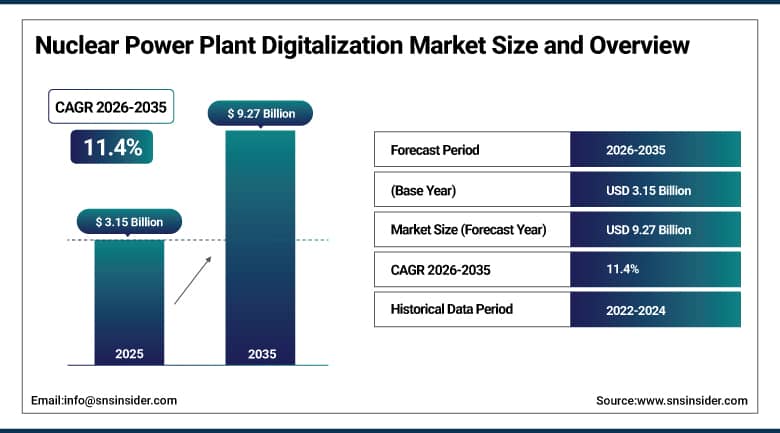
The Nuclear Power Plant Digitalization Market was valued at USD 3.15 Billion in 2025 and is projected to reach USD 9.27 Billion by 2035, registering a CAGR of 11.4% from 2026 to 2035.
The Nuclear Power Plant Digitalization Market is transforming the reactors’ operations by incorporating the use of digital twins, predictive analytics based on artificial intelligence, industrial internet of things sensors, and cybersecurity systems for improved safety, reliability, and regulation. Key features of the market include increasing spending by utilities on condition monitoring systems across their entire fleet, modernization of aging reactors’ instrumentation and control systems, increased adoption of digital licensing and simulation tools for extended life cycles, and the application of the technology in outage management and small modular reactors' control systems.
In August 2026, ABB focused on its digitalization offering for the nuclear sector, which consisted of digital surveillance, automation updates, and upgrading the electrical system in order to increase the lifetime of current nuclear power stations.
To Get More Information On Nuclear Power Plant Digitalization Market - Request Free Sample Report
Nuclear Power Plant Digitalization Market Trends
-
Expanding deployment of digital twin platforms continues improving predictive diagnostics across aging reactor fleets.
-
Growing integration of AI-based predictive maintenance tools continues reducing unplanned outage duration for utilities.
-
Rising investment in small modular reactor digital control architecture continues expanding the addressable base for next-generation I&C platforms.
-
Increasing utility focus on cybersecurity hardening continues strengthening demand for hardware-isolated and FPGA-based digital I&C systems.
-
Growing adoption of cloud-enabled fleet performance analytics continues accelerating cross-plant benchmarking and remote monitoring capabilities.
U.S. Nuclear Power Plant Digitalization Market Outlook
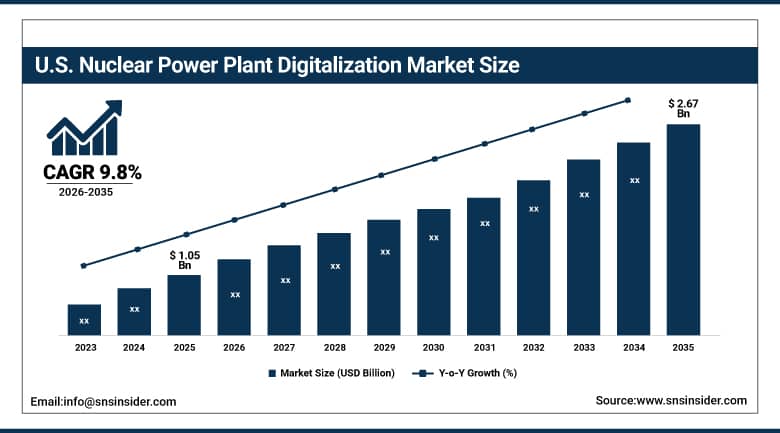
The U.S. Nuclear Power Plant Digitalization Market was valued at approximately USD 1.05 Billion in 2025 and is projected to reach approximately USD 2.67 Billion by 2035, registering a CAGR of approximately 9.8% from 2026 to 2035.
The high level of demand in the U.S. was attributed to significant investments in the life extension of nuclear fleets, extensive replacement of analog instrumentation and control by digital ones, and high levels of need for predictive fault-detection technologies among utilities managing aged pressurized and boiling water reactors. The use of digital twin diagnostics and artificial intelligence-enabled fleet performance analysis within the large utility fleets contributed greatly to the status of the U.S. as the biggest market for digitalization of nuclear power plants globally. Additionally, digitalization of I&C for outage optimization, cyber security reinforcement, and small modular reactor licensing support were contributing to the high local demand for the technology.
In 2026, Westinghouse Electric Company also kept working on the modernization of digital instrument and control systems in American nuclear power plants, with its Common Q safety-grade system and Ovation-based control systems. The company’s Limerick Digital Modernization Project is the first-of-its-kind domestic upgrade of a BWR I&C system to digital technology.
Nuclear Power Plant Digitalization Market Segment Analysis
-
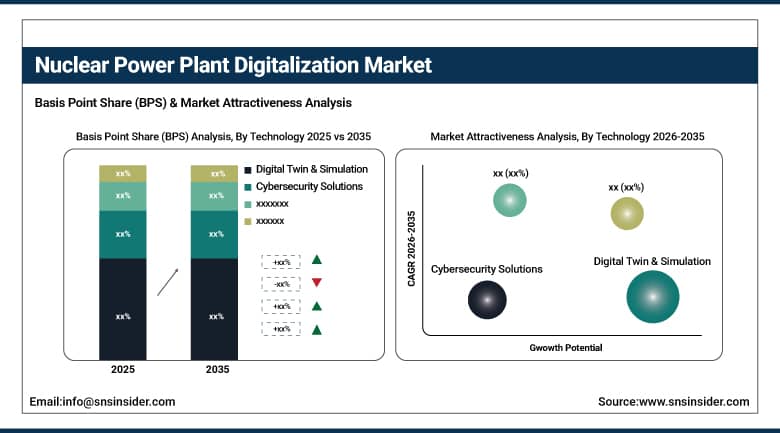
By Technology, Digital Twin & Simulation segment dominated the Nuclear Power Plant Digitalization Market in 2025 with 29% share; Artificial Intelligence & Predictive Analytics segment is the fastest growing segment, registering a CAGR of 13.6% from 2026 to 2035.
-
By Component, Software segment dominated the market in 2025 with 48% share; Services segment is the fastest growing segment, registering a CAGR of 13.2% from 2026 to 2035.
-
By Application, Predictive Maintenance segment dominated the market in 2025 with 31% share; Safety & Compliance Management segment is the fastest growing segment, registering a CAGR of 13.0% from 2026 to 2035.
-
By Deployment, On-Premise segment dominated the market in 2025 with 64% share; Cloud segment is also the fastest growing segment, registering a CAGR of 13.5% from 2026 to 2035.
-
By End User, Utilities segment dominated the market in 2025 with 58% share; EPC & OEM Providers segment is the fastest growing segment, registering a CAGR of 12.8% from 2026 to 2035.
By Technology, Digital Twin & Simulation Leads, While AI & Predictive Analytics Grows Fastest
Digital Twin & Simulation dominated the Nuclear Power Plant Digitalization Market in 2025 due to the significant role this category plays in the licensing process, safety case, and life extension of aging pressurized and boiling water reactor facilities. The application of the Metroscope digital diagnostics platform developed by Framatome for reactor facilities on the basis of the U.S. Department of Energy contract demonstrates how utilities leverage the potential of the virtual twin of their plants to predict problems with auxiliary systems. The research conducted by the Oak Ridge National Laboratory also underscores the leading position of this technology category amid utility plans of plant-wide digitalization in advance of the deployment of advanced analytics.
Artificial Intelligence & Predictive Analytics is projected to record the fastest growth within the Nuclear Power Plant Digitalization Market due to the transition of utilities from scheduled maintenance to the condition-based interventions. GE Vernova Hitachi Nuclear Energy is already implementing an AI & predictive analytics approach as part of the control system of its BWRX-300 small modular reactor. Data availability and the demand for fault classification automation continue to drive the growth of this segment.
By Component, Software Dominates, Services Post Fastest Growth
Software captured the largest component share of the Nuclear Power Plant Digitalization Market in 2025 as utilities focused on the licensing of simulation, analytics, and fleet monitoring platforms rather than buying any hardware solutions. Platforms, such as AVEVA’s asset performance management suite and Bentley Systems’ digital twin software have emerged as critical platforms in utilities’ attempts to integrate the plant’s data into unified operational dashboards. The fact that software licensing has a recurring revenue model as well as constant updates related to new NRC and IAEA digital I&C guidelines has made software the leading component category.
Services are expected to post the fastest growth rate over the forecast period due to increasing dependence of utilities on third-party providers of integration, calibration, and commissioning services as they seek to implement digital solutions into legacy plants. The commercialization agreement signed by Framatome for its Metroscope diagnostics platform, which consists of software licensing and engineering services is a reflection of the rising preference of turnkey solutions provided by vendors. The fleet rollout initiatives will create additional demand for integration and cybersecurity validation services.
By Application, Predictive Maintenance Leads, Safety & Compliance Management Grows Fastest
Predictive Maintenance was the leading application segment in the Nuclear Power Plant Digitalization Market in 2025, accounted for the largest share of the Nuclear Power Plant Digitalization Market in 2025 owing to the push from utilities towards reduced forced outages and extended life of reactor components. Predictive maintenance is supported by well-developed business cases based on operational and maintenance cost savings and is, therefore, the most well-funded of all digitalization initiatives undertaken by the utilities. Extensive use of vibration, thermal, and acoustic sensor fusion in analytics software platforms has enabled a move from calendar-based maintenance scheduling towards condition-based maintenance, underpinning Predictive Maintenance as the key revenue source for digitalization vendors.
Safety & Compliance Management is the fastest-growing application segment due to the increasing regulation from regulators such as the U.S. NRC and IAEA with respect to cybersecurity and digital I&C qualification requirements for not only existing fleets but also new small modular reactors. Continuous development of digitally verifiable safety case documents by Rolls-Royce SMR and Westinghouse's continuous deployment of digitally qualified I&C platforms in AP1000 reactors are clear examples of compliance-related digitalization becoming an integral part of the licensing process.
By Deployment, On-Premise Systems Dominate, While Cloud Deployment Grows Fastest
The On-Premise deployment accounted for the largest market share in the Nuclear Power Plant Digitalization Market in 2025 due to strict regulations requiring physical isolation of control environments from external networks for nuclear reactor control systems. Hardware isolated platforms like RadICS FPGA based I&C systems are preferred by utilities for their architecture that eliminates cybersecurity risks present in the networked software environment that is mandatory to pass regulations for safety-related digitalization in both legacy and next-gen reactors.
Cloud deployment is forecasted to be the fastest-growing segment since utilities will separate non-safety related analytics such as fleet performance benchmarking or reporting from the control of safety-critical systems. It will allow using cloud-based machine learning/AI models on historic data sets without compromising security of protected control systems. The growth of cloud-based fleet analytics adoption will accelerate once the framework for cybersecurity of non-safety digital layers is mature enough.
By End User, Utilities Dominate, EPC & OEM Providers Gain Fastest Traction
Utilities represented the dominant end-user segment of the Nuclear Power Plant Digitalization Market in 2025 owing to their responsibilities for ensuring the safety and reliability of reactors in addition to the compliance with the regulations. The large-scale implementation of digitalization projects by operators such as predictive maintenance and digital twins in North America and Europe indicates that utilities are integrating digital investments into asset management strategies in order to prolong the license of operations and to save life cycle costs for aging reactor parks.
EPC & OEM Providers are expected to emerge as suppliers of reactors are starting to offer digital I&C, simulation and analytics solutions as part of their reactor contracts. The example of Framatome, which has acquired Rolls-Royce's civil nuclear I&C business, and the example of GE Vernova Hitachi Nuclear Energy and its embedded digital control architecture for BWRX-300 demonstrate that OEMs use digitalization as a competitive advantage for winning contracts and that is why their share will grow faster than the one of the Utilities.
Regional Analysis:
|
Region |
Major Country |
Share within Region, 2025 (%) |
|---|---|---|
|
North America |
United States |
84.20% |
|
Europe |
France |
24.60% |
|
Asia Pacific |
China |
36.50% |
|
Middle East and Africa |
United Arab Emirates |
29.40% |
|
Latin America |
Brazil |
33.20% |
North America Nuclear Power Plant Digitalization Market Insights
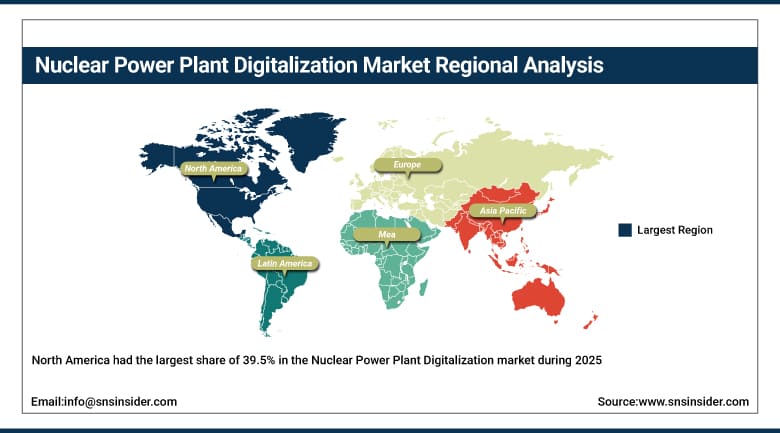
North America had the largest share of 39.5% in the Nuclear Power Plant Digitalization market during 2025 owing to substantial investments made by the utilities for extending the life of their fleets and upgrading digital instrumentation and control systems, regulatory focus on cybersecurity hardening through NRC guidelines, and leading vendors of reactors and predictive analytics operating from this region. Close partnership between the utilities and digital twins and predictive analytics providers from the region added to the lead of North America in both the retrofitting of the existing fleets and SMRs projects.
The U.S. held dominant revenue share of North America largely owing to the robust deployment of the Framatome's Metroscope diagnostic tool, Westinghouse's qualified digital I&C solutions for the existing AP1000 and PWR fleets, and the GE Vernova Hitachi Nuclear Energy's advanced reactors' digital control solutions. Grid modernization and nuclear refurbishment initiatives in Canada also helped the region make further contributions to the dominant position of North America in the market.
Get Customized Report as Per Your Business Requirement - Enquiry Now
Europe Nuclear Power Plant Digitalization Market Insights
The sustainable share of Europe in the global Nuclear Power Plant Digitalization market revenue was facilitated by advanced life extension programs of its reactors, considerable spending on the replacement of the I&C system with the digital one and increasing installation of intelligent monitoring systems in both existing and new reactors. The adoption of the standardized framework of digital licensing also contributed to the investment in neutral simulation and analytical software of utilities in Europe, ensuring the leading position of the region in the regulation of nuclear digitalization.
Among European countries, France showed the highest market demand of the region owing to EDF's extensive program of digital I&C upgrade in domestic reactor fleet and presence of the production facilities for Framatome's TELEPERM XS digital platform. Rolls-Royce SMR's digitally integrated small modular reactor control system was responsible for high demand in the UK, while further nuclear digitalization demand in Europe can be expected against the background of reactor refurbishment and construction.
Asia Pacific Nuclear Power Plant Digitalization Market Insights
The Asia Pacific region has recorded the fastest growth rate of all the regions included in the market at a CAGR of 13.8% due to huge investment in the development of reactors in China and India, an increased mandate for the digitalization of documentation related to safety and licensing, and improved domestic manufacturing capability of digital I&C hardware. Both the factors of reactor fleet increase and demand for AI-based operation have guaranteed that this particular region has the fastest digitalization growth rate of all the regions included in this report.
China has been holding the top position due to huge investments in reactors and an increasing capability of domestic digital I&C manufacturing. Some other countries which have contributed to this result include India where the expansion of fleet from NPCIL and South Korea where KEPCO KPS is implementing predictive maintenance solution for all reactors.
MEA and Latin America Nuclear Power Plant Digitalization Market Insights
The Middle East and Africa and Latin America both showed steady growth in the Nuclear Power Plant Digitalization Market due to the growing investments in nuclear reactors, the implementation of government-driven energy diversification strategies, and increasing cooperation of local utility companies with global vendors of digital I&C and analytics solutions. The real-time digital insights into the operation of the nuclear power plants are becoming increasingly important for ME&A and LATAM countries as their nuclear reactors transition from the phase of commissioning to full commercial operation.
In ME&A, the United Arab Emirates was the largest country market due to the digital fleet monitoring deployment and investment in the operational analytics in the Barakah Nuclear Energy Plant as its reactors continue to transition into commercial operation. The early development of the nuclear program in Saudi Arabia also contributed to the growth. Among LATAM countries, the largest revenue generator was Brazil due to the digitalization efforts.
Market Dynamics:
Growth Drivers: Rising Demand for Predictive Maintenance and Expanding Digital I&C Retrofits
The market is being driven by increased demand from utilities for real-time reactor visibility capabilities, rising adoption of predictive analytics and digital twin software enabled by AI, investments in fleet life extension and cyber security fortifications, as well as increasing use cases that include outages optimization, fuel management, and licensing of small modular reactors. With more utilities launching fleets digitalization plans in accordance with their license renewal schedule, the demand for verified and approved by regulatory authorities digital I&C solutions will stay high across the supply chain during the forecasted period.
Increasing numbers of integrations between reactor OEMs and analytics providers, as well as higher commitment of utilities to unified platforms of AI-powered fleet management prior to implementation of stricter requirements regarding cyber security reporting, constitute additional evidence of the trend mentioned above. Moreover, government-financed projects of nuclear life extension and new builds also contribute to the rise in digitalization capability baseline.
Restraints: Legacy Infrastructure Qualification and Cybersecurity Concerns
The continued existence of incompatibility problems in the plant legacy is also one of the real barriers to market growth due to the use of analog control systems in many existing plants that need a long period of nuclear-grade certification, normally taking up to several years according to the NRC and IAEA processes, prior to installation of any kind of digital system.
One of the existing threats related to cybersecurity becomes more important since there is an expansion in digital connectivity between reactor auxiliary and monitoring systems, which may become a new target for attacks. This problem should be solved by hardware isolation, secure data transfer, and anomaly detection, a process that requires considerable investment of utilities and digital I&C vendors to get approval.
Opportunities: AI-Driven Fleet Analytics and Small Modular Reactor Digital Control Investment
With increased interest in investments in AI-powered fleet performance analytics, there is a clear opportunity for manufacturers in light of the trend of utilities making multi-year commitments for platform contracts that integrate sensor data, predictive analytics, and diagnostics through one platform. Manufacturers with early anchor customers that adopt fleet-level platforms, including the phased adoption of Framatome's Metroscope diagnostics, are in an ideal position to gain significant market share as utilities move from standalone pilot projects to full-fleet digital orchestration.
There is another significant opportunity in the emerging small modular reactors where digital control systems are being engineered right at the design stage. Vendors with solutions for qualified digital I&C, AI-powered diagnostics, and cyber-secured control systems embedded into the designs of SMR reactors, such as the GE Vernova Hitachi Nuclear Energy's BWRX-300 program, will be in a strong position to gain a large share of investments in digitalization during new builds over the forecast period.
Recent Developments:
-
2026: Framatome advanced commercialization of its Metroscope-powered Digital Twin-based Diagnostics platform under a phased U.S. Department of Energy contract, extending automated fault detection to plant service water and cooling water systems across additional light water reactor sites in North America.
-
2026: GE Vernova Hitachi Nuclear Energy integrated AI-based predictive analytics into the digital control architecture of its BWRX-300 small modular reactor, aiming to reduce unplanned outage duration and support early-adopter utilities pursuing fleet-wide digital licensing.
-
2026: Emerson continued advancing its digital automation and AI-enabled industrial software portfolio, including enhancements to its Guardian Digital Platform. Such technologies support lifecycle management, predictive insights, and operational optimization relevant to digitally modernized nuclear facilities.
Nuclear Power Plant Digitalization Market key players are:
-
Westinghouse Electric Company LLC
-
Framatome
-
GE Vernova Hitachi Nuclear Energy
-
Siemens AG
-
Schneider Electric SE
-
Rolls-Royce SMR Ltd.
-
Rosatom State Nuclear Energy Corporation
-
Mitsubishi Electric Corporation
-
Toshiba Energy Systems & Solutions Corporation
-
Emerson Electric Co.
-
Honeywell International Inc.
-
ABB Ltd
-
Rockwell Automation, Inc.
-
AVEVA Group plc
-
L3Harris Technologies, Inc.
-
Doosan Enerbility Co., Ltd.
-
KEPCO KPS Co., Ltd.
-
Bentley Systems, Incorporated
-
HIMA Paul Hildebrandt GmbH
-
NuScale Power Corporation
Nuclear Power Plant Digitalization Market Report Scope:
| Report Attributes | Details |
|---|---|
| Market Size in 2025 | USD 3.15 Billion |
| Market Size by 2035 | USD 9.27 Billion |
| CAGR | 11.4% from 2026 to 2035 |
| Base Year | 2025 |
| Forecast Period | 2026-2035 |
| Historical Data | 2022-2024 |
| Report Scope & Coverage | Market Size, Segments Analysis, Competitive Landscape, Regional Analysis, DROC & SWOT Analysis, Forecast Outlook |
| Key Segments |
• By Technology (Digital Twin & Simulation, Artificial Intelligence & Predictive Analytics, Industrial IoT & Smart Sensors, Cybersecurity Solutions, Others) • By Component (Software, Services, hardware) • By Application (Predictive Maintenance, Safety & Compliance Management, Plant Operations & Monitoring, Outage & Fuel Management)
• By Deployment (On-Premise, Cloud) • By End User (Utilities, EPC & OEM Providers, Government & Regulatory Bodies)
|
| Regional Analysis/Coverage | North America (US, Canada), Europe (Germany, UK, France, Italy, Spain, Russia, Poland, Rest of Europe), Asia Pacific (China, India, Japan, South Korea, Australia, ASEAN Countries, Rest of Asia Pacific), Middle East & Africa (UAE, Saudi Arabia, Qatar, South Africa, Rest of Middle East & Africa), Latin America (Brazil, Argentina, Mexico, Colombia, Rest of Latin America). |
| Company Profiles | Westinghouse Electric Company LLC, Framatome, GE, Vernova Hitachi Nuclear Energy, Siemens AG, Schneider Electric SE, Rolls-Royce SMR Ltd., Rosatom State Nuclear Energy Corporation, Mitsubishi Electric Corporation, Toshiba Energy, Systems & Solutions Corporation, Emerson, Electric Co., Honeywell International Inc., ABB Ltd, Rockwell Automation, Inc., AVEVA Group plc, L3Harris Technologies, Inc., Doosan Enerbility Co., Ltd., KEPCO KPS Co., Ltd., Bentley Systems, Incorporated, HIMA Paul Hildebrandt GmbH, and NuScale Power Corporation. |

Frequently Asked Questions
Key players include Westinghouse Electric Company LLC, Framatome, GE, Vernova Hitachi Nuclear Energy, Siemens AG, and Schneider Electric SE, among others.
Key opportunities include increasing nuclear power investments, modernization of aging reactors, AI-driven predictive maintenance, digital twin adoption, cybersecurity upgrades, and growing demand for operational efficiency.
The major growth factor is rising demand for real-time reactor visibility and predictive maintenance, expanding digital twin and AI-enabled analytics deployment, and growing regulatory-driven cybersecurity and digital I&C modernization investment by utilities.
The Digital Twin & Simulation segment dominated the Nuclear Power Plant Digitalization Market by technology, representing the largest share of revenue in 2025.
North America had the largest share of 39.5% in the Nuclear Power Plant Digitalization market during 2025.
