
Nuclear-Radiation Transducers Market Report Scope & Overview:
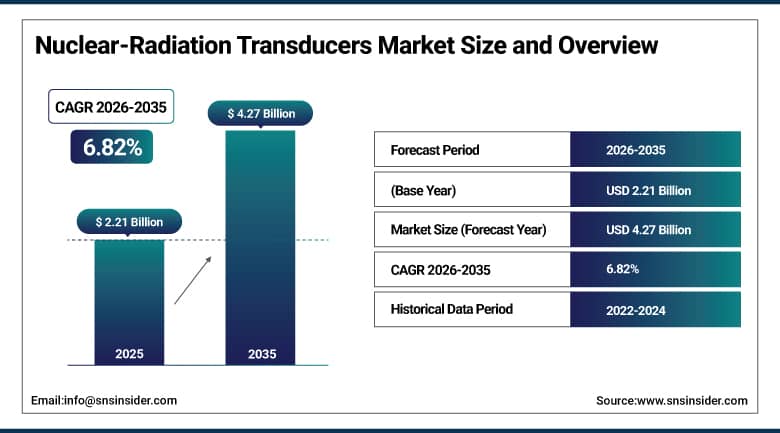
The Nuclear-Radiation Transducers Market was valued at USD 2.21 Billion in 2025 and is expected to reach USD 4.27 Billion by 2035, growing at a CAGR of 6.82% from 2026 to 2035.
Nuclear-radiation transducers represent a truly indispensable yet low-key component of nuclear power, healthcare, defense, and research activities, as they transform radiation exposure into electricity used by safety systems, diagnostic machines, and monitoring programs. Growth of the market can be attributed to increased generation of nuclear power, growing use of radiation for diagnostics and cancer treatment in medicine, and toughening of the radiation safety regulations around the globe. Increased expenditures on defense and homeland security, development of the environmental radiation monitoring programs, and technology advancements in solid-state and portable radiation detectors are among other factors contributing to the growth of the market within industrial, research, and safety applications. The global market for nuclear-radiation transducers is largely defined by the increase of nuclear power generation and life extension programs for already installed reactors, as those require constant monitoring of radiation in order to meet the ever-growing safety and regulatory requirements.
Growth of nuclear power generation and small modular reactors, along with increasing usage of next-generation semiconductor and neutron detectors, is driving the market and changing the technology landscape.
Market Size and Forecast
-
Market Size in 2026E: USD 2.36 Billion
-
Market Size by 2035: USD 4.27 Billion
-
CAGR: 6.82% from 2026 to 2035
-
Fastest Growing Region: Asia Pacific
-
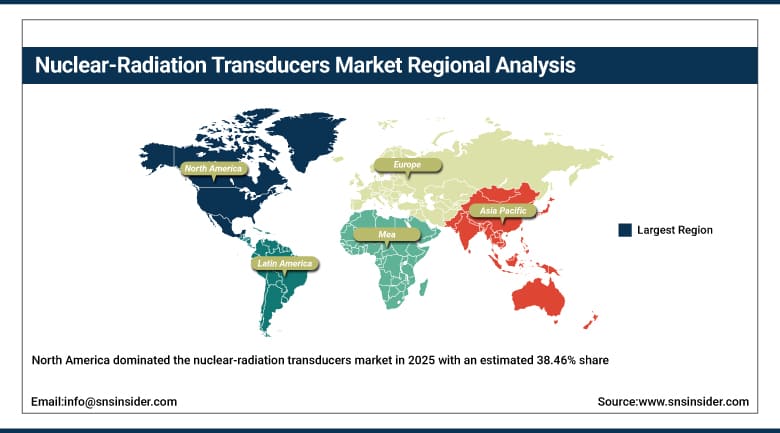
Largest Region: North America
To Get More Information On Nuclear-Radiation Transducers Market - Request Free Sample Report
Nuclear-Radiation Transducers Market Trends
-
Increasing adoption of next-generation semiconductor and neutron detectors with higher sensitivity and portability keeps reshaping the competitive landscape.
-
Expansion of nuclear power generation and small modular reactor projects is driving demand for advanced radiation monitoring systems.
-
Expanding use of radiation in healthcare, particularly medical imaging, radiotherapy, and nuclear medicine, continues boosting demand for accurate and reliable transducers.
-
Increased defense and homeland security investment for border control, port security, and counter-terrorism applications keeps supporting market growth.
-
Continuous technological advancement, including solid-state detectors, digital signal processing, and compact portable systems, is encouraging replacement of legacy equipment.
The U.S. Nuclear-Radiation Transducers Market Outlook
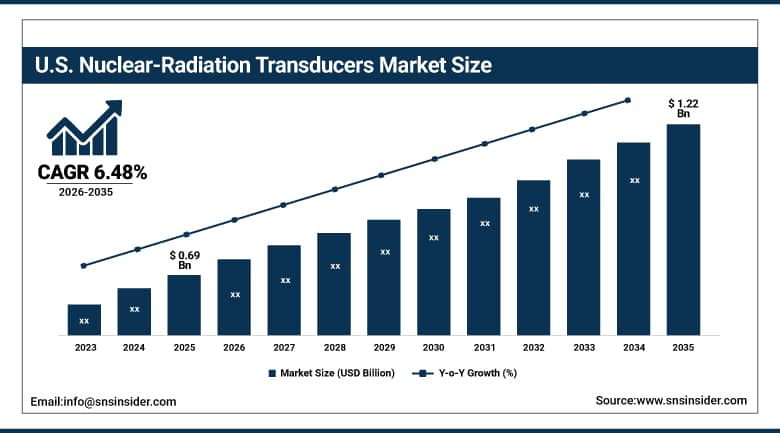
The U.S. Nuclear-Radiation Transducers Market was valued at approximately USD 0.69 Billion in 2026 and is expected to reach approximately USD 1.22 Billion by 2035, growing at a CAGR of approximately 6.48%.
The United States market of nuclear-radiation transducers is expanding on account of the modernization of the nuclear power stations, growth in investments in the imaging and radiation therapy sector, enhanced safety regulations regarding the use of radiation and increasing budgets of homeland security and defense for advanced radiation measurement and monitoring equipment. American operators of the nuclear stations have been continuously working on the extension of the life of the reactors, which requires constant modernizations of the radiation measurement equipment, to ensure compliance with the increasingly stringent requirements for safety and regulation. This combination of factors of aging reactor fleet modernization, medical imaging investment growth and defense-driven demands guarantees that the United States market of nuclear-radiation transducers remains one of the largest and most developed markets in the world.
In 2025, Mirion Technologies introduced a number of innovative radiation monitoring devices such as the Instadose® VUE wireless X-ray dosimeter and became certified under ISO.
Nuclear-Radiation Transducers Market Segment Analysis
-
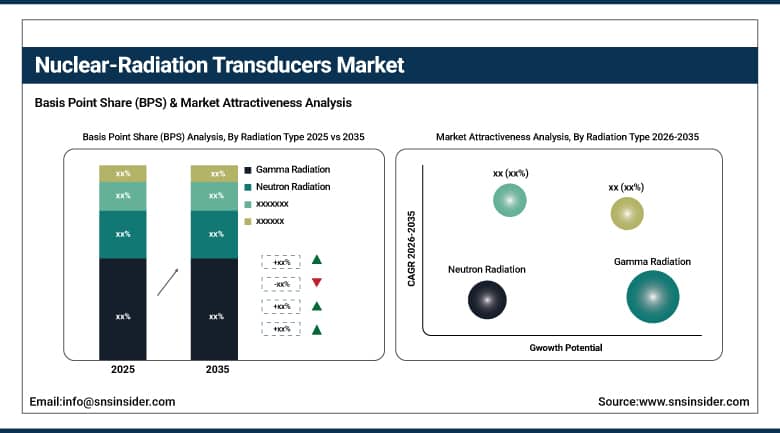
By Radiation Type, Gamma Radiation Transducers dominated with a 44.65% share in 2025, while Neutron Radiation Transducers is the fastest-growing radiation type at a CAGR of 7.63%.
-
By Type, Scintillation Detector Transducers dominated with a 34.97% share in 2025, while Semiconductor Detector Transducers is the fastest-growing type at a CAGR of 7.31%.
-
By End-User, Nuclear Power & Energy dominated with a 34.72% share in 2025, while Defense & Homeland Security is the fastest-growing end-user segment at a CAGR of 7.33%.
-
By Application, Radiation Safety & Protection dominated with a 38.48% share in 2025, while Research & Academic Instrumentation is the fastest-growing application at a CAGR of 7.89%.
By Radiation Type, Gamma leads, Neutron grows fastest
Gamma radiation transducers dominated the market in 2025, due to extensive applications in medical imaging, industrial inspection, and nuclear power monitoring, benefiting from high reliability and established technology that's been refined over decades of commercial use. That broad, mature application base has kept gamma detection the largest single radiation-type category by a comfortable margin.
Neutron radiation transducers are expected to grow at the fastest CAGR through 2035, driven by increasing adoption in advanced nuclear reactors, defense applications, fusion research, and specialized scientific instrumentation requiring high sensitivity and precise neutron detection. As next-generation reactor designs and fusion research programs keep expanding globally, that specialized, high-value detection requirement is what's pushing neutron transducers' growth rate ahead of the more commoditized gamma detection segment.
By Type, Scintillation Detectors lead, Semiconductor Detectors grow fastest
The scintillation detector transducers held a leading position in the market in 2025 owing to the extensive use of such devices in the areas of medical imaging, nuclear power plant surveillance, and industries due to the high level of development of technologies and well-developed production processes. Such a combination of reliability and wide range of applications makes scintillation detectors the most significant segment within the market.
It is anticipated that the highest CAGR will be shown by the semiconductor detector transducers until 2035 due to the development of solid-state technologies, high energy resolution, compactness, low-power consumption, and increasing needs in portable and highly precise radiation detectors. With the growing need for accurate and portable devices in the field, semiconductor detectors' small size makes them preferable to scintillation detectors.
By End-User, Nuclear Power & Energy leads, Defense & Homeland Security grows fastest
Nuclear Power & Energy dominated the end-user segment in 2025, reflecting the sheer scale of continuous radiation monitoring required across power generation, reactor maintenance, and fuel-cycle operations. That ongoing, mission-critical monitoring need across the nuclear power industry has kept this end-user category the largest single buyer group for radiation transducers.
Defense & Homeland Security is expected to grow at the fastest CAGR through 2035, driven by increased defense and homeland security investment for border control, port security, and counter-terrorism applications. As governments keep expanding radiation detection infrastructure at borders, ports, and public venues to guard against nuclear and radiological threats, that growing security-driven procurement is what's pushing this end-user category's growth rate ahead of the traditionally dominant nuclear power segment.
By Application, Radiation Safety & Protection leads, Research & Academic Instrumentation grows fastest
Radiation Safety & Protection was leading the applications sector in 2025, owing to its extensive use in the medical industry, nuclear sites, industrial establishments, and compliance programs. The universal requirement for radiation monitoring and protection in all industries has ensured that safety & protection applications remain the dominant type in the application segment.
Research & Academic Instrumentation is forecasted to register the highest CAGR between 2026 and 2035, due to rising investments in nuclear research, study of new materials, experimentation, and development of new detection devices, which require precision instruments. The growing spending on nuclear and radiation research by governments and universities is driving the growth rate of this application segment above that of the safety and protection segment.
Regional Analysis
|
Region |
Major Country |
Share within Region, 2025 (%) |
|---|---|---|
|
North America |
United States |
79.75% |
|
Europe |
Germany |
24.60% |
|
Asia Pacific |
China |
33.20% |
|
Latin America |
Brazil |
35.70% |
|
Middle East & Africa |
UAE |
24.90% |
North America Nuclear-Radiation Transducers Market Insights
North America dominated the nuclear-radiation transducers market in 2025 with an estimated 38.46% share, driven by well-established nuclear power infrastructure, stringent radiation safety regulations, and widespread adoption of advanced medical imaging and radiotherapy technologies. That combination of a mature nuclear industry, deep healthcare investment, and strict regulatory environment has kept North America firmly at the center of global demand.
The United States accounts for roughly 79.75% of regional revenue, anchored by modernization of nuclear power plants, increased investment in medical imaging and radiation therapy, and rising defense and homeland security spending. Canada adds further regional demand as its own nuclear power and healthcare sectors continue investing in radiation monitoring technology, and that combined regional strength should keep North America the largest addressable market for nuclear-radiation transducer vendors through the forecast period.
Get Customized Report as Per Your Business Requirement - Enquiry Now
Europe Nuclear-Radiation Transducers Market Insights
Europe holds a meaningful share of the global nuclear-radiation transducers market, supported by an established nuclear power base, strong regulatory frameworks, and expanding healthcare infrastructure across the region's major economies. Continued investment in reactor life-extension programs and radiation safety modernization keeps reinforcing demand across the region's nuclear power sector.
Germany leads regional demand at roughly 24.60% of European revenue, supported by its strong industrial and healthcare infrastructure. The UK and France contribute substantial additional demand through their own established nuclear power sectors, and continued European nuclear safety modernization should keep regional demand for radiation transducers climbing steadily through the forecast period.
Asia Pacific Nuclear-Radiation Transducers Market Insights
The Asia-Pacific region is expected to grow at the fastest CAGR of 7.52% through 2035 in the nuclear-radiation transducers market. Growth is driven by expanding nuclear power programs, increasing healthcare infrastructure, rising defense and security initiatives, and growing industrial applications. Rapid technological adoption, government-led radiation monitoring projects, and investment in advanced research and small modular reactors further fuel demand for high-precision, portable, and next-generation radiation detection solutions.
China dominated the nuclear-radiation transducers market within Asia-Pacific, accounting for roughly 33.20% of regional revenue, due to its rapid expansion of nuclear power plants, growing healthcare and medical imaging infrastructure, substantial defense investment, and increasing adoption of advanced radiation monitoring and detection technology. Japan and South Korea contribute meaningful additional demand through their own established nuclear power sectors, keeping Asia Pacific's growth trajectory well ahead of every other region tracked in this report.
MEA & Latin America Nuclear-Radiation Transducers Market Insights
Asia Pacific is set to witness the highest CAGR of 7.52% until 2035 in the nuclear-radiation transducers market owing to increased nuclear power initiatives, improved healthcare infrastructure, rising defense and security measures, and various applications in industries. Adoption of advanced technologies, radiation monitoring projects by the government, and research & development on small modular reactors drive the need for advanced, portable, and next-generation nuclear radiation transducers.
China was leading in the nuclear-radiation transducers market of Asia Pacific accounting for around 33.20% of the total regional revenue as it had seen an increasing number of nuclear power plants, improved healthcare and medical imaging infrastructures, investments in defense, and advanced technologies related to radiation monitoring and detection. Demand from Japan and South Korea is another major contribution from Asia Pacific which has a strong nuclear power sector.
Market Dynamics
Growth Drivers: Nuclear power expansion and healthcare radiation applications
The global nuclear-radiation transducers market is primarily driven by rising nuclear power generation and life-extension programs for existing reactors, which require continuous radiation monitoring to meet strict safety and regulatory standards. Expansion of nuclear power generation and small modular reactor projects is driving demand for advanced radiation monitoring systems, and that global nuclear power renaissance, driven partly by decarbonization goals, keeps expanding the installed base of reactors requiring continuous radiation monitoring infrastructure.
Expanding use of radiation in healthcare, particularly medical imaging, radiotherapy, and nuclear medicine, continues to boost demand for accurate and reliable transducers as diagnostic and treatment technology keeps advancing. Increased defense and homeland security investment for border control, port security, and counter-terrorism applications further supports market growth, and heightened environmental awareness combined with government-led radiation surveillance programs keeps accelerating adoption across industrial and public safety sectors.
Restraints: High costs and complex regulatory compliance requirements
Advanced radiation detection systems, particularly semiconductor and neutron detectors, carry substantial upfront costs that can make broader deployment genuinely difficult for smaller facilities and organizations operating on tighter budgets. That cost barrier keeps a meaningful share of the market concentrated among larger, well-resourced nuclear, healthcare, and defense institutions rather than achieving truly widespread adoption.
Stricter radiation safety regulations, while a genuine growth driver overall, also add real compliance complexity and certification cost for manufacturers bringing new detection technology to market. Navigating varying regulatory requirements across different countries and applications can meaningfully slow product development and market entry timelines, particularly for smaller vendors without established regulatory affairs capability.
Opportunities: Small modular reactors and next-generation portable detectors
Expansion of nuclear power generation and small modular reactor projects represents a genuinely significant opportunity for radiation transducer vendors, as SMR deployment keeps accelerating globally in response to growing demand for reliable, low-carbon power generation. Vendors positioned to serve this expanding reactor fleet, both new construction and life-extension of existing plants, stand to capture meaningful new demand across the nuclear power end-user category.
Continued advancement of next-generation semiconductor and neutron detectors with higher sensitivity and portability represents a second meaningful opportunity, as field applications across defense, environmental monitoring, and industrial inspection increasingly demand instruments that combine precision with genuine portability. Vendors that can successfully commercialize these advanced, compact detection technologies stand to capture disproportionate share as the broader market keeps shifting away from legacy, less portable detection systems.
Recent Developments:
-
2025: Mirion Technologies expanded its radiation monitoring offerings with new products including the Instadose® VUE wireless X-ray dosimeter and achieved ISO certification for its personal and environmental radiation protection technology.
-
2025: Multiple vendors continued expanding next-generation semiconductor and neutron detector product lines, targeting improved sensitivity and portability for defense and research applications.
Nuclear-Radiation Transducers Market key players are:
-
Mirion Technologies, Inc.
-
Thermo Fisher Scientific Inc.
-
Fluke Corporation (Fortive Corporation)
-
Ametek, Inc.
-
Ludlum Measurements, Inc.
-
Canberra Industries (Mirion)
-
Landauer, Inc.
-
Hitachi, Ltd.
-
Kromek Group plc
-
Berthold Technologies GmbH & Co. KG
-
Baltic Scientific Instruments
-
Polimaster Ltd.
-
RADOS Technology Oy
-
Saint-Gobain Crystals
-
Hamamatsu Photonics K.K.
-
Nuvia Limited (Framatome)
-
Rotem Industries Ltd.
-
Toshiba Corporation
-
General Electric Company (GE Healthcare)
-
Smiths Detection Inc.
Nuclear-Radiation Transducers Market Report Scope:
| Report Attributes | Details |
|---|---|
| Market Size in 2025 | USD 2.21 Billion |
| Market Size by 2035 | USD 4.27 Billion |
| CAGR | CAGR of 6.82% From 2026 to 2035 |
| Base Year | 2025 |
| Forecast Period | 2026-2035 |
| Historical Data | 2022-2024 |
| Report Scope & Coverage | Market Size, Segments Analysis, Competitive Landscape, Regional Analysis, DROC & SWOT Analysis, Forecast Outlook |
| Key Segments | • by Type (Scintillation Detector Transducers, Semiconductor Detector Transducers, Gas-Filled Detector Transducers) • by Radiation Type (Gamma Radiation, Neutron Radiation, Alpha/Beta Radiation) • by End-User (Nuclear Power & Energy, Defense & Homeland Security, Healthcare, Industrial) • by Application (Radiation Safety & Protection, Research & Academic Instrumentation, Medical Diagnostics) |
| Regional Analysis/Coverage | North America (US, Canada, Mexico), Europe (Eastern Europe [Poland, Romania, Hungary, Turkey, Rest of Eastern Europe] Western Europe] Germany, France, UK, Italy, Spain, Netherlands, Switzerland, Austria, Rest of Western Europe]), Asia Pacific (China, India, Japan, South Korea, Vietnam, Singapore, Australia, Rest of Asia Pacific), Middle East & Africa (Middle East [UAE, Egypt, Saudi Arabia, Qatar, Rest of Middle East], Africa [Nigeria, South Africa, Rest of Africa], Latin America (Brazil, Argentina, Colombia, Rest of Latin America) |
| Company Profiles | Mirion Technologies, Inc., Thermo Fisher Scientific Inc., Fluke Corporation (Fortive Corporation), Ametek, Inc., Ludlum Measurements, Inc., Canberra Industries , Landauer, Inc., Hitachi, Ltd., Kromek Group plc, Berthold Technologies GmbH & Co. KG, Baltic Scientific Instruments, Polimaster Ltd., RADOS Technology Oy, Saint-Gobain Crystals, Hamamatsu Photonics K.K., Nuvia Limited (Framatome), Rotem Industries Ltd., Toshiba Corporation, General Electric Company (GE Healthcare), Smiths Detection Inc |
Frequently Asked Questions
The Nuclear-Radiation Transducers Market is expected to grow at a CAGR of 6.82% from 2026 to 2035.
The Nuclear-Radiation Transducers Market was valued at USD 2.21 Billion in 2025.
The major growth factor is rising nuclear power generation, increased use of radiation in medical diagnostics and cancer therapy, and stricter radiation safety regulations worldwide.
The Scintillation Detector Transducers segment dominated the market with a 34.97% share by type in 2025.
North America dominated the Nuclear-Radiation Transducers Market in 2025 with an estimated 38.46% share of total global market revenue.
