
Microcatheter Market Report Scope & Overview:
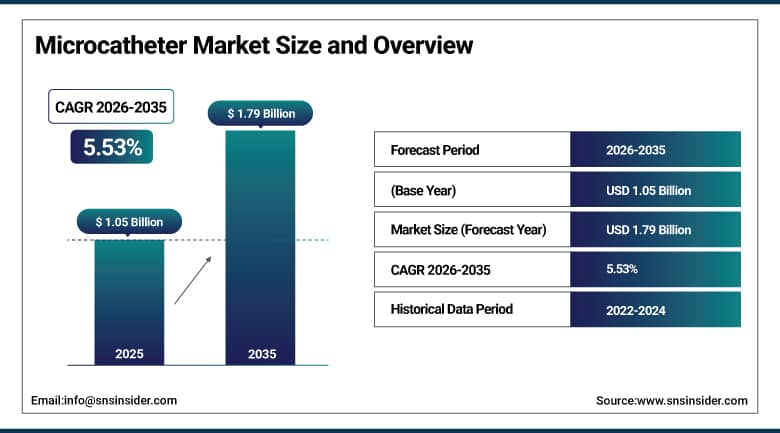
The Microcatheter Market was valued at USD 1.05 Billion in 2025 and is expected to reach USD 1.79 Billion by 2035, growing at a CAGR of 5.53% from 2026–2035.
The global microcatheter market is growing at a sustained and commercially significant pace. Microcatheters are thin, flexible tubes typically 0.5–1.5 mm in diameter designed to navigate complex, tortuous, and narrow vascular and non-vascular anatomical pathways to deliver therapies, embolic agents, contrast media, or mechanical devices to target locations that standard catheters cannot access. The market is experiencing significant growth driven by increasing demand for minimally invasive surgical procedures, advancements in catheter technology improving flexibility and navigability, and rising prevalence of cardiovascular and neurovascular diseases globally. About 805,000 heart attacks occur in the U.S. annually, underscoring the extraordinary demand for minimally invasive solutions. Microcatheters’ enhanced flexibility and navigability enable safer, more effective procedures, aligning with the global shift toward minimally invasive techniques.
In 2024, Stryker Corporation received FDA clearance for its next-generation Headway 27 microcatheter for neurovascular access, featuring enhanced torque response and distal tip softness for improved navigation through tortuous intracranial vessels during thrombectomy and aneurysm coiling procedures. The device’s improved torque transmission reduces operator corrective manoeuvres in challenging vessel anatomy, creating procedural efficiency improvements whose clinical value sustains premium specification in the neurovascular intervention programme whose technical performance directly impacts patient outcomes.
To Get More Information On Microcatheter Market - Request Free Sample Report
Microcatheter Market Trends:
-
Steerable microcatheters are gaining rapid adoption in neurovascular and peripheral vascular interventions due to their enhanced navigation capabilities in complex vessel anatomies
-
Increasing use of dual-lumen microcatheters is supporting advanced thrombectomy, coronary intervention, and targeted delivery procedures
-
Development of biodegradable and advanced biocompatible microcatheter materials is improving safety and reducing thrombogenic risks in vascular procedures
-
AI-assisted catheter navigation and robotic guidance technologies are enhancing procedural precision, efficiency, and reproducibility in interventional therapies
-
Growing adoption of microcatheters in interventional oncology is driving demand for minimally invasive treatments such as chemoembolization, radioembolization, and targeted tumor therapies
U.S. Microcatheter Market Outlook:
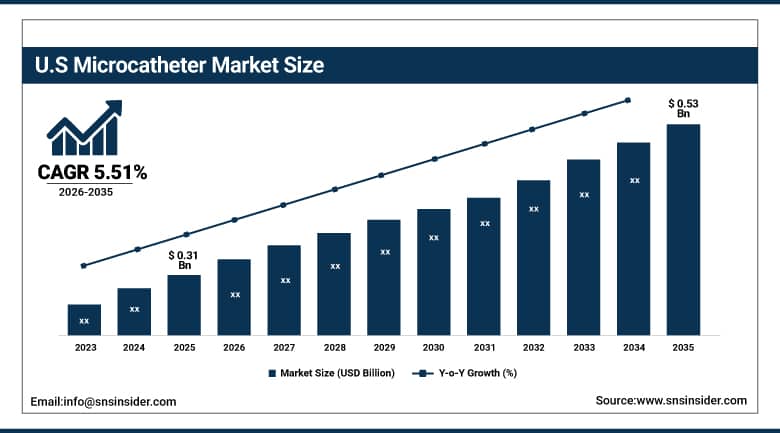
The U.S. Microcatheter Market was valued at approximately USD 0.31 Billion in 2025 and is expected to reach approximately USD 0.53 Billion by 2035, growing at a CAGR of approximately 5.51%.
The U.S. is the most commercially sophisticated microcatheter market within North America’s dominant revenue position. Stryker, Medtronic, Boston Scientific, Penumbra, and Merit Medical’s U.S. commercial operations collectively define the domestic microcatheter technology and commercial landscape. The FDA’s established 510(k) and PMA pathways for microcatheter clearance, CMS’ interventional procedure reimbursement, and the large interventional cardiology, neurointerventional radiology, and interventional oncology communities create the most commercially sophisticated microcatheter procurement environment globally.
Penumbra Inc. launched the 3D REVASCULARIZATION catheter system in 2024, combining aspiration microcatheter with integrated thrombus management for ischaemic stroke treatment, achieving above-conventional clot retrieval efficiency through continuous aspiration that reduces procedure time and improves first-pass effect. The system’s clinical performance documentation creates competitive differentiation in the neurovascular thrombectomy market whose outcome-sensitive procurement creates above-average adoption motivation for technically superior aspiration systems.
Microcatheter Market Segment Analysis:
-
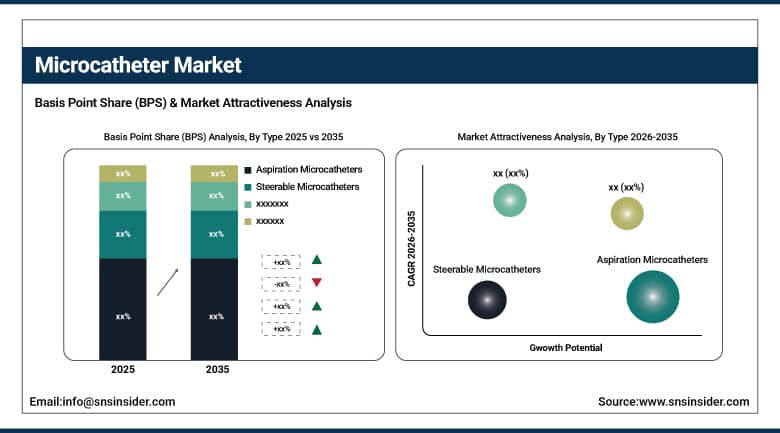
By Type, the Aspiration Microcatheters segment dominated the Microcatheter Market with approximately 36% share in 2025, , while the Steerable Microcatheters segment is the fastest growing with a CAGR of 7.86%.
-
By Design, the Single Lumen segment dominated the Microcatheter Market with approximately 58% share in 2025, while the Dual Lumen segment is the fastest growing.
-
By Application, the Cardiovascular segment dominated the Microcatheter Market with 43% share in 2025, while the Neurovascular segment is the fastest growing with a CAGR of 7.13%.
-
By End User, the Hospitals & Clinics segment dominated the Microcatheter Market with approximately 63% share in 2025, while the Ambulatory Surgical Centres segment is the fastest growing.
By Type, aspiration dominates, steerable grows fastest
Aspiration microcatheters retained the dominant type position with approximately 36% of the microcatheter market in 2025. The aspiration microcatheter’s commercial primacy reflects its critical role in the two highest-volume microcatheter-dependent emergency procedures: stroke thrombectomy and ST-elevation myocardial infarction’s thrombus aspiration. Each ischaemic stroke requiring mechanical thrombectomy creates aspiration microcatheter procurement whose per-procedure commercial value reflects the device’s critical role in recanalization. The extraordinary global stroke incidence of approximately 12.2 million annually creates consistent aspiration microcatheter demand whose emergency procedure character creates per-procedure clinical urgency that creates structured procurement independent of discretionary budget constraints.
Steerable microcatheters are the fastest-growing type at 7.86% CAGR because neurovascular interventions’ progressive complexity requires active deflection capability that fixed-curve alternatives cannot provide in the tortuous intracranial vasculature. Each new neurovascular interventional programme that establishes aneurysm coiling and AVM embolisation capability creates steerable microcatheter specification whose precision navigation requirement creates premium device procurement. The steerable catheter’s ability to reduce fluoroscopy time through more direct vessel navigation creates radiation exposure reduction whose safety benefit sustains specification preference.
By Application, cardiovascular dominates, neurovascular grows fastest
Cardiovascular applications retained the dominant position with 43% of the microcatheter market in 2025. The cardiovascular disease’s extraordinary global burden, encompassing coronary artery disease, chronic total occlusion, structural heart disease, and peripheral arterial disease, creates the most commercially concentrated microcatheter application category. Each percutaneous coronary intervention for coronary artery disease creates microcatheter delivery procurement whose per-procedure commercial value reflects the device’s essential role in guidewire delivery and stent placement. The global PCI procedure volume of approximately 3 million annually creates consistent cardiovascular microcatheter demand whose procedure volume sustains commercial dominance.
Neurovascular is the fastest-growing application at 7.13% CAGR because the rising incidence of ischaemic stroke, cerebral aneurysm, and arteriovenous malformation is creating growing endovascular treatment demand whose microcatheter-dependent procedural requirement creates structured commercial growth. The WHO’s documentation that stroke is the second leading cause of death globally, combined with the progressive adoption of mechanical thrombectomy as standard of care for large vessel occlusion stroke, creates procedure volume growth that sustains neurovascular microcatheter’s fastest-growing application status. Each stroke centre that establishes thrombectomy programme creates aspiration and delivery microcatheter procurement whose per-case economics sustain commercial relationships.
By End User, hospitals dominate, ASCs grow fastest
Hospitals and clinics retained the dominant end-user position with approximately 63% of the microcatheter market in 2025. The cardiac catheterisation laboratory, neurointerventional radiology suite, and interventional oncology unit’s hospital infrastructure concentration creates inherent microcatheter procurement concentration in hospital settings. Each hospital that operates a cardiac catheterisation laboratory, stroke programme, or interventional oncology service creates consistent microcatheter procurement whose per-procedure commercial value reflects the device’s critical procedural role. The hospital’s comprehensive patient management capability, whose pre-procedure imaging, anaesthesia, and post-procedure intensive care create a complete procedural infrastructure, sustains the majority of complex high-risk vascular interventions in hospital settings.
Ambulatory surgical centres are the fastest-growing end user because the migration of selected elective peripheral vascular and lower-risk cardiovascular procedures from inpatient hospital to outpatient ASC settings creates new procurement channels whose per-procedure economics create commercial differentiation. Each ASC that establishes vascular interventional capability creates microcatheter procurement whose lower facility cost creates payer motivation for procedure migration that sustains ASC’s fastest-growing commercial momentum.
Regional Analysis:
|
Region |
Major Country |
Share within Region, 2025 (%) |
|---|---|---|
|
North America |
United States |
87.4% |
|
Europe |
Germany |
22.3% |
|
Asia Pacific |
China |
44.8% |
|
Middle East & Africa |
Saudi Arabia |
31.2% |
|
Latin America |
Brazil |
44.2% |
North America Microcatheter Market Insights
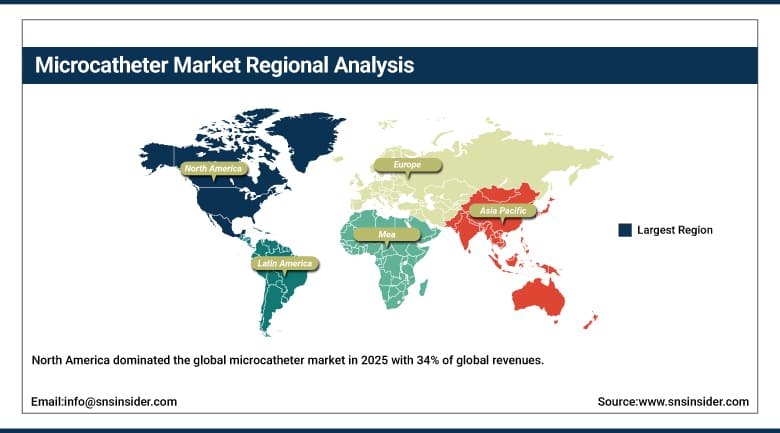
North America dominated the global microcatheter market in 2025 with 34% of global revenues. The United States accounts for approximately 87.4% of North American revenues through Stryker, Medtronic, Boston Scientific, Penumbra, and Merit Medical’s commercial operations. The advanced interventional cardiology, neurointerventional radiology, and interventional oncology communities create the world’s most commercially sophisticated microcatheter deployment environment, sustaining premium device specification that creates above-market per-unit commercial value.
Canada contributes approximately 12.6% of North American revenues through its cardiac catheterisation laboratory network, the growing neurointerventional programme, and the health system’s progressive interventional procedure investment.
Get Customized Report as Per Your Business Requirement - Enquiry Now
Europe Microcatheter Market Insights
Europe is a technically sophisticated microcatheter market where CE marking’s product quality standard, European Society of Cardiology’s clinical guidelines, and the neurovascular intervention programme’s progressive adoption create structured institutional demand. Germany accounts for approximately 22.3% of European revenues through its advanced cardiac catheterisation laboratory infrastructure, the university hospital system’s neurointerventional programme, and the comprehensive stroke centre network’s thrombectomy programme.
France, Italy, and the United Kingdom are significant secondary markets where national stroke programme investment, cardiac catheterisation programme infrastructure, and interventional oncology adoption create consistent microcatheter procurement.
Asia Pacific Microcatheter Market Insights
Asia Pacific is the fastest-growing regional microcatheter market, driven by rising cardiovascular and neurovascular disease burden in China, India, Japan, and South Korea, expanding interventional care infrastructure, and the progressive adoption of minimally invasive procedures. China accounts for approximately 44.8% of Asia Pacific revenues through its extraordinary hospital catheterisation laboratory expansion, the stroke programme’s thrombectomy adoption, and the cardiovascular disease’s escalating burden from lifestyle and demographic factors.
India’s rapidly expanding cardiac catheterisation programme, Japan’s advanced interventional infrastructure, and South Korea’s sophisticated hospital system create significant secondary markets whose combined procurement reinforces Asia Pacific’s fastest-growing regional status.
MEA & Latin America Microcatheter Market Insights
Saudi Arabia leads MEA revenues at approximately 31.2% through its advanced cardiac hospital network, the Ministry of Health’s cardiovascular programme investment, and the growing neurointerventional programme. Brazil leads Latin American revenues at approximately 44.2% through its large cardiac catheterisation laboratory network, the comprehensive stroke centre development, and the growing interventional oncology programme.
Market Dynamics:
Growth Drivers: Rising cardiovascular and neurovascular disease burden and minimally invasive procedure adoption
Rising global prevalence of cardiovascular disease and neurovascular disorders is the microcatheter market’s most commercially certain structural growth driver. WHO’s documentation that cardiovascular disease accounts for 32% of all global deaths, combined with stroke’s position as the second leading cause of death and the leading cause of disability, creates the most clinically urgent microcatheter demand whose emergency procedure character creates procurement independent of discretionary budget cycles. The global aging population’s progressive cardiovascular risk factor accumulation creates growing procedural volume that compounds with each year’s demographic progression. Each new cardiac catheterisation laboratory commissioned in an emerging market creates microcatheter procurement whose first-time adoption creates net new commercial volume.
The progressive global adoption of minimally invasive catheter-based procedures as standard of care for vascular disease treatment creates systematic microcatheter demand growth. Each new consensus guideline that endorses mechanical thrombectomy for large vessel occlusion stroke creates institutional programme investment whose procedural volume creates consistent microcatheter procurement. The clinical evidence demonstrating minimally invasive approaches’ superior outcomes for selected vascular conditions creates physician adoption motivation that sustains procedure volume growth.
Restraints: High device cost and regulatory approval complexity in emerging markets
Premium microcatheter device cost, ranging from USD 200-2,000 per device depending on technology complexity, creates procurement constraint in emerging market healthcare systems whose per-procedure reimbursement cannot accommodate premium device economics. Each hospital whose DRG reimbursement creates per-procedure cost constraint creates value-based purchasing pressure that moderates premium microcatheter specification in cost-sensitive procurement environments.
Regulatory approval pathway complexity in emerging markets, whose device registration processes create 12-24 month approval timelines before commercial sale, moderates the pace of market entry for new premium microcatheter technologies whose global commercial rollout is sequenced by regulatory approval timeline. Each market whose approval timeline extends commercially successful device availability creates market access delay that moderates commercial growth.
Opportunities: Steerable microcatheter neurovascular adoption and robotic catheter navigation
Steerable microcatheter’s neurovascular adoption represents the most commercially premium near-term growth opportunity whose active deflection capability creates procedural differentiation that fixed-curve alternatives cannot provide in the most technically demanding intracranial vascular interventions. Each neurointerventional programme that adopts steerable microcatheter as standard equipment for aneurysm coiling and AVM embolisation creates premium procurement whose per-device commercial value substantially exceeds standard fixed-curve alternatives.
Robotic catheter navigation system integration with advanced microcatheters creates a new premium intervention category whose precision, reproducibility, and radiation reduction create institutional adoption motivation that manual catheterisation systems cannot provide equivalently. Each robotic catheterisation laboratory installation creates microcatheter specification optimised for robotic interface whose compatibility requirements create new commercial procurement categories.
Recent Developments:
-
2024: Stryker Corporation received FDA clearance for its next-generation Headway 27 microcatheter in 2024, featuring enhanced torque response and distal tip softness for improved navigation through tortuous intracranial vessels during thrombectomy and aneurysm coiling.
-
2024: Penumbra Inc. launched the 3D REVASCULARIZATION catheter system in 2024 combining aspiration microcatheter with integrated thrombus management for ischaemic stroke treatment, achieving above-conventional clot retrieval efficiency through continuous aspiration.
-
2024: Medtronic launched the Solitaire X revascularization device with compatible Phenom 27 microcatheter system in 2024, offering improved microcatheter-device compatibility for neurovascular thrombectomy whose integrated system design reduces preparation time and improves procedural efficiency.
Microcatheter Market Key Players:
-
Stryker Corporation
-
Medtronic PLC
-
Boston Scientific Corporation
-
Penumbra Inc.
-
Merit Medical Systems Inc.
-
Terumo Corporation
-
Asahi Intecc Co., Ltd.
-
Teleflex Incorporated
-
Cook Medical Inc.
-
AngioDynamics Inc.
-
Becton, Dickinson and Company (BD)
-
Cardinal Health Inc.
-
Baylis Medical Company Inc.
-
Lepu Medical Technology Co., Ltd.
-
Kaneka Corporation
-
MicroVention Inc.
-
Balt Group
-
Acandis GmbH & Co. KG
-
Surmodics Inc.
-
Integer Holdings Corporation
Microcatheter Market Report Scope:
| Report Attributes | Details |
|---|---|
| Market Size in 2025 | USD 1.05 Billion |
| Market Size by 2035 | USD 1.79 Billion |
| CAGR | CAGR of 5.53% From 2026 to 2035 |
| Base Year | 2025 |
| Forecast Period | 2026-2035 |
| Historical Data | 2022-2024 |
| Report Scope & Coverage | Market Size, Segments Analysis, Competitive Landscape, Regional Analysis, DROC & SWOT Analysis, Forecast Outlook |
| Key Segments | • by Type (Aspiration Microcatheters, Delivery Microcatheters, Diagnostic Microcatheters, Steerable Microcatheters) • by Design (Single Lumen, Dual Lumen) • by Application (Cardiovascular/Cardiology, Neurovascular/Neurology, Peripheral Vascular, Oncology, Urology & Gynaecology, Others) • by End User (Hospitals & Clinics, Ambulatory Surgical Centres, Specialty Catheterisation Laboratories, Others) |
| Regional Analysis/Coverage | North America (US, Canada, Mexico), Europe (Eastern Europe [Poland, Romania, Hungary, Turkey, Rest of Eastern Europe] Western Europe] Germany, France, UK, Italy, Spain, Netherlands, Switzerland, Austria, Rest of Western Europe]), Asia Pacific (China, India, Japan, South Korea, Vietnam, Singapore, Australia, Rest of Asia Pacific), Middle East & Africa (Middle East [UAE, Egypt, Saudi Arabia, Qatar, Rest of Middle East], Africa [Nigeria, South Africa, Rest of Africa], Latin America (Brazil, Argentina, Colombia, Rest of Latin America) |
| Company Profiles | Stryker Corporation, Medtronic PLC, Boston Scientific Corporation, Penumbra Inc., Merit Medical Systems Inc., Terumo Corporation, Asahi Intecc Co., Ltd., Teleflex Incorporated, Cook Medical Inc., AngioDynamics Inc., Becton, Dickinson and Company (BD), Cardinal Health Inc., Baylis Medical Company Inc., Lepu Medical Technology Co., Ltd., Kaneka Corporation, MicroVention Inc., Balt Group, Acandis GmbH & Co. KG, Surmodics Inc., Integer Holdings Corporation |
Frequently Asked Questions
The Microcatheter Market is expected to grow at a CAGR of 5.53% from 2026 to 2035.
The Microcatheter Market was valued at USD 1.05 Billion in 2025.
Rising prevalence of cardiovascular and neurovascular diseases including stroke and coronary artery disease creating demand for minimally invasive catheter-based interventions, and technological advancements in microcatheter design improving flexibility, navigability, and precision in complex vascular procedures.
Aspiration Microcatheters dominated the Microcatheter Market with approximately 36% share in 2025, while Steerable Microcatheters is the fastest growing with a CAGR of 7.86%.
Cardiovascular dominated the Microcatheter Market with 43% share in 2025, while the Neurovascular segment is the fastest growing with a CAGR of 7.13%.
