
Mobile Application Security Market Report Scope & Overview:
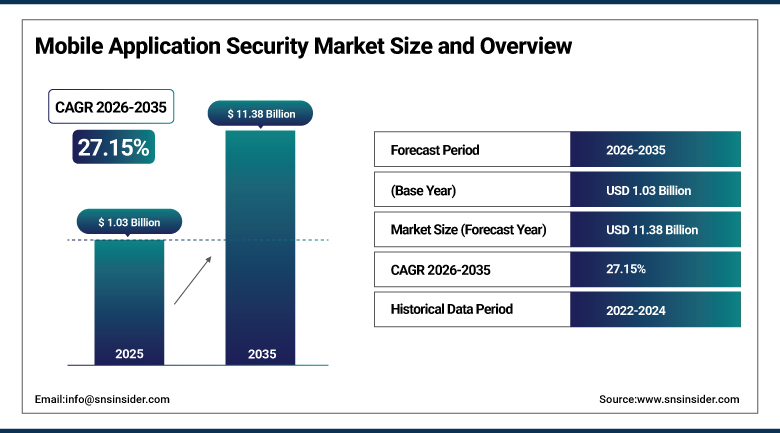
The Mobile Application Security Market was valued at USD 1.03 Billion in 2025 and is expected to reach USD 11.38 Billion by 2035, growing at a CAGR of 27.15% from 2026 to 2035.
The Mobile Application Security Market is growing rapidly owing to the rising usage of mobile applications in the BFSI, healthcare, retail, and government industries. Growing cybersecurity threats, including hacking, data theft, malware infections, etc., related to mobile application usage have triggered the requirement for robust security solutions. Compliance regulations pertaining to privacy of data are expected to boost adoption rates even further. With the advent of mobile banking, digital transactions, e-commerce, etc., security vulnerabilities have increased manifold.
According to the International Telecommunication Union (ITU), there are over 5.4 billion mobile phone users globally, representing more than two-thirds of the world’s population, highlighting the rapid expansion of mobile connectivity and accelerating digital and financial adoption worldwide. According to GSMA, global mobile internet users exceed 4.7 billion, while mobile connections surpass 11 billion, including IoT-enabled devices, reflecting large-scale growth in connected ecosystems and increasing reliance on mobile networks for communication and digital services.
Market Size and Forecast
-
Market Size in 2026E: USD 1.31 Billion
-
Market Size by 2035: USD 11.38 Billion
-
CAGR: 27.15% from 2026 to 2035
-
Fastest Growing Region: Asia Pacific
-
Largest Region: North America
To Get more information AI Server Market - Request Free Sample Report
Mobile Application Security Market Trends
-
Rising use of smartphones and mobile-based services for banking, shopping, and communication is driving the mobile application security market.
-
Growing frequency of mobile cyberattacks, malware, and phishing threats is boosting market growth.
-
Expansion of enterprise mobility, BYOD policies, and remote work environments is fueling security solution adoption.
-
Increasing focus on protecting sensitive user data, financial transactions, and app integrity is shaping adoption trends.
-
Advancements in runtime application self-protection (RASP), AI-driven threat detection, and encryption technologies are enhancing security capabilities.
The U.S. Mobile Application Security Market Outlook
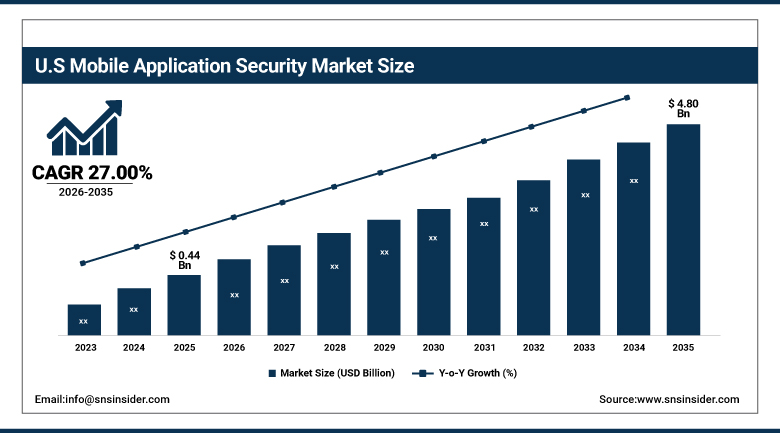
The U.S. Mobile Application Security Market was valued at approximately USD 0.44 Billion in 2025 and is expected to reach approximately USD 4.80 Billion by 2035, growing at a CAGR of approximately 27.00%.
The United States is the world's most commercially advanced mobile application security market, driven by the highest enterprise mobile application deployment density among major economies, the most stringent and actively enforced mobile application security regulatory framework, and the concentration of both mobile application security technology vendors and their target enterprise customers in the same commercial ecosystem. U.S. financial services regulators including the Office of the Comptroller of the Currency and the Consumer Financial Protection Bureau have issued guidance specifically addressing mobile banking application security requirements that create compliance-driven investment mandates.
Mobile Application Security Market Segment Analysis
-
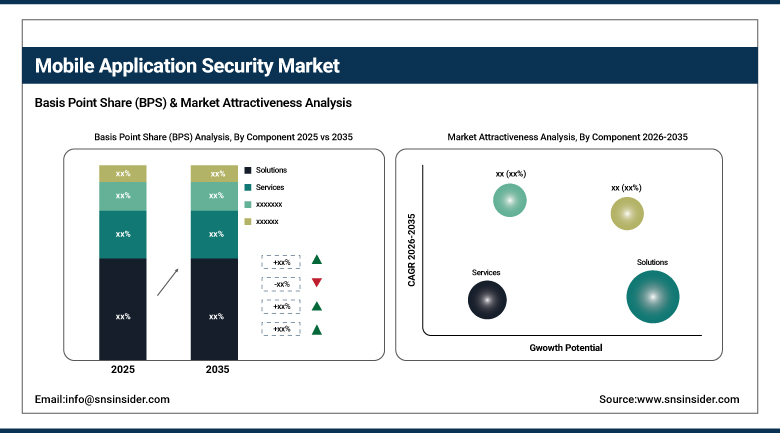
By Component, Solutions segment dominated the Mobile Application Security Market in 2025 with 64% share; Services segment is the fastest growing segment.
-
By Deployment Mode, Cloud-based segment dominated the Mobile Application Security Market in 2025 with 58% share; Cloud-based segment is also the fastest growing segment.
-
By Testing Method, Static Application Security Testing (SAST) segment dominated the market in 2025 with 37% share; Interactive Application Security Testing (IAST) segment is the fastest growing segment.
-
By Industry Vertical, Banking, Financial Services & Insurance (BFSI) segment dominated the market in 2025 with 29% share; Healthcare & Life Sciences segment is the fastest growing segment.
By Component, Solutions segment dominates the Mobile Application Security Market, Services segment expected to grow fastest
The Solutions segment dominated the Mobile Application Security Market in 2025 owing to the growing demand for highly sophisticated security platforms that could detect threats in real time, manage vulnerabilities, and offer secure coding systems. Enterprises are increasingly opting for integrated security solutions that help protect their mobile applications against malware, phishing attacks, and any potential data breach. The high usage of mobile apps by businesses, banking sectors, and retail enterprises has fueled the demand for better security solutions. Continuous advancements in AI-powered threat intelligence and automated testing have added momentum to the solutions segment.
The Services segment is the fastest growing due to high demand for consulting services, implementation services, training, and managed security services for mobile applications. Many enterprises do not have enough in-house cybersecurity professionals and depend on outside experts for deploying and monitoring their mobile application security infrastructure. The complex mobile threat landscape and frequent mobile application updates make it necessary to keep performing security assessments continuously.
By Deployment Mode, Cloud-based segment dominates the Mobile Application Security Market, Cloud-based segment expected to grow fastest
The Cloud-based segment dominated the Mobile Application Security Market in 2025 owing to benefits such as scalability, quick deployment, and efficient security management. This is because organizations have started preferring cloud-based platforms for real-time threat detection, automatic updates, and easy integration with mobile application development frameworks. This market segment also represents the fastest growing segment, as companies are gradually transitioning from traditional methods of operation to a cloud-based environment in order to implement their mobile-first strategy. The increasing need for threat intelligence using artificial intelligence and the increased threat of cybersecurity attacks on mobile applications has also contributed significantly to its growth.
By Testing Method, SAST segment dominates the Mobile Application Security Market, IAST segment expected to grow fastest
Static Application Security Testing (SAST) dominated the market in 2025 owing to its capability to identify application weaknesses at the very onset of the application development process through the analysis of source code prior to execution. SAST is a popular solution that is extensively used in DevSecOps for discovering coding errors, security flaws, and compliance requirements. The use of SAST solutions assists businesses in saving money on remediation and improving application security during their development process. The integration capabilities of SAST solutions into development processes make them even more dominant.
The Interactive Application Security Testing (IAST) segment is the fastest growing due to its real-time vulnerability detection during application runtime. IAST combines benefits of both static and dynamic testing, providing highly accurate and context-aware security insights. Increasing adoption of agile development and continuous integration/continuous deployment (CI/CD) practices is driving demand for faster and more precise testing methods. Organizations are also adopting IAST to improve threat visibility, reduce false positives, and enhance overall application security efficiency.
By Industry Vertical, BFSI segment dominates the Mobile Application Security Market, Healthcare & Life Sciences segment expected to grow fastest.
The Banking, Financial Services & Insurance (BFSI) segment dominated the Mobile Application Security Market in 2025 due to its higher vulnerability to cyber risks along with stringent compliance policies. The financial institutions store personal information of customers and manage their online transactions through mobile banking applications which makes them susceptible to various cyber risks. With increased digitization in the sector and use of financial technology and mobile payment platforms, there is greater emphasis on creating security frameworks to protect organizations against these risks.
The Healthcare & Life Sciences segment is the fastest growing driven by the fast-paced digital transformation in the industry and the increased use of mobile applications for patient-related activities such as telemedicine. As cyber attacks on the healthcare system are on the rise, organizations in this vertical are now investing more in implementing advanced security solutions due to greater emphasis on protecting patient data from any kind of breach.
Regional Analysis
|
Region |
Major Country |
Share within Region, 2025 (%) |
|---|---|---|
|
North America |
United States |
84.73% |
|
Europe |
United Kingdom |
28.47% |
|
Asia Pacific |
India |
34.82% |
|
Middle East & Africa |
UAE |
22.84% |
|
Latin America |
Brazil |
43.84% |
North America Mobile Application Security Market Insights
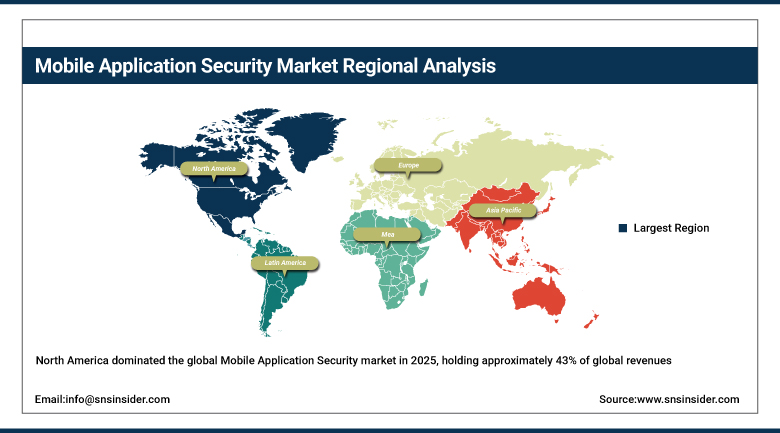
North America dominated the global Mobile Application Security market in 2025, holding approximately 43% of global revenues. The United States accounts for approximately 84.73% of regional revenue through its concentration of enterprise mobile application deployments, the highest mobile commerce and mobile banking transaction volumes globally, and the regulatory compliance framework that creates non-discretionary mobile security investment across BFSI, healthcare, and government sectors. Canada contributes supplementary demand through its aligned financial services regulatory framework and its growing technology sector whose enterprise mobile application deployments create comparable security investment profiles to U.S. counterparts.
According to the FBI Internet Crime Complaint Center (IC3), mobile phishing, SMS-based attacks, and app impersonation contribute significantly to cybercrime losses exceeding $12 billion annually, highlighting rising risks across mobile-first digital environments and financial applications.
According to the U.S. Census Bureau, over 90% of U.S. adults use smartphones, making mobile applications a primary digital access point for communication, payments, and services, and increasing reliance on secure mobile ecosystems and cybersecurity measures.
Get Customized Report as per Your Business Requirement - Enquiry Now
Europe Mobile Application Security Market Insights
Europe held a significant share of the global Mobile Application Security market in 2025. GDPR's data protection requirements for mobile applications processing EU resident personal data, the Digital Operational Resilience Act's mobile application security obligations for financial services firms, and the NIS2 Directive's cybersecurity requirements for critical infrastructure operators collectively create a comprehensive regulatory mandate framework for mobile application security investment across European enterprises. Germany, France, the United Kingdom, and the Netherlands are the leading national markets whose financial services, healthcare, and enterprise software sectors generate substantial mobile application security platform demand.
According to Eurostat, over 75% of EU citizens use smartphones to access the internet, significantly increasing mobile application exposure risks and highlighting growing concerns around digital security, data privacy, and secure mobile ecosystem usage across the region.
According to the European Central Bank (ECB), over 60% of digital payments in several EU countries are now mobile-based, increasing security requirements for BFSI applications and driving stronger authentication, fraud prevention, and digital payment infrastructure resilience.
Asia Pacific Mobile Application Security Market Insights
Asia Pacific is the fastest-growing regional Mobile Application Security market, driven by the world's largest smartphone user base, the rapid growth of mobile commerce and digital financial services across China, India, Southeast Asia, and South Korea, and the progressive development of national cybersecurity regulatory frameworks that are creating compliance-driven mobile security investment.
According to GSMA Mobile Economy Asia-Pacific Report, APAC accounts for over 60% of global mobile users, with rapidly rising smartphone adoption across India, China, and Southeast Asia, driven by expanding digital connectivity and mobile-first service ecosystems.
India accounts for approximately 34.82% of Asia Pacific revenues through its enormous smartphone user population, the rapid expansion of its digital payments infrastructure under the UPI system, and the growing mobile application deployment of its large IT services and fintech sectors.
According to India digital economy data, over 800 million smartphone users are driving rapid adoption of UPI-based mobile payments across the country, accelerating financial inclusion, digital transactions, and mobile-first economic ecosystem expansion nationwide adoption trend.
China's mobile commerce scale, mobile gaming industry, and government cybersecurity regulations create substantial domestic mobile application security market demand.
According to the Ministry of Industry and Information Technology (MIIT), China has over 1.1 billion internet users, with mobile applications dominating digital transactions across platforms, reflecting massive scale of mobile-first digital economy infrastructure ecosystems systems growth.
MEA & Latin America Mobile Application Security Market Insights
Middle East and Latin America are growing Mobile Application Security markets where rapidly expanding mobile user bases, growing digital financial services adoption, and emerging national cybersecurity regulatory frameworks are creating increasing commercial demand. The UAE leads MEA revenues at approximately 22.84% of the regional total through its advanced digital economy infrastructure, the smart government initiative's extensive mobile application deployment, and its cybersecurity regulatory framework that includes specific mobile application security requirements.
Brazil leads Latin American revenues at approximately 43.84% of the regional total through its enormous smartphone user population, the world's leading digital banking adoption rate, and the Lei Geral de Proteção de Dados personal data protection law that creates GDPR-equivalent mobile application data security obligations.
Market Dynamics
Growth Drivers: Escalating mobile cyber threats and mobile-first digital transformation are driving strong structural demand for security solutions globally.
The mobile application security market's growth is driven by the convergence of a rapidly expanding mobile attack surface and the escalating capability of threat actors targeting it. Mobile malware sophistication has advanced dramatically in recent years, with state-sponsored threat actors, financially motivated cybercriminal organisations, and commercial spyware vendors each investing in mobile exploitation techniques whose capability now includes zero-click delivery exploits, persistent rootkit-level access, and supply chain attacks through compromised mobile SDK libraries. Each high-profile mobile application breach generates enterprise security awareness and investment urgency that sustains demand growth independent of underlying platform adoption rates.
Restraints: Developer resistance to security testing and complex multi-device environments are slowing mobile application security adoption across enterprises.
Mobile application security testing integration within agile development sprints requires developers to accept security-induced build delays, vulnerability remediation interruptions, and additional tool management overhead that create resistance in high-velocity software development teams whose productivity metrics do not capture the long-term security debt that skipping security testing accumulates. Organisations that have established mature DevSecOps practices absorb these friction costs successfully, but the majority of enterprise mobile application development teams are still in the early stages of DevSecOps adoption where security testing is perceived as a development velocity constraint rather than a development quality enabler.
Opportunities: AI-powered runtime protection and healthcare mobile application security expansion represent major high-value growth opportunities
Runtime application self-protection systems that deploy AI-powered behavioural monitoring engines within mobile application runtime environments, detecting and blocking exploitation attempts in real time without requiring prior vulnerability knowledge, represent the most commercially significant technology advancement opportunity in mobile application security. RASP eliminates the detection gap between vulnerability discovery and patch deployment that creates the window of opportunity that attackers exploit in conventional static defence approaches.
Healthcare mobile application security represents the fastest-growing and highest-value industry vertical opportunity, with the global expansion of telehealth platforms, hospital mobile health application deployment, and pharmaceutical company patient engagement applications creating a mobile application population handling extraordinarily sensitive data whose regulatory security obligations and liability exposure create the most compelling commercial investment case in any sector.
Recent Developments:
-
2025: Symantec introduced its cloud-based Mobile Threat Defense platform with AI-driven detection capabilities offering automated vulnerability scanning and real-time incident response for BFSI and healthcare enterprises, integrating with leading MDM solutions to eliminate separate security agent deployment requirements.
-
2025: Lookout Security expanded its Cloud Security Platform with unified mobile endpoint detection, response, and cloud application access control through a mobile-first SASE architecture, enabling consistent security policy enforcement across mobile device and cloud application access without separate tool deployment.
-
2024: NowSecure released its Platform 4.0 automated mobile application security testing suite incorporating AI-powered privacy analysis and OWASP MASVS compliance verification, enabling enterprise security teams to assess mobile application security and regulatory compliance coverage within automated CI/CD pipeline integration.
Mobile Application Security Market Key Players are:
-
IBM Corporation
-
Symantec Corporation
-
Trend Micro Inc.
-
Check Point Software Technologies Ltd.
-
Qualys Inc.
-
Veracode
-
Zimperium Inc.
-
NowSecure
-
Lookout Inc.
-
MobileIron / Ivanti
-
McAfee LLC
-
Pradeo Security Systems
-
Guardsquare NV
-
Synopsys, Inc.
-
Rapid7, Inc.
-
WhiteHat Security (Synopsys)
-
AppDome
-
F5, Inc.
Mobile Application Security Market Report Scope:
| Report Attributes | Details |
|---|---|
| Market Size in 2025 | USD 1.03 Billion |
| Market Size by 2035 | USD 11.38 Billion |
| CAGR | CAGR of 27.15% From 2026 to 2035 |
| Base Year | 2025 |
| Forecast Period | 2026-2035 |
| Historical Data | 2022-2024 |
| Report Scope & Coverage | Market Size, Segments Analysis, Competitive Landscape, Regional Analysis, DROC & SWOT Analysis, Forecast Outlook |
| Key Segments | • By Component (Solutions, Services) • By Deployment Mode (Cloud-based, On-premises) • By Testing Method (Static Application Security Testing [SAST], Dynamic Application Security Testing [DAST], Interactive Application Security Testing [IAST]) • By Industry Vertical (Banking, Financial Services & Insurance [BFSI], Healthcare & Life Sciences, IT & Telecommunications, Retail & E-commerce, Government & Defense, Media & Entertainment, Others) |
| Regional Analysis/Coverage | North America (US, Canada), Europe (Germany, UK, France, Italy, Spain, Russia, Poland, Rest of Europe), Asia Pacific (China, India, Japan, South Korea, Australia, ASEAN Countries, Rest of Asia Pacific), Middle East & Africa (UAE, Saudi Arabia, Qatar, South Africa, Rest of Middle East & Africa), Latin America (Brazil, Argentina, Mexico, Colombia, Rest of Latin America). |
| Company Profiles | IBM Corporation, Symantec Corporation, Trend Micro Inc., Check Point Software Technologies Ltd., Cisco Systems Inc., Qualys Inc., Veracode, Zimperium Inc., NowSecure, Lookout Inc., MobileIron / Ivanti, McAfee LLC, Pradeo Security Systems, Guardsquare NV, Checkmarx Ltd., Synopsys, Inc., Rapid7, Inc., WhiteHat Security (Synopsys), AppDome, F5, Inc. |
Frequently Asked Questions
The Mobile Application Security Market is expected to grow at a CAGR of 27.15% from 2026 to 2035.
The Mobile Application Security Market was valued at USD 1.03 Billion in 2025.
Escalating mobile cyber threats and mobile-first digital transformation are driving strong structural demand for security solutions globally.
The BFSI segment dominated the Mobile Application Security Market with 29% share in 2025.
North America dominated the Mobile Application Security Market in 2025, holding approximately 43% of global revenues.
