
Mobile Mapping Market Report Scope & Overview:
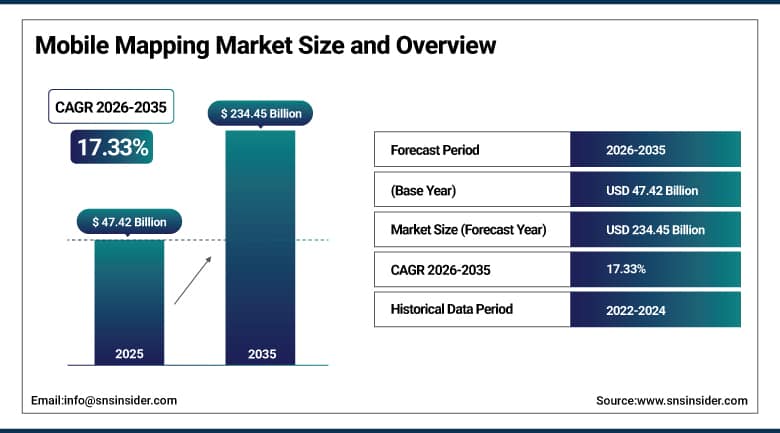
The Mobile Mapping Market was valued at USD 47.42 Billion in 2025 and is expected to reach USD 234.45 Billion by 2035, growing at a CAGR of 17.33% from 2026 to 2035.
The Mobile Mapping Market is growing rapidly due to rising demand for high-resolution geospatial data in applications ranging from transportation to urban planning, infrastructure management, and autonomous mobility. Increased usage of LiDAR technology, GNSS, artificial intelligence-driven imagery analysis, and drones for mapping is increasing the efficiency of data gathering processes. Heavy investments by governments and private firms in smart cities, digital infrastructure, and intelligent transport systems add momentum to the demand. Increasing demand for mobile mapping in environmental monitoring, construction, utility management, mining, and asset management, alongside innovations in cloud geospatial platforms and real-time data analysis, is boosting the market’s growth.
Mobile mapping demand surpassed 12 million units in 2025, driven by smart city projects, autonomous vehicles, and advanced surveying solutions, reflecting just how broadly the technology has spread across both public infrastructure and private industry applications.
Market Size and Forecast
-
Market Size in 2026E: USD 55.64 Billion
-
Market Size by 2035: USD 234.45 Billion
-
CAGR: 17.33% from 2026 to 2035
-
Fastest Growing Region: Asia Pacific
-
Largest Region: North America
To Get More Information On Mobile Mapping Market - Request Free Sample Report
Mobile Mapping Market Trends
-
Rising adoption of smart city initiatives is fueling demand for advanced mapping and geospatial solutions across urban planning and infrastructure management.
-
Integration of autonomous vehicles and drones is accelerating the use of UAV- and vehicle-mounted mapping platforms across both public and private sectors.
-
Governments and private enterprises are increasingly investing in advanced geospatial and mapping technologies for urban planning, infrastructure monitoring, and transportation management.
-
The need for precise, real-time spatial data is boosting demand across UAV, terrestrial, and handheld mapping platforms alike.
-
Advancements in LiDAR, GNSS, and photogrammetry continue improving accuracy and lowering the cost barrier to mobile mapping adoption across new industries.
The U.S. Mobile Mapping Market Outlook
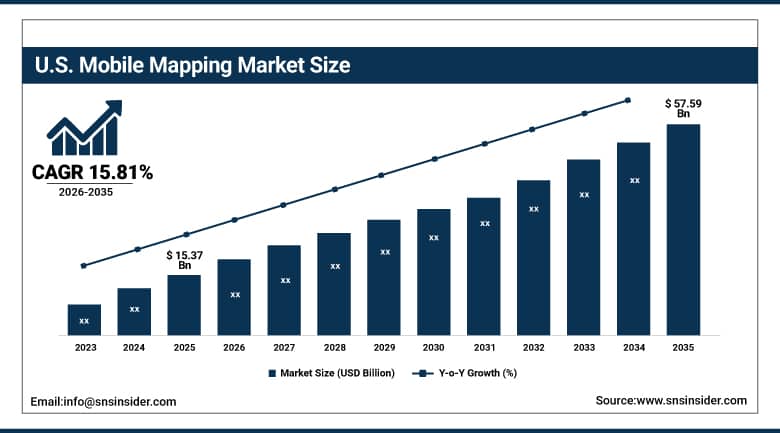
The U.S. Mobile Mapping Market was valued at approximately USD 15.37 Billion in 2026 and is expected to reach approximately USD 57.59 Billion by 2035, growing at a CAGR of approximately 15.81%.
Growth in the U.S. market is being driven by rapid urbanization, infrastructure modernization, and expanding smart city initiatives across the country's largest metropolitan areas. Rising adoption of UAVs, LiDAR, and photogrammetry solutions, alongside increasing autonomous vehicle deployment and expanding geospatial data applications, is driving technological innovation, real-time mapping capability, and integrated surveying solutions across both government agencies and private enterprise. Expanding smart city projects and autonomous vehicle adoption keep fueling robust demand for advanced mapping solutions, and governments and private enterprises alike are increasingly investing in geospatial technology specifically for urban planning, infrastructure monitoring, and transportation management.
Trimble Inc. launched its Applanix POS LVX+ and POS AVX RTX mobile mapping systems in October 2025 at INTERGEO 2025, offering centimeter-level positioning accuracy for both land and airborne applications, meaningfully enhancing geospatial workflow productivity for surveying, construction, and infrastructure projects across the U.S.
Mobile Mapping Market Segment Analysis
-
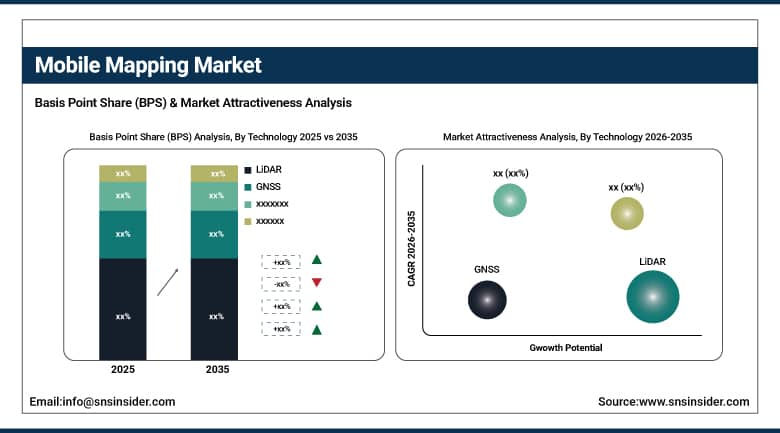
By Technology, LiDAR segment dominated the Mobile Mapping Market in 2025 with 36% share; GNSS (Global Navigation Satellite System) segment is the fastest growing segment.
-
By Platform, UAV/Drones segment dominated the market in 2025 with 39% share; Handheld Devices segment is the fastest growing segment.
-
By Application, Transportation & Logistics segment dominated the market in 2025 with 27% share; Urban Planning & Smart Cities segment is the fastest growing segment.
-
By End User, Government & Public Sector segment dominated the market in 2025 with 31% share; Transportation & Logistics Providers segment is the fastest growing segment.
By Technology, LiDAR segment dominates the Mobile Mapping Market, GNSS segment expected to grow fastest
LiDAR dominated the Mobile Mapping Market in 2025 due to its capability to provide highly accurate three-dimensional spatial data with great speed and precision. LiDAR works effectively in all types of terrain and different lighting conditions, and hence the technology has been the most favorable in the case of transportation infrastructure, road asset management, urban mapping, and autonomous vehicle mapping among others. Increasing investments in the area of smart cities, digital twins, and geospatial surveying contributed to more usage of LiDAR technology.
GNSS is the fastest-growing technology segment due to the rising need for accurate positioning and real-time navigation in drone mapping, autonomous mobility, and infrastructure inspection areas. Improvements in the satellite constellations, multiband receivers, and corrections services have greatly increased the positioning accuracy. Increased integration of GNSS with LiDAR, IMU, and AI mapping platforms enables easy geospatial data collection, while the expansion of connected transport and smart infrastructure projects continues to boost its adoption.
By Platform, UAV/Drones segment dominates the Mobile Mapping Market, Handheld Devices segment expected to grow fastest
UAV/Drones dominated the Mobile Mapping Market in 2025 owing to their quickness, cost-effectiveness, and high-resolution mapping capabilities that cover expansive or hard-to-reach areas. UAVs considerably reduced the time spent during the survey and made surveys safer through increased operational safety during construction, mining, agriculture, utilities, and disasters. The advancements in LiDAR, camera technology, and AI-based image processing have resulted in efficient mapping of areas. Increased government funding in infrastructure and environmental monitoring are factors adding value to demand for UAV-based mobile mapping systems.
Handheld devices are the fastest-growing platform as they are portable, easy to use, and capable of providing highly precise mapping in indoor and GPS-challenging locations. These are extensively being used for building inspection, facility management, cultural documentation, and public safety. Constant advancements in lightweight LiDAR sensors, improved mobile computing, and cloud-based data processing have enabled faster data acquisition and analysis. Demand for flexible on-site mapping services has fuelled the rapid growth of handheld mobile mapping systems.
By Application, Transportation & Logistics segment dominates the Mobile Mapping Market, Urban Planning & Smart Cities segment expected to grow fastest
Transportation & Logistics dominated the Mobile Mapping Market in 2025 because governments and organizations were using geospatial information to manage assets, conduct traffic studies, plan roads, maintain highways, inspect railways, and navigate fleet. Mobile mapping helps in effective asset management, traffic studies, infrastructure monitoring, and saving costs of operations. With the accelerated deployment of intelligent transport systems, connectivity, and autonomous vehicles testing, there is an increasing need for accurate mapping technologies among others.
Urban Planning & Smart Cities is the fastest-growing application segment due to increased adoption of digital technologies for infrastructure planning, utility management, and urban development in municipalities. With the help of mobile mapping, cities can make accurate digital twin, 3D models, and monitor infrastructure. Growing investments in smart cities projects, intelligent transport systems, and resilient infrastructure are driving the demand for mobile mapping solutions among others.
By End User, Government & Public Sector segment dominates the Mobile Mapping Market, Transportation & Logistics Providers segment expected to grow fastest
Government & Public Sector dominated the Mobile Mapping Market in 2025 due to massive investments in infrastructural development, transportation, land administration, disaster management, and utility system modernization. Public bodies need accurate geospatial data for planning, maintenance, tax assessment, environment monitoring, and emergency services. Increasing usage of smart cities projects, digital governance systems, and large mapping projects have led to the increased usage of advanced mobile mapping technology, making the government organization the leading end-user segment on a global basis.
Transportation & Logistics Providers are the fastest-growing end-user segment due to increasing demand for route optimization, fleet management, warehouse connections, and infrastructure intelligence. Usage of mobile mapping improves efficiency through accurate road information, asset information, and navigation information that help deliver faster deliveries and reduce fuel consumption. Growth of the e-commerce sector, connected logistics network, autonomous delivery technologies, and intelligent transportation systems are driving the adoption of advanced mobile mapping technology.
Regional Analysis
|
Region |
Major Country |
Share within Region, 2025 (%) |
|---|---|---|
|
North America |
United States |
81.75% |
|
Europe |
Germany |
24.60% |
|
Asia Pacific |
China |
31.85% |
|
Middle East & Africa |
UAE |
26.95% |
|
Latin America |
Brazil |
37.80% |
North America Mobile Mapping Market Insights
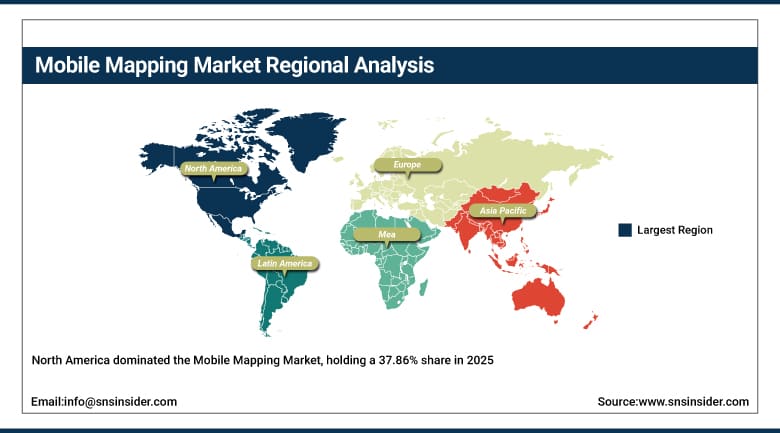
North America dominated the Mobile Mapping Market, holding a 37.86% share in 2025, due to the significant use of the technology in the U.S. and Canada. The strong demand of the government projects and the investments into smart cities, autonomous vehicles, advanced surveying technologies and widespread use of UAVs, terrestrial and airborne platforms increase the accessibilities of the technology in the region. The constant innovation of LiDAR, GNSS and photogrammetry solutions further cements the position of North America as one of the leading markets for mobile mapping vendors.
The U.S. makes up around 81.75% of the regional revenue due to the fast-paced urbanization and the projects involving infrastructure modernization and the development of smart cities of the largest cities in the region. Canada provides additional demand due to its own infrastructure and urban planning projects involving advanced geospatial technology, which means that North America is likely to remain the largest addressable market for mobile mapping vendors during the forecast period.
Get Customized Report as Per Your Business Requirement - Enquiry Now
Europe Mobile Mapping Market Insights
Europe contributes a significant share to the global mobile mapping market due to increasing investments in infrastructure, environmental monitoring needs, and the growing development of smart cities and autonomous vehicles projects in the largest economies in the region. Data privacy rules and sustainability programs have been making geospatial data more important and better governed in Europe.
Germany accounts for 24.60% of European sales because of high investments in smart mobility programs and presence of highly developed engineering and infrastructure sectors. The UK and France also make significant contributions to the market, and with continuous government spending on smart city and autonomous vehicle programs, demand for mobile mapping systems will be rising throughout the forecast period in Europe.
Asia Pacific Mobile Mapping Market Insights
Asia Pacific is the fastest-growing region for mobile mapping, projected to expand at a CAGR of approximately 20.14% through 2035, fueled by high urbanization and infrastructure development in China, India, Japan, and Australia as well as development of smart cities in all these regions. Increasing application of UAV, terrestrial, and handheld mapping systems together with further development of LiDAR, GNSS, and photogrammetry technologies continue to fuel the market growth, and the increased number of government programs, autonomous vehicle deployment, and industrial surveying contribute to the dynamically growing APAC market.
One of the most important markets for the global mobile mapping technology is China, where the market accounts for more than 31.85% of regional revenues. It is driven by fast urbanization and growth of the smart city initiatives, as well as increasing infrastructure spending, and expanding use of UAVs, LiDAR, and photogrammetric solutions is boosting the market growth.
MEA & Latin America Mobile Mapping Market Insights
There is growing demand for mobile mapping services in the Middle East & Africa and Latin America mobile mapping markets due to investments in infrastructural developments, smart cities projects, and urban development programs in their respective large economies. The use of technology, UAV mapping systems, and terrestrial mapping services are key to driving the demand in these regions.
In the Middle East & Africa region, UAE contributes about 26.95% to the revenues of the region, while infrastructure and smart cities projects fuel its demand. Moreover, Saudi Arabia and South Africa generate more demand for the region through their respective efforts towards modernization. In Latin America, Brazil generates more than 37.80% of the region’s revenues, and the growth of urban planning and industrial surveying projects in Brazil, Mexico, and Argentina fuels demand in this region.
Market Dynamics
Growth Drivers: Smart city expansion and autonomous vehicle adoption
Rising adoption of smart city initiatives is fueling substantial demand for advanced mapping and geospatial solutions worldwide, as municipal governments increasingly rely on detailed, accurate spatial data to plan infrastructure, manage transportation networks, and optimize public services. Integration of autonomous vehicles and drones is accelerating the use of UAV- and vehicle-mounted mapping platforms further, since autonomous navigation systems fundamentally depend on the kind of precise, real-time spatial data that mobile mapping technology provides.
Governments and private enterprises are increasingly investing in advanced geospatial and mapping technologies for urban planning, infrastructure monitoring, and transportation management, and that dual public-private investment stream is what's kept market growth running at such a rapid pace. The need for precise, real-time spatial data continues boosting demand across UAV, terrestrial, and handheld mapping platforms alike, and as more industries discover practical applications for this data, the addressable market keeps expanding well beyond mobile mapping's traditional surveying roots.
Restraints: High equipment costs and data processing complexity
Advanced mobile mapping systems, particularly those built around high-precision LiDAR sensors, carry substantial upfront equipment costs that can run well into six figures for enterprise-grade systems. That cost barrier keeps a meaningful share of smaller survey firms and organizations in developing markets on the sidelines, particularly when cheaper, lower-precision alternatives can handle less demanding mapping requirements adequately.
The sheer complexity of processing and analyzing the massive point-cloud datasets these systems generate adds a further layer of restraint, since converting raw sensor data into genuinely usable mapping deliverables requires specialized software and technical expertise that many organizations don't have readily available in-house. That processing bottleneck can meaningfully slow project timelines and add cost even after the initial hardware investment has already been made.
Opportunities: Expanding applications in autonomous navigation and defense
The rapid expansion of autonomous vehicle technology represents a genuinely substantial opportunity for mobile mapping vendors, as self-driving systems require continuously updated, high-precision spatial data that only mobile mapping technology can practically deliver at the necessary scale and accuracy. As autonomous vehicle deployment keeps expanding beyond pilot programs into broader commercial use, demand for the underlying mapping infrastructure supporting that expansion should climb in step.
Growing defense and security applications represent a second meaningful opportunity, as military and security agencies increasingly rely on precise terrain mapping and tactical geospatial intelligence for mission planning and situational awareness. Vendors that can meet the stringent accuracy, reliability, and security requirements defense customers demand stand to capture a genuinely valuable, high-margin segment of the broader mobile mapping market as this application category continues its rapid growth.
Recent Developments:
-
2025: Trimble Inc. launched its Applanix POS LVX+ and POS AVX RTX mobile mapping systems at INTERGEO 2025, offering centimeter-level positioning accuracy for land and airborne applications.
-
2024: Woolpert expanded its geospatial data acquisition capabilities with a new mobile mapping system, investing in Leica Geosystems' Leica Pegasus TRK700 Neo dual scanner.
-
2024: Trimble introduced the MX90 mobile mapping system, an all-in-one product combining GNSS, inertial technology, and Trimble's proprietary mapping software.
Mobile Mapping Market key players are:
-
Trimble Inc.
-
Hexagon AB
-
Topcon Corporation
-
Leica Geosystems AG
-
Teledyne Technologies Incorporated
-
RIEGL Laser Measurement Systems GmbH
-
Velodyne Lidar, Inc.
-
SICK AG
-
OxTS
-
GeoSLAM Ltd.
-
GreenValley International
-
Routescene
-
SLAMcore
-
HERE Technologies
-
TomTom International BV
-
FARO Technologies, Inc.
-
NavVis GmbH
-
Cyclomedia Technology B.V.
-
iM‑Ajing SAS
-
Hi‑Target Surveying Instrument Co., Ltd.
Mobile Mapping Market Report Scope:
| Report Attributes | Details |
|---|---|
| Market Size in 2025 | USD 47.42 Billion |
| Market Size by 2035 | USD 234.45 Billion |
| CAGR | CAGR of 17.33% From 2026 to 2035 |
| Base Year | 2025 |
| Forecast Period | 2026-2035 |
| Historical Data | 2022-2024 |
| Report Scope & Coverage | Market Size, Segments Analysis, Competitive Landscape, Regional Analysis, DROC & SWOT Analysis, Forecast Outlook |
| Key Segments | • By Technology (LiDAR, GNSS, Photogrammetry, RADAR, Inertial Measurement Units (IMU), Others) • By Platform (UAV/Drones, Terrestrial, Handheld Devices, Airborne (Manned Aircraft), Marine/Underwater Platforms, Others) • By Application (Urban Planning & Smart Cities, Transportation & Logistics, Forestry & Agriculture, Utilities & Infrastructure Management, Defense & Security, Environmental Monitoring, Mining & Construction, Others) • By End-User (Government & Public Sector, Construction & Engineering Companies, Transportation & Logistics Providers, Environmental & Research Organizations, Defense & Security Agencies, Technology & Survey Companies, Others) |
| Regional Analysis/Coverage | North America (US, Canada), Europe (Germany, UK, France, Italy, Spain, Russia, Poland, Rest of Europe), Asia Pacific (China, India, Japan, South Korea, Australia, ASEAN Countries, Rest of Asia Pacific), Middle East & Africa (UAE, Saudi Arabia, Qatar, South Africa, Rest of Middle East & Africa), Latin America (Brazil, Argentina, Mexico, Colombia, Rest of Latin America). |
| Company Profiles | Trimble Inc., Hexagon AB, Topcon Corporation, Leica Geosystems AG, Teledyne Technologies Incorporated, RIEGL Laser Measurement Systems GmbH, Velodyne Lidar, Inc., SICK AG, OxTS, GeoSLAM Ltd., GreenValley International, Routescene, SLAMcore, HERE Technologies, TomTom International BV, FARO Technologies, Inc., NavVis GmbH, Cyclomedia Technology B.V., iM Ajing SAS, Hi-Target Surveying Instrument Co., Ltd. |
Frequently Asked Questions
The Mobile Mapping Market is expected to grow at a CAGR of 17.33% from 2026 to 2035.
The Mobile Mapping Market was valued at USD 47.42 Billion in 2025.
The major growth factor is rising demand for urban digitization, geospatial intelligence, infrastructure monitoring, and autonomous navigation solutions.
The LiDAR segment dominated the Mobile Mapping Market with a 36% share by technology in 2025.
North America dominated the Mobile Mapping Market in 2025 with a 37.86% share of total global market revenue.
