
Network Synchronization ICs Market Report Scope & Overview:
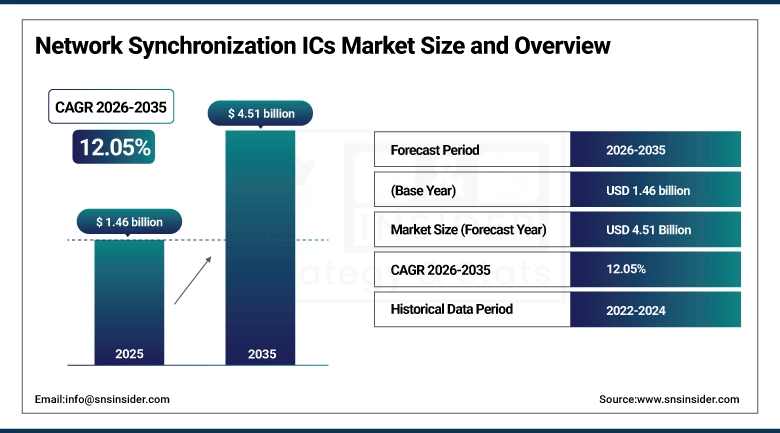
The Network Synchronization ICs Market size is valued at USD 1.46 Billion in 2025 and is projected to reach USD 4.51 Billion by 2035, growing at a CAGR of 12.05% during the forecast period 2026–2035.
This network synchronization ICs market report is focused on providing a comprehensive assessment of the market dynamics, innovative products, and applications of technology. The growth of this market can be attributed to the increasing use of 5G and 6G networks, hyperscale data center requirements, industrial internet of things applications, and the adoption of precision timing modules in the automotive and energy industries.
The global consumption of synchronization ICs surpassed 1.1 billion units in 2025 owing to telecom upgrades, cloud computing services, and industrial automation initiatives.
Market Size and Forecast:
-
Market Size in 2025: USD 1.46 Billion
-
Market Size by 2035: USD 4.51 Billion
-
CAGR: 12.05% from 2026 to 2035
-
Base Year: 2025
-
Forecast Period: 2026–2035
-
Historical Data: 2022–2024
To Get more information on Network Synchronization ICs Market - Request Free Sample Report
Network Synchronization ICs Market Trends:
-
The need for very accurate synchronization ICs has arisen due to the rapid deployment of 5G and 6G networks.
-
There is an increasing demand for timing modules due to hyperscale cloud and edge data center requirements.
-
The growth of IIoT (industrial Internet of things) and smart grids has resulted in increased use of synchronization ICs.
-
The need for synchronization ICs continues to grow in the automotive sector and transport systems.
-
The deployment of synchronization ICs based on GPS/GNSS technology becomes widespread across several industries.
-
Synchronous Ethernet and PTP continue to gain momentum but PTP is taking precedence as the leading solution.
-
The need to protect against timing attacks in the cybersecurity field is increasing the demand for synchronization ICs.
U.S. Network Synchronization ICs Market Size Outlook:
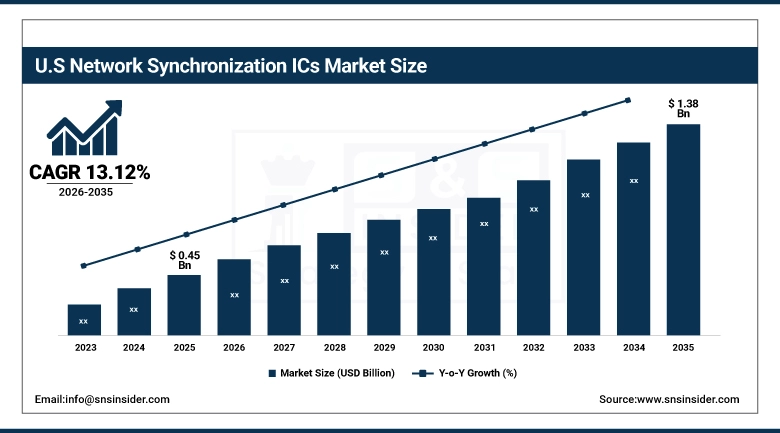
The U.S. Network Synchronization ICs Market is projected to grow from USD 0.45 Billion in 2025 to USD 1.38 Billion by 2035, at a CAGR of 13.12%. Growth is fueled by the quick adoption of 5G and next-generation 6G infrastructure, increased need for hyperscale clouds and edge data centers, high adoption of sophisticated timing and synchronization technology including PTP and GPS/GNSS-based modules, and the growing investment in novel timing solutions within telecommunications, automation, automotive, and energy segments.
Network Synchronization ICs Market Growth Drivers:
-
Rising 5G and 6G deployments and hyperscale data center expansion are driving demand for advanced Network Synchronization ICs.
Telecom advancements and the growing use of cloud and edge computing solutions are some of the important factors contributing to the growth of Network Synchronization ICs market. The telecom industry players, cloud service providers, and industrial organizations are increasingly incorporating synchronization solutions including PTP, SyncE, and GPS/GNSS-based modules in their operations to facilitate ultra-low latency communication. Improvements in clock generators, Phase-Locked Loops (PLL), and timing modules, which offer better accuracy, reduced jitter, and multiple protocol support, are also playing an important role in driving the market forward.
Over 54% of telecom operators, cloud providers, and industrial automation firms utilized advanced Network Synchronization ICs in 2025 to optimize connectivity, strengthen data transfer reliability, and support next‑generation infrastructure.
Network Synchronization ICs Market Restraints:
-
High R&D costs and complex design requirements are restraining wider adoption of Network Synchronization ICs.
The development of next-generation synchronization solutions including PTP, SyncE, and GPS/GNSS devices involves substantial expenditure on R&D, evaluation, and integration processes, and is thus confined only to major semiconductor manufacturers. Small-scale organizations encounter obstacles owing to their high-cost factor and lengthy time frame, causing delays in the widespread adoption of these products. The current maturity level of the market in developed countries is hampering its expansion prospects, especially when compared to developing nations.
Over 42% of telecom operators and cloud providers reported delays in synchronization IC deployment in 2025 due to supply chain challenges, regulatory compliance costs, and cybersecurity concerns, underscoring the key restraints impacting sustained market expansion.
Network Synchronization ICs Market Opportunities:
-
Expanding 5G and upcoming 6G deployments are creating significant opportunities for advanced Network Synchronization ICs.
The quick advancements in telecom infrastructures coupled with the rising requirement for ultra-low latency communications have created promising growth prospects for synchronization ICs. Telecom companies, cloud service providers, and manufacturing organizations have been making significant investments in Precision Time Protocol (PTP), Synchronous Ethernet (SyncE), and GPS/GNSS solutions to improve accuracy and efficiency. The future prospects for synchronization ICs involve creating hybrid synchronization technologies that leverage multiple protocols, thus providing flexibility to cater to different applications.
Over 61% of telecom operators, cloud providers, and industrial enterprises are expected to adopt advanced synchronization ICs by 2030, highlighting the scale of opportunities across multiple verticals and regions.
Network Synchronization ICs Market Segmentation Analysis:
-
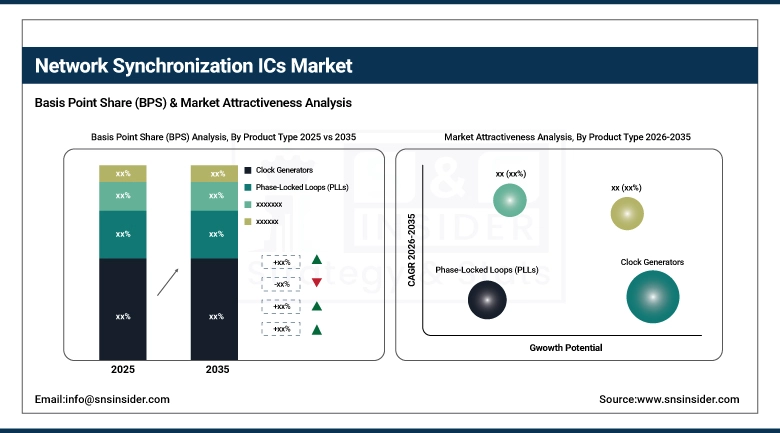
By Product Type, Clock Generators held the largest market share of 27.28% in 2025, while Timing Modules are expected to grow at the fastest CAGR of 13.27% during 2026–2035.
-
By Vertical, Telecommunications dominated with 35.61% market share in 2025, whereas Data Centers & Cloud are projected to record the fastest CAGR of 12.70% through 2026–2035.
-
By Synchronization Technology, Precision Time Protocol (PTP) accounted for the highest market share of 32.85% in 2025, while Synchronous Ethernet (SyncE) are expected to grow at the fastest CAGR of 12.99% during the forecast period.
-
By Application, Carrier Network Operations dominated with a 33.89% share in 2025, while they are aslo anticipated to expand at the fastest CAGR of 11.13 % through 2026–2035.
By Product Type, Clock Generators dominate while Timing Modules grow rapidly:
The Clock Generator Segments hold the dominant market share owing to its high application rate in telecommunications, data centers, and industrial automation. The extensive use in the industries makes it an effective and reliable source of timing signals. Their efficient usage and popularity among telecommunications companies and cloud computing firms make it the most preferred segment.
Timing Modules hold the fastest growth rate owing to the increasing demand for highly synchronized networks in 5G and 6G communications, smart grid, and autonomous driving systems. There is an increasing demand for Precision Time Protocol, SyncE, and GPS GNSS modules for critical timing and synchronization purposes.
By Vertical, Telecommunications dominate while Data Centers & Cloud grow rapidly:
Telecom is the dominant segment in the industry due to the significant deployment of 5G and 6G technologies, where synchronization ICs become vital to provide ultra-low latency and stable connections. The widespread use of these ICs among telecommunications operators has further strengthened the dominance of this market segment.
The Data Centers & Cloud vertical is growing faster than others due to the increasing need for hyperscale centers, artificial intelligence, and distributed clouds. Synchronization ICs have become an essential part of improving workload balancing and providing reliable data transmission. Therefore, the growth driver for the industry lies in this particular market vertical.
By Synchronization Technology, Precision Time Protocol (PTP) dominates while Synchronous Ethernet (SyncE) grows rapidly:
The Precision Time Protocol (PTP) segment dominates the market due to its importance in achieving highly accurate synchronization in 5G/6G communications, industrial automation, and smart grids. This technology's capability to provide very accurate timing in mission critical systems has seen its widespread adoption among telecommunications operators and cloud computing organizations.
The Synchronous Ethernet (SyncE) segment is fastest growing due to the increasing incorporation of this technology into telecom backhaul networks and corporate networks. The rising requirement for accurate frequency synchronization in advanced communications infrastructure systems will be driving the SyncE segment going forward.
By Application, Carrier Network Operations dominate while also representing the fastest‑growing segment:
Carrier Network Operations have taken the dominate in the market due to the wide-scale implementation of 5G and 6G networks, which make it necessary to use synchronization ICs for ultra-low latencies and connections. The widespread acceptance within telecom operators and infrastructure vendors further cements its dominance in being the biggest application sector.
Furthermore, the Carrier Network Operations sector is also the fastest growing due to steady improvements made to the infrastructure of next generation networks, and increasing mobile broadband usage. The demand for more synchronization is also driven by the need for mission critical applications.
Asia Pacific Network Synchronization ICs Market Insights:
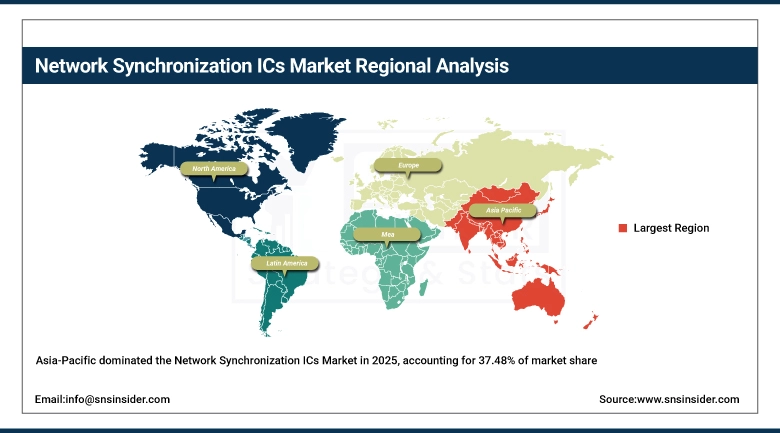
Asia-Pacific is the market dominated with market share of 37.48%, owing to significant deployments of 5G networks, proliferation of smart cities, and industrial automation in nations such as China, India, South Korea, and Japan. Hyperscale data centers, Internet-of-things platforms, and advanced mobility systems have led to a high demand for synchronization ICs. With government investments in digital infrastructure along with the increasing popularity of GPS/GNSS-based modules and precision time protocol, Asia-Pacific is poised to lead the market.
Get Customized Report as per Your Business Requirement - Enquiry Now
China Network Synchronization ICs Market Insights:
China is the leader in the Asia-Pacific region, backed by enormous investments in telecommunications infrastructure, massive 5G rollouts, and robust government support for smart city and IIoT initiatives. China’s hyperscale cloud service providers and telcos are swiftly implementing synchronization ICs to guarantee ultra-low-latency connectivity. Increased traction from the automotive and ITS segments provides additional impetus. Persistent product innovations and advancements in synchronization technology have cemented China’s reputation as a global center.
North America Network Synchronization ICs Market Insights:
North America continues to be the fastest-growing market with a CAGR of 13.13% due to early adoption of synchronized technology. The United States is the front-runner with significant investments made in 5G/6G, hyper-scale data center, and connected vehicles. Strong semiconductor technology innovations, research & development activities, and adoption of PTP and SyncE technology solutions strengthen the regional position. Despite being a stable growth market, factors such as cybersecurity risks and issues in supply chains pose constraints to market performance.
U.S. Network Synchronization ICs Market Insights:
The United States is at the forefront of North America’s influence, bolstered by large-scale 5G deployments, rapid hyperscale cloud buildout, and high levels of industrial automation. Synchronization ICs are prevalent in telecom operators, cloud service providers, and automotive industry systems to provide accurate synchronization and extremely low latencies. Ongoing innovations in clock generator products and timing solutions, along with robust semiconductor research and development, strengthen the position of the United States as the leading market in the region.
Europe Network Synchronization ICs Market Insights:
Europe is one of the major markets, due to the wide use of synchronization integrated circuits in modernization of telecommunication, automation of industry, and energy systems. Nations such as Germany, France, and the United Kingdom are spending a lot of money in developing 5G networks, smart grids, and connected mobility systems. The availability of a robust regulatory environment that encourages digital transformation and sustainable development drives the need for synchronization integrated circuits. Although the growth rate is lower than that of the Asia Pacific region, it is still stable.
Germany Network Synchronization ICs Market Insights:
Germany has taken the front seat among European countries owing to its highly developed industrial automation, automobile sector, and rapid deployment of 5G infrastructure across the nation. Synchronization ICs have found applications in industries including smart manufacturing, robotics, and intelligent vehicles for ensuring precision timing. With Germany focusing on Industry 4.0 and digital transformation, there is an ever-growing demand for high-end synchronization ICs.
Latin America Network Synchronization ICs Market Insights:
Latin America has become an attractive market with the growing telecom network, increasing popularity of cloud, and the development of smart cities in countries such as Brazil, Mexico, and Argentina. Synchronization integrated circuits have been widely used in order to enable the development of mobile broadband, industrial automation, and energy grid infrastructures. However, despite these developments, infrastructure constraints and economic fluctuations limit the progress of the industry.
Middle East & Africa Network Synchronization ICs Market Insights:
The Middle East & Africa market is experiencing a steady growth trend thanks to huge investments made by the countries into telecom networks, smart cities, and energy grid infrastructure development. The UAE, Saudi Arabia, and South Africa are installing synchronization ICs to provide connectivity, smart energy solutions, and industrial control applications. Growing demand for smart transportation and digital transformation activities is another driver for the use of synchronization ICs.
Network Synchronization ICs Market Competitive Landscape:
Microchip Technology
Microchip Technology Inc., one of the largest semiconductors companies of the United States, operates in the market segment of Network Synchronization ICs and provides an integrated solution for timing requirements through its various services including GPS-based timing, IEEE 1588 Precision Time Protocol (PTP), Network Time Protocol (NTP), and Synchronous Ethernet. The company offers an extensive range of products including grandmasters used by carriers, network time servers designed for enterprises, GPS disciplined oscillators, and atomic clocks extensively utilized in the telecommunication, cloud computing, and industrial industries.
-
In June 2025, Microchip expanded its modular synchronization systems to support smart grids and industrial IoT applications, strengthening its role in mission‑critical timing solutions.
Texas Instruments
Texas Instruments (TI) is an American company that has been making innovations in the semiconductor industry for almost a century and holds the headquarters in Dallas, Texas. As far as the Network Synchronization ICs segment goes, TI relies on its competence in analog electronic devices, embedded processors, and power management for delivering highly efficient clocking and timing solutions. Its wide product range caters to telecom infrastructure, automotive, and industrial automation applications. The company’s stringent operations, extensive manufacturing, and R&D efforts make TI a dominant force in timing technology innovation.
-
In October 2025, TI introduced enhanced clock generator ICs optimized for 5G base stations and automotive ADAS systems, reinforcing its role in next‑generation synchronization applications.
Analog Devices
Analog Devices (ADI), which operates from Wilmington, Massachusetts, is an international semiconductor corporation renowned for its expertise in areas which includes data conversion, signal processing, and clocking applications. With respect to the Network Synchronization ICs domain, ADI has been acknowledged for its innovative mixed signal ICs, coherent timing products, and RF system technology used in telecommunications, aerospace, defense industries, and industrial automation. The Samana platform developed by ADI for next-generation radio designs and the Quad Apollo MxFE technology demonstrate how ADI simplifies designs and improves performance efficiency.
-
In May 2025, ADI expanded its precision clocking portfolio with integrated synchronization solutions for wideband beamforming and distributed computing, strengthening its competitive edge in high‑growth verticals.
Network Synchronization ICs Companies are:
-
Texas Instruments
-
Analog Devices
-
Broadcom
-
Maxim Integrated (Analog Devices)
-
Qualcomm
-
Intel
-
NXP Semiconductors
-
STMicroelectronics
-
Infineon Technologies
-
Skyworks Solutions
-
Silicon Labs
-
Marvell Technology
-
ON Semiconductor
-
IDT (Integrated Device Technology, now part of Renesas)
-
Epson (Seiko Epson timing solutions)
-
Cypress Semiconductor (Infineon)
-
Rohm Semiconductor
-
Abracon
| Report Attributes | Details |
|---|---|
| Market Size in 2025 | USD 1.46 Billion |
| Market Size by 2035 | USD 4.51 Billion |
| CAGR | CAGR of 12.05% From 2026 to 2035 |
| Base Year | 2025 |
| Forecast Period | 2026-2035 |
| Historical Data | 2022-2024 |
| Report Scope & Coverage | Market Size, Segments Analysis, Competitive Landscape, Regional Analysis, DROC & SWOT Analysis, Forecast Outlook |
| Key Segments | • By Product Type (Clock Generators, Phase Locked Loops (PLLs), Clock Recovery ICs, Timing Modules, Others), • By Vertical (Telecommunications, Data Centers & Cloud, Industrial & Energy, Automotive & Transportation, Others), • By Synchronization Technology (Precision Time Protocol (PTP), Synchronous Ethernet (SyncE), Network Time Protocol (NTP), GPS/GNSS Based Synchronization, Others), • By Application (Carrier Network Operations, Enterprise Computing & AI Workloads, Smart Manufacturing Systems, Intelligent Transport Applications, Others) |
| Regional Analysis/Coverage | North America (US, Canada), Europe (Germany, UK, France, Italy, Spain, Russia, Poland, Rest of Europe), Asia Pacific (China, India, Japan, South Korea, Australia, ASEAN Countries, Rest of Asia Pacific), Middle East & Africa (UAE, Saudi Arabia, Qatar, South Africa, Rest of Middle East & Africa), Latin America (Brazil, Argentina, Mexico, Colombia, Rest of Latin America). |
| Company Profiles | Microchip Technology, Texas Instruments, Analog Devices, Broadcom, Maxim Integrated (Analog Devices), Renesas Electronics, Qualcomm, Intel, NXP Semiconductors, STMicroelectronics, Infineon Technologies, Skyworks Solutions, Silicon Labs, Marvell Technology, ON Semiconductor, IDT (Integrated Device Technology, now part of Renesas), Epson (Seiko Epson timing solutions), Cypress Semiconductor (Infineon), Rohm Semiconductor, Abracon. |

Frequently Asked Questions
Asia Pacific dominated with a 37.48% share in 2025, while North America is the fastest-growing region, expected to expand at a CAGR of 13.13% during 2026–2035.
Clock Generators dominated with a 27.28% share in 2025, while Timing Modules are projected to grow at the fastest CAGR of 13.27% during 2026–2035.
Growth is driven by the rapid deployment of 5G and upcoming 6G networks, expansion of hyperscale and edge data centers and increasing demand for ultra‑low latency.
The market is valued at USD 1.46 Billion in 2025 and is projected to reach USD 4.51 Billion by 2035.
The Network Synchronization ICs Market is projected to grow at a CAGR of 12.05% during 2026–2035.
