
High Frequency Military Antenna Market Report Scope & Overview:
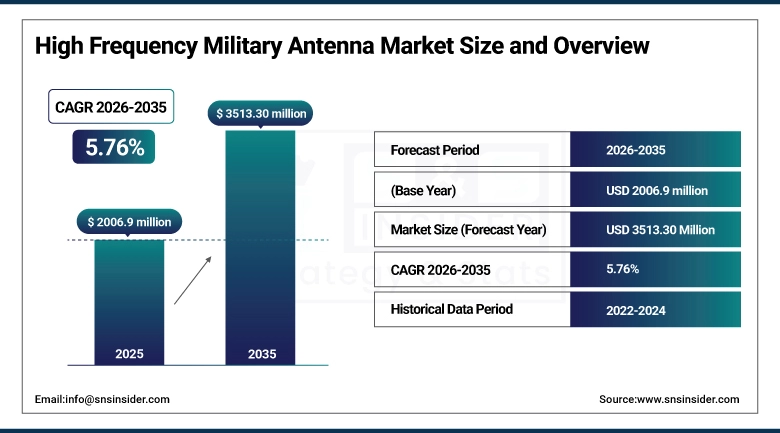
The High Frequency Military Antenna Market size was valued at USD 2006.9 Million in 2025 and is projected to reach USD 3513.30 Million by 2035, growing at a CAGR of 5.76% during 2026–2035.
High Frequency Military Antenna Market Growth & Trends The global high frequency military antenna market is anticipated to witness healthy growth due to growing need for secure, long-range and robust military communications systems for defense operations. Widespread antennas demand for radio connectivity is seen at global level as expanding attention on operational continuity in contentious environments promotes increasing use of advanced antenna technologies that enable persistent RF transmission to withstand interference or disruption conditions. Performance for Naval, Airborne, and Ground platforms is improving with modern RF systems, software-defined architectures, and multi-band capabilities. Rising focus on defense modernization programs along with focus on electronic warfare preparedness is further bolstering the deployment arm set of high-performance antenna systems, thereby, leading to enhanced connectivity, situational awareness, and efficiency in mission-critical communication.
In April 2025, he FCC put out a Notice of Inquiry towards resilient Positioning, Navigation and Timing (PNT) tech development that could be used as an alternative and supplement to GPS for essential activities. This effort will prepare satellite and terrestrial options to improve security, reliability, and resilience for a diverse array of defense, commercial, and public safety systems.
HF Military Antenna Market Size and Growth Forecast:
-
Market Size in 2025: USD 2006.9 Million
-
Market Size by 2035: USD 3513.30 Million
-
CAGR: 5.76% (from 2026 to 2035)
-
Base Year: 2025
-
Forecast Period: 2026–2035
-
Historical Data: 2022–2024
To Get more information on High Frequency Military Antenna Market - Request Free Sample Report
High Frequency Military Antenna Market Trends Highlights:
-
Rising demand for secure long-range military communication systems across land, air, and naval defense platforms.
-
Increasing adoption of advanced HF antenna technologies in electronic warfare and battlefield networking applications.
-
Strong shift toward software-defined and multi-band antenna systems for improved operational flexibility.
-
Growing integration of HF antennas in UAVs, naval ships, and airborne surveillance systems for real-time data exchange.
-
Continuous defense modernization programs and rising geopolitical tensions driving sustained market expansion.
U.S. HF Military Antenna Market Size Outlook:
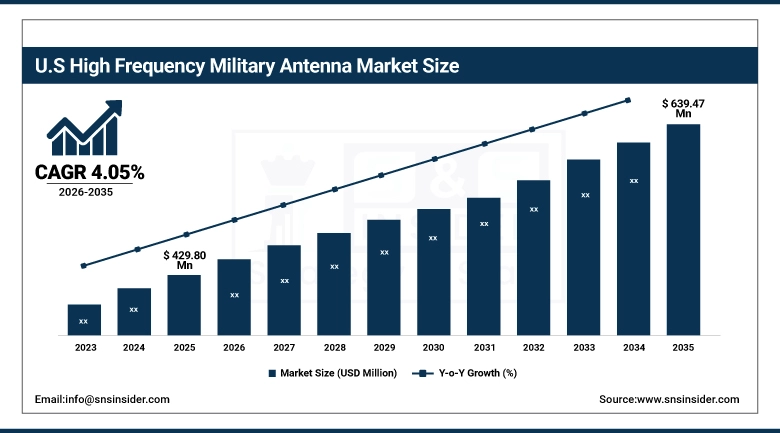
The U.S. HF Military Antenna Market size was valued at USD 429.80 Million in 2025 and is projected to reach USD 639.47 Million by 2035, growing at a CAGR of 4.05% during 2026–2035, mainly due to increase in defense modernization programs, demand for secure long-range military communication, and rapid adoption of smart antenna technologies in naval, airborne, and ground-based military platforms. The increasing focus on military forces resilience, high-performance communication infrastructure essential for supporting multi-domain scenario and mission-critical applications (hardware and software-based) is supporting growth of electronic warfare, software-defined radio systems (SDR), and next-generation battlefield connectivity, fueling the overall market growth.
HF Military Antenna Market Drivers:
-
Advancements in Active Electrically Small HF Antenna Technology Enhancing Military Communication Performance
Increasing demand for High Frequency Military Antenna is driven by advancements in Class-E active electrically small HF antenna technology. These breakthroughs overcome the limitations of typical passive antenna techniques by efficient broad-band transmission, delivering power up to the given order of magnitude, and further arrive at a more bandwidth-efficiency performance in a compact design. These advanced designs are envisioned to meet modern military needs for electrically secure, high-data-rate, long-range communication in tightly packed platforms. The continued innovation in HF antenna system architecture is driven by the ability to integrate advanced modulation techniques and software-driven signal control, offering a combination of interoperability, resilience and security that is being rapidly adopted across defense communication systems, electronic warfare platforms and next-generation battlefield networks.
In April 2024, Researches Design Class-E active electrically small HF antenna, The New Configuraton enables High-power Transmission with enhanced Bandwidth Efficiency Over Passive Designs for Military Communication Systems.
HF Military Antenna Market Restraints:
-
High Cost and Integration Complexity of Advanced HF Military Antenna Systems
High development, procurement and lifecycle maintenance costs for advanced antenna systems are major restraints for the High Frequency Military Antenna market. The integration of modern technologies (e.g., phased arrays, software-defined radio compatibility, multi-band capabilities) has added complexity to the system and has resulted in the need for extensive customizations across different defense platforms. Further, the slow adoption is also due to long certification cycles, specific regulations around defense approvals, and lack of interoperability across legacy and next-generation systems. Deficits on budget lines in specific defense domains, combined with reliance on niche providers, further limits mass deployment and consequently establishes barriers in wide-scale improvements to HF military antenna infrastructure by armed forces across the globe.
HF Military Antenna Market Opportunities:
-
Expansion of Secure Naval HF/UHF Antenna Modernization Programs
The increasing demand for advanced high-frequency and ultra-high frequency antenna systems in naval communication networks is creating strong market opportunities for defense technology providers. Modern naval forces are rapidly adopting digitally integrated communication architectures that require secure, interoperable, and upgradeable antenna systems to support real-time data exchange and mission-critical operations. This shift is driving opportunities in rugged antenna design, subsystem upgrades, and modular communication solutions that enhance reliability, encryption capability, and operational efficiency across surface fleets, supporting next-generation maritime defense modernization programs and long-term fleet communication infrastructure upgrades.
In July 2025, The U.S. Navy awarded a contract modification to Frontgrade Technologies for continued supply of OE-570 ultra-high frequency antenna systems, upgrade kits, and related subsystems supporting the Digital Modular Radio Program across naval surface ships, strengthening secure HF/UHF maritime communication infrastructure.
High Frequency Military Antenna Market Segment Highlights:
-
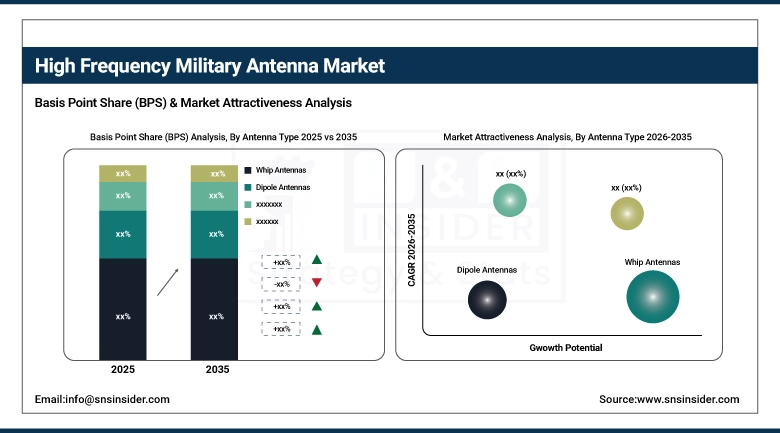
By Antenna Type: Dominant – Whip Antennas (25.50% in 2025 → 27.80% in 2035); Fastest Growing – Array/Phased Array Antennas (20.00% in 2025 → 28.00% in 2035)
-
By Application: Dominant – Communication Systems (34.30% in 2025 → 28.70% in 2035); Fastest Growing – Electronic Warfare (20.50% in 2025 → 24.50% in 2035)
-
By Platform/Deployment: Dominant – Ground-based Systems (49.20% in 2025 → 42.80% in 2035); Fastest Growing – Airborne Platforms (31.00% in 2025 → 39.00% in 2035)
-
By Frequency Band/Technology: Dominant – HF (3–30 MHz) (39.80% in 2025 → 24.60% in 2035); Fastest Growing – Software-Defined Radio (SDR)-Enabled Antennas (25.00% in 2025 → 45.30% in 2035)
By Antenna Type: Whip Antennas (Dominant) and Array/Phased Array Antennas (Fastest-Growing)
The Whip Antennas segment accounted for the larger market share and is expected to maintain its dominance over the forecast period owing to its extensive deployment in military communication systems, simple rugged design, and reliable performance across diverse operational environments including ground, naval, and tactical field missions. Its cost-effectiveness and ease of integration further strengthen its widespread adoption in legacy and modern defense platforms. On the other hand, the Array/Phased Array Antennas segment is projected to register the fastest growth due to increasing demand for advanced beam steering, multi-target tracking, and electronic warfare capabilities. Growing investments in next-generation defense systems and the shift toward digitally controlled, high-performance communication and surveillance technologies are further accelerating the adoption of phased array antenna solutions globally.
By Application: Communication Systems (Dominant) and Electronic Warfare (Fastest-Growing)
The Communication Systems segment ranked the largest segment in the market owing to its importance in providing connectivity and long-range, secure and reliable military communication across defense networks, command center, and tactical field operations. This maintains fleet command and control and makes its wide distribution and utility a guarantee of continued leadership. On the other hand, Electronic Warfare segment is the fastest-growing segment, which attributes to heightened geopolitical tensions and the demand for enhanced capabilities like interception, jamming and spectrum superiority and are the vital characteristics of modern defense strategies.
By Platform/Deployment: Ground-based Systems (Dominant) and Airborne Platforms (Fastest-Growing)
Ground-Based System retains its position as the largest platform segment as they are heavily deployed at military bases, border security, radar installations, and command-and-control infrastructure. The deep penetration of these systems within legacy defense systems will guarantee their continued use among militaries worldwide. On the other hand, Airborne Platforms are expected to grow at the highest rate as the increasing adoption of UAVs, communicable airborne surveillance systems, and the rising need for mobile and rapid-response communication and reconnaissance capabilities in modernization warfare environments expands the market for airborne discrete long-range communication systems.
By Frequency Band/Technology: HF (3–30 MHz) (Dominant) and SDR-Enabled Antennas (Fastest-Growing)
The HF (3–30 MHz) segment is also continue to hold the largest share of the market owing to long-range communication capability and reliability of the frequency for beyond-line-of-sight military operations, making high-frequency bands an essential part of traditional defense communication systems. On the other hand, Software-Defined Radio (SDR)-Enabled Antennas are expected to witness the highest growth in terms of size owing to the transition from traditional to software-driven communication systems, providing features such as dynamic frequency management, flexible design capabilities, and better efficiency for applications in electronic warfare and secure military communication.
High Frequency Military Antenna Market Regional Highlights:
-
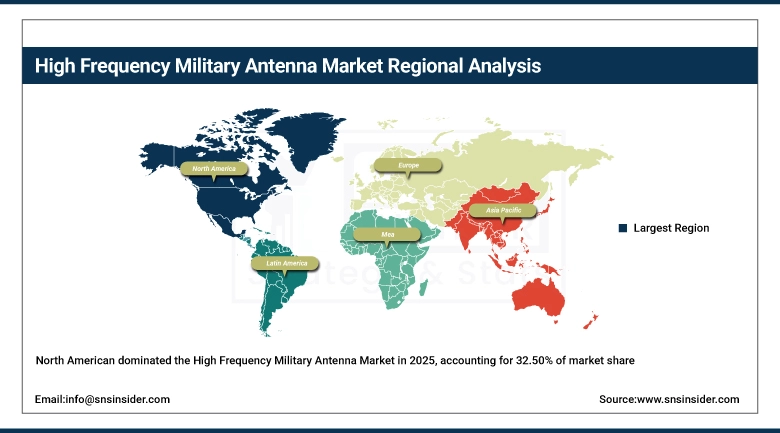
North America (Dominating – 32.50% in 2025 → 28.00% in 2035, CAGR 4.19%)
-
Middle East & Africa (Fastest Growing – 8.00% in 2025 → 11.00% in 2035, CAGR 9.13%)
-
Europe (27.00% in 2025 → 23.00% in 2035, CAGR 4.07%)
-
Asia-Pacific (25.00% in 2025 → 30.00% in 2035, CAGR 7.69%)
-
Latin America (7.50% in 2025 → 8.00% in 2035, CAGR 6.45%)
North America High Frequency Military Antenna Market Insights:
North America leads the global High Frequency Military Antenna market due to strong defense spending, rapid adoption of advanced military communication systems, and the presence of major defense contractors such as L3Harris Technologies, Lockheed Martin, and Northrop Grumman. The region benefits from continuous modernization programs of the U.S. Department of Defense, which heavily invest in secure, long-range, and high-performance HF communication systems for naval, airborne, and ground forces. Additionally, increasing focus on electronic warfare, battlefield connectivity, and interoperable communication networks further strengthens regional demand. The integration of advanced technologies such as software-defined radios and electronically steerable antennas is also accelerating market growth in North America, making it a key innovation hub for military antenna development.
Get Customized Report as per Your Business Requirement - Enquiry Now
U.S. High Frequency Military Antenna Market Insights:
The U.S. High Frequency Military Antenna market is growing steadily owing to defense modernization, increasing need for secure communication, electronic warfare expansion, and adoption of advanced long-range military communication technologies..
Asia-Pacific High Frequency Military Antenna Market Insights:
Asia Pacific is anticipated to outpace other regions in growth of the High Frequency Military Antenna market attributed to rapidly increasing defense expenditures, number of large-scale military modernization programs as well as geopolitical tensions over nations such as China, India, Japan and Korea thus anticipated to grow at the higher speed in the market compare to other regions. In addition, rising emphasis on the development of safe, long-distance communication systems for naval, airborne, and ground forces is also fuelling the market over the coming years. Further boost to the market growth can be attributed to the upsurge in demand for electronic warfare systems, integration of satellite communication, and emergence of software-based defined radio technologies. Indigenous defence manufacturing initiatives coupled with strong partnerships with global defense contractors are also adding to the solid growth path being pursued by the regional defense industry.
China High Frequency Military Antenna Market Insights:
China is the largest and fastest growing High Frequency Military Antenna market due to increased defense modernization along with high military communication investments, rapid electronic warfare expansion and high development of domestic antenna technologies.
Europe High Frequency Military Antenna Market Insights:
The Europe High Frequency Military Antenna market is expected to witness steady growth in the coming years attributed to the rising defense modernization programs, NATO led communication standardization initiatives, and growing secure military communication system investments. Electronic warfare improvements, upcoming cross-border defense cooperation, and increasing embedding of advanced radar antenna technologies into naval, airborne, and land systems further underpin demand. Meanwhile, the defense modernization efforts of large European nations continue to be fueled by geopolitics and the requirement for interoperable, long-range communications systems.
Germany High Frequency Military Antenna Market Insights:
Germany High Frequency Military Antenna market is steadily growing due to defense modernization, NATO-aligned upgrades, rising secure communication demand, and investment in advanced electronic warfare systems, driving adoption of next-generation HF antennas across military land, naval, and airborne defense platforms.
Latin America High Frequency Military Antenna Market Insights:
The Latin America High Frequency Military Antenna market is witnessing a gradual rise including increasing defense modernization activities, growing demand for secure and reliable military communication systems, and increasing investment in border security and surveillance operations. States throughout the area are slowly modernizing their protection infrastructure for better operability and better extended-range capability through the proper transmission of naval, airborne, and land pixels. Moreover, due to steady but limited defense budgets, the establishment of partnerships with worldwide defense technology providers, and growing adoption of advanced HF antenna systems are aiding the market growth of HF antenna system. The growing emphasis on electronic warfare preparedness and regional security challenges is making way for the market growth in rest of Latin America.
Brazil High Frequency Military Antenna Market Insights:
he Latin America High Frequency Military Antenna market is dominated by Brazil due to the countries strong defence modernisation programs, increasing investments in secure military communication systems and a growing focus on border surveillance & naval communication capabilities.
Middle East & Africa High Frequency Military Antenna Market Insights:
The Middle East & Africa High Frequency Military Antenna market is witnessing significant momentum is propelled by heightened defense expenditure, persisting geopolitical tensions and growing need for secure, long-range military communication systems. Regional nations have invested significantly to modernize their militaries, improve electronic warfare systems and utilize high-frequency antenna systems at naval, airborne, and land venues. Moreover, rising partnerships with international defense providers and focus on enhancing border security and surveillance facilities are also contributing to market proliferation in the region.
United Arab Emirates High Frequency Military Antenna Market Insights:
Saudi Arabia dominates the High Frequency Military Antenna market due to rising defense spending, Vision 2030 modernization, border security needs, electronic warfare expansion, and procurement of advanced military communication systems.
High Frequency Military Antenna Market Competitive Landscape:
Rohde & Schwarz (Est. 1933) is a Germany-based global leader in test, measurement, broadcast, and secure communications technologies. The company specializes in advanced military communication systems, including HF and UHF antennas, SDR-based solutions, and electronic warfare support systems. It plays a key role in naval and defense modernization programs, delivering secure, reliable, and high-performance communication infrastructure worldwide.
-
In Nov 2025 - Rohde & Schwarz partnered with Sitep Australia to supply UHF-MILSATCOM antenna systems for the Royal Australian Navy’s Hunter-class frigates under the NAVICS communications program with BAE Systems Australia. The project enhances secure, IP-based naval communication capabilities and strengthens sovereign defense antenna infrastructure.
BAE Systems (Est. 1999) is a London, UK-based global provider of defense and aerospace and security system specializing in advanced military electronic warfare systems, satellite secure communications, and high-frequency military antenna systems. The firm thrives in its contribution to naval, aerial, and terrestrial defense programs, providing integrated communication and radar solutions to enable connected modern battlefields and global multi-domain operations.
-
In July 2024 - BAE Systems received a firm-fixed-price contract for maintenance and modernization of USS Mobile (LCS 26), including integrated communication and operational systems that support advanced naval antenna and mission-critical defense communication readiness.
High Frequency (HF) Military Antenna Companies are:
-
Lockheed Martin
-
Raytheon Technologies
-
Northrop Grumman
-
BAE Systems
-
Thales Group
-
Saab AB
-
Elbit Systems
-
Rohde & Schwarz
-
Cobham Limited
-
General Dynamics
-
Boeing Defense, Space & Security
-
Airbus Defence and Space
-
Hensoldt
-
QinetiQ Group
-
ViaSat
-
Comrod Communication AS
-
MTI Wireless Edge
-
Alaris Antennas
| Report Attributes | Details |
|---|---|
| Market Size in 2025 | USD 2006.9 Million |
| Market Size by 2035 | USD 3513.30 Million |
| CAGR | CAGR of 5.76% From 2026 to 2035 |
| Base Year | 2025 |
| Forecast Period | 2026-2035 |
| Historical Data | 2022-2024 |
| Report Scope & Coverage | Market Size, Segments Analysis, Competitive Landscape, Regional Analysis, DROC & SWOT Analysis, Forecast Outlook |
| Key Segments | • By Antenna Type (Dipole Antennas, Monopole Antennas, Loop Antennas, Whip Antennas and Array / Phased Array Antennas) • By Application (Communication systems, Surveillance & reconnaissance, Electronic Warfare (EW), Navigation and Signal Intelligence (SIGINT)) • By Platform / Deployment (Ground-based systems (fixed & mobile units), Airborne platforms (aircraft, UAVs) and Naval platforms (ships, submarines)) • By Frequency Band / Technology (HF (3–30 MHz), Multi-band HF systems and Software-defined radio (SDR)-enabled antennas) |
| Regional Analysis/Coverage | North America (US, Canada), Europe (Germany, UK, France, Italy, Spain, Russia, Poland, Rest of Europe), Asia Pacific (China, India, Japan, South Korea, Australia, ASEAN Countries, Rest of Asia Pacific), Middle East & Africa (UAE, Saudi Arabia, Qatar, South Africa, Rest of Middle East & Africa), Latin America (Brazil, Argentina, Mexico, Colombia, Rest of Latin America). |
| Company Profiles | L3Harris Technologies, Lockheed Martin, Raytheon Technologies, Northrop Grumman, BAE Systems, Thales Group, Leonardo S.p.A., Saab AB, Elbit Systems, Rohde & Schwarz, Cobham Limited, General Dynamics, Boeing Defense, Airbus Defence and Space, Hensoldt, QinetiQ Group, ViaSat, Comrod Communication AS, MTI Wireless Edge, Alaris Antennas. |

Frequently Asked Questions
North America dominated the High Frequency Military Antenna Market in 2025.
The “Whip Antennas” segment dominated during the projected period.
The High Frequency Military Antenna market is driven by rising demand for secure long-range military communication, growing electronic warfare capabilities, defense modernization programs, and increasing adoption of advanced RF and software-defined antenna systems.
The Market was valued at USD 2006.9 Million in 2025 and is projected to reach USD 3513.30 Million by 2035.
The Market is expected to grow at a CAGR of 5.76% during 2026–2035.
