
Chemical Sensors Market Report Scope & Overview:
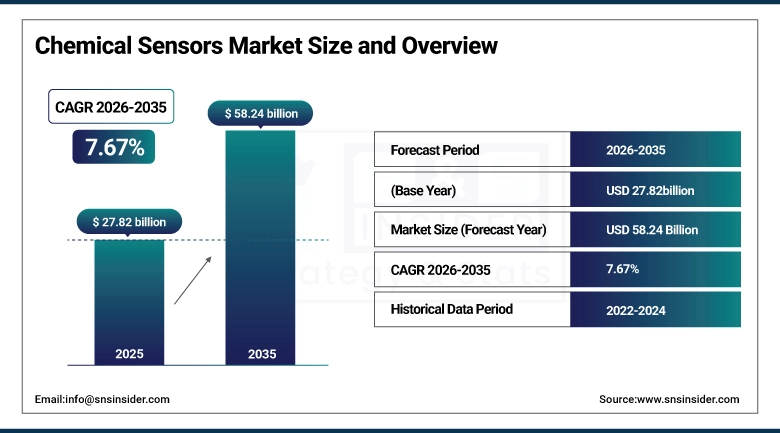
The Chemical Sensors Market size was valued at USD 27.82 Billion in 2025 and is projected to reach USD 58.24 Billion by 2035, growing at a CAGR of 7.67% during 2026–2035.
Rising demand for real-time monitoring in industrial, environmental, healthcare and automotive applications is driving solid revenue growth in the chemical sensors market. Increasing air pollution and work place safety concerns, along with tight regulatory standards are driving the adoption of advanced sensing technologies. Ongoing advances in nanotechnology; Internet of Things (IoT) integration; and the development of platform agnostic digital sensors are improving detection precision, reliability, and operational efficiency. The increasing adaptation of chemical sensors in gas detection, emission control, water quality monitoring, and medical diagnostics is anticipated to create major opportunities for market growth. Improved miniaturization and low-power sensing systems also facilitate more widespread use in portable and wearable devices. In summary, the market is growing fast and has great potential in both developed and emerging economies.
In March 2026, ABB announced the launch of its 500 X pH/ORP sensor purposefully designed for use in harsh industrial environments, enabling a longer lifetime of up to five-years Indoors and outdoors, the 500 X, and highly resistant to fouling and chemical interference. The sensor combines digital connectivity provided by the EZLink platform for real-time monitoring, faster installation and predictive maintenance, improving efficiency in various industrial process control and water analysis applications.
Market Size and Growth Forecast:
-
Market Size in 2025: USD 27.82 Billion
-
Market Size by 2035: USD 58.24 Billion
-
CAGR: 7.67% (from 2026 to 2035)
-
Base Year: 2025
-
Forecast Period: 2026–2035
-
Historical Data: 2022–2024
To Get more information on Chemical Sensors Market - Request Free Sample Report
Chemical Sensors Market Trends Highlights:
-
Strong growth driven by rising demand for environmental monitoring, industrial safety, and healthcare diagnostics
-
Increasing adoption of IoT-enabled and AI-integrated sensing technologies for real-time detection and analysis
-
Expanding use in automotive emissions control, gas detection, and smart manufacturing applications
-
Rapid technological advancements in nanomaterials and miniaturized sensor systems enhancing performance and accuracy
-
Growing regulatory pressure for air quality, workplace safety, and environmental compliance boosting deployment
-
Rising integration of chemical sensors in smart cities, wearable devices, and portable diagnostic systems
-
Increasing investments in R&D and digital sensor platforms supporting next-generation sensing solutions
U.S. Chemical Sensors Market Size Outlook:
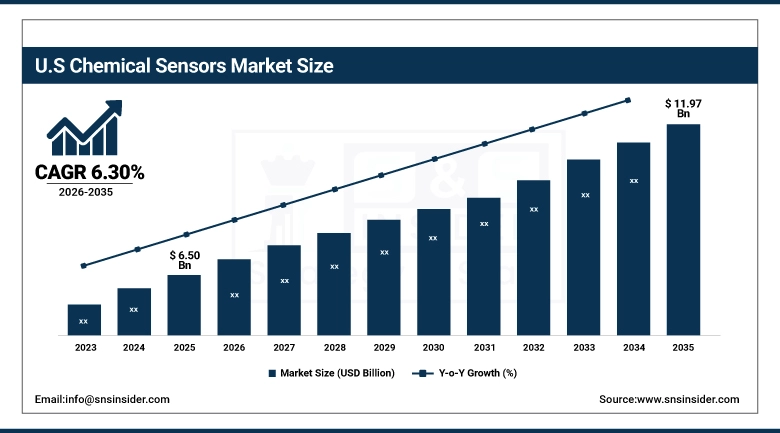
The U.S. Chemical Sensors Market was valued at USD 6.50 Billion in 2025 and is projected to reach USD 11.97 Billion by 2035, growing at a CAGR of 6.30% during 2026–2035. with growing demand throughout industrial safety, health care diagnostics, environmental monitoring, and automotive applications. This is backed by the regional market due to various data driven technological improvements like Internet of Things based on low power sensing systems, artificial intelligence driven analytics, and technological advances in miniaturization of the sensor technologies to increase detection accuracy and spontaneous detection capability. Environmental Controls on emissions and workplace safety regulations are tightening, creating more urgency for businesses to adopt across core industries. The surge in investments in major end-use industries such as smart infrastructure, oil & gas monitoring, and medical diagnostics are expected to drive the market expansion.
Market Drivers: Nanopore Enabled Chemical Sensors Transforming Precision Detection Technologies
Nanopore-based chemical sensors, which provide high sensitivity, real-time detection of single volatile organic compounds, are fast becoming one of the leading fuel for growth in the chemical sensors market as they make dramatic improvements in diagnosis accuracy and response speed. The need for early detection of a disease, particularly in respiratory disorders and cancer, is fueling adoption of novel sensing technologies in healthcare applications. This is additionally driving the growth of market as this is increasingly becoming widespread for economic, portable, and low-rate point-of-care tests. Moreover, continuous developments in Nanotechnology, Protein engineering, and micro system technology are improving functionality and stability. Smart electronics, IoT connectivity, and data analytics integration aid in evolving real-time monitoring & expand applications into medical, industrial, and environmental safety worldwide.
In November 2025 – Research News – Scientists developed a nanopore-based chemical sensor that detects individual volatile organic compounds in real time using engineered protein pores, enabling rapid and accurate identification of disease-related biomarkers for advanced point-of-care diagnostics.
Market Restraints: Intelligent Chemical Sensors Powering Real Time Detection Systems
The chemical sensors industry is witnessing strong expansion due to increasing demand for environmental monitoring, industrial safety, healthcare diagnostics, and automotive emissions control across global industries. Growing regulatory pressure on air quality and workplace safety is encouraging widespread deployment of advanced sensing technologies in manufacturing, oil & gas, and smart city infrastructure. Technological advancements such as miniaturized sensors, IoT-enabled monitoring systems, and AI-based analytics are significantly improving detection accuracy and real-time response capabilities. Additionally, rising adoption of wearable medical devices and smart industrial automation systems is further driving market growth. However, challenges such as high development costs, sensor calibration issues, and limited durability in harsh environments continue to restrain adoption.
Market Opportunities: Advanced Chemical Sensors Driving the Next Wave of Intelligent Detection Systems
Chemical sensors are experiencing the growth of its market at a relentless pace as they are being extensively used in environmental monitoring, industrial safety, healthcare diagnostics, and the development of smart infrastructure owing to rising demand. Rising air pollution, growing awareness of occupational hazards, and regulatory compliance are driving industries to increasingly rely on advanced sensing technologies. Recent technological advancements in miniaturization of sensors, the Internet of Things (IoT), AI-enabled monitoring systems, and self-powered sensing platforms have increased performance, accuracy, and efficiency, resulting in more effective monitoring. Market growth is further driven by the increasing application of chemical sensors in automotive emission control, oil & gas safety, and medical diagnosis. Moreover, increasing investment for smart cities, industrial automation, and next-generation sensing materials is driving huge demand over developed and emerging regions.
In March 2026, Self-powered chemical sensing platform: Researchers combined graphene sensors with MoS₂ logic circuits and silicon photovoltaic modules to create a self-powered chemical sensing platform, allowing autonomous chemical sensing by converting signals into digital forms directly, in real-time, and without needing external power, paving the way for environmental, industrial, and healthcare applications.
Chemical Sensors Market Segment Highlights:
-
By Type: Dominant – Gas Sensors (53.70% in 2025 → 50.90% in 2035); Fastest Growing – Solid Sensors (19.90% in 2025 → 24.50% in 2035)
-
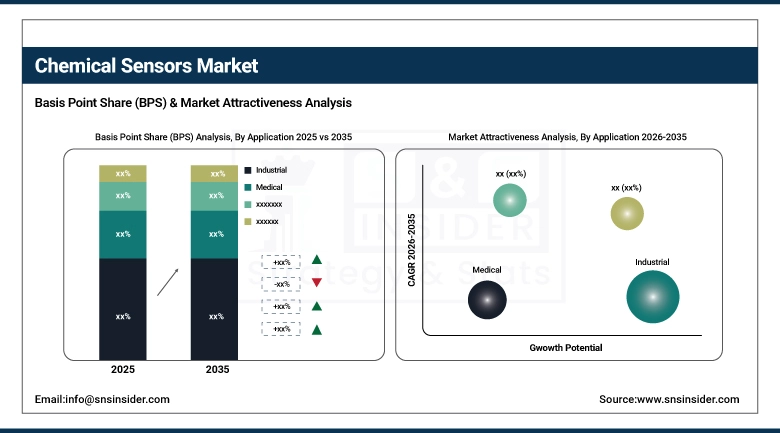
By Application: Dominant – Industrial (41.80% in 2025 → 38.60% in 2035); Fastest Growing – Environmental Monitoring (16.90% in 2025 → 19.40% in 2035)
-
By Technology: Dominant – Electrochemical (36.40% in 2025 → 33.10% in 2035); Fastest Growing – Thermometric (6.60% in 2025 → 7.80% in 2035)
-
By End Use: Dominant – Healthcare (36.50% in 2025 → 31.80% in 2035); Fastest Growing – Automotive (28.90% in 2025 → 30.40% in 2035)
By Type: Gas Sensors (Dominant) and Solid Sensors (Fastest-Growing)
The Gas Sensors segment accounted for the largest share of the chemical sensors industry due to its extensive use in industrial safety systems, environmental monitoring, automotive emissions control, and healthcare diagnostics where accurate detection of toxic and combustible gases is critical. Strong regulatory standards and rising demand for air quality monitoring further support its dominance over the forecast period. On the other hand, the Solid Sensors segment is expected to witness the fastest growth driven by increasing adoption in advanced industrial automation, smart manufacturing systems, and next-generation sensing technologies. Continuous innovation in material science, miniaturization of devices, and integration with IoT-based monitoring platforms are further accelerating the expansion of solid-state chemical sensors.
By Application: Industrial (Dominant) and Environmental Monitoring (Fastest-Growing)
The Industrial segment accounted for the largest share of the chemical sensors market due to its extensive deployment in manufacturing plants, process control systems, and workplace safety monitoring where continuous detection of hazardous chemicals is critical. Strong regulatory compliance requirements and growing automation across industries further support its dominance over the forecast period. On the other hand, the Environmental Monitoring segment is expected to witness the fastest growth driven by rising concerns over air pollution, climate change, and strict government regulations on emissions control. Increasing adoption of smart city initiatives and real-time air quality monitoring systems is further accelerating demand for advanced chemical sensing solutions.
By Technology: Electrochemical (Dominant) and Thermometric (Fastest-Growing)
Electrochemical was the largest segment of chemical sensors owing to high accuracy, cost effectiveness, and application in wide range of industries including gas detection, industrial safety, and healthcare diagnostics. It has an established track record and is used in portable and fixed monitoring systems, which helped maintain a leading position in the market. On the other hand, expected rapid growth of the Thermometric segment is likely to occur owing to growing product demand in the fields of industrial automation and environmental analysis, especially for advanced temperature-sensitive chemical detection systems. Increasing integration of smart sensing technologies and IoT-based monitoring platforms are also contributing to its growing adoption.
By End Use: Healthcare (Dominant) and Automotive (Fastest-Growing)
The Healthcare segment accounted for the largest share of the chemical sensors market applications of chemical sensors in medical diagnostics, patient monitoring, and respiratory analysis—where accurate detection of chemical biomarkers is crucial. The presence of high healthcare expenditure and boom in demand of sophisticated diagnostic devices further solidifies its leadership. However, the Automotive segment is projected to show the maximum growth due to their growing integration with chemical sensors for use in emission control systems, cabin air quality monitoring, and advanced driver assistance systems (ADAS). The increasing acceptance of electric vehicles along with stringent emission laws is fueling the market growth for this segment.
Chemical Sensors Market Regional Highlights:
-
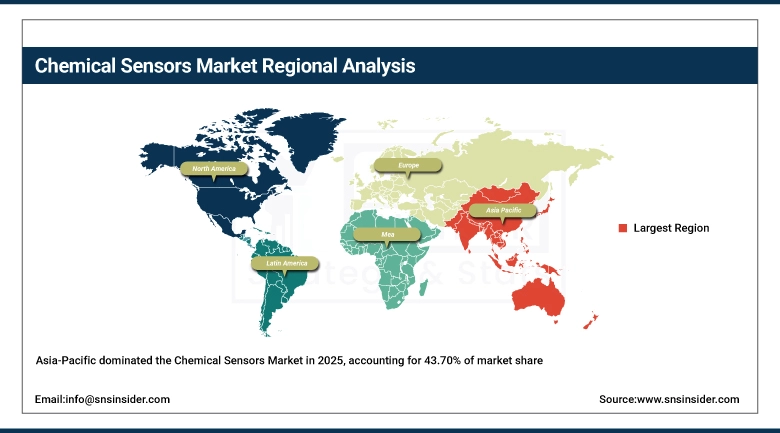
Asia-Pacific (Dominating & Fastest Growing – 43.70% in 2025 → 47.90% in 2035, CAGR 8.66%)
-
North America (27.60% in 2025 → 24.80% in 2035, CAGR 6.52%)
-
Europe (20.80% in 2025 → 19.10% in 2035, CAGR 6.75%)
-
Latin America (5.90% in 2025 → 5.80% in 2035, CAGR 7.49%)
-
Middle East & Africa (2.00% in 2025 → 2.40% in 2035, CAGR 9.63%)
Asia-Pacific Chemical Sensors Market Insights:
Asia Pacific is the leading region in the chemical sensors market, due to factors such as increasing industrialization, manufacturing operations and environmental monitoring regulations in the key economies, such as China, Japan, South Korea, and India. High application of chemical sensors in the automotive emissions control application area, the industrial safety systems market, and in the consumer electronics segment for gas detection and air quality monitoring will help drive demand in the region. Moreover, with the existence of high semiconductor and sensor manufacturing hubs, along with rising smart cities and IoT-based sensing technology investments, regional leadership becomes a continuing trend. Ongoing government initiatives for pollution control and workplace safety standards further drives the adoption and making Asia Pacific the fastest growing and the most lucrative market for chemical sensors worldwide.
Get Customized Report as per Your Business Requirement - Enquiry Now
China Chemical Sensors Market Insights:
China is further dominant in chemical sensors industry owing to strong industrial base coupled with large electronics manufacturing market, strict environmental regulations and rapid adoption of IoT based and smart city technologies sustaining widespread deployment of sensors..
North America Chemical Sensors Market Insights:
North America is expected to be the fastest growing region in the chemical sensors market, due to the high degree of technological innovation in coupled with high adoption potential of advanced industrial automation and rising investments in environmental monitoring and workplace safety system in North America. Given large number of sensor manufactures, rich R&D infrastructure, quick adoption of IoT based and AI based sensing solutions in sectors such as healthcare, oil & gas, automotive, defense etc., the region is expected to develop rapidly. In addition to this, strict regulatory standards issued by federal agencies like the EPA are driving increasing demand for accurate and reliable gas & chemical detection systems. The chemical sensors industry evolution is also playing to the North America high growth markets with increased deployment driven by an increased awareness for air quality, emissions control and industrial hazard prevention.
U.S. Chemical Sensors Market Insights:
The U.S. dominates the North American chemical sensors industry owing to its strong industrial base along with the presence of robust R&D infrastructure leading to higher penetration of IoT-enabled sensing technologies and strict government guidelines and norms related to the environment, workplace safety, and public health driving widespread sensor deployment in end-user industries.
Europe Chemical Sensors Market Insights:
The Europe chemical sensors market is experiencing steady growth driven by pressing environmental regulations, heightened focus on industrial safety, and growing adoption of enhanced monitoring solutions across manufacturing, automotive, and healthcare markets. With their long-standing industrial bases and continuous investments in clean energy and emission control technologies, countries like Germany, France, and the UK are at the forefront of adoption. In addition, the region also experiences high research and innovation functionality for enabling sensor technology, and rising adoption of IoT and smart monitoring systems in industrial processes. As air quality and workplace safety concerns grow, the region is expected to continue to show consistent demand, making Europe a strong and relatively stable growth market for chemical sensors.
Germany Chemical Sensors Market Insights:
Germany dominates the Europe chemical sensors industry due to its strong industrial manufacturing base, advanced automotive sector, strict environmental regulations, and high adoption of industrial automation and smart sensing technologies across key end-use industries.
Latin America Chemical Sensors Market Insights:
The Latin America chemical sensors market is witnessing gradual growth due to increased industrialization, rising environmental awareness, and widespread deployment of safety monitoring systems in oil & gas, mining, and manufacturing sectors are expected to promote growth. Driven by increasing investments in industrial infrastructure as well as regulatory efforts to improve air quality and workplace safety standards, countries like Brazil and Mexico are leading demand. All of these factors are contributing to the gradual inclusion of automation and IoT based monitoring solutions into the product market. Yet underlying technological penetration, and gradual adoption compared to more mature regions continue to restrain faster growth, making Latin America a gradual increasing but yet emerging market for chemical sensors.
Brazil Chemical Sensors Market Insights:
Brazil leads the Latin America chemical sensors industry powered by large investments in oil & gas and mining, continuous implementation of environmental monitoring activities in the country and increasing adoption of industrial safety and automation technologies in major end-use industries.
Middle East & Africa Chemical Sensors Market Insights:
The Middle East & Africa chemical sensors market is witnessing significant momentum due to the diversification of markets, rapid industrialization, investments in oil & gas infrastructure allied with the growing demand for environmental monitoring and workplace safety systems. Arising demand and high energy sector activities are considered responsible for strong adoption in countries like Saudi Arabia, UAE and South Africa along with growing efforts for industrial diversification all will have a contribution in addition to what is mentioned above. Hence governments in this region are also inclined to air quality control and emission reduction which boosts the deployment of advanced sensing technologies. Faster adoption of smart city projects and automation in industrial operations is further boosting the demand and making MEA as the developing high revenue generating region for chemical sensors.
Saudi Arabia Chemical Sensors Market Insights:
Saudi Arabia is the largest chemical sensors industry in the Middle and Africa due to its huge oil and gas industry, well-established industrial base, and growing focus on investments in the application sectors for environmental monitoring and growing demand for smart industrial automation systems.
Chemical Sensors Market Competitive Landscape:
Honeywell International Inc. (Est. 1906) – Honeywell is a global diversified technology and industrial company specializing in aerospace systems, building technologies, industrial automation, and safety solutions. The company is a key player in the chemical and gas sensors market, offering advanced sensing technologies for industrial safety, environmental monitoring, and process control applications. It focuses on innovation in gas detection, IoT-enabled sensors, and AI-based monitoring systems to improve operational efficiency and workplace safety across oil & gas, manufacturing, healthcare, and energy sectors worldwide.
-
In March , 2026 – Honeywell launched a next-generation NDIR Hydrocarbon Gas Sensor to improve industrial safety by detecting flammable gases like methane, propane, and butane using advanced infrared technology for higher accuracy and reliability in harsh environments.
Siemens AG (Est. 1847) – Siemens is a Germany-based global technology company specializing in industrial automation, electrification, digitalization, and smart infrastructure solutions. It develops advanced software, sensors, and AI-driven systems used across manufacturing, energy, healthcare, and transportation sectors, enabling efficient, reliable, and sustainable industrial operations worldwide.
-
In Dec 2025, Siemens has partnered with GlobalFoundries to deploy AI-driven semiconductor manufacturing solutions, integrating automation, sensors, and digital technologies to improve efficiency, reliability, and predictive maintenance in chip production.
Chemical Sensors Companies are:
-
Honeywell International Inc.
-
Siemens AG
-
ABB Ltd.
-
Emerson Electric Co.
-
Bosch Sensortec GmbH
-
Amphenol Advanced Sensors
-
Figaro Engineering Inc.
-
Sensirion AG
-
City Technology Ltd.
-
Membrapor AG
-
Aeroqual Ltd.
-
MSA Safety Incorporated
-
Drägerwerk AG & Co. KGaA
-
SGX Sensortech
-
Teledyne Technologies Incorporated
-
SICK AG
-
Halma plc
-
Yokogawa Electric Corporation
| Report Attributes | Details |
|---|---|
| Market Size in 2025 | USD 27.82 Billion |
| Market Size by 2035 | USD 58.24 Billion |
| CAGR | CAGR of 7.69% From 2026 to 2035 |
| Base Year | 2025 |
| Forecast Period | 2026-2035 |
| Historical Data | 2022-2024 |
| Report Scope & Coverage | Market Size, Segments Analysis, Competitive Landscape, Regional Analysis, DROC & SWOT Analysis, Forecast Outlook |
| Key Segments | • By Type (Gas, Liquid and Solid) • By Application (Industrial, Medical, Environmental Monitoring, Defense and Homeland Security) • By Technology (Electrochemical, Biochemical, Optical, Electrical, Electromechanical and Thermometric) • By End Use (Medical, Automotive and Healthcare) |
| Regional Analysis/Coverage | North America (US, Canada), Europe (Germany, UK, France, Italy, Spain, Russia, Poland, Rest of Europe), Asia Pacific (China, India, Japan, South Korea, Australia, ASEAN Countries, Rest of Asia Pacific), Middle East & Africa (UAE, Saudi Arabia, Qatar, South Africa, Rest of Middle East & Africa), Latin America (Brazil, Argentina, Mexico, Colombia, Rest of Latin America). |
| Company Profiles | Honeywell International Inc., Siemens AG, ABB Ltd., Emerson Electric Co., Thermo Fisher Scientific Inc., Bosch Sensortec GmbH, Amphenol Advanced Sensors, Figaro Engineering Inc., Sensirion AG, City Technology Ltd., Alpha MOS, Membrapor AG, Aeroqual Ltd., MSA Safety Incorporated, Drägerwerk AG & Co. KGaA, SGX Sensortech, Teledyne Technologies Incorporated, SICK AG, Halma plc, and Yokogawa Electric Corporation are key players operating in the chemical sensors market, offering advanced sensing technologies for industrial safety, environmental monitoring, healthcare diagnostics, and automotive applications. |

Frequently Asked Questions
Asia-Pacific dominated the Chemical Sensors Market in 2025.
The “Gas” segment dominated during the projected period.
Increasing demand for environmental monitoring, growing adoption in industrial safety and process control, rising use in healthcare diagnostics, and expanding applications in automotive emissions and IoT-based smart sensing systems are the key drivers of the Chemical Sensors Market.
The Market was valued at USD 27.82 Billion in 2025 and is projected to reach USD 58.24 Billion by 2035.
The Market is expected to grow at a CAGR of 7.67%during 2026–2035.
