
Nonwoven Fabrics Market Report Scope & Overview:
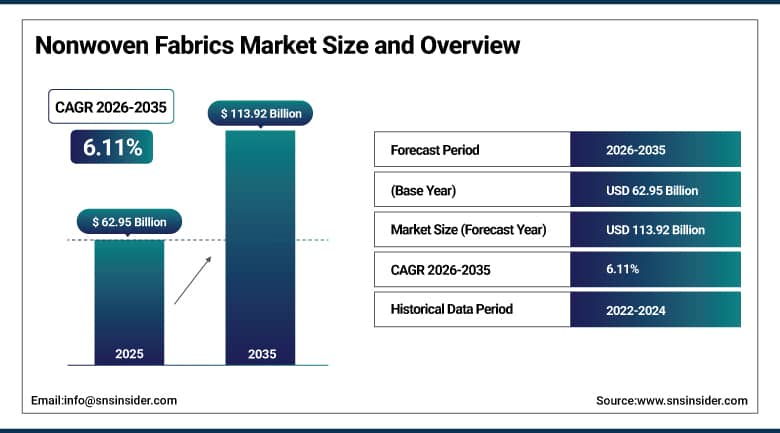
The Nonwoven Fabrics Market was valued at USD 62.95 Billion in 2025 and is expected to reach USD 113.92 Billion by 2035, growing at a CAGR of 6.11% from 2026 to 2035.
Nonwoven fabrics are engineered textile materials manufactured by bonding or interlocking fibres, filaments, or films through mechanical, thermal, or chemical processes rather than the traditional weaving or knitting operations that define conventional textiles, creating sheet or web structures whose properties including porosity, tensile strength, absorbency, liquid barrier performance, and thermal insulation can be precisely engineered for specific end-use requirements.
The nonwoven manufacturing ecosystem encompasses a diverse range of production technologies whose selection determines the resulting fabric's structural characteristics: spunbond processes extrude continuous polymer filaments directly onto a moving belt where they are bonded to create the high-strength, cost-effective fabrics used in hygiene product coverstock, geotextiles, and agricultural mulch. Meltblown processes force molten polymer through fine nozzles to create microfibre webs whose submicron fibre diameter creates high filtration efficiency for medical masks, HVAC filters, and liquid filtration.
The Berry Global Group witnessed an increase in the demand for its sustainable nonwoven fabrics in 2025 due to its sustainable nonwoven products made from recycled PET and biopolymers which received commercial success with the brand owner customers who had sustainability policies towards their packaging which meant that they were preferring nonwoven fabrics having recycled content and smaller carbon footprints than virgin polymer counterparts. In addition to this, the company's sustainable nonwoven athletic apparel fabrics distribution deal with Hanes Brands was an example of how the technical nonwoven material was moving into consumer apparel with moisture management properties, four-way stretch properties, and antimicrobial treatments which could not be provided by conventional woven and knitted materials at same costs.
Market Size and Forecast:
-
Market Size in 2026E: USD 66.79 Billion
-
Market Size by 2035: USD 113.92 Billion
-
CAGR: 6.11% from 2026 to 2035
-
Fastest Growing Region: Asia Pacific
-
Largest Region: North America
To Get More Information On Nonwoven Fabrics Market - Request Free Sample Report
Nonwoven Fabrics Market Trends:
-
Sustainable and biodegradable nonwoven materials are gaining traction amid stricter environmental regulations.
-
SMS and SMMS composite nonwovens are expanding into packaging, agriculture, and automotive applications.
-
AI-powered quality control is improving manufacturing efficiency and product consistency.
-
Meltblown production capacity is increasing to meet filtration and healthcare demand.
-
Automotive light weighting initiatives are driving higher adoption of engineered nonwoven fabrics.
U.S. Nonwoven Fabrics Market Outlook:
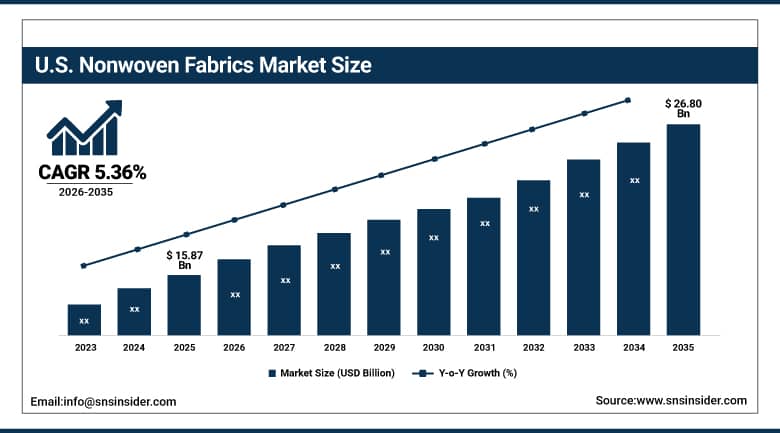
The U.S. Nonwoven Fabrics Market was valued at approximately USD 15.87 Billion in 2025 and is expected to reach approximately USD 26.80 Billion by 2035, growing at a CAGR of approximately 5.36%.
The United States is the world's largest nonwoven fabrics market within the dominant North American region, driven by the domestic concentration of the world's most commercially advanced hygiene products sector including Procter & Gamble, Kimberly-Clark, and Edgewell Personal Care whose combined disposable diaper, adult incontinence, and feminine hygiene product consumption creates the largest single national nonwoven fabric procurement market, the most extensive medical disposables sector whose surgical suite and patient care nonwoven consumption creates substantial premium-grade medical fabric procurement, and the automotive manufacturing sector's growing nonwoven content per vehicle driven by fuel efficiency and electric vehicle range optimization programmes. Tariff impacts on imported nonwoven feedstocks and specialty fabrics are stimulating domestic production capacity investment.
Kimberly-Clark unveiled new biodegradable nonwoven technology integrated into its Huggies diaper coverstock in partnership with a biopolymer supplier in 2024, replacing conventional polypropylene coverstock with a proprietary biopolymer-based nonwoven that provides equivalent infant skin softness and liquid acquisition performance while achieving accelerated composting degradation under industrial composting conditions whose certification by international biodegradability standards enables Huggies' sustainability claim communication. The development reflected the diaper category's growing parent consumer demand for products whose disposal environmental impact is reduced relative to conventional petroleum-derived plastic nonwoven diapers, creating commercial incentive for bio-based nonwoven development whose cost premium relative to polypropylene alternatives must be validated against consumer willingness to pay for sustainability differentiation.
Nonwoven Fabrics Market Segment Analysis:
-
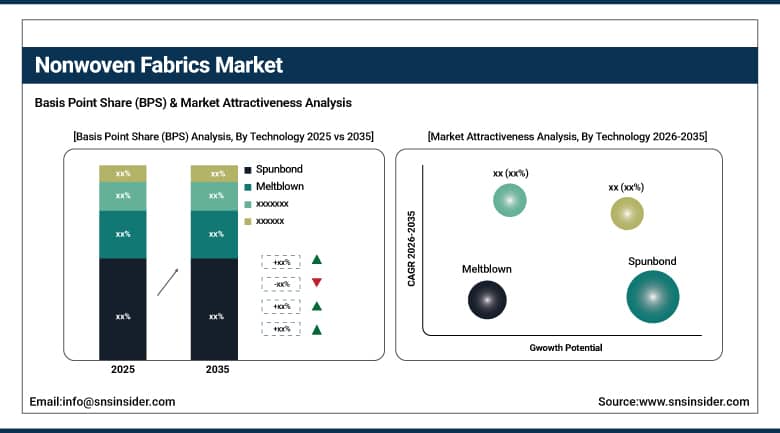
By Technology, the spunbond segment dominated the nonwoven fabrics market with approximately 48.00% share in 2025, while the meltblown segment is growing at an above-average CAGR driven by filtration and medical applications.
-
By Raw Material, the polypropylene segment dominated the nonwoven fabrics market with approximately 45.00% share in 2025, while the bio-composites and biopolymer segment is growing fastest due to sustainability requirements.
-
By Application, the hygiene products segment dominated the nonwoven fabrics market with approximately 40.00% share in 2025, while the medical & surgical segment is growing rapidly through increased healthcare infrastructure investment.
-
By End Use Industry, the healthcare & hygiene segment dominated the nonwoven fabrics market with approximately 48.00% share in 2025, while the automotive segment is growing at a notable CAGR through vehicle light weighting programmes.
By Technology, spunbond dominates, meltblown grows above average
Spunbond technology retained the dominant position with approximately 48.00% of nonwoven fabrics market revenue in 2025, reflecting its status as the most commercially deployed nonwoven production technology whose cost efficiency at high line speeds, versatile raw material compatibility with polypropylene, polyester, and biopolymer polymers, and broad application range spanning hygiene product coverstock through geotextiles and automotive trunk liners sustains the largest installed production capacity globally. Spunbond's dominance is reinforced by its role as the structural layer in SMS composite fabrics whose outer spunbond layers provide the tensile strength that sandwiches the central meltblown filtration layer whose combination creates the performance profile of medical gowns, surgical drapes, and industrial protective workwear.
Meltblown technology is growing at an above-average CAGR as the permanent healthcare sector demand elevation for high-efficiency filtration media, growing adoption of meltblown filter layers in automotive HVAC cabin air filtration systems, and air quality improvement investment at commercial buildings collectively sustain meltblown fabric demand substantially above the pre-2020 baseline.
By Application, hygiene dominates, medical grows rapidly
Hygiene products retained the dominant application position with approximately 40.00% of nonwoven fabrics market revenue in 2025, reflecting the enormous volume of disposable hygiene product consumption globally whose diaper, adult incontinence, and feminine hygiene pad production each require multiple nonwoven fabric layers including soft skin-contact coverstock, acquisition distribution layers, and outer barrier backsheet materials whose combined fabric content per product unit multiplied by billions of units annually creates the hygiene sector's foundational and stable nonwoven demand base. Developing market hygiene product adoption growth, where rising incomes, urbanization, and health awareness are progressively converting previously underserved consumer populations in India, Sub-Saharan Africa, and Southeast Asia from cloth-based reusable hygiene solutions toward disposable alternatives.
Medical and surgical nonwoven applications are growing rapidly through healthcare infrastructure expansion globally and the permanent specification elevation of medical-grade fabrics post-pandemic.
Regional Analysis:
|
Region |
Major Country |
Share within Region, 2025 (%) |
|---|---|---|
|
North America |
United States |
84.73% |
|
Europe |
Germany |
27.84% |
|
Asia Pacific |
China |
42.84% |
|
Middle East & Africa |
UAE |
22.84% |
|
Latin America |
Brazil |
43.84% |
North America Nonwoven Fabrics Market Insights
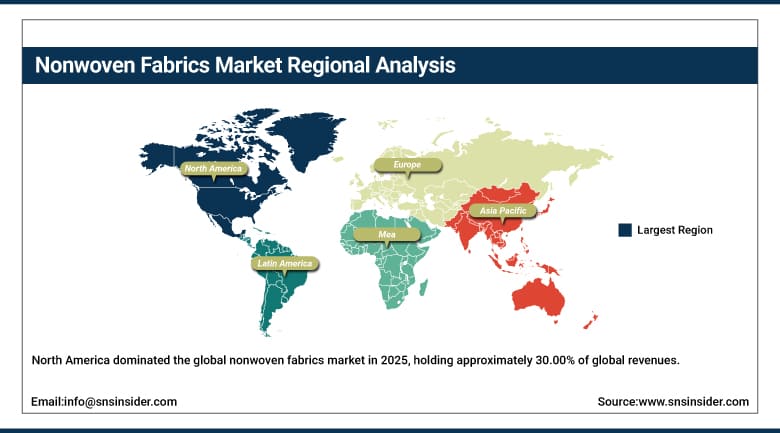
North America dominated the global nonwoven fabrics market in 2025, holding approximately 30.00% of global revenues. The United States accounts for approximately 84.73% of regional revenue through the world's largest hygiene products, medical disposables, and automotive sectors whose combined nonwoven fabric procurement creates the most commercially significant concentrated demand base globally. Canada contributes meaningful supplementary North American demand through its healthcare and industrial applications.
Get Customized Report as Per Your Business Requirement - Enquiry Now
Europe Nonwoven Fabrics Market Insights
Europe held prominent share of global nonwoven fabrics revenues in 2025. Germany accounts for approximately 27.84% of European revenues through its automotive sector's nonwoven interior component demand, Freudenberg SE's global nonwoven manufacturing, and the domestic medical device sector's fabric requirements. The EU's Single-Use Plastics Directive and Circular Economy Action Plan create regulatory pressure that is simultaneously constraining certain disposable nonwoven applications and stimulating innovation in sustainable nonwoven materials. The United Kingdom, France, and the Netherlands contribute meaningful European demand through their healthcare and industrial sectors.
Asia Pacific Nonwoven Fabrics Market Insights
Asia Pacific is the fastest-growing regional nonwoven fabrics market and the world's largest production base, projected to account for approximately 42% of global market share by 2035. China accounts for approximately 42.84% of Asia Pacific revenues through its dominant global nonwoven production capacity, large domestic hygiene product consumption, and export-oriented technical nonwoven manufacturing. India is growing rapidly through expanding hygiene product adoption, healthcare infrastructure investment, and agricultural nonwoven demand. Japan and South Korea contribute through automotive and technical nonwoven specialty manufacturing.
MEA & Latin America Nonwoven Fabrics Market Insights
Middle East and Latin America represent growing nonwoven fabrics markets where expanding healthcare infrastructure and hygiene product market development are creating increasing demand. The UAE leads MEA revenues at approximately 22% of the regional total through its advanced healthcare sector, growing domestic hygiene product consumption, and regional distribution hub role for medical nonwovens. Brazil leads Latin American revenues at approximately 43 % of the regional total through its large hygiene product manufacturing sector, medical textile consumption, and agricultural nonwoven applications in its extensive agricultural sector.
Market Dynamics:
Growth Drivers: Rising disposable hygiene product consumption in emerging economies and sustained medical nonwoven demand elevation from post-pandemic healthcare infrastructure investment.
The global hygiene product market's expansion in developing economies, where rising incomes, urbanization, and health awareness are converting hundreds of millions of consumers from reusable cloth hygiene solutions toward disposable alternatives, creates nonwoven fabric demand growth whose geographic expansion sustains above-GDP market growth rates that mature developed market hygiene consumption alone cannot maintain. UNICEF and WHO data indicating that global baby diaper penetration rates among births in low- and middle-income countries remain below 30 percent in the lowest income quintiles, compared to near-100 percent penetration in high-income markets, illustrates the addressable market growth potential that income convergence progressively unlocks. Medical nonwoven demand's permanent elevation above pre-COVID levels, driven by healthcare facilities' institutional stockpiling mandates, PPE strategic reserve programmes, and infection control protocol upgrades.
Restraints: Plastic pollution pressure and extended producer responsibility regulations creating cost and compliance challenges for polypropylene-based disposable nonwoven manufacturers.
Polypropylene nonwoven fabrics' petroleum polymer derivation creates lifecycle environmental footprint concerns that are intensifying as consumer brand sustainability commitments and regulatory frameworks including the EU Single-Use Plastics Directive place disposable nonwoven products under increased scrutiny. The development of bio-based and compostable nonwoven alternatives requires significant material science investment and bio-based polymer supply chain development whose commercial scale at competitive pricing relative to conventional polypropylene remains under development, creating a transition cost burden for producers investing in sustainable material capability ahead of established consumer willingness to pay for the premium.
Opportunities: Biodegradable and recycled content nonwoven material development for sustainability-committed brand owners and technical nonwoven innovations in battery separator and electronics applications creating high-value growth segments.
The global market for sustainable nonwoven materials, encompassing bio-based polylactic acid fabrics, recycled PET nonwovens, and naturally derived cellulosic nonwovens, represents a premium growth segment whose commercial scale is expanding proportionally with brand owner sustainability commitment seriousness and consumer willingness to pay for verified eco-performance in hygiene, personal care, and medical applications. Battery separator nonwoven applications for lithium-ion and solid-state battery production, where ceramic-coated polyethylene or polypropylene microporous separator membranes or glass microfibre nonwoven separators provide the ion transport and thermal stability functions that battery safety depends on, represent a high-value technical nonwoven market segment whose commercial scale is growing proportionally with global electric vehicle battery production investment.
Recent Developments:
-
2025: Berry Global Group expanded its sustainable nonwoven product lines with recycled PET and biopolymer-based fabrics gaining commercial traction among brand owner customers, and Ahlstrom-Munksjo reported accelerating filtration nonwoven demand from HVAC, industrial, and water treatment applications driving meltblown production capacity investment.
-
2025: James Hardie announced an expanded range at the 2025 International Builders' Show, while Freudenberg SE invested in advanced technical nonwoven production for electric vehicle battery component applications including thermal management and structural battery enclosure materials.
-
2024: Kimberly-Clark introduced biodegradable nonwoven technology into Huggies diaper coverstock in partnership with a biopolymer supplier, replacing conventional polypropylene with biopolymer-based nonwoven achieving equivalent performance with industrial composting certification.
Nonwoven Fabrics Market Key Players are:
-
Berry Global Group Inc.
-
Kimberly-Clark Corporation
-
DuPont de Nemours Inc.
-
Ahlstrom-Munksjo Oyj
-
Freudenberg SE
-
Toray Industries Inc.
-
Suominen Corporation
-
PFNonwovens Group
-
Avgol Nonwovens Ltd.
-
Fitesa SA
-
Glatfelter Corporation
-
Fibertex Nonwovens A/S
-
TWE GmbH & Co. KG
-
Johns Manville (Berkshire Hathaway)
-
Mitsui Chemicals Inc.
-
Asahi Kasei Corporation
-
CHTC Jiahua Nonwoven Co. Ltd.
-
Mogul Nonwoven Fabrics
-
HEMA Industrial Yarns
-
Lydall Inc.
Nonwoven Fabrics Market Report Scope:
| Report Attributes | Details |
|---|---|
| Market Size in 2025 | USD 62.95 Billion |
| Market Size by 2035 | USD 113.92 Billion |
| CAGR | CAGR of 6.11% From 2026 to 2035 |
| Base Year | 2025 |
| Forecast Period | 2026-2035 |
| Historical Data | 2022-2024 |
| Report Scope & Coverage | Market Size, Segments Analysis, Competitive Landscape, Regional Analysis, DROC & SWOT Analysis, Forecast Outlook |
| Key Segments | • By Technology (Spunbond, Meltblown, Spunmelt (SMS/SMMS), Needle Punch, Spunlace/Hydroentanglement, Airlaid, Wetlaid/Drylaid, Others) • By Raw Material (Polypropylene (PP), Polyester (PET), Polyethylene (PE), Rayon/Viscose, Biopolymers & Natural Fibers, Bio-Composites, Others) • By Application (Hygiene Products, Medical & Surgical, Filtration, Automotive, Construction & Geotextiles, Packaging, Agriculture, Wipes & Personal Care, Others) • By End Use Industry (Healthcare & Hygiene, Automotive, Construction, Filtration, Agriculture, Consumer Goods, Packaging, Others) |
| Regional Analysis/Coverage | North America (US, Canada), Europe (Germany, UK, France, Italy, Spain, Russia, Poland, Rest of Europe), Asia Pacific (China, India, Japan, South Korea, Australia, ASEAN Countries, Rest of Asia Pacific), Middle East & Africa (UAE, Saudi Arabia, Qatar, South Africa, Rest of Middle East & Africa), Latin America (Brazil, Argentina, Mexico, Colombia, Rest of Latin America). |
| Company Profiles | Berry Global Group Inc., Kimberly-Clark Corporation, DuPont de Nemours Inc., Ahlstrom-Munksjo Oyj, Freudenberg SE, Toray Industries Inc., Suominen Corporation, PFNonwovens Group, Avgol Nonwovens Ltd., Fitesa SA, Glatfelter Corporation, Fibertex Nonwovens A/S, TWE GmbH & Co. KG, Johns Manville (Berkshire Hathaway), Mitsui Chemicals Inc., Asahi Kasei Corporation, CHTC Jiahua Nonwoven Co. Ltd., Mogul Nonwoven Fabrics, HEMA Industrial Yarns, and Lydall Inc. |
Frequently Asked Questions
The Nonwoven Fabrics Market is expected to grow at a CAGR of 6.11% from 2026 to 2035.
The Nonwoven Fabrics Market was valued at USD 62.95 Billion in 2025.
The primary growth factors are rising disposable hygiene product consumption in emerging economies, sustained medical nonwoven demand elevation from post-pandemic healthcare investment.
The spunbond segment dominated the Nonwoven Fabrics Market with approximately 48.00% share in 2025.
North America dominated the Nonwoven Fabrics Market in 2025, holding approximately 30.00% of global revenues.
