
Cooling Fabrics Market Report Scope & Overview:
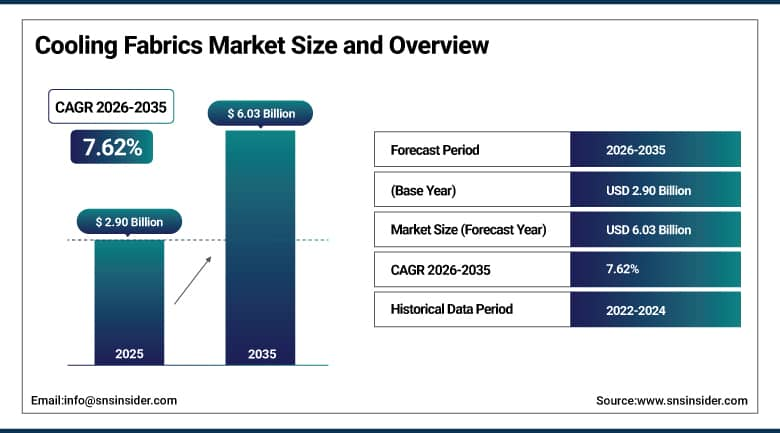
The Cooling Fabrics Market was valued at USD 2.90 billion in 2025 and is expected to reach USD 6.03 billion by 2035, growing at a CAGR of 7.62% from 2026–2035.
The cooling fabrics market is witnessing steady growth in the global market owing to rising demand for performance apparel. Increasing heat stress conditions and climate change are boosting adoption. Growing sportswear and athleisure trends are supporting market expansion. Manufacturers are focusing on advanced moisture management technologies. Rising demand for lightweight and breathable textiles is driving innovation. Increasing use in healthcare and industrial protective clothing is further accelerating market adoption.
According to the textile trade statistics from the International Trade Centre and materials sustainability indicators from OECD, synthetic fibers make up more than 60% of all fibers produced in the world with polyester making up more than 55%. By 2025, the use of performance apparel in sports attire will be more than 35% in developed countries.
To Get More Information On Cooling Fabrics Market - Request Free Sample Report
Cooling Fabrics Market Trends:
-
The growing use of cooling fabrics in sports and athleisure wear is prompting constant innovations in light-weight and moisture controlling textile materials around the world.
-
The rising use of cooling technologies and smart textiles is improving heat management, comfort, durability and performance of the functional garment.
-
The rising use of cooling textiles in the healthcare industry is prompting manufactures to produce better cooling garments, which help in increasing patient comfort and provide support during recovery.
-
The growing use of protective wear for industrial and military use is making manufacturers work on protective clothing, which has heat management properties and helps increase safety and operational efficiency.
-
Continuous funding of R&D activities is helping manufacturers create customized cooling fabric solutions.
-
The growing consumer preference towards breathable and moisture-controlled sportswear that can remain cool for a long time is helping in expanding the market continuously.
U.S. Cooling Fabrics Market Outlook:
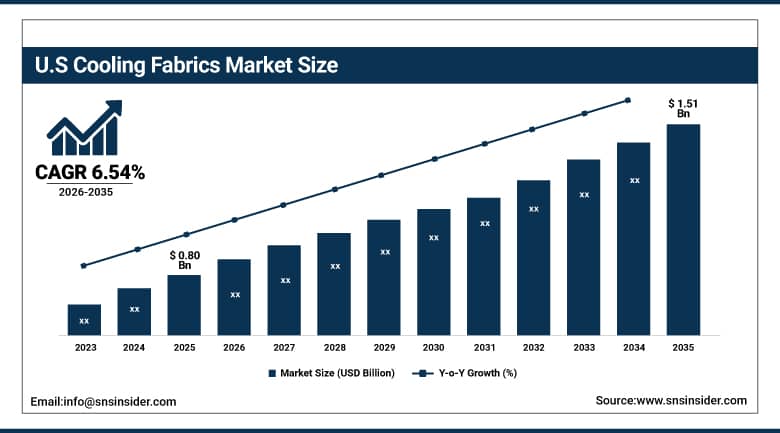
The U.S. Cooling Fabrics Market was valued at USD 0.80 billion in 2025 and is expected to reach around USD 1.51 billion by 2035, growing at a CAGR of 6.54% from 2026–2035.
The U.S. cooling fabrics market is expanding steadily owing to strong demand for performance apparel. Increasing participation in sports and fitness activities is supporting market growth. Rising awareness of heat stress and thermal comfort is driving adoption across consumers. Growth in athleisure and outdoor clothing is further accelerating demand. Manufacturers are focusing on advanced phase change materials and moisture management technologies. Increasing use in healthcare and protective workwear is strengthening market penetration.
As stated by the Bureau of Labor Statistics and Census Bureau textile manufacturing information in the U.S., performance wear and use of synthetic textiles has gradually increased, with more than 60% of activewear including polyester or blends of other materials. Furthermore, Department of Defense Uniform Program figures indicate an increase in the use of moisture-wicking and thermal regulating textiles in more than 70% of contemporary military uniforms.
Cooling Fabrics Market Segment Analysis:
-
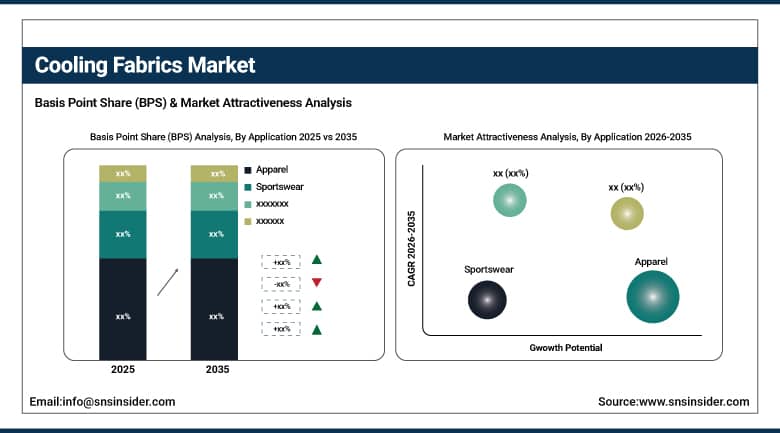
By Application, apparel dominated the market with 42.35% share in 2025; while sportswear is the fastest growing segment with CAGR of 9.73% during 2026 to 2035.
-
By Type, polyester dominated the market with 46.80% share in 2025; while blends are the fastest growing segment with CAGR of 10.92% during 2026 to 2035.
-
By End Use, fashion apparel dominated the market with 33.80% share in 2025; while sports fitness is the fastest growing segment with CAGR of 9.74% during 2026 to 2035.
-
By Technology, phase change materials dominated the market with 31.25% share in 2025; while active cooling is the fastest growing segment with CAGR of 10.83% during 2026 to 2035.
By Application, apparel dominated the cooling fabrics market, while sportswear is the fastest growing segment.
The Apparel Segment accounted for the dominated market share among the application segments in the cooling fabrics market in 2025. The segment’s dominance can be attributed to the extensive usage of cooling fabrics in clothing and the growing preference of consumers for comfort-based fabrics. The increase in urbanization levels and changing lifestyles of people is driving the consumption levels of apparels. Awareness regarding thermal comfort and moisture management in everyday clothing is aiding in boosting the adoption of cooling fabrics among clothing manufacturers and retailers worldwide.
The Sportswear Segment is projected to register the fastest CAGR during the forecast period of 2026-2035 on account of rising participation in fitness activities and outdoor games across the globe. The increasing level of health consciousness and active lifestyles are driving the demand for the segment. Growth in athleisure fashion is also fueling the demand for the adoption of performance-based cooling fabrics.
By Type, polyester dominated the cooling fabrics market, while blends is the fastest growing segment.
Polyester segment accounted for the dominated market share based on revenue generation in 2025 owing to the low price, high durability, and superior moisture wicking capability. The fabric is extensively used in sportswear & performance clothing. It possesses excellent shrinkage and stretches resistance. Superior compatibility with advanced cooling finishes along with large scale manufacturing availability helps the segment to retain its dominance in the global textile & apparel industry.
Blends segment is projected to exhibit the fastest CAGR during 2026-2035 owing to the growing demand for added comfort and functionality. Blends are the fabrics that are made using multiple fiber types. They possess superior breathability and cooling ability than the single fiber. Blends have better thermal regulation than the single fiber. The use in sportswear and athleisure drives growth in this segment.
By End Use, fashion apparel dominated the cooling fabrics market, while sports fitness is the fastest growing segment.
The Fashion Apparel segment was the leader of the cooling fabrics market, accounting for the dominated share in terms of revenue in 2025. The reason behind the leadership is increasing consumer preference towards fashion and comfort wear. The growing need for breathable clothes in day-to-day apparel is fueling the growth. Urbanization and fast fashion trends are increasing adoption. Growing awareness about thermal comfort in premium apparels is helping the segment dominate the global fashion industry.
The Sports & Fitness segment is projected to register the fastest CAGR between 2026 and 2035 owing to the growing participation of people in fitness activities and sports. Health consciousness among consumers is increasing the demand for performance-based apparel. The growing trend of going to gyms and doing outdoor training sessions is aiding adoption. The rising need for sweat resistance and moisture management fabrics is fueling the growth in the segment.
By Technology, phase change materials dominated the cooling fabrics market, while active cooling is the fastest growing segment.
The Phase Change Materials segment has dominated the cooling fabrics market in terms of having the largest revenue share in 2025. Their market dominance is because of their superior capacity of absorbing, retaining, and releasing heat. They offer reliable thermal regulation and comfort in a wide range of temperature. Their growing adoption in sportswear, medical clothing, and protective garments is contributing to their market dominance. The growing preference for longer cooling performance of consumers is helping in their market dominance.
The Active Cooling segment is projected to expand at the fastest CAGR from 2026 to 2035. The growing demand for efficient wearable cooling technology is driving its growth. The rising cases of heat stress and climate change are boosting their adoption. The use of smart textiles and electronic cooling technology is improving their efficiency. The growing applications of the segment in the military, sports, and industrial safety wear is boosting the segment demand.
Regional Analysis:
|
Region |
Major Country |
Share within Region, 2025(%) |
|---|---|---|
|
North America |
United States |
79.35% |
|
Europe |
Germany |
26.40% |
|
Asia Pacific |
China |
41.20% |
|
Middle East & Africa |
UAE |
17.30% |
|
Latin America |
Brazil |
46.10% |
North America Cooling Fabrics Market Insights.
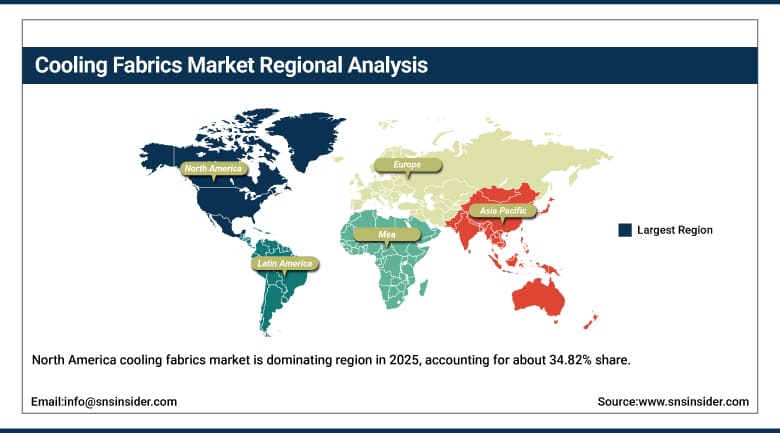
North America cooling fabrics market is dominating region in 2025, accounting for about 34.82% share, driven by strong demand from sportswear and performance apparel. The region benefits from advanced textile manufacturing capabilities and high consumer awareness. Increasing adoption of thermal regulation clothing is significantly strengthening product penetration. Expansion of fitness culture and outdoor activities is accelerating demand. A strong focus on innovative smart textiles further reinforces the region’s dominant position in the market.
According to the U.S. National Oceanic and Atmospheric Administration, was the warmest year recorded in the history of the globe, and the United States had the second-hottest year, having its average temperatures 3.5°F warmer than the 20th century average. According to the Canadian government, over 18 million people were exposed to heat warnings in the summer months. These climate facts are leading to an increase in demand for moisture-wicking, breathable, and thermoregulating cooling textiles in North America.
Get Customized Report as Per Your Business Requirement - Enquiry Now
Europe Cooling Fabrics Market Insights.
Europe cooling fabrics market is characterized by stable growth in 2025 owing to strong demand for sustainable and functional textiles. Key countries include Germany, France, United Kingdom, and Italy. Rising preference for eco-friendly performance fabrics is driving adoption. Increasing focus on workplace safety and thermal comfort is boosting demand. Growth in sportswear and outdoor apparel industries is further supporting market expansion. Strict sustainability regulations are encouraging innovation in cooling textile technologies.
As per the European Climate Risk Assessment 2025 by European Environment Agency and Eurostat, the heat exposure in Europe has been rising, with being the warmest year recorded in the continent till date. Eurostat further states that there are more than 143,000 textile and clothing production companies in the EU employing around 1.3 million people.
Asia Pacific Cooling Fabrics Market Insights.
Asia Pacific is the fastest growing region in the cooling fabrics market, registering a CAGR of about 9.58% during 2026–2035. Rapid urbanization and rising disposable income are driving strong demand across China, India, Japan, South Korea, and Southeast Asia. Expanding sportswear manufacturing and export activities are boosting market growth. Increasing heat conditions and climate change impacts are further accelerating adoption. Growth in textile production hubs is supporting large scale supply expansion.
According to the ILO and IEA 2025, the Asia-Pacific region is still the world's largest producer of textiles with China, India, Bangladesh, and Vietnam contributing largely towards the production of clothes. According to the ILO, over 65% of the world’s textile and clothing labor force operates in the Asia region, and the IEA indicates that 400 gigawatts of new renewable power capacity was added in the region.
Middle East & Africa and Latin America Cooling Fabrics Market Insights.
The Middle East & Africa along with Latin America regions are witnessing steady growth due to rising climate temperatures and expanding consumer markets. Key contributing countries include Brazil, Mexico, UAE, Saudi Arabia, and South Africa. Increasing demand for breathable and heat-resistant clothing is driving adoption. Growth in sports activities and outdoor lifestyles is further supporting market expansion. Rising retail penetration and apparel imports are boosting regional demand.
From the ILO and UNDESA 2025, it is found that about 57% of the workforce in Sub-Saharan Africa and 48% in Latin America and the Caribbean are subjected to moderate to high heat stress during their peak working hours. UN DESA further states that the rate of urbanization in Latin America is over 81%, while in Africa, it is more than 44%. The World Meteorological Organization further validates it as the hottest year in history, thus increasing the need for cool textiles in such regions.
Market Dynamics:
Growth Drivers: Rising participation in sports, fitness, and outdoor recreational activities is accelerating demand for advanced cooling fabrics across global apparel markets.
Increased participation in sports, fitness, and outdoor recreation has become a major factor in the rising popularity of cooling fabrics globally. People are showing interest in purchasing clothes that can increase their comfort level while doing strenuous physical activities. Rising awareness about moisture wicking and breathability has led to an increase in the demand for products. Athleisure fashion trend is leading manufacturers to come up with unique and effective cooling textiles. Athletes and fitness lovers are increasingly adopting premium products in various geographical locations. Consistent product innovations have improved fabric durability and cooling properties.
According to WHO 2025 physical activity goals, almost 31% of adults around the world fail to achieve the physical activity goals, which makes it essential for the governments to encourage physical activities and sport activities. As per IHRSA (Health & Fitness Association) 2025 report, more than 205 million people are members of health and fitness clubs around the world.
Restraints: Limited consumer awareness regarding functional cooling textile benefits is slowing adoption across several emerging and developing regional markets worldwide.
Consumer lack of awareness about the efficiency of cooling fabrics is continuing to limit growth in the market. There are many consumers who have yet to be aware of the advanced cooling technology and its efficiency. Consumers' traditional approach towards buying clothes focuses more on the cost of the clothing rather than on the functionalities. There are fewer promotional activities for making consumers aware of the products in various developing countries. Availability in retail stores is relatively low except in high-end clothing.
Opportunities:Growing demand from healthcare, military, and industrial protective clothing applications is expanding future growth opportunities for cooling fabrics worldwide.
Increasing demands from the health sector, military and the industries have generated many opportunities for the manufacture of cooling fabrics. Thermal protective clothing has been adopted in increasing numbers for use in harsh working environments. Health institutions have been employing cooling apparels that improve patient’s experience and health outcomes. Military institutions have been adopting improved uniforms that perform well in tough climatic conditions. Industries have been emphasizing on safety measures of their employees by adopting cooling apparels. Constant product customization has been ensuring better performance in applications.
As indicated by the International Labor Organization and the World Health Organization, there are close to 2.6 billion people who are exposed to excessive heat while working, accounting for more than 70% of the world’s entire workforce. As per the ILO, around 18,970 work related deaths each year can be directly linked to heat exposure at the workplace. Moreover, the World Health Organization states that one in every six individuals will be 60 years old or above by the year 2030.
Recent Developments:
-
2026: Nike Inc. introduced Aero-FIT performance cooling technology across football federation kits, delivering more than twice legacy fabric airflow using recycled textile waste.
-
2025: Lululemon Athletica Inc. completed the acquisition of YY Sports, strengthening direct retail operations and expanding market presence across China.
-
2025: Adidas AG reported record 24.8 billion revenue, driven by 13% currency-neutral adidas brand growth across markets, channels, footwear, and apparel.
-
2024: HeiQ Group partnered with GQ Apparel to launch biobased HeiQ Cool technology in Thai denim after testing over 500 prototypes.
Cooling Fabrics Market Key Players are:
-
Nike Inc.
-
Adidas AG
-
Under Armour Inc.
-
Columbia Sportswear Company
-
Lululemon Athletica Inc.
-
Patagonia Inc.
-
Milliken & Company
-
Toray Industries Inc.
-
Teijin Limited
-
Asahi Kasei Corporation
-
Hyosung TNC
-
Lenzing AG
-
Schoeller Textil AG
-
HeiQ Group
-
Outlast Technologies GmbH
-
Nan Ya Plastics Corporation
-
NILIT Ltd.
-
Koch Industries Inc.
-
Ahlstrom Oyj
-
Tex-Ray Industrial Co. Ltd.
Cooling Fabrics Market Report Scope:
| Report Attributes | Details |
|---|---|
| Market Size in 2025 | USD 2.90 Billion |
| Market Size by 2035 | USD 6.03 Billion |
| CAGR | CAGR of 7.62% From 2026 to 2035 |
| Base Year | 2025 |
| Forecast Period | 2026-2035 |
| Historical Data | 2022-2024 |
| Report Scope & Coverage | Market Size, Segments Analysis, Competitive Landscape, Regional Analysis, DROC & SWOT Analysis, Forecast Outlook |
| Key Segments | • By Application (Apparel, Home Textiles, Sportswear, Workwear) • By Type (Polyester, Nylon, Cotton, Blends, Other Fibers) • By End Use (Sports Fitness, Fashion Apparel, Industrial, Healthcare, Domestic) • By Technology (Phase Change Materials, Active Cooling, Passive Cooling, Moisture Management, Cooling Finishes) |
| Regional Analysis/Coverage | North America (US, Canada), Europe (Germany, UK, France, Italy, Spain, Russia, Poland, Rest of Europe), Asia Pacific (China, India, Japan, South Korea, Australia, ASEAN Countries, Rest of Asia Pacific), Middle East & Africa (UAE, Saudi Arabia, Qatar, South Africa, Rest of Middle East & Africa), Latin America (Brazil, Argentina, Mexico, Colombia, Rest of Latin America). |
| Company Profiles | Nike Inc., Adidas AG, Under Armour Inc., Columbia Sportswear Company, Lululemon Athletica Inc., Patagonia Inc., Milliken & Company, Toray Industries Inc., Teijin Limited, Asahi Kasei Corporation, Hyosung TNC, Lenzing AG, Schoeller Textil AG, HeiQ Group, Outlast Technologies GmbH, Nan Ya Plastics Corporation, NILIT Ltd., Koch Industries Inc., Ahlstrom Oyj, Tex-Ray Industrial Co. Ltd |
Frequently Asked Questions
North America dominated the cooling fabrics market due to strong sportswear demand, advanced textile manufacturing, consumer awareness, fitness trends, and cooling innovations.
The apparel dominated the market due to widespread everyday use, rising demand for breathable fabrics, comfort-focused clothing, and increasing global consumer adoption.
The cooling fabrics market is expected to grow at a CAGR of 7.62% from 2026 to 2035.
The Major growth factors include rising demand for performance apparel, increasing sports participation, growing heat stress awareness, expanding healthcare and industrial applications, and continuous advancements in moisture management, phase change materials, and smart cooling textile technologies.
The cooling fabrics market was valued at USD 2.90 billion in 2025.
