
Industrial Fabrics Market Report Scope & Overview:
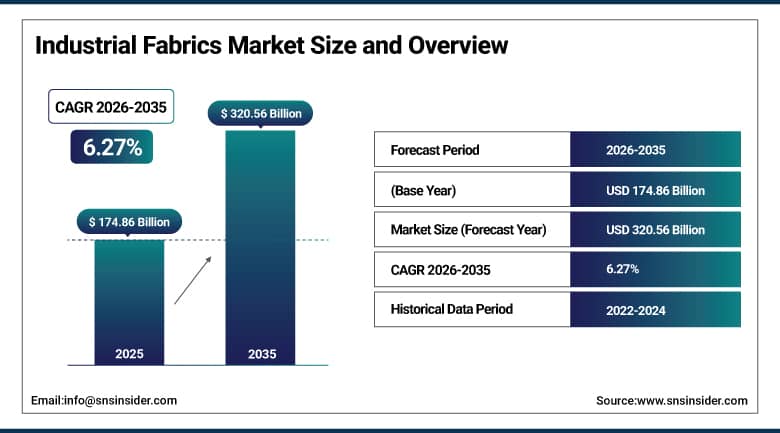
The Industrial Fabrics Market was valued at USD 174.86 billion in 2025 and is expected to reach USD 320.56 billion by 2035, growing at a CAGR of 6.27% from 2026–2035.
The industrial fabrics market is witnessing steady global growth due to rising demand for high-performance technical textiles across automotive, aerospace, construction, medical, agriculture, and industrial safety applications, along with the increasing adoption of advanced materials such as polyester, nylon, aramid, glass fiber, and composite-based fabrics for enhanced strength, durability, and resistance properties. The expansion of infrastructure development, industrial manufacturing, and protective clothing requirements, coupled with growing focus on lightweight materials, operational efficiency, and worker safety standards, is also contributing to market growth.
The governmental regulations related to workplace safety standards such as OSHA textile safety norms in the United States, EU REACH chemical compliance regulation, Flammable Fabrics Act (CPSC) requirements, and the EU Green Deal sustainability framework are significantly influencing industrial fabric production and usage. In addition, the U.S. EPA emission control standards, India’s BIS technical textile standards and Make in India initiative, and China’s green manufacturing and industrial modernization policies are further accelerating market adoption.
To Get More Information On Industrial Fabrics Market - Request Free Sample Report
Industrial Fabrics Market Trends
-
Increasing demand for high-performance industrial fabrics is driving adoption in automotive, aerospace, and construction applications for durability and safety.
-
Growing focus on sustainable and recyclable textiles is reshaping manufacturing practices across global industries.
-
Rising adoption of non-woven industrial fabrics is expanding applications in filtration, medical, and hygiene sectors.
-
Increasing use of advanced composite fabrics like aramid and glass fiber is enhancing performance in high-stress environments.
-
Growing integration of smart textiles with sensors and conductive fibers is enabling real-time monitoring and safety solutions.
-
Rapid industrialization in emerging economies is boosting demand for industrial fabrics in infrastructure and manufacturing sectors.
U.S. Industrial Fabrics Market Size Outlook
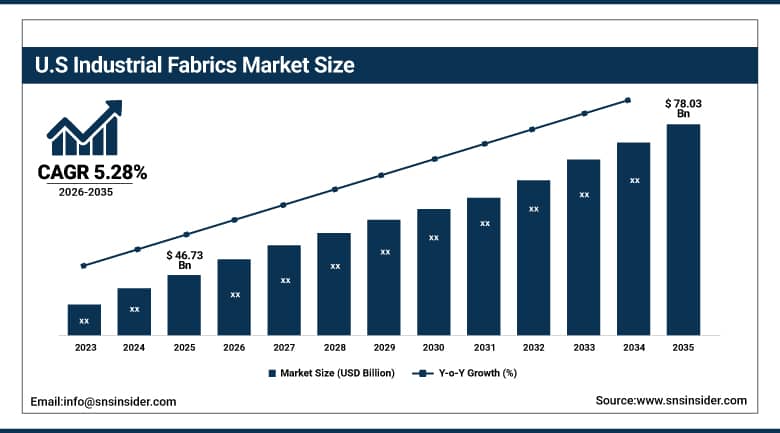
The U.S. Industrial Fabrics Market was valued at USD 46.73 billion in 2025 and is expected to reach around USD 78.03 billion by 2035, growing at a CAGR of 5.28% from 2026–2035.
The U.S. industrial fabrics market is considered one of the most advanced technical textile markets globally owing to strong demand from automotive, aerospace, defense, construction, and industrial safety sectors, along with widespread adoption of high-performance fabrics such as polyester, nylon, aramid, glass fiber, and composite-based materials for reinforcement, filtration, protective clothing, and structural applications, along with increasing demand for lightweight, durable, heat-resistant, and high-strength textile solutions across manufacturing and infrastructure industries. Major companies such as DuPont de Nemours Inc., Berry Global Inc., Owens Corning, Milliken & Company, Johns Manville, W. L. Gore & Associates Inc., Hexcel Corporation, Saint-Gobain, Freudenberg Performance Materials, and Johns Manville are actively focusing on expanding industrial fabric production, strengthening R&D capabilities, and enhancing product performance, sustainability, and compliance with advanced material standards.
Governments' efforts to enhance workplace safety through OSHA rules, emission restrictions through the U.S. EPA rules, flammability controls through the Flammable Fabrics Act rules, chemical controls through TSCA rules, and backing through infrastructure modernization and manufacturing revitalization rules are contributing to an increased demand for industrial fabrics. Efforts towards minimizing industrial risks, enhancing energy efficiencies, supporting domestic manufacturing industries, and encouraging the use of sustainable materials are also playing a role in the area.
Industrial Fabrics Market Segment Analysis
-
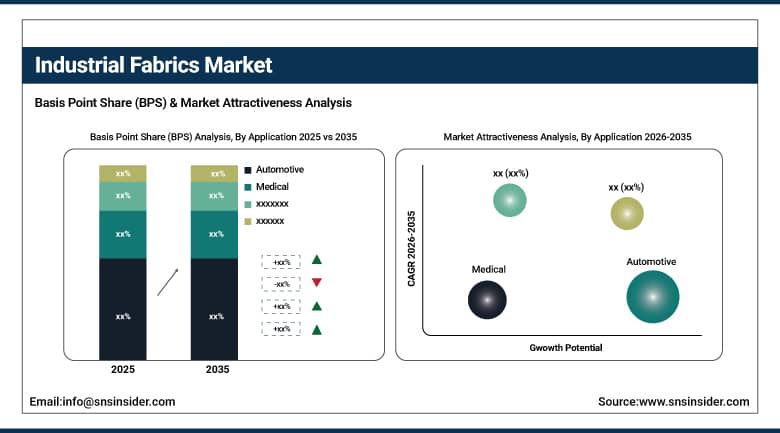
By Application, automotive dominated the industrial fabrics market with 31.78% share in 2025; while medical are the fastest growing segment.
-
By End Use, protective clothing dominated the industrial fabrics market with 29.84% share in 2025; while geotextiles are the fastest growing segment.
-
By Material Type, polyester dominated the industrial fabrics market with 37.56% share in 2025; while glass fiber are the fastest growing segment.
-
By Weaving Type, woven dominated the industrial fabrics market with 44.72% share in 2025; while non-woven are the fastest growing segment.
-
By Fiber Type, polyester dominated the industrial fabrics market with 30.36% share in 2025; while composites are the fastest growing segment.
By Application, automotive dominated the industrial fabrics market, while medical is the fastest-growing segment.
Automotive segment has the dominated market share in industrial fabrics market in terms of revenues in 2025 owing to high growth prospects due to high demand for materials required in air bags, seat belts, tire reinforcement, upholstery, and filtration applications. The increasing number of vehicles being manufactured, increased regulatory emphasis on vehicle safety, and higher use of lightweight fabrics to improve fuel economy are adding to its dominance in the global industrial fabric market for automotive applications.
Medical Segment is projected to have the fastest CAGR during 2026-2035 owing to increasing demand for medical textiles like surgical gowns, masks, wound care products, and filters in hospitals and clinics. Growing investments in healthcare facilities, increasing importance of infection control measures, and advanced technologies in antimicrobial and disposable medical fabrics are some key factors driving adoption, thus increasing the significance of industrial fabrics in healthcare industry applications.
By End Use, protective clothing dominated the industrial fabrics market, while geotextiles is the fastest-growing segment.
Protective clothing segment captured the dominated share of revenue in the industrial fabrics market in 2025 owing to high demand for personal safety among workers working in dangerous industries like construction, oil & gas, chemicals, and manufacturing industries. Growing demand for industrial textiles that offer protection against fire hazards, chemicals, and wear & tear due to increasing implementation of regulations relating to occupational health and safety laws is boosting the global adoption of protective industrial fabrics in emerging and developed countries.
Geotextile segment is expected to exhibit the fastest CAGR in terms of growth over the forecast period from 2026 to 2035 due to the high rate of growth in infrastructure development, road construction, and land stabilization across the world. The growing focus on the construction of smart cities, transportation infrastructure, and initiatives for environmental protection are contributing to the growing demand for geotextiles for soil reinforcement, drainage, and erosion control applications.
By Material Type, polyester dominated the industrial fabrics market, while glass fiber is the fastest-growing segment.
Polyester segment constituted the dominated share of the revenue for the industrial fabrics market in 2025. The reasons for its dominance include its remarkable durability, cost-effectiveness, tensile strength, chemical resistance, and abrasion and moisture resistance properties. This material finds application in several uses, including automobiles and construction, among other sectors owing to its availability and reliability in harsh conditions.
Glass fiber segment is anticipated to witness the fastest CAGR during 2026 to 2035 owing to its better strength-to-weight ratio, thermal resistance, and dimensional stability. It finds increasing usage in the manufacture of products in aerospace, automotive, construction, and electric insulation industries. Growing demand for lightweight and efficient materials along with the increase in the development of infrastructure and manufacture of advanced composite products is propelling the adoption of glass fiber in many industrial nations.
By Weaving Type, woven dominated the industrial fabrics market, while non-woven is the fastest-growing segment.
Woven segment emerged as the dominated segment of the industrial fabrics market by generating maximum revenues in 2025 owing to its greater strength, dimensional stability, and high durability even in challenging industrial environments. Woven fabrics find widespread application in industries such as automotive, construction, and conveyor owing to their high load-bearing capacity. Moreover, proven technology and long life span contribute towards its market dominance.
Non-Woven segment will register the fastest CAGR between 2026 and 2035 on account of increasing requirements for lightweight, affordable, and versatile materials. Non-woven finds wide applicability in industries including filtration, medical, hygiene, and geo-textiles. Rapid technological advancements and growing demand for disposables have led to widespread adoption. Additionally, it’s fast manufacturing process and wider adoption in emerging countries fuel market growth.
By Fiber Type, polyester dominated the industrial fabrics market, while composites is the fastest-growing segment.
Polyester segment had a dominant position in the industrial fabrics market owing to its low cost, high durability, high tensile strength, and chemical and abrasion resistance properties. This segment finds wide application in automotive, construction, filtration, and protective purposes. The segment’s dominant status is due to its easy availability, lightweight, and performance in diverse industrial environments.
Composites segment is projected to have the highest CAGR during the forecast period. The increasing demand for lightweight and high-strength fibers has propelled this market growth. This material has better mechanical and thermal stability than conventional fibers. Fuel economy, structural design optimization, and engineering applications require such materials, which are making composites more popular.
Regional Analysis:
|
Region |
Major Country |
Share within Region, 2025(%) |
|---|---|---|
|
North America |
United States |
77.20% |
|
Europe |
Germany |
22.15% |
|
Asia Pacific |
China |
28.74% |
|
Middle East & Africa |
UAE |
6.66% |
|
Latin America |
Brazil |
7.83% |
North America Industrial Fabrics Market Insights
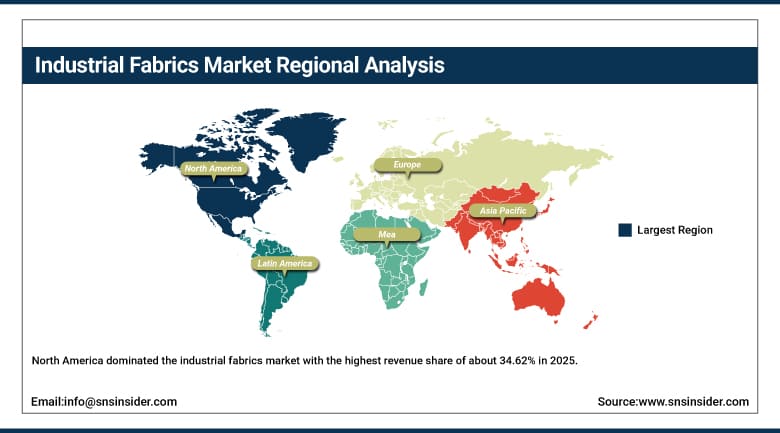
North America dominated the industrial fabrics market with the highest revenue share of about 34.62% in 2025 due to its strong industrial base, advanced manufacturing capabilities, and high adoption of technical textiles across automotive, aerospace, defense, construction, and industrial safety applications. The region benefits from widespread use of high-performance materials such as polyester, nylon, aramid, and composite fabrics in protective clothing, filtration, and reinforcement systems. Strict regulatory frameworks like OSHA workplace safety standards, EPA environmental compliance rules, and strong demand for lightweight durable materials further strengthen market dominance across the United States and Canada.
Consequently, regulations on the U.S. EPA, TSCA chemical safety, Flammable Fabrics Act, infrastructure upgrade projects, and the promotion of domestic manufacturing and materials advancement have spurred investments in the industrial fabrics sector. However, the increasing demands emanating from the automotive electrification, aerospace development, and construction upgrade sectors are helping to drive sustained growth in the industry.
Get Customized Report as Per Your Business Requirement - Enquiry Now
Europe Industrial Fabrics Market Insights
Europe is considered a highly important region in the industrial fabrics market owing to strong emphasis on sustainability, circular economy practices, and strict industrial safety and environmental regulations. Key countries such as Germany, France, the UK, and Italy are contributing significantly through advanced textile engineering, automotive manufacturing, and industrial filtration applications. The EU Green Deal, REACH chemical regulations, and carbon neutrality targets are supporting increased investment in eco-friendly fibers, recyclable materials, and energy-efficient industrial fabric production across the region.
Asia Pacific Industrial Fabrics Market Insights
Asia Pacific segment is expected to grow at the fastest CAGR of about 8.44% from 2026–2035 due to rapid industrialization, expanding manufacturing sector, and large-scale infrastructure development across emerging economies such as China, India, Japan, and Southeast Asia. Rising demand from automotive production, construction activities, and industrial safety applications is driving strong adoption of technical textiles. Government initiatives like Make in India, China’s industrial modernization programs, and smart city developments are further accelerating growth. Increasing foreign investments, low production costs, and expanding export-oriented textile manufacturing are also supporting rapid market expansion in the region.
Middle East & Africa and Latin America Industrial Fabrics Market Insights
The Middle East & Africa and Latin America regions, there is an anticipation of growth for the industrial fabrics market due to factors including increased infrastructure development, growing industrialization, and use of protective material. The United Arab Emirates, Saudi Arabia, and South Africa in the Middle East & Africa region are working on increasing their construction sector, oil & gas industry safety, and manufacturing industries. Meanwhile, in the Latin America region, the key countries that are propelling demand include Brazil and Mexico, where they are expanding their industrialization, transport infrastructure, and construction sector.
Growth Drivers: Rising demand for high-performance technical textiles across automotive, aerospace, and industrial safety applications worldwide
Rising demand for high-tech fabric materials in diverse sectors such as the automotive, aerospace, construction, and defense industries represents one of the key factors driving growth in the market. Diverse application areas such as airbags, seat belts, filters, insulation, and protection clothing are expected to create a rising demand for industrial fabrics owing to their need for durability, resistance to heat, strength, and weight. Increasing industrialization and infrastructure development is anticipated to drive rising levels of consumption. Increasing safety and fuel efficiency measures will boost the demand for technical textiles.
Restraints: Environmental regulations and sustainability mandates increasing compliance challenges for industrial fabric manufacturing industries worldwide
Environmental restrictions like EU REACH, carbon emissions reductions, and waste management regulations pose compliance issues for the producers of industrial fabrics. The manufacturing process is becoming increasingly stringent owing to its potential impact on the environment, and hence, producers have to adopt technologies that are environmentally friendly as well as make use of recycled raw material. Although environmental standards provide for innovations within industries, they are a cause of difficulty for conventional producers who face problems in maintaining compliance with these standards. Compliance varies from region to region and hence proves difficult for global players.
Opportunities:Rising adoption of smart textiles and advanced composite fabrics creating high-growth innovation opportunities in industrial applications
Advancements in the field of smart textiles that have been integrated with sensors and conductive materials are creating a lot of opportunities for the industrial fabrics market. Such textile materials allow one to record data and analyze the safety and performance in the industrial environment. In addition, the usage of composite fabrics such as aramid and glass fiber in the aerospace, military, and automobile sectors is increasing. The developments in technology including nanotechnology and light weight materials are driving innovation in products.
Recent Developments
-
2026: DuPont de Nemours Inc. expanded aramid and Kevlar industrial fabrics for automotive, aerospace, and protective applications. Focused on high-strength, heat-resistant, lightweight safety materials.
-
2025: Freudenberg Performance Materials increased nonwoven and filtration fabric production across Europe and Asia. Supported demand from automotive, medical, and industrial filtration with sustainable solutions.
-
2025: Berry Global Inc. strengthened its nonwoven industrial fabrics business through capacity expansion and innovation. Focused on hygiene, medical, and filtration applications using lightweight engineered materials.
-
2024: Ahlstrom Oyj launched advanced filtration materials for industrial air and liquid systems. Emphasized sustainable fiber innovation and high-efficiency performance solutions.
Industrial Fabrics Market Key Players are:
-
Freudenberg Performance Materials
-
DuPont de Nemours Inc.
-
Ahlstrom Oyj
-
Owens Corning
-
Compagnie de Saint-Gobain
-
Toray Industries Inc.
-
Teijin Limited
-
Sioen Industries NV
-
Johns Manville
-
Propex Operating Company LLC
-
GKD Gebr. Kufferath AG
-
Sefar AG
-
Kolon Industries Inc.
-
Toyobo Co. Ltd.
-
Asahi Kasei Corporation
-
Kuraray Co. Ltd.
-
W. L. Gore & Associates Inc.
-
Hexcel Corporation
Industrial Fabrics Market Report Scope:
| Report Attributes | Details |
|---|---|
| Market Size in 2025 | USD 174.86 Billion |
| Market Size by 2035 | USD 320.56 Billion |
| CAGR | CAGR of 6.27% From 2026 to 2035 |
| Base Year | 2025 |
| Forecast Period | 2026-2035 |
| Historical Data | 2022-2024 |
| Report Scope & Coverage | Market Size, Segments Analysis, Competitive Landscape, Regional Analysis, DROC & SWOT Analysis, Forecast Outlook |
| Key Segments | • By Application (Automotive, Aerospace, Construction, Medical, Agriculture) • By End Use (Protective Clothing, Industrial Equipment, Transportation, Building Materials, Geotextiles) • By Material Type (Polyester, Nylon, Aramid, Glass Fiber) • By Weaving Type (Woven, Non-Woven, Knitted, Braided) • By Fiber Type (Polyamide, Polyester, Aramid, Composites, Others) |
| Regional Analysis/Coverage | North America (US, Canada), Europe (Germany, UK, France, Italy, Spain, Russia, Poland, Rest of Europe), Asia Pacific (China, India, Japan, South Korea, Australia, ASEAN Countries, Rest of Asia Pacific), Middle East & Africa (UAE, Saudi Arabia, Qatar, South Africa, Rest of Middle East & Africa), Latin America (Brazil, Argentina, Mexico, Colombia, Rest of Latin America). |
| Company Profiles | Freudenberg Performance Materials, Berry Global Inc., DuPont de Nemours Inc., Ahlstrom Oyj, Owens Corning, Compagnie de Saint-Gobain, Toray Industries Inc., Teijin Limited, Sioen Industries NV, Johns Manville, Milliken & Company, Propex Operating Company LLC, GKD Gebr. Kufferath AG, Sefar AG, Kolon Industries Inc., Toyobo Co. Ltd., Asahi Kasei Corporation, Kuraray Co. Ltd., W. L. Gore & Associates Inc., Hexcel Corporation |

Frequently Asked Questions
The industrial fabrics market is expected to grow at a CAGR of 6.27% from 2026 to 2035.
The industrial fabrics market was valued at USD 174.86 billion in 2025.
Rising demand for high-performance technical textiles across automotive, aerospace, construction, medical, and industrial safety applications, along with increasing adoption of advanced materials such as polyester, nylon, aramid, glass fiber, and composites, is driving market growth globally.
The Automotive segment dominated the industrial fabrics market in 2025.
North America dominated the industrial fabrics market in 2025.
