
Payment Analytics Software Market Report Scope & Overview:
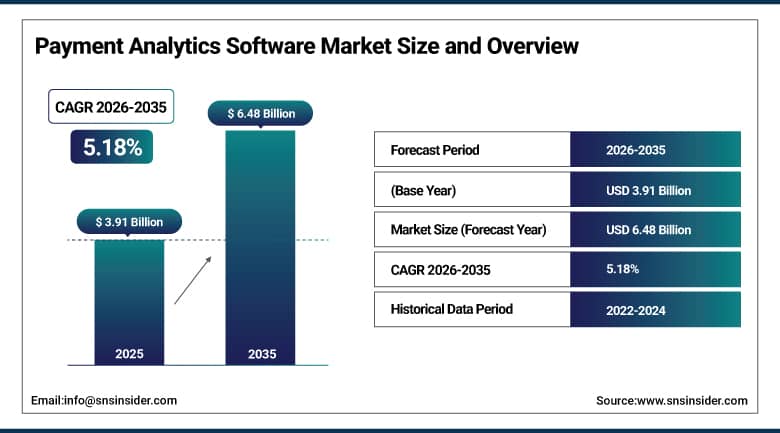
The Payment Analytics Software Market was valued at USD 3.91 Billion in 2025 and is expected to reach USD 6.48 Billion by 2035, growing at a CAGR of 5.18% from 2026 to 2035.
The Payment Analytics Software Market is experiencing stable growth, driven by the increasing use of digital payments, higher numbers of e-commerce transactions, and increased demands for real-time payment monitoring and fraud prevention. Companies are turning to advanced analytics tools in order to streamline the process of payments, enhance customer experience, and maintain compliance with regulations. Artificial intelligence, machine learning, and predictive analytics make transaction analysis more efficient and sophisticated. Moreover, the expanding number of cross-border payments, fast-growing fintech platforms, and higher demand for data-powered financial decision making are contributing to further market growth.
Large Enterprises accounted for roughly 64% of the Payment Analytics Software Market in 2025, while Cloud-Based deployment led with about 70% share, reflecting how firmly scalable, subscription-priced analytics platforms have become the default choice across payment operations of every size.
Market Size and Forecast
-
Market Size in 2026E: USD 4.11 Billion
-
Market Size by 2035: USD 6.48 Billion
-
CAGR: 5.18% from 2026 to 2035
-
Fastest Growing Region: Asia Pacific
-
Largest Region: North America
To Get More Information On Payment Analytics Software Market - Request Free Sample Report
Payment Analytics Software Market Trends
-
A growing appetite for data-driven insight into payment operations is pushing more businesses toward dedicated analytics platforms rather than relying on basic processor-level reporting.
-
Wider adoption of digital payments, e-wallets, and real-time transactions is steadily lifting demand for more advanced analytics tooling.
-
Fraud detection, risk management, and compliance monitoring keep expanding as application areas, adding further momentum to overall market growth.
-
Deeper integration with AI, machine learning, and big data platforms is giving businesses far better transaction visibility and predictive capability than legacy dashboards ever offered.
-
Vendors are increasingly focused on improving customer experience, lifting authorization rates, and helping merchants recover revenue that would otherwise be lost to failed transactions.
The U.S. Payment Analytics Software Market Outlook
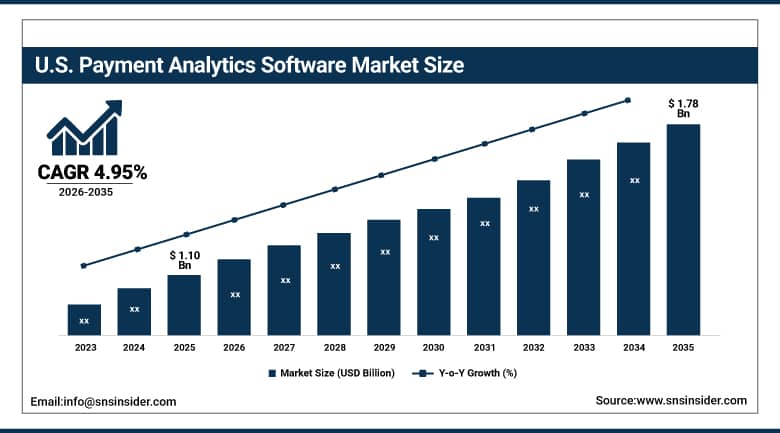
The U.S. Payment Analytics Software Market was valued at approximately USD 1.10 Billion in 2025 and is expected to reach approximately USD 1.78 Billion by 2035, growing at a CAGR of approximately 4.95%.
Growth in the U.S. market comes down to a fairly predictable combination: near-universal digital payment adoption, steadily rising transaction volumes, and mounting pressure on banks and e-commerce businesses to catch fraud before it happens rather than after. U.S. financial institutions and merchants have been some of the earliest and heaviest investors in AI-driven analytics specifically because the cost of getting fraud prevention or compliance wrong is so high here, both financially and reputationally. That investment appetite, combined with a payments ecosystem that's grown genuinely complex across cards, wallets, and instant-payment rails, keeps American businesses reaching for more sophisticated analytics tools to optimize payment performance and stay ahead of regulatory expectations.
Stripe's total payment volume reached $1.4 trillion in 2024, a scale increasingly underpinned by AI-enhanced analytics and fraud tools, and the company has continued building out that capability through Stripe Orchestration and AI-based fraud scoring in Radar, giving U.S. merchants considerably deeper visibility into transaction performance.
Payment Analytics Software Market Segment Analysis
-
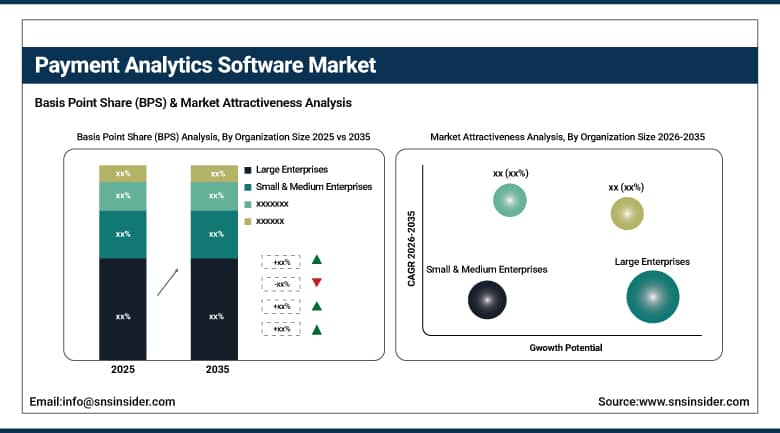
By Organization Size, Large Enterprises dominated the payment analytics software market with roughly 64% share in 2025, while Small & Medium Enterprises is the fastest-growing organization-size segment.
-
By Analytics Type, Predictive Analytics dominated with roughly 34% share in 2025, while Prescriptive Analytics is the fastest-growing analytics type.
-
By End-Use Industry, BFSI dominated with roughly 35% share in 2025, while Retail & E-commerce is the fastest-growing end-use industry.
-
By Deployment Mode, Cloud-Based led with roughly 70% share in 2025 and is also the fastest-growing deployment mode.
By Organization Size, Large Enterprises lead, SMEs grow fastest
Large Enterprises dominated the organization-size segment in 2025, which makes sense given how much transaction volume and ecosystem complexity these organizations are dealing with day to day. Their scale gives them both the budget and the operational justification to invest heavily in advanced analytics platforms aimed at optimizing revenue, staying compliant, and running payment operations efficiently, and their ability to actually integrate sophisticated platforms into already-complex IT environments is exactly what's kept driving higher market revenue from this segment.
Small & Medium Enterprises are set to grow fastest from 2026 through 2035, and cloud-based, subscription-priced platforms are the main reason why. Those models have quietly lowered the entry barrier that used to keep analytics out of reach for smaller businesses, and as digital payment adoption spreads further into the SME world, along with rising awareness of just how costly fraud and payment inefficiency can be, more of these businesses are finally signing up for analytics platforms they would have skipped a few years back.
By Analytics Type, Predictive Analytics leads, Prescriptive Analytics grows fastest
Predictive Analytics dominated the analytics-type segment in 2025, largely because it lets organizations get ahead of problems rather than just documenting them after the fact. Being able to forecast transaction failures, spot fraud patterns before they escalate, and proactively optimize payment processes has proven genuinely valuable for reducing financial losses and improving customer experience, and that practical payoff is what's kept driving higher adoption and revenue in this segment.
Prescriptive Analytics is expected to grow fastest through 2035, building on predictive capability by actually recommending what to do next, whether that's automating payment routing, optimizing authorization rates, or supporting broader strategic decisions. As payment ecosystems get more complex, with more providers, more currencies, and more channels to manage at once, that shift from insight to recommendation is exactly what's accelerating adoption of prescriptive tools across industries.
By End-Use Industry, BFSI leads, Retail & E-commerce grows fastest
BFSI dominated the end-use segment in 2025, unsurprisingly given the sheer transaction volume banks and financial institutions process alongside the strict regulatory requirements they operate under. Fraud prevention sits close to the top of every bank's priority list, and that focus, combined with heavy investment in risk management and compliance-oriented analytics, has kept BFSI firmly ahead of every other end-use industry in market revenue.
Retail & E-commerce is expected to grow fastest through 2035, as digital commerce keeps expanding and multi-channel payments generate increasingly messy, fragmented transaction data that merchants need help making sense of. Analytics platforms are proving genuinely useful here, helping merchants optimize checkout flows, cut down on declined transactions, catch fraud earlier, and generally deliver a smoother customer experience, all of which is translating into accelerated adoption across the retail sector.
By Deployment Mode, Cloud-Based leads and grows fastest
Cloud-Based deployment dominated in 2025 and looks set to keep growing fastest through 2035, which is a fairly unusual combination but makes intuitive sense here. Scalability, flexibility, and cost-efficiency have made cloud the clear preference for organizations that want seamless integration with multiple payment gateways, real-time data processing, and lower ongoing IT infrastructure costs, and those advantages only compound as more businesses digitize their payment operations.
What's kept cloud deployment ahead on both fronts, dominant share and fastest growth, is how well it fits the direction the broader payments industry is heading. Rapid implementation, remote access, and automatic updates make cloud solutions genuinely practical for businesses of every size, and as digital payments keep expanding and the need for agile, always-current analytics keeps growing alongside them, on-premise deployment looks increasingly like the legacy option rather than a real alternative.
Regional Analysis
|
Region |
Major Country |
Share within Region, 2025 (%) |
|---|---|---|
|
North America |
United States |
78.60% |
|
Europe |
Germany |
23.40% |
|
Asia Pacific |
China |
31.20% |
|
Middle East & Africa |
UAE |
27.85% |
|
Latin America |
Brazil |
36.90% |
North America Payment Analytics Software Market Insights
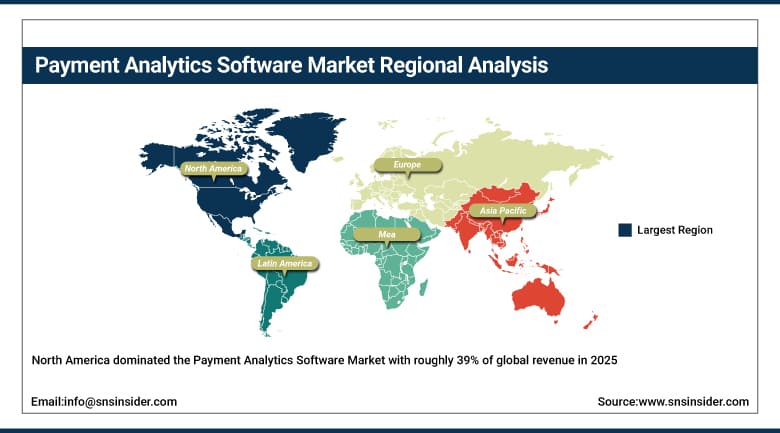
North America dominated the Payment Analytics Software Market with roughly 39% of global revenue in 2025, supported by advanced digital payment infrastructure, high adoption of AI-driven analytics, and the presence of many of the world's largest payment solution providers headquartered right in the region. Businesses across the region prioritize fraud prevention, real-time transaction monitoring, and regulatory compliance in ways that translate directly into sustained analytics investment, and strong financial services activity, ongoing e-commerce growth, and continuous technological innovation have all reinforced North America's leading position.
The United States accounts for roughly 78.60% of regional revenue, anchored by the scale of its banking and payments infrastructure and the sheer number of major fintech and payment technology companies based domestically. Canada adds further regional demand as its own financial institutions and e-commerce sector continue investing in analytics-driven fraud prevention and payment optimization. That combination of scale, technology leadership, and regulatory pressure should keep North America the largest addressable market for payment analytics vendors through the forecast period.
Get Customized Report as Per Your Business Requirement - Enquiry Now
Europe Payment Analytics Software Market Insights
Europe is showing steady growth in the payment analytics software market, underpinned by strong regulatory frameworks, widespread digital payment adoption, and an increasing focus on fraud prevention across the region's banking and retail sectors. Banks, financial institutions, and e-commerce players are investing in analytics platforms largely to stay compliant, optimize transaction performance, and improve the customer experience, and that combination of regulatory pressure and commercial upside has made Europe a genuinely significant contributor to global market revenue.
Germany leads regional demand at roughly 23.40% of European revenue, supported by its large financial-services sector and steady investment in payment technology infrastructure. The UK, France, and Italy contribute substantial additional demand, and rising awareness of AI-driven payment insight across the continent, paired with continued technological advancement, is keeping European adoption on a fairly consistent upward path.
Asia Pacific Payment Analytics Software Market Insights
The Asia-Pacific region is anticipated to witness the most significant growth in payment analytics software during the forecast period from 2022 to 2035, at a compound annual growth rate (CAGR) of around 6.78%, backed by high digital payment adoption, increasing adoption of smartphones and internet, and rapidly growing e-commerce activities in the biggest economies in the region. The cashless payment systems being encouraged by the government, coupled with technological innovations within the FinTech sector, are driving adoption of analytics significantly, along with SME players adopting digital payment solutions, along with high fraud prevention awareness.
China stands out as the biggest national market in the region, contributing about 31.20% of the revenue generated in the region, thanks to the presence of an extensive digital payment system and the investments made in the FinTech industry. Other important contributors to the market include India, Japan, and South Korea, among which India has emerged as a strong growth driver due to the rapidly growing digital payments infrastructure in the country.
MEA & Latin America Payment Analytics Software Market Insights
Payment analytics software solutions are witnessing consistent adoption in the Middle East & Africa and Latin America markets due to increased digital payments, investments in fintech, and government policies to establish cashless economies. Businesses in the two regions are adopting analytics tools to make transactions more efficient and fraud-free, and the increased number of e-commerce activities, development of better digital infrastructure, and improved fintech industry in the two regions are drawing investments from leading global players in the field of analytics.
The UAE is leading the market for Middle East & Africa with an approximate share of 27.85% in terms of revenue as a result of the fast-growing fintech industry and digital payment-related projects initiated by the government. Other countries like Saudi Arabia and South Africa have helped in creating demand in the region through financial modernization initiatives. In the case of Latin America, Brazil accounts for around 36.90% of revenue in the region owing to the developing fintech industry in the country.
Market Dynamics
Growth Drivers: Real-time digital payment expansion and rising transaction complexity
Rapid growth in digital payments across e-commerce, mobile wallets, and cross-border transactions is increasing both transaction complexity and volume at a pace legacy reporting tools simply can't keep up with. Businesses need immediate visibility into payment performance, failures, settlement delays, and conversion rates just to protect revenue that would otherwise quietly leak away, and payment analytics software is what gives merchants, banks, and payment processors real-time monitoring, pattern identification, and actionable insight across multiple payment channels at once.
As payment ecosystems keep becoming more multi-provider and multi-currency, analytics tools are increasingly what supports operational efficiency and genuinely strategic decision-making rather than just after-the-fact reporting. Merchants and processors alike are relying on these platforms to reduce declines, optimize authorization rates, and improve the checkout experience, and that growing dependency on data-driven payment intelligence is a big part of what's accelerating adoption across industries, even in a market with a comparatively modest overall growth rate.
Restraints: High implementation costs and integration complexity
Payment analytics solutions often require meaningful upfront investment in software licensing, infrastructure, and skilled personnel, and that cost profile alone keeps a fair number of smaller organizations on the sidelines. Integration with existing payment gateways, banking systems, and legacy ERP platforms can be technically complex and genuinely time-consuming, and small and medium enterprises in particular tend to struggle justifying that spend when the return on investment isn't immediately obvious.
Data normalization across multiple payment providers adds another layer of deployment difficulty, and ongoing maintenance, customization, and model updates keep adding to operational expense well after the initial rollout. These financial and technical barriers are slowing adoption most in cost-sensitive markets and organizations with fragmented IT ecosystems, and that friction is restricting broader market penetration even where the underlying demand drivers remain genuinely strong.
Opportunities: AI-driven predictive analytics and personalized payment experiences
Continued advances in artificial intelligence and machine learning are transforming payment analytics from reactive reporting into something closer to predictive intelligence. Businesses can now forecast transaction failures, fraud risk, and customer payment preferences before problems actually arise, which opens the door to proactive optimization of routing, pricing, and authorization strategies rather than reacting after the damage is done.
Personalized payment experiences built on that predictive foundation are improving both conversion rates and customer loyalty, and vendors offering genuinely AI-powered insights, automation, and self-learning models are gaining a real competitive edge over static-dashboard competitors. As enterprises increasingly look for intelligent decision-making tools rather than backward-looking reports, demand for advanced, AI-driven payment analytics presents a substantial growth opportunity across global digital commerce.
Recent Developments:
-
2025: Stripe unveiled Stripe Orchestration alongside AI-based fraud scoring in Radar and new checkout-optimization tools, deepening transaction-level analytics for merchants.
-
2025: Adyen launched Adyen Uplift, an AI-powered analytics suite designed to optimize payment funnels, boost conversion rates, and control fraud through data-driven insight.
-
2025: PayPal partnered with OpenAI to integrate PayPal payments into ChatGPT, enabling AI-powered transaction experiences alongside deeper UX and analytics capability.
-
2025: Adyen released two new point-of-sale terminals, the S1E4 Pro and S1F4 Pro, improving in-person payment analytics and operational insight for merchants.
Payment Analytics Software Market key players are:
-
Stripe
-
Adyen
-
PayPal (Braintree)
-
ACI Worldwide
-
FIS
-
Fiserv
-
Global Payments
-
Worldline
-
Visa
-
Mastercard
-
Oracle (Payments/Analytics)
-
SAS
-
NICE Actimize
-
Forter
-
Riskified
-
Signifyd
-
Featurespace
-
Sift
-
Corefy
-
Chargebee
Payment Analytics Software Market Report Scope:
| Report Attributes | Details |
|---|---|
| Market Size in 2025 | USD 3.91 Billion |
| Market Size by 2035 | USD 6.48 Billion |
| CAGR | CAGR of 5.18% From 2026 to 2035 |
| Base Year | 2025 |
| Forecast Period | 2026-2035 |
| Historical Data | 2022-2024 |
| Report Scope & Coverage | Market Size, Segments Analysis, Competitive Landscape, Regional Analysis, DROC & SWOT Analysis, Forecast Outlook |
| Key Segments | • By Deployment Mode (Cloud-Based, On-Premise) • By Organization Size (Large Enterprises, Small & Medium Enterprises) • By Analytics Type (Descriptive Analytics, Diagnostic Analytics, Predictive Analytics, Prescriptive Analytics) • By End-Use Industry (BFSI, Retail & E-commerce, Hospitality & Travel, Healthcare, Media & Entertainment, IT & Telecommunication) |
| Regional Analysis/Coverage | North America (US, Canada), Europe (Germany, UK, France, Italy, Spain, Russia, Poland, Rest of Europe), Asia Pacific (China, India, Japan, South Korea, Australia, ASEAN Countries, Rest of Asia Pacific), Middle East & Africa (UAE, Saudi Arabia, Qatar, South Africa, Rest of Middle East & Africa), Latin America (Brazil, Argentina, Mexico, Colombia, Rest of Latin America). |
| Company Profiles | Stripe, Adyen, PayPal (Braintree), ACI Worldwide, FIS, Fiserv, Global Payments, Worldline, Visa, Mastercard, Oracle (Payments/Analytics), SAS, NICE Actimize, Forter, Riskified, Signifyd, Featurespace, Sift, Corefy, Chargebee |
Frequently Asked Questions
The Payment Analytics Software Market is expected to grow at a CAGR of 5.18% from 2026 to 2035.
The Payment Analytics Software Market was valued at USD 3.91 Billion in 2025.
The major growth factor is rapid digital payment adoption, rising transaction volumes, and rising demand for real-time monitoring, fraud prevention, and AI-driven insight.
The Large Enterprises segment dominated the Payment Analytics Software Market with roughly 64% share in 2025.
North America dominated the Payment Analytics Software Market in 2025 with the highest revenue share, at approximately 39% of total global market revenue.
