
Platform Engineering Services Market Report Scope & Overview:
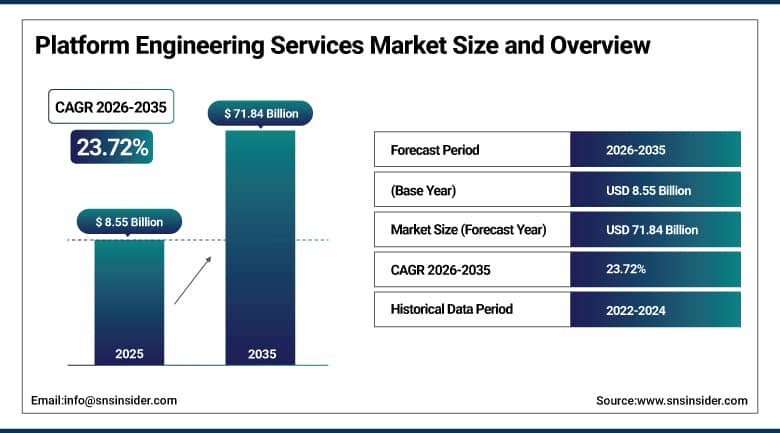
The Platform Engineering Services Market was valued at USD 8.55 Billion in 2025 and is expected to reach USD 71.84 Billion by 2035, growing at a CAGR of 23.72% from 2026-2035.
The Platform Engineering Services Market covers consulting, build, integration and managed operation of internal developer platforms. These platforms give software teams self-service access to infrastructure, pipelines, security controls and observability through a single portal. Enterprises are adopting them to cut cognitive load, shorten release cycles and enforce standards at scale. Service providers design golden paths, deploy open-source portals such as Backstage, and run the platform as a product for the client. Kubernetes, infrastructure as code and policy as code form the technical base. Generative AI coding assistants now push demand higher because they raise code volume and need guardrails. Skills gaps keep most buyers dependent on outside specialists. North America leads on spending while Asia Pacific adds developers and projects fastest.
⮞In January 2026, the Cloud Native Computing Foundation reported that 82% of container users ran Kubernetes in production in 2025, up from 66% in 2023. Kubernetes is the common base for internal developer platforms, which widens the pool of enterprises that need platform engineering services.
To Get More Information On Platform Engineering Services Market - Request Free Sample Report
Platform Engineering Services Market Trends
-
Enterprises are treating the internal developer platform as a product with owners, roadmaps and user feedback.
-
Backstage-based portals and managed portal offerings are becoming a default starting point for new builds.
-
AI coding agents are being wired into golden paths with policy checks and cost controls.
-
Security and compliance checks are moving into the platform layer to meet new regulatory reporting duties.
-
Providers are shifting from one-time builds to multi-year managed platform contracts.
U.S. Platform Engineering Services Market Outlook
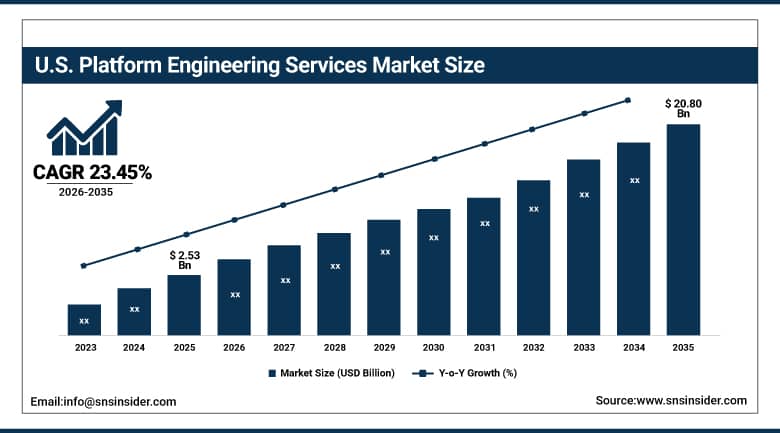
The U.S. Platform Engineering Services Market was valued at USD 2.53 Billion in 2025 and is expected to reach USD 20.80 Billion by 2035, growing at a CAGR of 23.45% from 2026-2035.
The U.S. Platform Engineering Services Market is the largest national pool of demand, led by banks, insurers, healthcare systems, retailers and technology firms with large engineering organizations. Buyers are consolidating fragmented toolchains into a single portal with built-in security and cost controls. Global systems integrators and boutique specialists compete for platform design, migration and managed-platform contracts. Cloud providers and open-source vendors supply the tooling that services firms assemble and operate. Federal and state agencies are modernizing delivery pipelines and adopting secure-by-design practices. Engineering leaders also want platform teams to measure developer experience and deployment frequency. Talent shortages push firms toward outsourced platform teams. Procurement is shifting from short projects to outcome-based, multi-year agreements.
⮞In February 2025, IBM completed its acquisition of HashiCorp at USD 35 per share in cash, an enterprise value of USD 6.4 billion. The deal places infrastructure-as-code tooling inside a large U.S. services and software portfolio and signals consolidation around platform automation.
Platform Engineering Services Market Segment Analysis
-
By Service Type, the Platform Implementation and Integration segment dominated the Platform Engineering Services Market with approximately 41.50% share in 2025, while the Managed Platform Services segment is the fastest growing with a CAGR of approximately 26.10%.
-
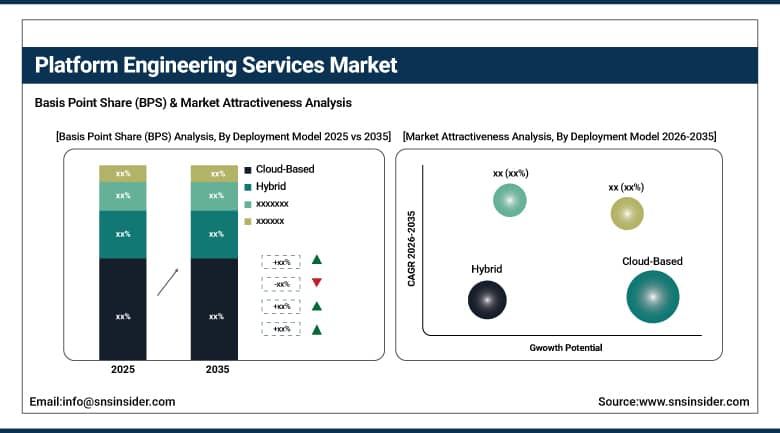
By Deployment Model, the Cloud-Based segment dominated the Platform Engineering Services Market with approximately 62.40% share in 2025, while the Hybrid segment is the fastest growing with a CAGR of approximately 25.80%.
-
By Enterprise Size, the Large Enterprises segment dominated the Platform Engineering Services Market with approximately 68.20% share in 2025, while the Small and Medium Enterprises segment is the fastest growing with a CAGR of approximately 26.40%.
-
By Industry Vertical, the BFSI segment dominated the Platform Engineering Services Market with approximately 24.60% share in 2025, while the Healthcare segment is the fastest growing with a CAGR of approximately 27.20%.
By Deployment Model, Cloud-Based Dominates the Platform Engineering Services Market and Hybrid Grows Fastest
Cloud-based deployment leads because internal developer platforms are built on managed Kubernetes, serverless services and cloud-native pipelines. Public cloud providers offer identity, networking and policy services that platform teams assemble quickly. Pay-as-you-go pricing lets teams test a thin platform before scaling it. Cloud regions near customers cut latency and meet data rules. Providers favor cloud-native stacks because reusable modules shorten delivery. Most new platform programs begin with a cloud landing zone, which anchors the first services engagement.
Hybrid is the fastest growing model because regulated firms and manufacturers keep workloads on premises while moving others to cloud. Platform teams must offer a single developer experience across data centers, private clouds and public clouds. That raises design complexity and the need for specialist integration. Portable tooling such as Kubernetes distributions, Terraform and policy as code supports consistent guardrails. Edge and sovereign cloud requirements add further hybrid demand. Providers with experience across environments win the larger multi-year programs.
⮞Opsio, in its service page released in July 2025 and revised in September 2025, provides services for internal developer platform design, golden path execution, portal creation, and a two-week pilot evaluation. This is an illustration of how the providers encapsulate short pilots to begin larger cloud and hybrid platforms projects.
By Service Type, Platform Implementation and Integration Dominates the Platform Engineering Services Market and Managed Platform Services Grows Fastest
Implementation and integration lead because most buyers are still building their first internal developer platform. The work includes portal setup, pipeline automation, identity integration, infrastructure templates and observability wiring. It is labor intensive and needs specialists in Kubernetes, Terraform, policy engines and cloud services. Providers earn project revenue first and then expand into run services. Buyers prefer outside teams for the initial build because internal staff are busy with product delivery. Integration with existing ticketing, security and cost tools adds scope. Reusable accelerators help providers shorten delivery and defend margins.
Managed platform services are growing faster as clients seek to avoid hiring scarce platform engineers. Providers operate the platform, patch components, add new golden paths and track adoption metrics. Contracts run for several years and include service levels for availability and support. Managed models suit mid-size firms that cannot staff a full platform team. They also help large firms with multi-cloud estates that need round-the-clock coverage. Advisory and support work grows alongside because buyers need maturity assessments and coaching to raise adoption among developers.
⮞In February 2026, Xebia announced it had become a Platform Engineering Certified Service Provider through PlatformEngineering.org and uses its own Platform Architecture Maturity Model for client assessments. The certification reflects the growth of formal assessment and advisory services.
By Enterprise Size, Large Enterprises Dominates the Platform Engineering Services Market and SMEs Grows Fastest
Large enterprises account for most spending because they run hundreds of teams and thousands of services that need common standards. Platform programs reduce duplicated tooling, speed onboarding and cut audit effort. Budgets allow multi-year engagements with global integrators. These buyers need multi-cloud support, role-based access, cost allocation and compliance evidence. Dedicated platform teams exist but are under-staffed relative to demand, so outside partners fill gaps. Executives also link platform adoption to AI delivery targets, which keeps funding stable.
Small and medium enterprises are growing faster from a smaller base. Managed portals, open-source templates and subscription pricing now put platform engineering within reach of firms with 50 to 500 developers. Providers offer packaged pilots and fixed-scope builds. Cloud marketplaces make procurement simple. These buyers rarely have platform staff, so they rely on providers for operation. Growth also comes from software firms that want to give customers a developer portal. Smaller firms are less likely to over-customize and so often reach value sooner.
⮞In May 2026, Accenture reported in its Pulse of Change research that only 32% of leaders see AI impact that is sustained and enterprise-wide. The gap shows why large enterprises are seeking platform foundations that turn pilots into repeatable delivery.
By Industry Vertical, BFSI Dominates the Platform Engineering Services Market and Healthcare Grows Fastest
BFSI comes first since the banking and insurance industry utilizes large, regulated software portfolios and has frequent releases. The platform engineering discipline delivers consistency of controls, auditing and automated testing expected by regulators. Core modernization, open banking, and fraud detection require fast and safe releases. Companies in this domain have outsourced engineers for migration and services. Security and resilience regulations drive controls in the pipelines. Large budgets and vendor relationships help to build multi-year contracts.
Healthcare is the fastest growing vertical as providers, payers and life-science firms digitize care and data exchange. Platforms help teams meet privacy rules while shipping patient apps and analytics. Government, retail and manufacturing also add demand for common delivery pipelines. Public bodies use platforms to run shared digital services across departments. Retailers need elastic platforms for peak seasons. Manufacturers connect plant data to cloud applications through standard templates. Each vertical favors providers with domain accelerators and compliance know-how.
⮞In September 2026, Tata Consultancy Services reported that its OSWAS 3.0 digital governance platform for the Government of Odisha supports more than 4,600 government offices and nearly 50,000 users statewide. The program shows how public-sector buyers adopt shared platforms with microservices architecture.
Regional Analysis
|
Region |
Major Country |
Share within Region, 2025 (%) |
|---|---|---|
|
Asia Pacific |
India |
36.18% |
|
North America |
United States |
87.00% |
|
Europe |
Germany |
27.41% |
|
Latin America |
Brazil |
46.37% |
|
Middle East and Africa |
United Arab Emirates |
29.33% |
North America Platform Engineering Services Market Insights
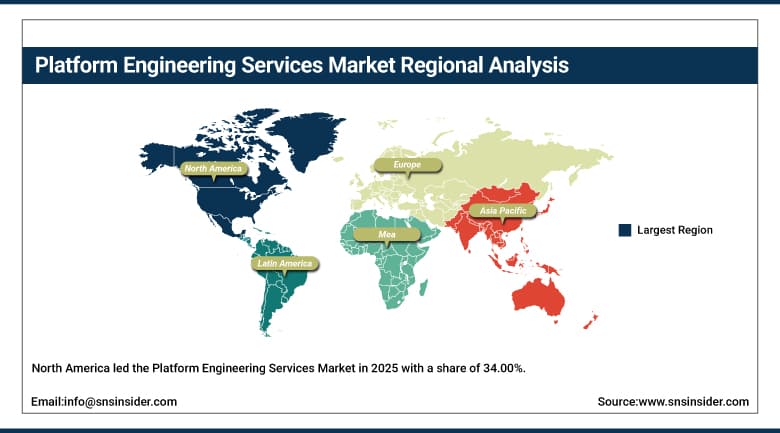
North America led the Platform Engineering Services Market in 2025 with a share of 34.00%. The United States supplies most regional demand, with Canada adding public-sector and financial services programs. The region hosts the main cloud providers, open-source foundations and venture-backed platform vendors, so ideas move quickly into services. Large enterprises in finance, healthcare, retail and technology fund platform teams and still buy outside help. Engineering leaders track developer experience and delivery metrics to justify spend.
Competition among global integrators, consultancies and specialist boutiques is intense. Providers differentiate through accelerators, reference architectures and managed run services. AI coding tools are creating new work to build guardrails, cost controls and evaluation pipelines. Talent shortages remain the main constraint. Firms use offshore delivery to scale. Procurement increasingly asks for measurable outcomes, such as lead time and incident reduction, in contracts.
⮞In June 2025, the Linux Foundation reported in its State of Tech Talent study that 56% of organizations face skills shortages in platform engineering. The shortage supports outside service demand across North America.
Get Customized Report as Per Your Business Requirement - Enquiry Now
Asia Pacific Platform Engineering Services Market Insights
Asia Pacific is the fastest growing region, with a projected CAGR of 26.50% from 2026-2035. India supplies a large share of global delivery capacity and is also a fast-growing domestic buyer. Japan, Australia and Singapore add enterprise demand for platform modernization and security. Local and global integrators run delivery centers that host platform teams for clients across time zones. Government cloud policies push agencies toward standard pipelines and controls. Telecom and banking firms are early adopters of internal developer platforms.
Growth in developers’ numbers is good for the future. An increasing number of engineers results in the need for portals, templates, and training courses. Cloud companies develop new regions and skills courses, making the entry threshold for building platforms smaller. New businesses and people who grew up in the digital era use open source portals at an early stage. Offers are localized according to data localization and language.
⮞In April 2026, Microsoft announced a USD 10 billion investment in Japan from 2026 through 2029, with a goal of training more than one million engineers, developers and workers by 2030. The commitment expands cloud capacity and skills that platform engineering projects rely on.
Europe Platform Engineering Services Market Insights
Europe is a large market shaped by data sovereignty, security regulation and strong engineering communities. Germany, the United Kingdom, France and the Netherlands lead demand. Banks, automakers, telecom operators and public bodies are building internal platforms to standardize delivery. Open-source stacks and sovereign clouds are favored among many European companies. There is stiff competition between regional integrators and boutique vendors and global companies based on the availability of local language support and compliance knowledge. Platform teams have also to deal with works councils and strict data requirements, which require design.
Regulation is a no-brainer. New responsibilities in reporting of digital products have compelled manufacturers and software companies to integrate vulnerability management and logging into their pipelines. Energy and sustainability reporting add further requirements to platform data. Providers that bundle compliance automation with golden paths find ready buyers. Growth is steady, though procurement cycles are longer than in North America. Cross-border projects need multi-region designs that respect national rules.
⮞In September 2026, the European Commission reported that its Cyber Resilience Act single reporting platform became operational on 11 September 2026, requiring manufacturers to submit an early warning within 24 hours of becoming aware of an exploited vulnerability. The rule adds compliance automation to platform engineering scopes.
MEA and Latin America Platform Engineering Services Market Insights
Middle East and Africa is led by the United Arab Emirates, Saudi Arabia, South Africa and Egypt. Governments are building national cloud regions and digital programs that need standard delivery platforms. Banks and telecom operators adopt internal developer platforms to speed product launches. Global cloud providers are opening regions in the Gulf, which attracts integrators and local partners. Skills shortages are acute, so managed services and training are important parts of offers. Africa shows rising developer numbers, though budgets remain modest.
⮞January 2025 witnessed the launch of AWS’ Mexico (Central) Region with three availability zones and AWS making plans to invest over USD 5 billion in Mexico within a period of 15 years. It acts as a local base for cloud-native platforms for businesses from Latin America.
Latin America includes Brazil, Mexico, Colombia, and Argentina as well. Mexico belongs to the Latin American region. Banks, Fintech companies, and retail players develop platforms for digital channels. There is an improvement in latency and data residency by establishing new cloud regions. Both regional suppliers and nearshoring facilities cater to the needs of North American customers and local consumers. Fluctuations in currencies and skill set disparity may impact the projects, but the number of developers is increasing rapidly.
⮞In October 2025, GitHub reported in its Octoverse study that Africa and the Middle East gained 3.4 million developers in 2025, and Latin America gained 3.2 million. The growth in builders expands the audience for internal developer platforms and related services.
Growth Drivers: Internal developer platform adoption and developer productivity goals are lifting demand
Enterprises now see the internal platform as a core part of software delivery. Teams lose time on setup, tickets and unclear standards, so a self-service portal with approved templates is attractive. Platform programs cut onboarding time for new developers and reduce errors by standardizing pipelines. Executives link faster delivery to revenue and customer experience. Service firms offer maturity assessments that help buyers set priorities and funding. Open-source projects lower tool cost and let buyers start small.
Cloud adoption and security rules add momentum. Kubernetes and infrastructure as code make shared platforms technically simple to build. Policy checks, secret management and software bills of materials can be enforced in the platform instead of left to each team. Generative AI coding tools raise code output, which makes automated guardrails more important. Boards are asking for evidence of control, and platform data supplies it. These pressures turn platform engineering from an experiment into a funded program.
⮞In September 2025, Google Cloud reported in the 2025 DORA findings that 90% of organizations have adopted at least one internal platform. The high adoption rate shows the base from which expansion and managed services demand is growing.
Restraints: Change fatigue, tool sprawl and unclear value are slowing platform programs
Many platform programs struggle because developers are not consulted and the platform becomes another mandated tool. Low adoption weakens the business case and leads to budget cuts. Tool sprawl adds integration work and licensing cost. Buyers often lack metrics to prove value, so executives hesitate to extend funding. Skills for product management of platforms are scarce and not found in typical infrastructure teams.
Organizational friction is a further limit. Security, operations and application teams may disagree on ownership of golden paths. Legacy systems resist standard templates. Vendor lock-in worries slow decisions on managed services. Rapid change in AI tooling forces frequent redesign. Providers that cannot show measured outcomes struggle in competitive bids. Overcoming these limits needs clear sponsorship, product-style roadmaps and regular developer feedback.
⮞In July 2025, Atlassian reported in its State of Developer Experience study that 50% of developers lose 10 or more hours a week to organizational inefficiencies. The lost time highlights tool friction that platform programs aim to fix, yet it also shows how hard adoption can be.
Opportunities: Managed portals, AI-ready guardrails and open-source ecosystems are opening new revenue pools
Managed portals let buyers adopt open-source platforms without running them. Providers can host, patch and extend the portal as a subscription, which lowers entry cost for mid-size firms. Packaged connectors to ticketing, security and cost tools shorten setup. Marketplaces help distribute these offers. Software vendors that sell their own internal tools to others are creating a larger partner ecosystem for services firms.
AI creates another pool of work. Agents that write code, review pull requests and run operations need identity, policy and audit layers. Platform teams can supply these controls once and reuse them. Providers can sell evaluation pipelines, cost governance and agent runtime services. Vertical templates for finance, healthcare and public services open further revenue. Training and certification programs for platform teams are also expanding.
⮞In October 2026, Spotify launched Spotify Technology to sell its internal developer tools, including Portal by Spotify, a fully managed Backstage offering. The move shows how internal platforms are turning into commercial products that services firms can implement.
Recent Developments:
-
In January 2026, Infosys and Cursor announced a Center of Excellence for software engineering agents and plans to integrate Cursor with Infosys Topaz Fabric. More than 100,000 Infosys engineers are expected to receive agentic coding platforms, which will increase demand for governed delivery pipelines.
-
In April 2026, Wipro launched an AI-Native Business and Platforms Unit that owns platform assets and delivery platforms and includes dedicated forward-deployed engineering teams. The unit gives the company a focused structure for platform-led services.
-
In July 2025, Mirantis published a brief for its Managed Platform Engineering Service, in which DevOps specialists run the client's platform with CI/CD and embedded DevSecOps. The offer reflects the shift toward managed operation of internal platforms.
-
In February 2025, Red Hat published guidance on adopting platform engineering, noting that most OpenShift Commons attendees surveyed already apply platform engineering practices. The guidance supports wider enterprise use of Kubernetes-based platforms.
Platform Engineering Services Market Key Players
-
Accenture
-
IBM Consulting
-
Infosys
-
Wipro
-
HCLTech
-
Cognizant
-
Capgemini
-
NTT DATA
-
Thoughtworks
-
Endava
-
Xebia
-
Opsio
-
CodiLime
-
Sonata Software
-
Mirantis
-
Red Hat
Platform Engineering Services Market Report Scope :
| Report Attributes | Details |
|---|---|
| Market Size in 2025 | USD 8.55 Billion |
| Market Size by 2035 | USD 71.84 Billion |
| CAGR | CAGR of 23.72% From 2026 to 2035 |
| Base Year | 2025 |
| Forecast Period | 2026-2035 |
| Historical Data | 2022-2024 |
| Report Scope & Coverage | Market Size, Segments Analysis, Competitive Landscape, Regional Analysis, DROC & SWOT Analysis, Forecast Outlook |
| Key Segments | • By Service Type (Platform Strategy and Consulting, Platform Implementation and Integration, Managed Platform Services, Support and Maintenance, and Others) • By Deployment Model (Cloud-Based, Hybrid, and On-Premises) • By Enterprise Size (Large Enterprises and Small and Medium Enterprises) • By Industry Vertical (BFSI, IT and Telecom, Healthcare, Retail and E-Commerce, Manufacturing, Government, and Others) |
| Regional Analysis/Coverage | North America (US, Canada), Europe (Germany, UK, France, Italy, Spain, Russia, Poland, Rest of Europe), Asia Pacific (China, India, Japan, South Korea, Australia, ASEAN Countries, Rest of Asia Pacific), Middle East & Africa (UAE, Saudi Arabia, Qatar, South Africa, Rest of Middle East & Africa), Latin America (Brazil, Argentina, Mexico, Colombia, Rest of Latin America). |
| Company Profiles | Accenture, IBM Consulting, Tata Consultancy Services, Infosys, Wipro, HCLTech, Cognizant, Capgemini, NTT DATA, Thoughtworks, Hexaware Technologies, Endava, Xebia, Opsio, CodiLime, Sonata Software, Mirantis, Red Hat |

Frequently Asked Questions
Leading companies in the Platform Engineering Services Market include Accenture, IBM Consulting, Tata Consultancy Services, Infosys, Wipro, HCLTech, Cognizant, and Capgemini, among others. Specialist firms such as Thoughtworks, Xebia and Mirantis compete on platform design, open-source expertise and managed operation.
Key opportunities include managed developer portals, AI-ready guardrails for coding agents, vertical platform templates and training programs for platform teams. Mid-size firms that cannot staff platform teams also offer a growing base for packaged and subscription-based services.
The major growth factor is enterprise adoption of internal developer platforms to speed delivery, enforce security standards and reduce developer workload. Kubernetes maturity, compliance rules and the spread of AI coding tools make shared platforms a funded priority.
The Platform Implementation and Integration segment dominated the Platform Engineering Services Market in 2025 with approximately 41.50% share. Most buyers are building first-generation platforms and need specialist teams for portals, pipelines, identity and observability.
North America dominated the Platform Engineering Services Market in 2025 with approximately 34.00% share. The region hosts the main cloud providers, large regulated enterprises and a dense network of integrators and specialist providers.
