
Player Tracking System Market Report Scope & Overview:
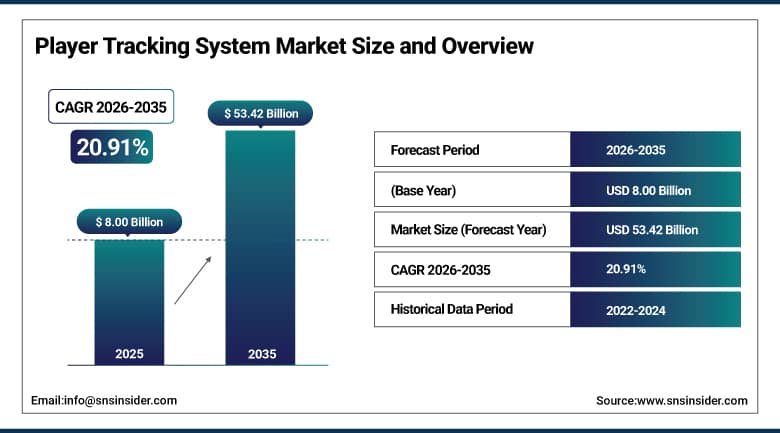
The Player Tracking System Market was valued at USD 8.00 Billion in 2025 and is expected to reach USD 53.42 Billion by 2035, growing at a CAGR of 20.91% from 2026 to 2035.
The Player Tracking System Market is growing rapidly owing to growing utilization of analytics, wearables, and performance monitoring tools in sports. The sports teams and players are using player tracking systems in order to analyze their performance, train better, avoid injury risks, and take tactical decisions. Growing investments in sports technology, increasing popularity of professional leagues, and need for data-enabled coaching solutions have been driving the growth of this market. Further, the technological improvements in AI, computer vision, GPS tracking, sensors, and others are offering accurate performance insights, along with increased fan engagement and broadcasting innovations.
Around 65–70% of professional sports teams now use player tracking systems, with wearable and optical technologies contributing nearly 40% of total market revenue through real-time analytics and broadcasting applications.
Market Size and Forecast
-
Market Size in 2026E: USD 9.67 Billion
-
Market Size by 2035: USD 53.42 Billion
-
CAGR: 20.91% from 2026 to 2035
-
Fastest Growing Region: Asia Pacific
-
Largest Region: North America
To Get More Information On Player Tracking System Market - Request Free Sample Report
Player Tracking System Market Trends
-
Demand for real-time performance and movement analytics keeps climbing across professional and increasingly amateur sport, pushing rapid adoption of tracking technology.
-
AI and machine learning are becoming central to how teams predict performance trends and flag injury risk before it becomes a problem.
-
Wearable sensors, optical systems, and GPS are increasingly fused together, giving teams a level of tracking precision no single technology could deliver alone.
-
Cloud-based analytics platforms are enabling remote access, easier scalability, and real-time data sharing between coaching staff, medical teams, and analysts.
-
Adoption is expanding well beyond elite professional leagues into youth, grassroots, and emerging sports markets, broadening the technology's commercial base considerably.
The U.S. Player Tracking System Market Outlook
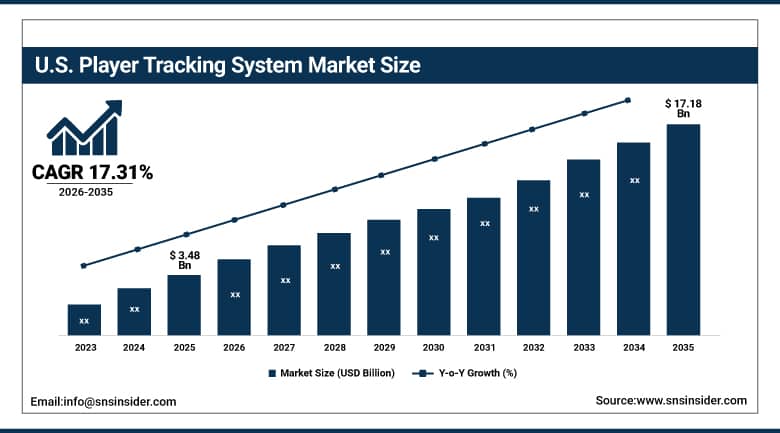
The U.S. Player Tracking System Market was valued at approximately USD 3.48 Billion in 2025 and is expected to reach approximately USD 17.18 Billion by 2035, growing at a CAGR of approximately 17.31%.
Growth in the U.S. market is being driven by rising adoption of advanced analytics, wearable sensors, and optical tracking across the country's major sports leagues, most of which have already built player tracking into their core operations rather than treating it as an experimental add-on. Performance optimization and injury prevention remain the primary use cases, but fan engagement has become an increasingly important secondary driver as leagues look for new ways to bring real-time data into broadcasts and second-screen experiences. That combination of on-field utility and commercial upside is keeping U.S. teams, leagues, and technology vendors firmly invested in expanding tracking infrastructure across venues nationwide.
Over 80% of major U.S. sports leagues, including the NFL, NBA, and MLB, have now adopted wearable and optical tracking systems for real-time analytics, injury prevention, and fan engagement, reflecting just how mainstream the technology has become across American professional sport.
Player Tracking System Market Segment Analysis
-
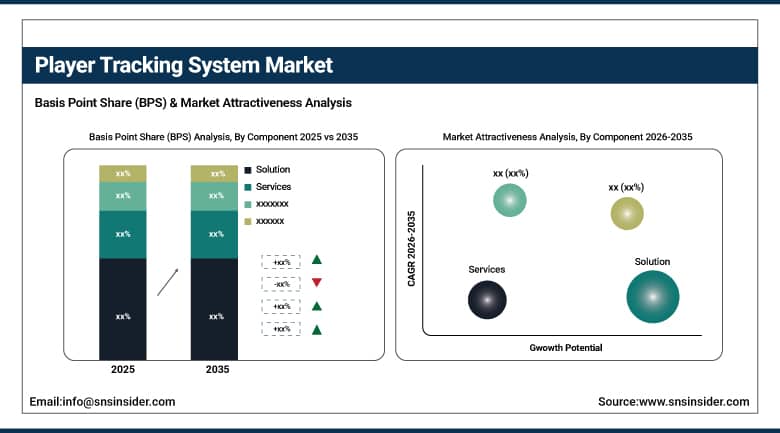
By Component, Solution segment dominated the Player Tracking System Market in 2025 with 68% share; Services segment is the fastest growing segment.
-
By Technology, Optical segment dominated the market in 2025 with 41% share; Wearable segment is the fastest growing segment.
-
By Application, Performance Tracking & Analysis segment dominated the market in 2025 with 36% share; Injury Prevention & Rehabilitation segment is the fastest growing segment.
-
By End Use, Team Sports segment dominated the market in 2025 with 72% share; Individual Sports segment is the fastest growing segment.
By Component, Solution segment dominates the Player Tracking System Market, Services segment expected to grow fastest
The Solution segment dominated the Player Tracking System Market in 2025 owing to the increasing use of player tracking technologies, which include real-time monitoring and performance analytics. Sports organizations, sports teams, and sports leagues require efficient hardware and software-based solutions for improving training efficiency and strategy optimization. With increasing investment in sports management using data, AI, and analytics-based performance analysis in sports organizations, there is high demand for player tracking solutions.
The Services segment is the fastest-growing because of increasing requirements for services such as system installation, integration, maintenance, data analysis, and support in relation to player tracking technologies. Specialized skills are required by sports organizations to handle huge data related to performance. Increased use of player tracking technology by sports teams without adequate analytical capabilities in-house and increased demand for customized solutions are contributing to the growth in the services sector.
By Technology, Optical segment dominates the Player Tracking System Market, Wearable segment expected to grow fastest
The Optical segment dominated the Player Tracking System Market in 2025 owing to the fact that optical tracking devices can measure accurately the position of players, their movements, and tactical plays while using no additional devices or equipment. It is being used extensively in professional stadiums and training grounds since optical technologies are reliable and capable of collecting data in real time. Constant developments in computer vision, artificial intelligence, and image processing technology are increasing the usage of such systems.
The Wearable segment is the fastest-growing due to the rising preference for portable and real-time player tracking devices. With the help of wearable technology equipped with GPS, accelerometers, and biometric sensors, players can monitor the level of workload, speed, and fatigue levels of their body. There is an increased emphasis on athlete health management, injury prevention, and personal training programs.
By Application, Performance Tracking & Analysis segment dominates the Player Tracking System Market, Injury Prevention & Rehabilitation segment expected to grow fastest
The Performance Tracking & Analysis segment dominated the Player Tracking System Market in 2025 owing to the increasing dependence on data-driven approaches to analyze player performance and develop tactics accordingly. These systems help measure speed, positioning, workload, and playstyle in real time. The growing popularity of sports analytics and performance optimization tools in professional sports teams and leagues has increased the demand for performance tracking applications greatly.
The Injury Prevention & Rehabilitation segment is the fastest-growing due to the increasing focus on player protection from injuries, workload control, and recovery time improvement. Player tracking systems allow identifying signs of fatigue and measuring physical stress levels, as well as developing personalized rehabilitation programs with the use of constant performance tracking. Increased awareness about injury prevention and recent technological advances in biometric monitoring have led to the fast adoption of tracking systems for injury management applications.
By End Use, Team Sports segment dominates the Player Tracking System Market, Individual Sports segment expected to grow fastest
The Team Sports segment dominated the Player Tracking System Market in 2025 as tracking systems became an essential part of tactical planning, player improvement, and competition victories in various sports. In team sports such as football, soccer, basketball, and rugby, the need to analyze multiple players simultaneously becomes more important, which creates demand for tracking systems. Investments of sports leagues, teams, and training institutes in advanced analytics and technology performance have helped the segment dominate.
The Individual Sports segment is the fastest-growing as the number of players using performance monitoring technologies increases among those participating in sports like athletics, tennis, swimming, and golf. Individual athletes use tracking systems to analyze techniques, enhance training processes, and improve their physical performance. Popularity of personal coaching, wearables, and data-based training programs drives the rapid growth of this segment.
Regional Analysis
|
Region |
Major Country |
Share within Region, 2025 (%) |
|---|---|---|
|
North America |
United States |
80.50% |
|
Europe |
United Kingdom |
27.30% |
|
Asia Pacific |
China |
30.85% |
|
Middle East & Africa |
UAE |
26.40% |
|
Latin America |
Brazil |
35.60% |
North America Player Tracking System Market Insights
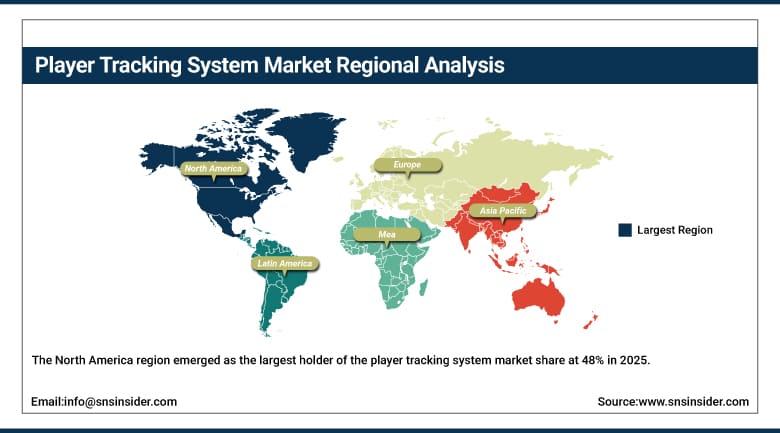
The North America region emerged as the largest holder of the player tracking system market share at 48% in 2025 owing to its well-established sports infrastructure, presence of high adoption rates of analytics and technologies, and concentration of leading technology vendors in the region. Sports leagues and teams in the U.S. and Canada have been spending money to monitor performance, prevent injuries, and make decisions based on strategies, and such consistent demand will help the region remain ahead in terms of market dominance.
The U.S. contributes to nearly 80.50% of revenue generated in the region, as more than 70% of professional teams in the U.S. and Canada use these solutions for performance optimization, injury prevention, and strategy decision making. Such widespread penetration of player tracking systems along with investments made in smart stadiums in the region is likely to keep it at the forefront during the forecast period, despite other regions narrowing down the gap in growth rate.
Get Customized Report as Per Your Business Requirement - Enquiry Now
Europe Player Tracking System Market Insights
Europe held a significant share of the player tracking system market in 2025, supported by the prominent presence of existing football leagues, increasing use of performance analytics, and technological advancements in training academies and clubs. Increasing usage of both wearable and optical technologies in addition to concerns over safety and tactical efficiency have kept demand in Europe steadily on the rise.
The United Kingdom is the dominant country in terms of demand for regional player tracking systems, representing about 27.30% of European revenues, thanks to the prominence of the Premier League and associated football clubs and academies. Germany and Spain and other football leagues represent significant levels of additional demand, and optical tracking systems deployed by the likes of Bundesliga and La Liga represent a key component of Europe’s prominence as a technologically advanced region.
Asia Pacific Player Tracking System Market Insights
Asia Pacific is expected to grow at the fastest CAGR of approximately 23.47% through 2035, due to growing popularity of professional sports, development of government programs focused on sports technologies, and investment into analysis of athlete performance. The level of investment into sports technologies in Asia Pacific increased by more than 35% annually due to emerging leagues, government projects, and rapid expansion of digital fan-engagement platforms.
China is the key driver of the market's expansion due to its share of 30.85% in terms of regional revenue and increasing investment into domestic leagues and athlete development programs. Moreover, contribution of other countries like India, Japan, and South Korea is also significant, while growing fan engagement platforms are providing additional grounds for broadcaster and league investment in tracking technologies besides its traditional application in field performance.
MEA & Latin America Player Tracking System Market Insights
The Middle East & Africa and Latin America regions collectively showed steady growth in the player tracking system market in 2025, owing to increasing investments in the sports infrastructure sector, the popularity of football, cricket, and other major sports leagues in their respective regions, and adoption of performance analytics technology. Increasing digitalization in the field of sports management, along with collaborations with international technology players, is enabling both the regions to catch up to more developed regions.
The UAE is the largest country in terms of demand within the Middle East & Africa region with around 26.40% share of regional revenue, due to its efforts to organize international sporting events and build smart sports infrastructure in the country. In the Latin America region, Brazil dominates with a regional revenue share of around 35.60%.
Market Dynamics
Growth Drivers: Data-driven performance analytics and smart stadium expansion
The growing emphasis on data-driven decision-making across professional sport is fueling steady adoption of player tracking systems. Coaches and teams increasingly rely on real-time tracking data to analyze player movement, workload, speed, and tactical performance, and turning that raw data into actionable intelligence is helping organizations optimize training intensity, refine game strategy, and reduce the risk of overtraining. It's a pattern that echoes what's been observed across data-driven industries more broadly, where companies that lean on data effectively tend to see materially better customer acquisition, retention, and profitability outcomes, and sports organizations are increasingly applying that same logic to player performance management.
At the same time, the rapid expansion of smart stadiums equipped with IoT-enabled infrastructure is creating real momentum for player tracking adoption. Advanced sensors, cameras, and wireless connectivity now allow seamless collection and analysis of player data both in training and during live matches, supporting deeper tactical analysis while also enhancing the broadcast experience through interactive visualizations. Venues like Santiago Bernabeu Stadium, which has deployed Wi-Fi 6 and AI-based analytics to improve both fan experience and day-to-day stadium operations, illustrate just how far smart-venue infrastructure has come, and as more venues follow that lead, demand for connected tracking solutions should keep climbing in step.
Restraints: Tracking accuracy limitations and data processing constraints
Player tracking systems still run into real accuracy challenges tied to environmental and technological limitations. Poor lighting, camera obstruction, fast player movement, and weak GPS or LPS signals can all lead to inconsistent or incomplete data capture, and these issues tend to be particularly pronounced in indoor arenas or multi-sport venues where line-of-sight and signal strength are naturally restricted. Computer-vision and AI-based systems, for instance, can show position measurement errors ranging from roughly 1.7 to over 16 meters depending on camera quality and conditions, which is more than enough variance to compromise performance analysis or tactical decision-making if left unaddressed.
A second, related constraint is bandwidth and data processing capacity. Real-time tracking generates enormous volumes of high-resolution positional, biometric, and performance data, often exceeding a thousand data points per second per player, and that demands robust network infrastructure and genuinely powerful analytics platforms to process without meaningful delay. Limited bandwidth or inadequate processing capability can push data latency up by 200 to 500 milliseconds, which is enough to noticeably degrade live analysis, and managing that continuous data flow remains expensive and technically demanding, particularly for teams without deep IT resources of their own.
Opportunities: AI-driven predictive analytics and growing commercialization
The integration of artificial intelligence, machine learning, and predictive analytics is reshaping what player tracking systems can actually do. These technologies enable real-time processing of well over a thousand performance metrics per athlete, giving coaches and analysts a materially deeper read on fatigue levels and injury risk than traditional monitoring ever allowed. Predictive analytics adoption has been linked to injury-incidence reductions of roughly 25 to 30%, alongside meaningfully more efficient training through better-optimized player load and tactical adjustments, and that combination of health and performance upside is exactly why AI-powered tracking keeps attracting fresh investment from technology providers and analytics firms alike.
Growing commercialization of sport is opening up a second substantial opportunity, particularly around fan engagement. Leagues, broadcasters, and digital platforms are increasingly using real-time tracking data to enhance live coverage, fantasy sports products, and interactive fan-facing analytics, and that kind of data-rich storytelling has been shown to boost engagement by more than 40% across major leagues. Broadcasters using tracking analytics have also reported viewership and digital-interaction gains of up to 25%, and as sponsorship, advertising, and data-licensing revenue streams mature around this data, commercialization looks set to become an increasingly significant growth lever for the market.
Recent Developments:
-
2025: STATSports added AI-powered insights to its Sonra Lite platform, giving grassroots coaches faster, simpler access to advanced performance analysis.
-
2024: Catapult signed a new multi-year deal with the Rugby Football Union, Premiership Rugby, and Premiership Women's Rugby, extending its tracking technology across English rugby.
-
2024: Zebra Technologies sponsored the NFL Health & Safety Summit, reinforcing its RFID-based tracking role in player performance and safety initiatives.
-
2024: Chyron showcased customer-driven innovations and cloud-native live production updates at the IBC Show, building on its TRACAB optical tracking platform used across major football leagues.
Player Tracking System Market key players are:
-
Catapult Group International Ltd
-
STATSports Group Ltd
-
Zebra Technologies Corporation
-
ChyronHego Corporation
-
KINEXON GmbH
-
Polar Electro Oy
-
PlayGineering Systems Pvt. Ltd.
-
Sonda Sports Ltd
-
JOHAN Sports B.V.
-
Xampion Ltd
-
TrackMan A/S
-
Heddoko Inc.
-
Opta Sports Data Limited
-
ShotTracker Inc.
-
PlaySight Interactive Ltd.
-
Q-Track (QTrack)
-
Sports Performance Tracking
-
SPT Sports Pty Ltd
-
Second Spectrum Inc.
-
VX Sport Global Pty Ltd
Player Tracking System Market Report Scope:
| Report Attributes | Details |
|---|---|
| Market Size in 2025 | USD 8.00 Billion |
| Market Size by 2035 | USD 53.42 Billion |
| CAGR | CAGR of 20.91% From 2026 to 2035 |
| Base Year | 2025 |
| Forecast Period | 2026-2035 |
| Historical Data | 2022-2024 |
| Report Scope & Coverage | Market Size, Segments Analysis, Competitive Landscape, Regional Analysis, DROC & SWOT Analysis, Forecast Outlook |
| Key Segments | • By Component (Solution, Services) • By Technology (Optical, Wearable, Industrial, Others) • By Application (Performance Tracking & Analysis, Injury Prevention & Rehabilitation, Team Performance & Tactical Analysis, Fitness Monitoring & Training, Broadcasting & Fan Engagement, Others) • By End Use (Individual Sports, Team Sports) |
| Regional Analysis/Coverage | North America (US, Canada), Europe (Germany, UK, France, Italy, Spain, Russia, Poland, Rest of Europe), Asia Pacific (China, India, Japan, South Korea, Australia, ASEAN Countries, Rest of Asia Pacific), Middle East & Africa (UAE, Saudi Arabia, Qatar, South Africa, Rest of Middle East & Africa), Latin America (Brazil, Argentina, Mexico, Colombia, Rest of Latin America). |
| Company Profiles | Catapult Group International Ltd, STATSports Group Ltd, Zebra Technologies Corporation, ChyronHego Corporation, KINEXON GmbH, Polar Electro Oy, PlayGineering Systems Pvt. Ltd., Sonda Sports Ltd, JOHAN Sports B.V., Xampion Ltd, TrackMan A/S, Heddoko Inc., Opta Sports Data Limited, ShotTracker Inc., PlaySight Interactive Ltd., Q-Track (QTrack), Sports Performance Tracking, SPT Sports Pty Ltd, Second Spectrum Inc., VX Sport Global Pty Ltd |
Frequently Asked Questions
The Player Tracking System Market is expected to grow at a CAGR of 20.91% from 2026 to 2035.
The Player Tracking System Market was valued at USD 8.00 Billion in 2025.
The major growth factor is rising integration of AI, IoT, and wearable sensors for real-time performance analytics and injury prevention
The Solution segment dominated the Player Tracking System Market with a 68% share in 2025.
North America dominated the Player Tracking System Market in 2025 with a 48% share of total global market revenue.
