
Potassium Sulfate Market Report Scope & Overview:
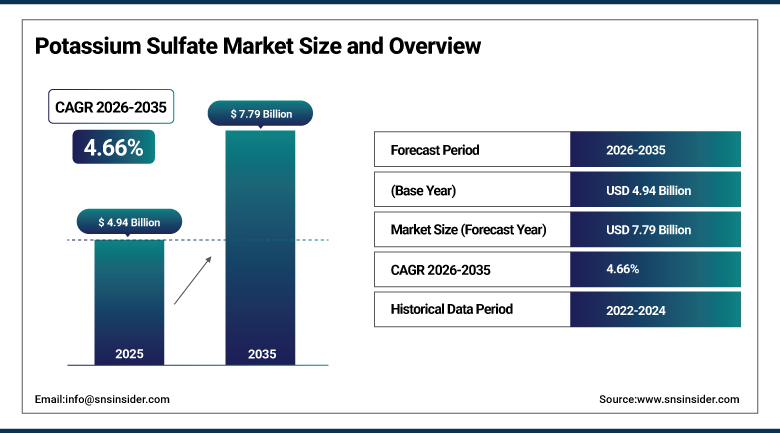
The Potassium Sulfate Market was valued at USD 4.94 billion in 2025 and is expected to reach USD 7.79 billion by 2035, growing at a CAGR of 4.66% from 2026-2035.
Potassium sulfate market growth is fueled by growing demand for salt-free fertilizers due to high-value crops like fruits, vegetables, and nuts. The growing need for food globally and the increasing requirement for higher production rates in the field are driving up fertilizer consumption rates. Potassium sulfate is being used by farmers in order to increase crop quality, yield, and soil quality. Advancements in technology and farming methods like precision farming are assisting in the efficient use of fertilizers. Furthermore, government programs that encourage sustainable agriculture and the growing concern over soil salinity are contributing to market growth.
Recent industry insights further support this trend. According to the Food and Agriculture Organization, global fertilizer consumption has been rising steadily, with potash fertilizers playing a crucial role in enhancing soil fertility and improving crop productivity as agricultural systems intensify to meet growing food demand. Similarly, the United States Department of Agriculture reports that precision farming technologies such as GPS-guided irrigation, soil nutrient mapping, and variable-rate fertilizer application are significantly improving nutrient efficiency and reducing fertilizer waste in large-scale agricultural operations.
To Get more information Potassium Sulfate Market - Request Free Sample Report
Potassium Sulfate Market Trends
-
Rising demand for high-efficiency fertilizers to improve crop yield and soil quality is driving the potassium sulfate market.
-
Growing adoption in chloride-sensitive crops such as fruits, vegetables, and tobacco is boosting market growth.
-
Expansion of global agriculture and increasing food security concerns are fueling fertilizer consumption.
-
Increasing focus on balanced nutrient management and sustainable farming practices is shaping adoption trends.
-
Advancements in fertilizer formulation and production technologies are enhancing nutrient efficiency and crop response.
The U.S. Potassium Sulfate Market Size Outlook
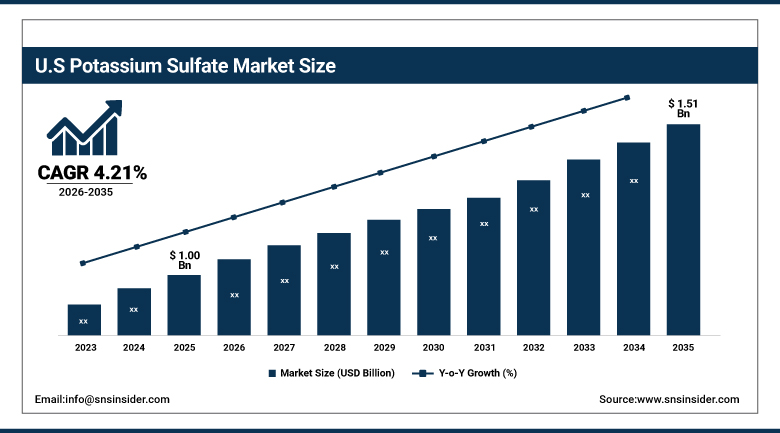
The U.S. Potassium Sulfate Market was valued at USD 1.00 billion in 2025 and is expected to reach USD 1.51 billion by 2035, growing at a CAGR of 4.21% from 2026-2035.
The U.S. Potassium Sulfate Market is expected to grow due to increasing demand for chlorine-free fertilizers for high-end crops like fruits and vegetables for improved yields and qualities. Improved farming practices along with increased use of precision agriculture techniques has made fertilizers highly efficient. In addition, increased attention toward sustainable and healthy soil management practices will also contribute to market growth
Potassium Sulfate Market Segment Analysis
-
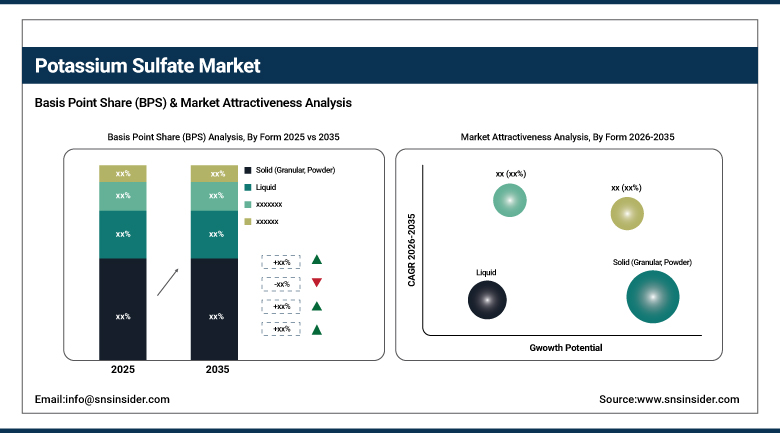
By Form, solid (granular, powder) segment dominated the potassium sulfate market in 2025 with ~75.76% share; liquid segment fastest growing (CAGR).
-
By Purity, up to 99% purity segment dominated the potassium sulfate market in 2025 with ~63.27% share; greater than 99% purity segment fastest growing (CAGR).
-
By Application, fertilizer segment dominated the potassium sulfate market in 2025 with ~69.35% share; drug ingredient segment fastest growing (CAGR).
-
By End-Use Industry, agriculture segment dominated the potassium sulfate market in 2025 with ~53.68% share; pharmaceuticals segment fastest growing (CAGR).
By Form, solid segment dominates the potassium sulfate market in 2025, liquid segment is expected to grow fastest
The solid form segment led the Potassium Sulfate Market in 2025 because of the widespread use in fertilizer, ease of handling, prolonged shelf-life, and lower transportation costs. The granular and powdered forms are widely sought after for their suitability in direct soil application as well as mixing with other fertilizers, thus becoming the best choice in agriculture. Well-established supply channels, easy to manage as bulk agribusiness products, and effective nutrient application make this form dominant in the world's consumption of potassium sulfate.
The liquid segment is the fastest growing because of the growing demand from precision agriculture where nutrients are supplied in water-soluble form. It allows for easier and faster nutrient absorption and application. The rise in greenhouse and hydroponic farming, along with the adoption of drip irrigation systems, is contributing to this trend. Easy integration into irrigation and fertilizer systems and the prevention of nutrient wastage are the factors behind the growing popularity of this segment.
By Purity, up to 99% purity segment dominates the potassium sulfate market in 2025, greater than 99% purity segment is expected to grow fastest
The purity range of up to 99% accounted for the largest share of the Potassium Sulfate Market in 2025 because of its economical nature and adequate functionality for regular agricultural applications. The aforementioned purity range does not lack anything in terms of nutritional content needed for the vast majority of crops that do not require ultra-high-grade potassium sulfates. In addition, the segment is backed by extensive use for agricultural purposes, wide availability, and efficient manufacturing methods.
The greater than 99% segment experienced the highest rate of growth due to increased consumption for growing high-quality crops and in precision agriculture. Ultra-pure potassium sulfate guarantees minimal amounts of impurities, thus maximizing the effectiveness of the process. Furthermore, the product is increasingly applied in the pharmaceutical sector and in controlled-environment agriculture. Increased interest in high-quality agricultural technologies and export-oriented agriculture has contributed to growing consumption.
By Application, fertilizer segment dominates the potassium sulfate market in 2025, drug ingredient segment is expected to grow fastest
The fertilizer category held a largest share in the Potassium Sulfate Market in 2025 owing to its importance in supplying potassium and sulfur nutrients that help grow plants. This product is commonly used in crops that are sensitive to chlorides such as fruits, vegetables, and tobacco plants that need premium nutrition. Moreover, increasing agricultural activities around the globe coupled with increasing demand for food products contribute significantly to the market dominance. Fertilizers' ability to boost yield and quality of crops, and their presence in traditional agriculture practices is driving their adoption in this field.
The drug ingredients application segment held the highest growth rate due to its extensive use in the pharmaceutical sector in drug development and manufacturing. The rising demands for highly pure chemicals for pharmaceuticals are driving the adoption in this sector. The growth of the global pharmaceutical industry, along with the increasing investment in drug research and development, supports this trend.
By End-Use Industry, agriculture segment dominates the potassium sulfate market in 2025, pharmaceuticals segment is expected to grow fastest
Agriculture held the lead share of the Potassium Sulfate Market in 2025 owing to the widespread use of potassium-based fertilizers in order to boost production in addition to enhancing soil fertility. Increased global food requirement, scarcity of farmland, along with the need for adopting advanced cultivation techniques are major factors fueling consumption. Potassium sulfate plays a vital role in case of chlorine sensitive crops, adding importance to its use in agriculture. Well-established distribution channels and active farming operations have driven its continuous usage in agriculture, thus accounting for the dominance of agriculture as the key end-use industry.
Pharmaceuticals emerged as the fastest-growing end-use industry owing to rising applications of highly purified potassium sulfate in formulations, laboratories, and medicines. Increasing global health care expenditure, coupled with expansion in the pharmaceutical industry, are major factors supporting the market growth. Demand for highly pure ingredients with strict quality requirements in the manufacturing of drugs has boosted adoption in this end-use segment.
Regional Analysis
|
Region |
Major Country |
Share within Region (%) |
|---|---|---|
|
North America |
United States |
87.9% |
|
Europe |
United Kingdom |
19.8% |
|
Asia Pacific |
Australia |
6.7% |
|
Middle East & Africa |
UAE |
12.3% |
|
Latin America |
Brazil |
45.9% |
North America Potassium Sulfate Market Insights
North American potassium sulfate market is growing consistently owing to the rise in usage of improved agriculture methods and growing need for good quality produce. The growing trend towards the use of fertilizers which do not contain chloride for better soil condition and higher productivity is another major factor driving the potassium sulfate market. The existence of substantial commercial farming operations and efficient irrigation system has contributed significantly to the growth of the market. Another aspect driving the growth is increasing consumption of vegetables and fruits.
Europe Potassium Sulfate Market Insights
The Europe potassium sulfate market continues to experience steady growth owing to the increasing focus on sustainable agriculture coupled with the implementation of stringent environmental laws restricting the use of chlorinated fertilizers. Agricultural players are increasingly inclined towards adopting green and efficient fertilizers to enhance product yields and soil sustainability. Increasing demand for organic food products and specialty crops is boosting market performance. Technological advancements within the agricultural sector and increasing focus on sustainable farming practices will continue to drive market growth.
Asia Pacific Potassium Sulfate Market Insights
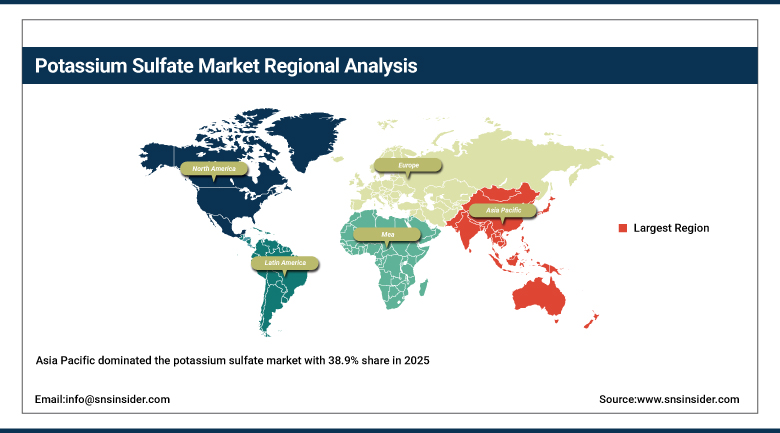
Asia Pacific dominated the potassium sulfate market with 38.9% share in 2025 and is expected to grow at the fastest CAGR from 2026–2035, due to extensive agricultural output and growing preference for higher yield crops. The region enjoys advantages such as high fertilizer consumption, growing population, and food security requirements. Modern agricultural practices and chlorine-free fertilizers are also helping propel market growth. Moreover, the growing efforts of governments towards improving agricultural efficiency and sustainable practices have increased demand for potassium sulfate. Growing fruit and vegetable cultivation activities have strengthened the region’s position in the global potassium sulfate market.
Get Customized Report as per Your Business Requirement - Enquiry Now
Middle East & Africa and Latin America Potassium Sulfate Market Insights
The growth of the potassium sulfate market in the Middle East & Africa and Latin America is being fueled gradually due to increasing agricultural production and rising demand for increased productivity in agriculture. Growing cultivation of fruits, vegetables, and other cash crops is fueling the demand for fertilizers that are free of chlorides. Modernization in the form of advanced irrigation techniques and better agricultural practices is also contributing towards market growth. Agricultural exports on a large scale in Latin America and food security projects in the Middle East & Africa are the major drivers of growth in these markets.
Market Dynamics
Growth Drivers: Rising demand for chloride-free fertilizers in high-value crops driving adoption of potassium sulfate globally
The increasing use of fertilizers in agriculture, which are chloride-free, is playing an important role in boosting the market of potassium sulfate, particularly in case of fruits, vegetables, and tobacco. Farmers have been switching to potassium sulfate due to its beneficial impact on the quality of crops produced, as well as soil. Population growth and increase in food requirement are also responsible for increased consumption of fertilizers. Moreover, advanced agriculture practices have made farmers inclined towards using potassium sulfate because of their preference for balanced fertilization. Growing knowledge about the management of salinity of the soil is also helping boost the potassium sulfate market.
Restraints: High production costs and limited raw material availability restricting large-scale potassium sulfate manufacturing
The production of potassium sulfate requires certain raw materials like potassium chloride and sulfuric acid, whose prices may change due to supply and demand. The process used in the manufacture of this fertilizer involves high costs due to the energy required, and this increases the total cost of production. Such high costs make this fertilizer relatively more expensive compared to other potassium fertilizers such as potassium chloride. This factor makes it difficult for potassium sulfate to compete well in the market where there is an abundance of other similar products.
Opportunities: Rising adoption of specialty and high-value crop farming creating strong growth opportunities for potassium sulfate
Rising plantation of specialty crops like fruits, vegetables, nuts, and horticulture goods provides immense opportunities for the growth of potassium sulfate. The specialty crops need to be planted using fertilizers that contain no chlorine, because this enhances quality, flavor, and shelf life of the crop. Another reason that drives demand for this compound in fertilizer production is the rising demand for high-quality organic agricultural products across the globe. Growing greenhouse farming techniques and controlled environment agriculture techniques provide an impetus to market growth as well. Growing attention by farmers towards increasing yield and improving export standards augments fertilizer demand.
Recent Developments:
-
2026: Nutrien expanded its premium sulfate-of-potash (SOP) fertilizer offerings to support chloride-sensitive crops. The company emphasized improved nutrient efficiency solutions and sustainable agriculture programs, strengthening its global specialty fertilizer portfolio for high-value crop production.
-
2025: Nutrien entered into an agreement to sell its 50 percent equity position in Argentina-based nitrogen producer Profertil S.A. to Adecoagro S.A. and Asociacion de Cooperativas Argentinas Coop Ltda through a joint acquisition.
-
2025: Mosaic Company announced the opening of a new fertilizer blending facility in Palmeirante, Brazil. The facility has a capacity to process 1 million tonnes of fertilizer annually, with approximately 500,000 tonnes expected to be processed in 2025
-
2025: K+S launched low-carbon potash and sulfate-based fertilizer products under its C:LIGHT range. These potassium sulfate-enhanced solutions support sustainable agriculture by reducing environmental footprint while maintaining high crop yield efficiency.
-
2024: Compass Minerals optimized sulfate-based specialty fertilizer production, focusing on improving potassium sulfate product consistency and supply chain efficiency. The company strengthened its agriculture segment supporting chloride-sensitive crop cultivation.
-
2023: Nutrien strengthened its potash and specialty fertilizer operations, including sulfate-based potassium products. The company focused on global agricultural demand growth and improving nutrient efficiency solutions for farmers
Potassium Sulfate Market Key Players are:
-
Nutrien Ltd.
-
The Mosaic Company
-
Yara International ASA
-
K+S Aktiengesellschaft
-
SQM S.A.
-
Compass Minerals International Inc.
-
Sesoda Corporation
-
Migao Corporation
-
Intrepid Potash, Inc.
-
Halogens
-
LCP Leuna Carboxylation Plant GmbH
-
Qing Shang Chemical
-
China Ching Shiang Chemical Co. Ltd
-
Kemira Kemi AB
-
SDIC Xinjiang Luobupo Potash Co., Ltd.
-
Hebei Sanyuanjiuqi Fertilizer Co., Ltd.
-
Utkarsh Agrochem
-
KSM Inc.
Potassium Sulfate Market Report Scope:
| Report Attributes | Details |
|---|---|
| Market Size in 2025 | USD 4.94 Billion |
| Market Size by 2035 | USD 7.79 Billion |
| CAGR | CAGR of 4.66% From 2026 to 2035 |
| Base Year | 2025 |
| Forecast Period | 2026-2035 |
| Historical Data | 2022-2024 |
| Report Scope & Coverage | Market Size, Segments Analysis, Competitive Landscape, Regional Analysis, DROC & SWOT Analysis, Forecast Outlook |
| Key Segments | • By Form (Solid (Granular, Powder), and Liquid) • By Purity (Up to 99% Purity, and Greater than 99% Purity) • By Application (Fertilizer, Food Additive, Drug Ingredient, and Chemical Intermediate) • By End User (Agriculture, Pharmaceuticals, Cosmetics, Food & Beverages, and Industrial Applications) |
| Regional Analysis/Coverage | North America (US, Canada), Europe (Germany, UK, France, Italy, Spain, Russia, Poland, Rest of Europe), Asia Pacific (China, India, Japan, South Korea, Australia, ASEAN Countries, Rest of Asia Pacific), Middle East & Africa (UAE, Saudi Arabia, Qatar, South Africa, Rest of Middle East & Africa), Latin America (Brazil, Argentina, Mexico, Colombia, Rest of Latin America). |
| Company Profiles | Nutrien Ltd., The Mosaic Company, Yara International ASA, K+S Aktiengesellschaft, SQM S.A., Compass Minerals International Inc., Tessenderlo Group, Sesoda Corporation, Migao Corporation, Intrepid Potash, Inc., Halogens, LCP Leuna Carboxylation Plant GmbH, Rusal, Qing Shang Chemical, China Ching Shiang Chemical Co. Ltd, Kemira Kemi AB, SDIC Xinjiang Luobupo Potash Co., Ltd., Hebei Sanyuanjiuqi Fertilizer Co., Ltd., Utkarsh Agrochem, KSM Inc. |
Frequently Asked Questions
Asia Pacific dominated the Potassium Sulfate Market in 2025.
Asia Pacific dominated the Potassium Sulfate Market in 2025.
Rising demand for chloride-free fertilizers in high-value crops driving adoption of potassium sulfate globally.
The Potassium Sulfate Market was valued at USD 4.94 billion in 2025.
The Potassium Sulfate Market is expected to grow at a CAGR of 4.66% from 2026 to 2035.
