
Predictive Automobile Technology Market Report Scope and Overview:
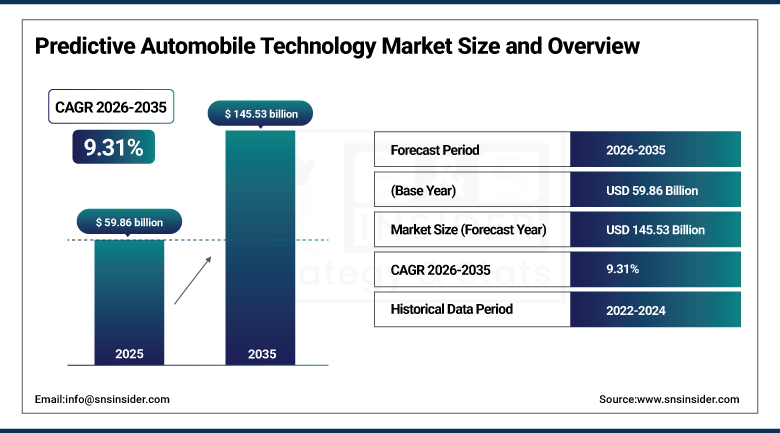
The Predictive Automobile Technology Market was valued at USD 59.86 billion in 2025 and is expected to reach USD 145.53 billion by 2035, growing at a CAGR of 9.31% from 2026-2035.
The Predictive Automobile Technology Market is witnessing strong growth owing to the synergy between artificial intelligence (AI), machine learning (ML), sensor technologies, and cloud computing across the worldwide automotive industry landscape. Predictive automobile technology entails a system that integrates multiple systems and platforms that utilize live data gathered through sensors on board automobiles, telematics devices, diagnostic tools, and connected infrastructure to make predictions concerning vehicle behavior, identify faults in components or driver behavior, and take preventive measures in order to avoid accidents or break downs before they actually happen. This enables a complete transformation of the automobile into a smart and data-gathering tool.
This market is driven by a paradigm shift within the automotive sector from the reactive schedule-based maintenance and safety management process to a more predictive approach based on condition monitoring that helps lower operating expenses, reduce unscheduled downtimes, and increase safety measures in passenger vehicles as well as commercial vehicles. Large fleet operators who own sizable numbers of commercial vehicles are among the early adopters of predictive automobile solutions because any slight improvement in their operations in terms of maintenance scheduling will result in significant savings in terms of total cost of ownership. Similarly, insurance companies are incorporating data from the predictive behavior of drivers into their telematic usage-based insurance policies that not only help them price risks more accurately but also incentivize drivers who exhibit good behavior with discounts on premiums.
Predictive Automobile Technology Market Size and Forecast
Market Size in 2025: USD 59.86 Billion
Market Size by 2035: USD 145.53 Billion
CAGR: 9.31% from 2026 to 2035
Base Year: 2025
Forecast Period: 2026-2035
Historical Data: 2022-2024
To Get more information on Predictive Automobile Technology Market - Request Free Sample Report
Predictive Automobile Technology Market Trends
-
The increasing use of electric vehicles around the world is driving the need for predictive battery life cycle monitoring, predictive thermal management, and range estimation solutions, as both prediction of battery deterioration and optimized charging cycle contribute to the prolongation of battery life cycles and reduced warranty expenses for OEMs.
-
Adoption of 5G vehicle to everything (V2X) communication systems is providing greater bandwidth to conduct real-time predictive analysis through enabling prediction of traffic conditions, alerts about road hazards, and information regarding infrastructure conditions to be sent to the vehicle's onboard predictive safety and navigation systems within sub-millisecond delays.
-
Increasing popularity of Software-as-a-Service predictive maintenance platforms deployed to the cloud is making it possible for vehicle fleet owners and insurance providers to monitor the health and condition of their vehicles through centralized software platforms without having to invest in on-premises infrastructure resources.
-
Increased implementation of usage-based auto insurance policies through leveraging the telematic insights into drivers' behavior is spurring insurance companies to develop predictive scoring systems for drivers, and to partner with car manufacturers and telematics vendors to deploy them to their vehicles.
-
Growing regulatory pressure for mandatory advanced driver assistance systems in new passenger and commercial vehicles across North America, Europe, and Asia Pacific is embedding predictive safety hardware and software into vehicle production requirements, creating structural demand that is independent of consumer adoption decisions and providing a government-mandated baseline for predictive technology penetration across new vehicle fleets.
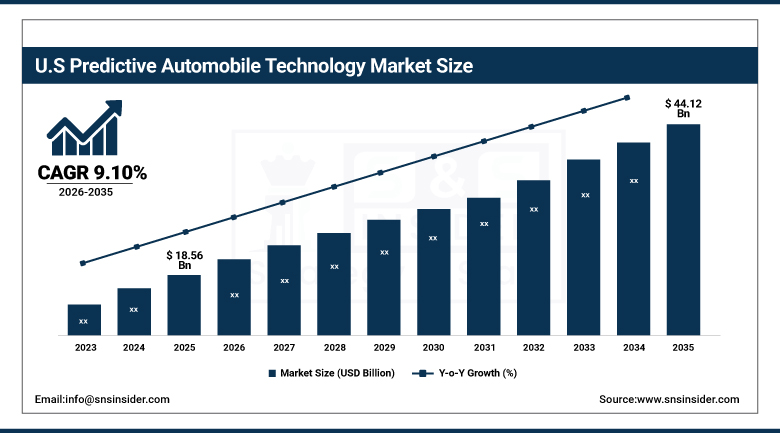
U.S. Predictive Automobile Technology Market was valued at USD 18.56 billion in 2025 and is expected to reach approximately USD 44.12 billion by 2035, growing at a CAGR of 9.10% through the forecast period. The United States represents the dominant national market within North America, anchored by substantial federal and state-level regulatory investment in autonomous vehicle development corridors, a large and established fleet telematics industry serving commercial trucking, logistics, and passenger transportation operators, and a mature usage-based insurance market through which telematics-driven predictive risk assessment has achieved significant consumer penetration. The U.S. National Highway Traffic Safety Administration 2019 continued promulgation of mandatory ADAS and collision avoidance system requirements for new passenger vehicles is structurally embedding predictive safety technology into the domestic vehicle production cycle.
Predictive Automobile Technology Market Segment Analysis
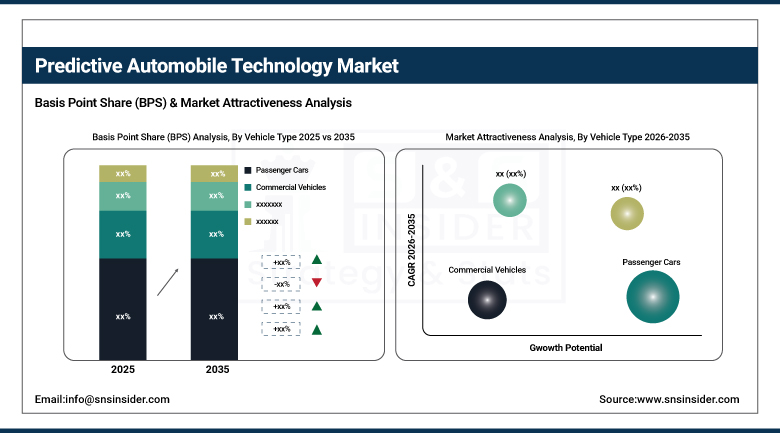
By Vehicle Type, Passenger Cars dominated with ~71.03% share in 2025; Passenger Cars is also the fastest growing segment.
By Component, Hardware dominated with ~58.79% share in 2025; Software is the fastest-growing component segment with a CAGR of 10.80%.
By Deployment Mode, On-premise dominated with ~58.22% share in 2025; Cloud is the fastest-growing deployment mode with a CAGR of 11.20%.
By Application, Predictive Maintenance dominated with ~31.20% share in 2025; it is also the fastest-growing application segment with a CAGR of 10.90%.
By End-User, Fleet Owners dominated with ~53.21% share in 2025; Insurers is the fastest growing segment.
By Vehicle Type: Passenger Cars dominate, Commercial Vehicles second largest
Passenger Cars held approximately 71.03% of the Predictive Automobile Technology Market in 2025, valued at USD 42.51 billion and is projected to grow at a CAGR of 9.70% through the forecast period. The dominant market position of passenger cars reflects the significantly larger global production and registered fleet volume of passenger vehicles relative to commercial vehicles, combined with the rapidly accelerating integration of predictive technology systems into mid-range and premium passenger car segments by major OEMs seeking to differentiate on technology, reduce warranty claims, and comply with increasingly stringent mandatory ADAS and safety system requirements in major markets.
The Commercial Vehicles segment, valued at USD 17.35 billion in 2025, is projected to grow at a CAGR of 8.20% through the forecast period. Commercial vehicle operators managing trucking, logistics, public transit, and construction equipment fleets represent some of the most economically motivated adopters of predictive automobile technology, as the financial consequences of unplanned vehicle downtime, component failures on active routes, and driver safety incidents are substantially higher per event in commercial fleet contexts than in consumer passenger car usage.
By Component: Hardware dominates, Software fastest-growing
Hardware held approximately 58.79% of the Predictive Automobile Technology Market in 2025. The hardware segment encompasses the physical sensing, computing, and connectivity infrastructure that enables predictive technology functions within vehicles, including advanced driver assistance systems sensors such as radar, LiDAR, cameras, and ultrasonic sensors; onboard diagnostics modules and telematics control units; semiconductor processors and microcontrollers for real-time data processing; and vehicle-to-everything communication hardware.
The Software segment, is projected to grow at the fastest CAGR of 10.80% through the forecast period. Software encompasses the AI and ML algorithm platforms, predictive analytics engines, cloud-based vehicle health monitoring dashboards, fleet management software, telematics data processing pipelines, and over-the-air update management systems that transform raw sensor data into actionable predictive insights.
By Deployment Mode: On-premise dominates, Cloud fastest-growing
The on-premises model accounted for about 58.22% of the Predictive Automobile Technology market in 2025 due to the fact that the in-vehicle predictive computing system is integrated into the car and processes sensor data locally by using processing units installed in the car itself. The on-premises model includes edge computing in cars, which produces predictive results instantly without the need for a constant connection to the cloud. Therefore, the on-premises deployment model is very important for predictive applications that involve safety concerns like collision detection, lane departure warning, and adaptive cruise control.
By Application: Predictive Maintenance dominates
The share of Predictive Maintenance in the global Predictive Automobile Technology Market is expected to be 31.20% in 2025. Applications in predictive maintenance technology make use of data feeds collected from sensor technology in automobile engines, drives, braking, transmissions, and batteries to predict wear out of parts, allowing preventive maintenance activities to be planned in advance and prevent mechanical breakdowns. Predictive maintenance has proven its economic viability in passenger as well as commercial vehicles, whereby a body of research suggests that predictive maintenance technologies lead to reduced vehicle downtimes of 30-50% and component longevity of 20-40% over maintenance by schedules, resulting in lower TCO and warranty claims.
By End-User: Fleet Owners dominate, Insurers second-largest
Fleet Owners held major share of the Predictive Automobile Technology Market in 2025. Fleet operators across commercial trucking, logistics and delivery, public transit, construction equipment, and ride-hailing segments represent the most economically motivated and highest-volume adopters of predictive automobile technology, driven by the direct financial returns generated by reduced maintenance costs, minimized vehicle downtime, improved fuel efficiency, and enhanced driver safety management.
Predictive Automobile Technology Market Regional Analysis
|
Region |
Major Country |
Share within Region (%) |
|---|---|---|
|
North America |
United States |
70% |
|
Europe |
Germany |
24% |
|
Asia Pacific |
China |
41% |
|
Middle East & Africa |
Saudi Arabia |
28% |
|
Latin America |
Brazil |
44% |
North America Predictive Automobile Technology Market Insights
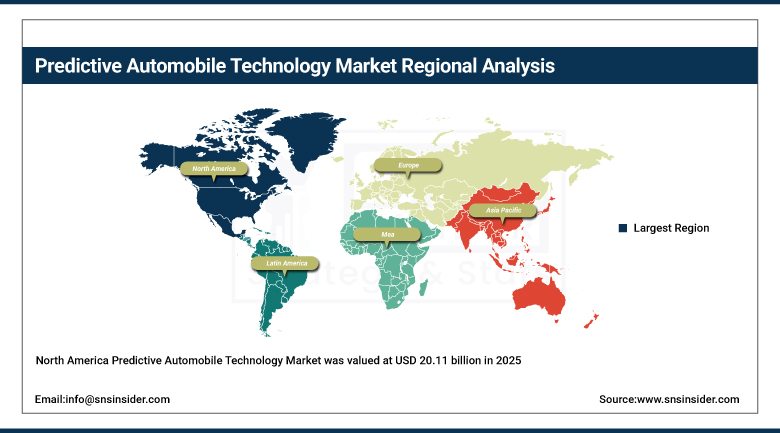
The North America Predictive Automobile Technology Market was valued at USD 20.11 billion in 2025. The United States market is characterized by the presence of leading global technology companies deploying AI and machine learning platforms for automotive applications, a large commercial fleet telematics industry serving long-haul trucking and logistics operations, and a mature regulatory environment that is progressively mandating advanced driver assistance systems in new passenger vehicles.
Get Customized Report as per Your Business Requirement - Enquiry Now
Europe Predictive Automobile Technology Market Insights
Europe Predictive Automobile Technology Market, with Germany, Sweden, France, and the United Kingdom as the primary national markets. Germany represents the largest national market within Europe, home to the continent leading automotive OEMs including Volkswagen Group, BMW Group, Mercedes-Benz, and major tier-one suppliers including Continental AG, Robert Bosch GmbH, ZF Friedrichshafen, and Valeo, all of which are significant producers and consumers of predictive automobile technology solutions. The European Union General Safety Regulation, which mandated a comprehensive package of advanced safety systems including intelligent speed assistance, driver drowsiness monitoring, emergency lane keeping, and advanced emergency braking for all new vehicles sold in the EU market beginning in 2022 and expanded requirements from 2024, has structurally embedded predictive safety technology into new vehicle production requirements across the entire European automotive market.
Asia Pacific Predictive Automobile Technology Market Insights
Asia Pacific is the fastest-growing regional Predictive Automobile Technology Market, projected to grow at a CAGR of 11.40%, the highest among all regions, through the forecast period. China represents the largest national market within Asia Pacific, driven by the highest volume of new energy vehicle sales, strong government policy support for intelligent connected vehicle development through national standards and smart city infrastructure investment programs, and the rapid integration of predictive AI capabilities into domestically produced EVs by Chinese OEMs including BYD, NIO, Xpeng, and Li Auto who compete aggressively on connected vehicle technology features. India is the fastest-growing national market within Asia Pacific, supported by the growing adoption of fleet telematics in the commercial vehicle sector, rising consumer demand for ADAS-equipped passenger vehicles in the premium and upper-mainstream segments, and government initiatives promoting intelligent transport systems.
Latin America Predictive Automobile Technology Market Insights
The Latin America Predictive Automobile Technology Market with Brazil, Mexico, Colombia, and Argentina as the primary national markets. Brazil accounts for the largest national market share, driven by a large commercial vehicle fleet serving the country extensive freight transport network, growing adoption of fleet telematics and predictive maintenance platforms among Brazilian logistics operators, and increasing penetration of ADAS-equipped passenger vehicles in the premium vehicle segment. Mexico is experiencing accelerating market growth driven by the expansion of manufacturing hub vehicle fleets associated with nearshoring supply chain investment, growing commercial telematics adoption among Mexican trucking operators, and increasing domestic sales of ADAS-equipped passenger vehicles from both international OEMs and domestic assemblers.
Middle East & Africa Predictive Automobile Technology Market Insights
The Middle East & Africa Predictive Automobile Technology Market with the Gulf Cooperation Council nations, South Africa, and Nigeria as the primary national markets. GCC nations including the UAE, Saudi Arabia, and Qatar are the most advanced markets for predictive automobile technology adoption within the region, driven by high new vehicle sales volumes in the premium and luxury segments where ADAS and connected vehicle features are standard equipment, active government investment in smart city and intelligent transportation system infrastructure, and the adoption of fleet telematics for vehicle safety and management in oil and gas, construction, and logistics sectors. Saudi Arabia Vision 2030 economic diversification program is generating significant commercial fleet expansion across logistics and infrastructure sectors that is driving demand for predictive fleet management technology.
Market Growth Drivers:
Rising demand for vehicle safety, regulatory mandates for ADAS, and the proliferation of connected and electric vehicles creating structural demand for predictive automobile technology
The market for predictive automobiles technologies is underpinned by a number of synergistically reinforcing factors driving demand which guarantee continued growth irrespective of economic cycles. Regulations mandating the use of Advanced Driver Assistance Systems (ADAS) in North America, Europe, and more recently Asia Pacific have ensured that predictive safety technologies are an essential part of new vehicle manufacturing, forming an obligatory demand base irrespective of consumer tastes and OEM spending on technology.
Market Restraints:
Data privacy and cybersecurity concerns, high technology integration costs, and uneven connectivity infrastructure creating adoption barriers across vehicle segments and geographies
There exist various barriers that have limited the uptake rate for predictive automotive technologies in the predictive automobile technology market to be below their maximum potential due to several reasons. For instance, the generation of data through the vehicle itself, which entails data on location tracking and performance of vehicle systems as well as data on the driver, poses some level of concern in terms of privacy and data security due to stringent data management regulation policies, like the EU General Data Protection Regulation. In addition, the use of the internet and communication links in the transfer of vehicle data poses cybersecurity risks, hence making it necessary to invest heavily in vehicle cybersecurity architecture.
Market Opportunities:
AI-driven predictive platform innovation, expansion of usage-based insurance telematics, and emerging market fleet technology adoption creating long-term growth opportunities
The predictive automobile technology market presents substantial long-term growth opportunities across multiple dimensions. The rapid advancement of generative AI and large language model capabilities is enabling new categories of in-vehicle predictive intelligence including natural language vehicle health reporting, AI-driven driver coaching platforms, and autonomous vehicle navigation systems that can predict and respond to complex traffic scenarios with human-level contextual understanding, creating premium product differentiation opportunities for technology providers and OEMs. The global expansion of usage-based insurance programs represents a large and rapidly growing market for telematics-driven predictive driving behavior analytics, with insurers in North America, Europe, and Asia Pacific actively investing in integrated telematics partnerships with OEMs and fleet operators to access vehicle data streams that enable more accurate risk pricing and proactive loss prevention.
Recent Developments:
-
2025: In January 2025, the company released its Gen 6 ADAS platform equipped with AI technology during CES 2025, which consisted of a predictive technology suite built with machine learning that enabled hands-free driving in urban environments, marking an improvement in consumer-grade predictive safety system technology.
-
2025: The company collaborated further with CARIAD through the Automated Driving Alliance in June 2025 on Level 2 and Level 3 automated driving systems incorporating AI technology, where systems underwent testing in various global locations. Generative AI was used to enhance automation driving tasks and reduced the number of validation tests needed for these systems.
Predictive Automobile Technology Market Key Players
Some of the Predictive Automobile Technology Market Companies
-
Continental AG
-
Robert Bosch GmbH
-
ZF Friedrichshafen AG
-
Aptiv PLC
-
Valeo SA
-
Garrett Motion Inc.
-
Harman International Industries (Samsung)
-
Visteon Corporation
-
NXP Semiconductors N.V.
-
Aisin Corporation
-
Infineon Technologies AG
-
Qualcomm Technologies, Inc.
-
Intel Corporation
-
Siemens AG
-
IBM Corporation
-
Microsoft Corporation
-
Verizon Communications Inc.
-
AT&T Corporation
-
Huawei Technologies Co., Ltd.
-
Magna International Inc.
Predictive Automobile Technology Market Report Scope:
| Report Attributes | Details |
|---|---|
| Market Size in 2025 | USD 59.86 Billion |
| Market Size by 2035 | USD 145.53 Billion |
| CAGR | CAGR of 8.01% From 2026 to 2035 |
| Base Year | 2025 |
| Forecast Period | 2026-2035 |
| Historical Data | 2022-2024 |
| Report Scope & Coverage | Market Size, Segments Analysis, Competitive Landscape, Regional Analysis, DROC & SWOT Analysis, Forecast Outlook |
| Key Segments | • By Vehicle Type (Passenger Cars, Commercial Vehicles) • By Component (Software, Hardware) • By Deployment Mode (On-premise, Cloud) • By Application (Predictive Maintenance, Vehicle Health Monitoring, Safety & Security, Driving Pattern Analysis, Others) • By End-User (Fleet Owners, Insurers, Others) |
| Regional Analysis/Coverage | North America (US, Canada), Europe (Germany, UK, France, Italy, Spain, Russia, Poland, Rest of Europe), Asia Pacific (China, India, Japan, South Korea, Australia, ASEAN Countries, Rest of Asia Pacific), Middle East & Africa (UAE, Saudi Arabia, Qatar, South Africa, Rest of Middle East & Africa), Latin America (Brazil, Argentina, Mexico, Colombia, Rest of Latin America). |
| Company Profiles | Continental AG, Robert Bosch GmbH, ZF Friedrichshafen AG, Aptiv PLC, Valeo SA, Garrett Motion Inc., Harman International Industries (Samsung), Visteon Corporation, NXP Semiconductors N.V., Aisin Corporation, Infineon Technologies AG, Qualcomm Technologies, Inc., Intel Corporation, Siemens AG, IBM Corporation, Microsoft Corporation, Verizon Communications Inc., AT&T Corporation, Huawei Technologies Co., Ltd., and Magna International Inc. |

Frequently Asked Questions
Asia Pacific is expected to grow at the fastest CAGR of 11.40% in the Predictive Automobile Technology Market.
Predictive Maintenance dominated with approximately 31.20% share in 2025.
Passenger Cars dominated with approximately 71.03% share in 2025.
The Predictive Automobile Technology Market was valued at USD 59.86 Billion in 2025.
The Predictive Automobile Technology Market is expected to grow at a CAGR of 9.10% from 2026 to 2035.
