
Predictive Patient No-Show & Scheduling Optimization Market Report Scope & Overview:
The Predictive Patient No-Show & Scheduling Optimization Market was valued at USD 0.29 Billion in 2025 and is projected to reach USD 0.46 Billion by 2035, expanding at a CAGR of 4.61% during the forecast period 2026–2035.
The predictive patient no-show & scheduling optimization market is growing steadily with increased use of artificial intelligence, predictive analytics, and automation tools by healthcare institutions to increase utilization of their schedules. Providers of health services have invested in platforms for predicting no-show appointments through the analysis of patients' behaviors, historical presence records, demographic, and clinical data to identify patients with a likelihood of missing the scheduled appointments.
Scheduling optimization with AI, automated reminder notifications, intelligent waiting list management, and capacity planning of healthcare services are being used by health facilities to mitigate losses in revenue, improve patient accessibility, increase productivity of the staff, and streamline clinical workflow processes. Growing digital transformation efforts, increased investment in healthcare, and adoption of cloud-based healthcare management platforms provide excellent opportunities for commercialization.
In 2025, the healthcare technology vendors rapidly commercialized AI scheduling platforms with predictive no-show analysis, patient communication automation, intelligent appointment scheduling, and cloud-based workforce management functionalities to optimize health resources utilization and improve patient engagement.
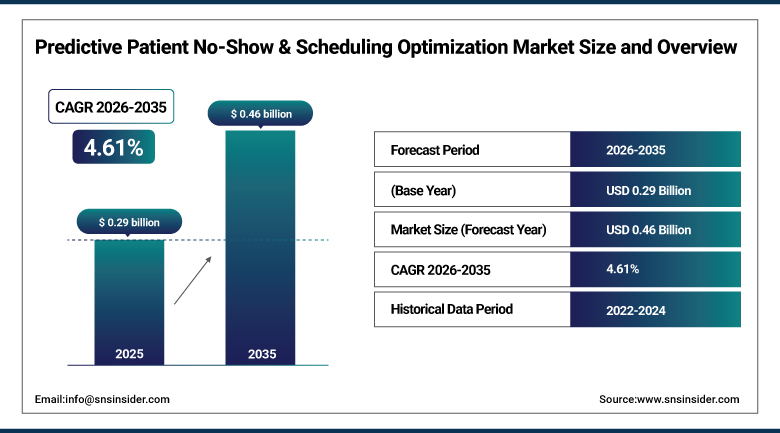
To Get more information Predictive Patient No-Show & Scheduling Optimization Market - Request Free Sample Report
Predictive Patient No-Show & Scheduling Optimization Market Trends:
-
Increasing adoption of AI-powered predictive analytics to reduce patient no-show rates.
-
Rising implementation of automated patient reminder and engagement platforms.
-
Growing deployment of cloud-based scheduling optimization solutions across healthcare systems.
-
Expansion of predictive capacity management and intelligent waitlist automation.
-
Increasing integration of scheduling platforms with electronic health records (EHR) and hospital information systems.
The U.S. Predictive Patient No-Show & Scheduling Optimization Market Size Outlook:
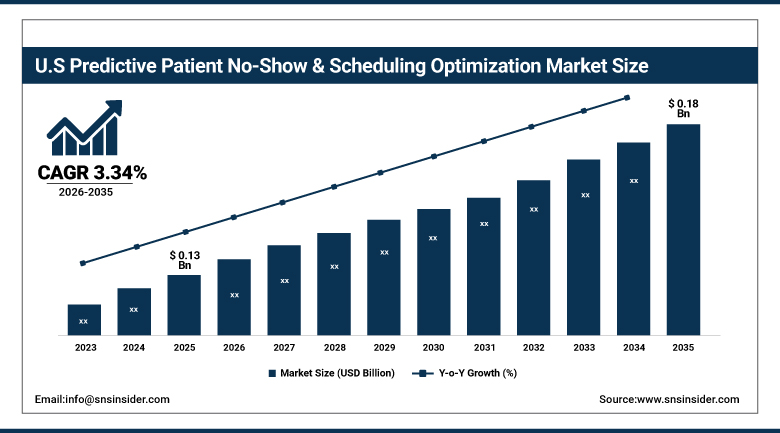
The U.S. Predictive Patient No-Show & Scheduling Optimization Market was valued at USD 0.13 billion in 2025 and is expected to reach approximately USD 0.18 billion by 2035, expanding at a CAGR of 3.34% during 2026–2035.
The USA has remained dominant in the market because of the increased use of IT technology in the healthcare industry, increased investment in healthcare operations supported by AI and increased demand for automation in the workflow process at both hospitals and integrated delivery network level. Hospitals have been using scheduling software that is integrated with electronic health records, patient engagement, cloud-based analytics, and automated communication technologies aimed at reducing the no-show rates. There has been an increased focus on value-based healthcare, cost-saving operational procedures, patient satisfaction, and resource efficiency. Within the year 2025, healthcare organizations in the USA adopted AI-powered patient scheduling and predictive analysis applications in order to increase accessibility and reduce missed appointments.
Predictive Patient No-Show & Scheduling Optimization Market Segment Analysis:
-
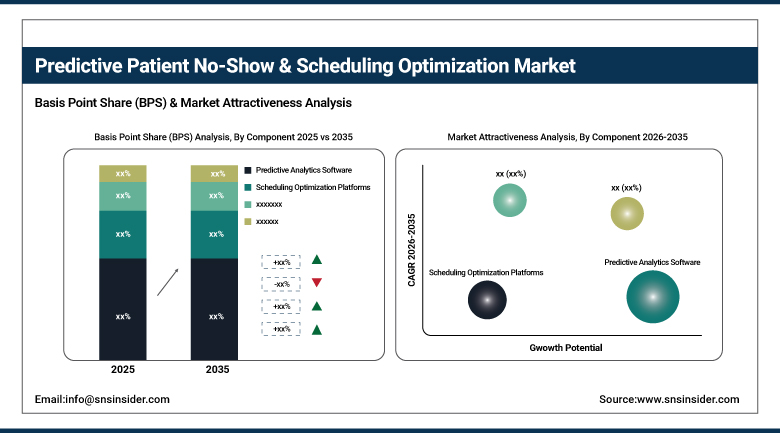
By Component, predictive analytics software dominated the market with 36.00% share in 2025, while patient engagement & reminder tools are projected to witness the fastest growth with 4.77% CAGR during the forecast period.
-
By Deployment, cloud-based solutions dominated the market with 61.00% share in 2025, and is projected to witness the fastest growth with 6.06% CAGR during the forecast period.
-
By Application, no-show prediction dominated the market with 34.00% share in 2025, while appointment scheduling optimization is projected to witness the fastest growth with 5.72% CAGR during the forecast period.
-
By End User Industry, hospitals & health systems dominated the market with 40.00% share in 2025, while digital health platforms are projected to witness the fastest growth with 6.97% CAGR during the forecast period.
By Component, predictive analytics software dominated, while patient engagement & reminder tools fastest-growing.
Predictive analytics software was recorded to have the largest market share of 36.00% in 2025 due to rising use of artificial intelligence and machine learning techniques in prediction of patient attendance, optimized scheduling and efficient running of healthcare services. Hospitals and healthcare organizations are combining predictive analytics software with EHR, scheduling systems and clinical processes in order to reduce missed visits, improve provider productivity and facilitate patient access.
The patient engagement & reminder tools market is expected to record the highest CAGR of 4.77% during the forecast period due to rising demand for customized patient communication, automated scheduling, SMS alerts, apps and Omni channel engagement systems. AI-based reminder systems have been gaining popularity among healthcare organizations which offer customized communication depending on patient preferences and likelihood of attending the appointments. These tools help in improving patient compliance, reducing missed appointments and improving patient care and experience.
By Deployment, Cloud-Based dominated, while Cloud-Based is the fastest-growing.
Cloud-Based Scheduling Solutions captured the maximum market share of 61.00% owing to growing digitization of the healthcare industry, scalability needs, reduced cost of infrastructure, and easy integration with EHRs and telehealth solutions. The cloud-native solution enables healthcare organizations to manage scheduling from different locations while offering real-time analytics, remote scheduling, automatic software updates, and patient management from one single platform. Cloud deployment solutions offer increased flexibility, higher interoperability, advanced security features, and reduced maintenance costs when compared to the on-premises deployment solutions. In 2025, healthcare providers witnessed growing adoption of cloud-based scheduling ecosystems for better interoperability, scalability, and automation of healthcare workflows using AI solutions.
Cloud-Based Scheduling Solutions are also anticipated to witness the highest CAGR of 6.06% during the forecast period due to rising investments in cloud healthcare infrastructure, AI solutions, and SaaS-based healthcare solutions. Growing adoption of cloud-based scheduling platforms due to the need for central scheduling, predictive analytics, mobile-friendly solutions, and overall healthcare coordination continues to drive healthcare organizations towards cloud solutions for scheduling needs. In 2026, enterprise healthcare organizations continue witnessing increased deployments of cloud-based scheduling solutions with predictive analytics and intelligent patient engagement features.
By Application, no-show prediction dominated, while appointment scheduling optimization fastest-growing.
The no-show prediction segment captured the largest market share of 34.00% in 2025 attributed to increasing usage of artificial intelligence and predictive analytics for identifying high-risk patients for no-shows before their scheduled visits. Machine learning algorithms using historical data on patient attendances, patient demographics, appointment history, weather conditions, and behavior patterns are helping healthcare organizations to schedule accurately and effectively use healthcare resources.
The appointment scheduling optimization segment will exhibit the highest CAGR of 5.72% during the forecast period attributed to increasing demands for smart scheduling algorithms, dynamic appointment scheduling, automated waiting list management, and capacity optimization. Advanced scheduling platforms based on artificial intelligence are helping healthcare providers to balance the needs of provider availability, patient preferences, clinical urgency, and other scheduling constraints to schedule appointments more efficiently and to minimize waiting time for patients. Integration of AI-based scheduling platforms with healthcare management systems on the cloud, patient portals, and self-scheduling platforms is fueling the growth of the market. In 2026, top-notch healthcare software companies extended AI-driven appointment scheduling features such as automated scheduling recommendations, predictive capacity planning, and intelligent workflow automation in hospitals and ambulatory care facilities.
Regional Analysis:
|
Region |
Major Country |
Share within Region, 2025 (%) |
|---|---|---|
|
North America |
United States |
93.00% |
|
Europe |
Germany |
26.00% |
|
Asia Pacific |
China |
18.00% |
|
Middle East & Africa |
UAE |
4.00% |
|
Latin America |
Brazil |
4.00% |
North America Predictive Patient No-Show & Scheduling Optimization Market Insights
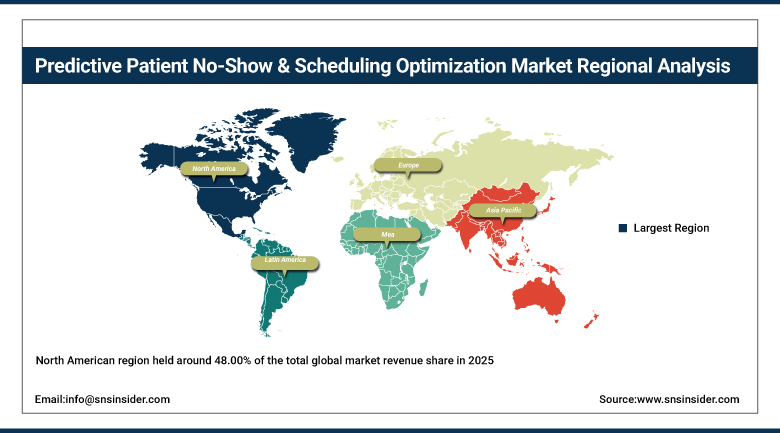
The North American region held around 48.00% of the total global market revenue share in 2025 due to high adoption rate of healthcare IT, developed infrastructure of electronic health records, and increased implementation of AI-based patient appointment booking systems within hospitals and integrated healthcare systems. Many investments have been made in healthcare establishments in North America, particularly in the United States and Canada, to adopt predictive analytics, intelligent appointment scheduling, automated patient interaction, and cloud computing workflow optimization technologies to minimize appointment no-shows and better utilize doctors' time.
In the year 2025, there were many successful implementations of AI-based appointment scheduling optimization software systems which are also integrated with no-show prediction analysis and automated patient interaction by the major U.S. healthcare providers.
Get Customized Report as per Your Business Requirement - Enquiry Now
Europe Predictive Patient No-Show & Scheduling Optimization Market Insights
In the European market, the ongoing digitization efforts within healthcare facilities, increasing implementation of scheduling solutions based on artificial intelligence technology, and wider implementation of IT solutions within hospitals in Germany, the United Kingdom, France, Italy, and other countries. Predictive analytics, appointment automation, and patient engagement platforms are being used to increase efficiency in outpatient services and optimize the healthcare process.
Government spending on the construction of digital infrastructure and patient-centered healthcare practices will boost the expansion of the market in the area. Throughout 2025, healthcare facilities in Europe were constantly implementing scheduling solutions based on artificial intelligence technology and combined with electronic health records and predictive analytics.
Asia Pacific Predictive Patient No-Show & Scheduling Optimization Market Insights
The Asia Pacific region is anticipated to experience the highest growth rate with CAGR 8.11% in the forecasted period owing to fast digitalization in the healthcare sector, development in hospital infrastructure, high healthcare IT spending, and increasing adoption of cloud-based appointment scheduling software in China, India, Japan, South Korea, and Southeast Asia.
The healthcare industry is making increasing use of artificial intelligence scheduling software, predictive patient engagement software, and automated appointment scheduling solutions to increase access to healthcare facilities amid an increasing number of patients. Digital healthcare programs led by governments, expansion of telemedicine ecosystem, and increased smartphone penetration are likely to drive the growth further. In March 2026, some of the Asia Pacific healthcare systems have increased their investment in AI-based appointment scheduling systems for healthcare facilities.
Middle East & Africa and Latin America Predictive Patient No-Show & Scheduling Optimization Market Insights
The Middle East & Africa region is witnessing stable growth owing to increased investments in the modernization of healthcare, expansion of digitized hospital infrastructure, and increased adoption of cloud-based patient scheduling solutions in UAE, Saudi Arabia, South Africa, and adjacent nations. AI-powered appointment management solutions, predictive analytics platforms, and patient communication automation solutions are increasingly being adopted by healthcare service providers in order to improve operational efficiency and healthcare access in this market. Various government initiatives focused on promoting digital transformation and quality improvement in healthcare will keep aiding long-term market development.
Latin America’s growth can be attributed to the increased adoption of healthcare information technology, the implementation of digital healthcare initiatives, and the increase in patient engagement technology investments in Brazil, Mexico, Argentina, and Chile. Digital scheduling software, automated reminders, and cloud-based healthcare management solutions are increasingly being adopted in this region for reducing the number of missed appointments and optimal usage of clinical resources. The awareness of healthcare efficiency is continuously growing in this region.
Market Dynamics:
Growth Drivers: Increasing use of AI-based predictive analytics for lowering patient no-shows.
The technologies of Artificial Intelligence, Predictive Analytics, and Machine Learning have become widely used by healthcare facilities worldwide in order to enhance the process of appointment adherence and clinical resource utilization. The predictions concerning no-shows rely upon the analysis of historical appointment data, patient data, weather information, transportation availability, and behavior data in order to predict the probability of patients failing to attend their appointments. Such kind of data is being integrated into automated scheduling, dynamic waiting list management, and patient engagement technologies to increase productivity, reduce revenue loss, and enhance patient access.
One of the main factors driving the adoption of scheduling optimization software solutions is value-based care delivery and digital transformation in the healthcare industry. By 2025, the adoption of AI-powered predictive scheduling solutions along with automated patient engagement and clinical workflow optimization in healthcare facilities has been enhanced.
Restraints: Issues of data privacy, interoperability, and existing healthcare IT systems.
Even in the context of increased commercialization, the application is still limited due to the difficulties of interoperability, the need for security, and the complexity of combining predictive scheduling systems with legacy electronic health records and hospital information systems. Healthcare institutions need to ensure data privacy legislation while dealing with vast amounts of healthcare data stored in cloud computing services. Budget constraints, cost of implementation, training of personnel, and disruptions in workflow are often experienced by smaller hospitals and individual clinics during digital transformation initiatives.
The heterogeneity of healthcare processes and existing healthcare IT systems may become barriers in deploying scheduling optimization solutions based on artificial intelligence on a broad scale. In 2025, healthcare regulatory bodies and digital health companies stressed interoperability and cyber security in the development of AI-based healthcare software.
Opportunities: Cloud healthcare platform adoption and value-based care.
Some of the major long-term opportunities that are being seen for the company are related to the growing ecosystem of cloud healthcare, telehealth solutions, and value-based healthcare delivery frameworks. Providers of healthcare are deploying intelligent scheduling platforms which can effectively optimize provider schedules, manage patient wait lists, predict appointment requests and help in decision making at the operational level.
The integration of conversational AI, mobile health applications, patient portals, and EHR solutions helps in delivering personalized scheduling solutions and improving patient engagement. With the increasing focus on efficiency and patient-centric approach in the healthcare sector, the adoption of AI-based scheduling optimization platforms is likely to remain high through the forecast period.
In 2026, digital health technology providers are growing their AI-based cloud scheduling ecosystems for predictive appointment scheduling and outreach and workflow optimization across the organization.
Recent Developments:
-
2026 – QGenda expanded its AI-powered workforce and patient scheduling platform with enhanced predictive analytics capabilities to optimize appointment utilization, reduce patient no-show rates, and improve provider scheduling efficiency across large healthcare systems.
-
2026 – Kyruus Health enhanced its patient access platform by introducing advanced AI-driven appointment matching and scheduling optimization capabilities, enabling healthcare providers to improve patient access, streamline referrals, and maximize clinical capacity utilization.
-
2025 – Oracle Health expanded intelligent healthcare scheduling capabilities across its healthcare ecosystem by integrating predictive analytics, AI-assisted patient engagement, and automated appointment management to improve operational efficiency and care coordination.
-
2025 – Luma Health introduced upgraded AI-powered patient engagement and scheduling automation features supporting personalized appointment reminders, predictive no-show reduction, self-scheduling, and automated waitlist management across healthcare organizations.
Predictive Patient No-Show & Scheduling Optimization Market Key Players are:
-
QGenda
-
Kyruus Health
-
Oracle Health
-
Epic Systems Corporation
-
AdvancedMD
-
Relatient
-
Luma Health
-
NexHealth
-
Phreesia Inc.
-
WELL Health Technologies
-
eClinicalWorks
-
Athenahealth Inc.
-
Veradigm LLC
-
Innovaccer Inc.
-
Salesforce Health Cloud
-
Klara
-
TeleVox
-
Solutionreach Inc.
-
ModMed
-
DrChrono Inc.
Predictive Patient No-Show & Scheduling Optimization Market Report Scope:
| Report Attributes | Details |
|---|---|
| Market Size in 2025 | USD 0.29 Billion |
| Market Size by 2035 | USD 0.46 Billion |
| CAGR | CAGR of 4.61% From 2026 to 2035 |
| Base Year | 2025 |
| Forecast Period | 2026-2035 |
| Historical Data | 2022-2024 |
| Report Scope & Coverage | Market Size Analysis, Revenue Forecasting, Segment Analysis, Competitive Landscape, Regional Analysis, Retail Automation Assessment, Smart Checkout Technology Trends, AI-Enabled Retail Infrastructure Analysis, DROC & SWOT Analysis, Investment Trends, Supply Chain Evaluation, Consumer Transaction Technology Assessment, and Future Market Opportunity EvaluationChain Evaluation, Industrial Packaging Demand Analysis, Sustainability Assessment, DROC & SWOT Analysis, Regulatory Framework Analysis, Innovation Benchmarking, and Future Market Opportunity Evaluation |
| Key Segments | • By Component (Predictive Analytics Software, Patient Engagement & Reminder Tools, Scheduling Optimization Platforms, Implementation & Managed Services, Others) • By Deployment (Cloud-Based, On-Premise, Hybrid, Others) • By Application (No-Show Prediction, Appointment Scheduling Optimization, Waitlist & Capacity Management, Patient Outreach Automation, Others) • By End User Industry (Hospitals & Health Systems, Ambulatory Clinics, Specialty Care Centers, Payers & Value-Based Care Organizations, Digital Health Platforms, Others) |
| Regional Analysis/Coverage | North America (US, Canada), Europe (Germany, UK, France, Italy, Spain, Russia, Poland, Rest of Europe), Asia Pacific (China, India, Japan, South Korea, Australia, ASEAN Countries, Rest of Asia Pacific), Middle East & Africa (UAE, Saudi Arabia, Qatar, South Africa, Rest of Middle East & Africa), Latin America (Brazil, Argentina, Mexico, Colombia, Rest of Latin America). |
| Company Profiles | QGenda, Kyruus Health, Oracle Health, Epic Systems Corporation, AdvancedMD, Relatient, Luma Health, NexHealth, Phreesia Inc., WELL Health Technologies, eClinicalWorks, Athenahealth Inc., Veradigm LLC, Innovaccer Inc., Salesforce Health Cloud, Klara, TeleVox, Solutionreach Inc., ModMed, DrChrono Inc. |

Frequently Asked Questions
The Predictive Patient No-Show & Scheduling Optimization Market was valued at USD 0.29 Billion in 2025.
North America dominated the global market.
Predictive Analytics Software accounted for the largest revenue share of 36.00% in 2025.
The market is projected to reach USD 0.46 Billion by 2035.
The market is expected to expand at a CAGR of 4.61% during the forecast period.
