
Prestressed Concrete Wire and Strand Market Report Scope & Overview:
The Prestressed Concrete Wire and Strand Market size was valued at USD 6.55 Billion in 2025 and is projected to reach USD 10.88 Billion by 2035, growing at a CAGR of 5.21% during 2026–2035.
The Prestressed Concrete Wire and Strand Market is witnessing steady growth, driven by rising investments in infrastructure development and increasing demand for durable, high-strength construction materials. Expanding transportation networks, urbanization, and large-scale bridge and highway projects are accelerating adoption of prestressed solutions. Prestressed wires and strands enhance load-bearing capacity, structural stability, and service life of concrete structures.
Prestressed Concrete Wire and Strand Market Size and Forecast:
-
Market Size in 2025: USD 6.55 Billion
-
Market Size by 2035: USD 10.88 Billion
-
CAGR: 5.21% from 2026 to 2035
-
Base Year: 2025
-
Forecast Period: 2026–2035
-
Historical Data: 2022–2024

To Get more information on Prestressed Concrete Wire and Strand Market - Request Free Sample Report
Key Prestressed Concrete Wire and Strand Market Trends:
-
Rising investments in transportation and infrastructure projects are increasing demand for high-strength prestressed wire and strand solutions in bridges, highways, and flyovers.
-
Growing focus on corrosion resistance and durability is driving adoption of epoxy-coated and galvanized prestressed strands, particularly in marine and coastal construction.
-
Advancements in high-tensile steel and fatigue-resistant designs are enhancing load performance, enabling longer spans and reduced material consumption.
-
Increasing use of prefabricated and modular concrete structures is accelerating demand for factory-produced prestressed wire and strand systems.
-
Sustainability-driven construction practices are encouraging use of longer-life prestressed materials that reduce maintenance, repair frequency, and lifecycle costs.
-
Expansion of energy, utility, and offshore infrastructure projects is broadening application scope for prestressed wire and strand products globally.
U.S. Prestressed Concrete Wire and Strand Market Insights
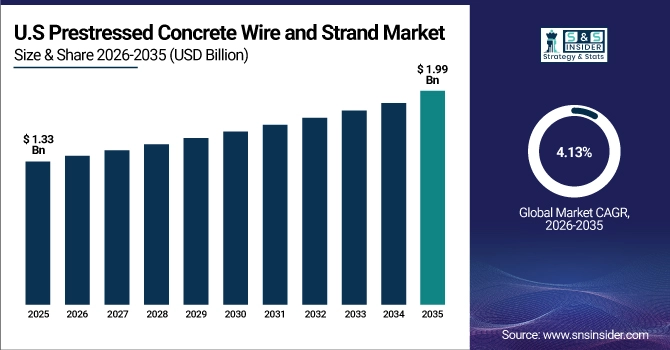
The U.S. Prestressed Concrete Wire and Strand Market size was USD 1.33 billion in 2025 and is expected to reach USD 1.99 billion by 2035, growing at a CAGR of 4.13% over the forecast period of 2026–2035. According to a study, rising federal and state infrastructure spending has increased adoption of prestressed reinforcement, as it improves structural durability and reduces lifecycle costs by nearly 20%. This cause, expanding bridge, highway, and energy projects, effects higher consumption of high-tensile wire and corrosion-resistant strands, strengthening long-term market demand across transportation and utility construction.
Prestressed Concrete Wire and Strand Market Drivers
-
Growing Large-Scale Infrastructure Development and Bridge Modernization Programs Accelerate Prestressed Concrete Wire and Strand Market Expansion
The market is strongly driven by increasing investments in large-scale infrastructure development, particularly in transportation and public utilities. This cause, rising government spending on bridges, highways, rail corridors, and urban transit systems, effects higher adoption of prestressed reinforcement solutions that offer superior load-bearing capacity and extended service life. Prestressed concrete wire and strand reduce structural cracking, enhance fatigue resistance, and lower long-term maintenance costs, making them preferred materials in modern infrastructure projects. As aging bridges and flyovers require rehabilitation or replacement, engineers increasingly specify prestressed solutions to meet stricter safety and durability standards. Technological advancements in high-tensile steel manufacturing further amplify this driver by enabling longer spans and reduced material usage.
In March 2025, a major U.S. state transportation authority approved the use of high-strength prestressed strands for bridge rehabilitation projects, reducing structural maintenance frequency by nearly 25% and improving long-term load performance.
Prestressed Concrete Wire and Strand Market Restraints
-
Volatility in Steel Raw Material Prices and High Production Costs Limit Market Growth Potential
Despite strong demand, the Prestressed Concrete Wire and Strand Market faces restraint from fluctuating steel raw material prices and elevated production costs. This cause, instability in iron ore and energy prices, effects unpredictable manufacturing expenses for prestressed wire and strand producers. High-strength steel requires precise metallurgical processes, specialized equipment, and strict quality controls, increasing capital and operational costs. These cost pressures often translate into higher product prices, limiting adoption in cost-sensitive construction projects and emerging economies. Smaller contractors may opt for conventional reinforcement alternatives to control budgets, slowing penetration rates. Additionally, prolonged price volatility complicates long-term procurement planning for infrastructure developers, creating demand uncertainty.
In 2024, several mid-sized construction firms delayed infrastructure projects after steel price fluctuations increased prestressed strand procurement costs by approximately 18%, impacting short-term demand cycles.
Prestressed Concrete Wire and Strand Market Opportunities
-
Rising Adoption of Corrosion-Resistant and Epoxy-Coated Prestressed Strands Creates New Growth Avenues
Significant opportunities are emerging from increasing adoption of corrosion-resistant and epoxy-coated prestressed wire and strand products. This cause, growing construction activity in marine, coastal, and offshore environments, effects higher demand for advanced protective coatings that extend structural lifespan. Epoxy-coated and galvanized strands significantly reduce corrosion-induced deterioration, lowering maintenance costs and improving safety. Infrastructure owners increasingly prioritize lifecycle cost optimization over upfront material costs, accelerating acceptance of premium prestressed solutions. Technological advancements in coating uniformity and bonding strength further enhance product reliability.
In July 2025, a European infrastructure developer adopted epoxy-coated prestressed strands for a coastal bridge project, extending projected service life by over 30 years and reducing corrosion-related repairs.
Prestressed Concrete Wire and Strand Market Segmentation Analysis:
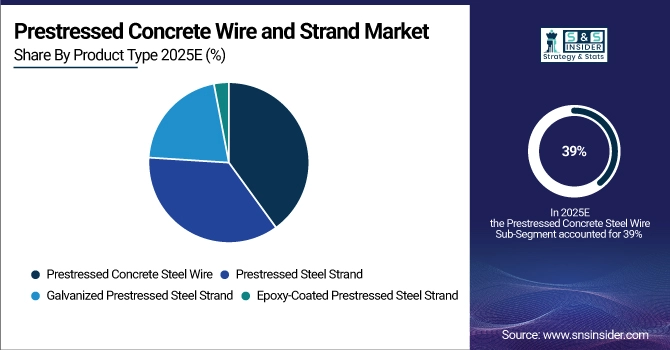
By Product Type, Prestressed Concrete Steel Wire Leads Market While Epoxy-Coated Prestressed Steel Strand Registers Fastest Growth
The Prestressed Concrete Steel Wire segment dominated the Prestressed Concrete Wire and Strand Market with the largest revenue share of 39% in 2025. This dominance is driven by its widespread use in bridges, flyovers, and precast concrete elements, where high tensile strength and cost efficiency are critical. This cause, rising infrastructure construction and demand for reliable reinforcement, effects extensive adoption of prestressed steel wire in large-scale transportation and urban projects. Its proven performance, ease of manufacturing, and compatibility with standard prestressing systems further reinforce dominance. Continuous product improvements in tensile strength and fatigue resistance directly support sustained demand, strengthening its contribution to overall market stability and volume growth.
The Epoxy-Coated Prestressed Steel Strand segment is growing at the largest CAGR of 7.30% during 2026–2035. This growth is driven by increasing construction in corrosive environments such as marine, coastal, and chemical-exposed structures. This cause, rising durability and lifecycle cost concerns, effects accelerated adoption of epoxy-coated strands that reduce corrosion-related failures. Product developments improving coating adhesion and damage resistance are enhancing long-term reliability, positioning this segment as a high-growth contributor to the Prestressed Concrete Wire and Strand Market.
By Construction Type, Bridges & Flyovers Dominate Market While Marine & Offshore Structures Register Fastest Growth
The Bridges & Flyovers segment accounted for the largest revenue share of 35% in 2025. This dominance is supported by extensive government investments in transportation infrastructure and bridge modernization programs. This cause, increasing traffic loads and aging bridge replacement needs, effects higher demand for prestressed wire and strand solutions that improve load capacity and structural longevity. Continuous advancements in high-tensile materials allow longer spans with reduced material usage, reinforcing dominance and directly strengthening the Prestressed Concrete Wire and Strand Market’s revenue base.
The Marine & Offshore Structures segment is growing at the fastest CAGR of 7.84% during 2026–2035. Growth is driven by expansion of ports, offshore energy platforms, and coastal infrastructure. This cause, exposure to harsh saline environments, effects increased reliance on corrosion-resistant prestressed strands. Product innovations in epoxy-coated and galvanized strands enhance performance under extreme conditions, accelerating adoption and expanding high-value opportunities within the market.
By Wire/Strand Type, Seven-Wire Strand Leads Market While Nine-Wire Strand Registers Fastest Growth
The Seven-Wire Strand segment dominated the market with a revenue share of 37% in 2025. This dominance is attributed to its balanced combination of strength, flexibility, and cost efficiency. This cause, widespread specification in bridges, buildings, and precast applications, effects consistent demand across infrastructure and commercial construction. Ongoing enhancements in tensile performance and fatigue resistance further reinforce its leadership, contributing significantly to stable growth in the Prestressed Concrete Wire and Strand Market.
The Nine-Wire Strand segment is growing at the highest CAGR of 7.98% during 2026–2035. Growth is driven by demand for higher load-bearing capacity in long-span bridges and heavy-duty infrastructure. This cause, rising structural complexity and load requirements, effects increased adoption of advanced strand configurations. Product development focused on strength optimization and durability positions this segment as a key growth accelerator within the market.
By End User, Transportation Leads Market While Energy & Utilities Register Fastest Growth
The Transportation segment dominated the Prestressed Concrete Wire and Strand Market with a revenue share of 33% in 2025. This dominance is driven by large-scale investments in highways, railways, bridges, and urban transit systems. This cause, increasing mobility demand and infrastructure upgrades, effects high consumption of prestressed reinforcement materials that improve safety and lifespan. Continuous adoption across public transportation projects reinforces the segment’s leadership and sustains market expansion.
The Energy & Utilities segment is growing at the fastest CAGR of 7.81% over the forecast period. Growth is driven by expansion of power plants, renewable energy facilities, and utility infrastructure. This cause, demand for durable structures capable of withstanding mechanical and environmental stress, effects rising adoption of prestressed wire and strand solutions. Product innovations supporting heavy-load applications strengthen this segment’s contribution to future Prestressed Concrete Wire and Strand Market growth.
Prestressed Concrete Wire and Strand Market Regional Analysis:
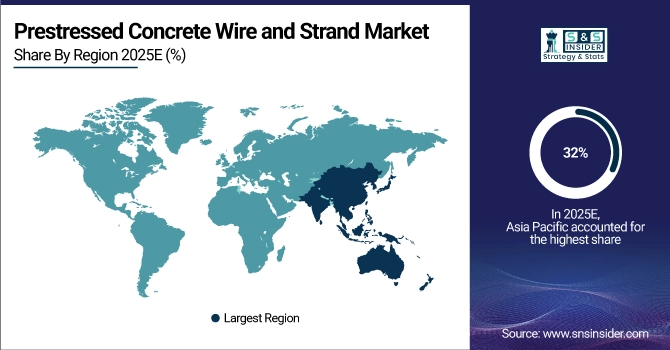
Asia Pacific Dominates Prestressed Concrete Wire and Strand Market in 2025
In 2025, the Asia Pacific region dominated the Prestressed Concrete Wire and Strand Market with an estimated market share of 32%. This cause, rapid urbanization and extensive transportation infrastructure projects, effects high demand for high-strength prestressed wire and strand across multiple applications.
Get Customized Report as per Your Business Requirement - Enquiry Now
China leads Asia Pacific’s Prestressed Concrete Wire and Strand Market
China dominates due to large-scale investments in bridges, highways, high-speed rail networks, and energy infrastructure. This cause, rising industrialization and urban population growth, effects widespread adoption of high-tensile and corrosion-resistant prestressed wire and strand. Prefabricated concrete structures and modular bridge elements further accelerate demand. Government-backed initiatives promoting durable, long-life infrastructure projects enhance construction efficiency and material longevity.
Europe Fastest-Growing Region in Prestressed Concrete Wire and Strand Market 2026–2035
Europe is projected to grow at a CAGR of 7.14% during 2026–2035, making it the fastest-growing region. This cause, increasing focus on sustainable and long-life infrastructure, effects accelerated adoption of advanced prestressed wire and strand solutions.
Germany leads Europe’s Prestressed Concrete Wire and Strand Market
Germany dominates due to strict environmental standards, aging transportation infrastructure, and expansion of urban bridges and highways. This cause, emphasis on safety, durability, and corrosion-resistant solutions, effects widespread use of epoxy-coated and high-strength prestressed strands. Germany’s preference for modular, prefabricated construction and innovative design techniques further increases demand. Large-scale energy, port, and rail projects require durable, long-life prestressed reinforcement, strengthening Germany’s market share. Ongoing R&D in high-tensile wire products ensures Germany continues to lead Europe’s regional market.
North America Prestressed Concrete Wire and Strand Market Insights 2025
In 2025, North America accounted for an estimated 29% share of the Prestressed Concrete Wire and Strand Market, driven by bridge rehabilitation, highway modernization, and energy infrastructure projects. This cause, strong construction standards and infrastructure investment, effects sustained adoption of high-strength, corrosion-resistant prestressed strands.
United States leads North America
The U.S. dominates due to extensive federal and state funding for infrastructure modernization, particularly bridges, flyovers, and transit networks. This cause, focus on reducing maintenance costs and extending structural lifespan, effects high adoption of seven-wire and epoxy-coated prestressed strands. Innovations in high-tensile steel and fatigue-resistant designs, combined with prefabricated concrete applications, reinforce the U.S. leadership and long-term demand in the region.
Middle East & Africa and Latin America Prestressed Concrete Wire and Strand Market Insights 2025
In 2025, the Prestressed Concrete Wire and Strand Market in the Middle East & Africa (MEA) and Latin America showed steady growth, with an estimated combined market share of 15%, driven by urban infrastructure expansion and industrial projects. This cause, challenging environmental and coastal construction conditions, effects higher adoption of corrosion-resistant and high-strength prestressed wire and strand solutions. Brazil leads Latin America due to extensive highway and coastal projects, while the UAE dominates MEA through advanced bridge, port, and energy infrastructure, emphasizing long-life, low-maintenance construction materials that enhance regional market growth.
Prestressed Concrete Wire and Strand Market Key Players:
-
Sumitomo Osaka Cement Co., Ltd. (SOCC)
-
Bekaert NV
-
Kobe Steel, Ltd.
-
ArcelorMittal
-
Strata Manufacturing
-
Crescent Wire Industries
-
Gerdau S.A.
-
Commercial Wire Company
-
VOESTALPINE Stahl GmbH
-
JFE Steel Corporation
-
POSCO
-
Bohler Edelstahl GmbH & Co. KG
-
WireCo WorldGroup
-
NKT A/S
-
Pacific Stranding Company
-
Acerinox, S.A.
-
Far S.p.A.
-
Danieli & C. Officine Meccaniche S.p.A.
Competitive landscape for prestressed concrete wire and strand market:
Tata Steel
Tata Steel is a leading global manufacturer of steel products, including high‑tensile prestressed steel wire and strand for infrastructure and construction applications. The company’s product portfolio emphasizes high strength, durability, and corrosion resistance, supporting bridges, flyovers, marine structures, and industrial facilities. Tata Steel’s extensive manufacturing footprint and integrated supply chain enable efficient production and delivery of prestressed solutions to key markets worldwide. Its role in the Prestressed Concrete Wire and Strand Market is significant, as the company provides advanced materials that contribute to long‑lasting, cost‑efficient structural designs.
-
In August 2025, Tata Steel expanded its high‑tensile prestressed strand production capacity at its Indian facility, incorporating automated quality‑control systems that enhance tensile uniformity and reduce defects, thereby strengthening its competitive position in Asia Pacific and Middle East markets.
Sumitomo Osaka Cement Co., Ltd. (SOCC)
Sumitomo Osaka Cement Co., Ltd. (SOCC) is a Japan‑based industrial materials company that manufactures prestressed concrete wire and strand products alongside specialized cement and construction materials. SOCC emphasizes reliability, precision manufacturing, and material performance under high‑stress conditions. Its prestressed products serve transportation infrastructure, commercial buildings, and coastal projects, where long‑term durability and fatigue resistance are critical. SOCC’s strategic focus on research and quality control reinforces its role as a key supplier in East Asia and other global markets.
-
In November 2025, SOCC unveiled a new corrosion‑resistant prestressed strand line, featuring enhanced epoxy coatings designed for marine and coastal infrastructure, improving long‑term performance in harsh environments and expanding its market presence in infrastructure segments.
Bekaert NV
Bekaert NV is a global leader in advanced steel wire transformation and coatings, supplying a wide range of prestressed concrete wire and strand solutions to infrastructure and industrial construction sectors. The company focuses on high‑performance materials engineered for tensile strength, fatigue resistance, and long service life. Bekaert’s global footprint, innovation investments, and technical support services position it as a major contributor in Europe, North America, and Asia Pacific. Its role in the Prestressed Concrete Wire and Strand Market is reinforced by continuous product enhancements and application‑specific wire treatments that improve structural outcomes.
-
In June 2025, Bekaert launched an advanced high‑ductility prestressed strand designed for ultra‑long‑span bridges and heavy infrastructure, offering improved crack‑control properties and enhanced fatigue resistance, expanding its adoption in large civil projects.
Nippon Steel Corporation
Nippon Steel Corporation is a Japan‑based steel producer with comprehensive capabilities in high‑tensile steel and prestressed concrete wire and strand manufacturing. Known for advanced metallurgical technologies and consistent quality, Nippon Steel’s products support transportation infrastructure, energy facilities, and industrial construction sectors. The company integrates innovation in high‑strength steel grades and corrosion‑resistant surface treatments to meet rigorous performance specifications. Its commitment to sustainability and long‑lasting materials reinforces its leadership in the Asian and global prestressed reinforcement markets.
-
In October 2025, Nippon Steel introduced a next‑generation eco‑coated prestressed wire line, featuring improved environmental compliance and reduced CO₂ footprints during production while maintaining high tensile performance, further differentiating its offerings in environmentally conscious infrastructure projects.
| Report Attributes | Details |
|---|---|
| Market Size in 2025 | US$ 6.55 Billion |
| Market Size by 2035 | US$ 10.88 Billion |
| CAGR | CAGR of 5.21 % From 2026 to 2035 |
| Base Year | 2025 |
| Forecast Period | 2026-2035 |
| Historical Data | 2022-2024 |
| Report Scope & Coverage | Market Size, Segments Analysis, Competitive Landscape, Regional Analysis, DROC & SWOT Analysis, Forecast Outlook |
| Key Segments | • By Product Type (Prestressed Concrete Steel Wire, Prestressed Steel Strand, Galvanized Prestressed Steel Strand, Epoxy‑Coated Prestressed Steel Strand) • By Construction Type (Bridges & Flyovers, Buildings & Infrastructure, Flooring & Roof Slabs, Marine & Offshore Structures, Tunnels & Pipes) • By End-Use Industry (Residential, Commercial, Transportation, Energy & Utilities, Industrial) • By Wire/Strand Type (Single Wire, Multi‑Wire Strand, Seven‑Wire Strand, Nine‑Wire Strand) |
| Regional Analysis/Coverage | North America (US, Canada), Europe (Germany, UK, France, Italy, Spain, Russia, Poland, Rest of Europe), Asia Pacific (China, India, Japan, South Korea, Australia, ASEAN Countries, Rest of Asia Pacific), Middle East & Africa (UAE, Saudi Arabia, Qatar, South Africa, Rest of Middle East & Africa), Latin America (Brazil, Argentina, Mexico, Colombia, Rest of Latin America). |
| Company Profiles | Tata Steel, Sumitomo Osaka Cement Co., Ltd. (SOCC), Bekaert NV, Nippon Steel Corporation, Kobe Steel, Ltd., ArcelorMittal, Strata Manufacturing, Crescent Wire Industries, Gerdau S.A., Commercial Wire Company, VOESTALPINE Stahl GmbH, JFE Steel Corporation, POSCO, Bohler Edelstahl GmbH & Co. KG, WireCo WorldGroup, NKT A/S, Pacific Stranding Company, Acerinox, S.A., Far S.p.A., and Danieli & C. Officine Meccaniche S.p.A. |
Frequently Asked Questions
Asia-Pacific dominated the Prestressed Concrete Wire and Strand Market in 2025.
The “Bridges & Flyovers” segment dominated during the projected period.
The key drivers of the Prestressed Concrete Wire and Strand Market are rising infrastructure development, increasing demand for durable construction materials, and adoption of corrosion-resistant, high-strength prestressed solutions.
The market was valued at USD 6.55 Billion in 2025 and is projected to reach USD 10.88 Billion by 2035.
The Prestressed Concrete Wire and Strand Market is expected to grow at a CAGR of 5.21% during 2026–2035.
