
Print Management Software Market Report Scope & Overview:
The Print Management Software Market is valued at USD 2.73 billion in 2025E and is expected to reach USD 7.72 billion by 2033, growing at a CAGR of 13.97% from 2026-2033.
The print management software market is growing due to increasing demand for cost control, secure printing, and workflow optimization across enterprises. Organizations are adopting centralized print management to reduce waste, improve document security, and support hybrid work environments. Rising digital transformation initiatives, cloud-based deployment, and integration with enterprise IT systems are further driving adoption. Additionally, growing compliance requirements, sustainability goals, and the need for real-time monitoring and analytics are accelerating market expansion across various industries.
75% of enterprises deployed print management software leveraging cloud platforms and AI-driven analytics to cut costs by 35%, meet sustainability targets, and enforce secure, compliant printing in hybrid work environments.
Print Management Software Market Size and Forecast
-
Market Size in 2025E: USD 2.73 Billion
-
Market Size by 2033: USD 7.72 Billion
-
CAGR: 13.97% from 2026 to 2033
-
Base Year: 2025E
-
Forecast Period: 2026–2033
-
Historical Data: 2022–2024

To Get more information on Print Management Software Market - Request Free Sample Report
Print Management Software Market Trends
-
Rising adoption of cloud-based print management solutions to support remote work and distributed enterprise printing environments
-
Increasing demand for cost optimization tools that reduce print waste, monitor usage, and control operational expenses
-
Integration of secure print release and user authentication features to address data security and compliance requirements
-
Growing use of analytics and reporting capabilities to improve print visibility and enable data-driven decision making
-
Expansion of managed print services as organizations outsource print infrastructure management for efficiency gains
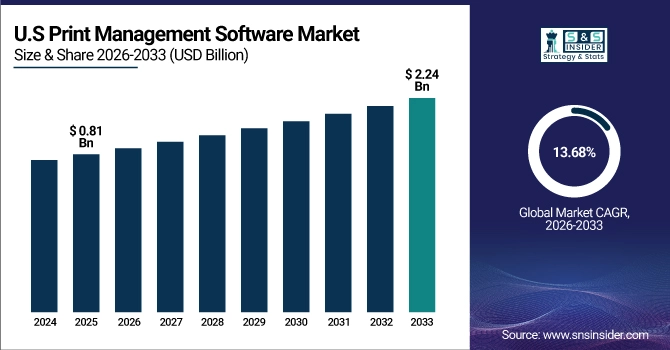
U.S. Print Management Software Market is valued at USD 0.81 billion in 2025E and is expected to reach USD 2.24 billion by 2033, growing at a CAGR of 13.68% from 2026-2033.
The U.S. print management software market is growing due to rising focus on reducing printing costs, enhancing document security, and improving operational efficiency. Increased adoption of cloud-based solutions, hybrid work models, sustainability initiatives, and stricter compliance requirements across enterprises are further accelerating market demand.
Print Management Software Market Growth Drivers:
-
Rising need to control printing costs, reduce paper waste, and improve document security is driving adoption of print management software across enterprises globally
Organizations across industries are increasingly focused on optimizing operational expenses and minimizing unnecessary printing costs. Print management software enables enterprises to monitor print usage, enforce print policies, and reduce paper and toner waste. Additionally, rising concerns around document security and data leakage are encouraging adoption, as these solutions provide user authentication, secure print release, and audit trails. Sustainability initiatives and corporate environmental goals further strengthen demand. As enterprises seek cost efficiency, compliance, and security, print management software becomes a critical tool for controlling print environments and supporting digital transformation strategies.
71% of global enterprises adopted print management software cutting printing costs by 33%, reducing paper waste by 30%, and strengthening document security through policy enforcement and audit controls.
-
Increasing digitization, remote working trends, and demand for centralized print monitoring are accelerating deployment of print management solutions in organizations
The shift toward digital workplaces and hybrid work models has increased the complexity of managing distributed printing environments. Organizations require centralized visibility and control over print activities across multiple locations and remote users. Print management software supports centralized monitoring, reporting, and policy enforcement, improving operational efficiency. As remote work becomes a long-term strategy, enterprises are investing in solutions that integrate with cloud platforms and digital workflows. This growing reliance on digitization and flexible work environments continues to drive demand for scalable and centralized print management systems globally.
73% of organizations deployed print management solutions driven by remote work and digitization to enable centralized monitoring, reduce waste by 28%, and cut printing costs across distributed teams.
Print Management Software Market Restraints:
-
High initial implementation costs, integration complexity, and resistance to change limit adoption of print management software among small and budget-constrained enterprises
Despite long-term cost savings, print management software often requires upfront investments in licensing, infrastructure upgrades, and system integration. Small and medium-sized enterprises may lack the financial resources or technical expertise to implement these solutions effectively. Additionally, resistance from employees accustomed to traditional printing practices can slow adoption. Integration challenges with existing IT systems and legacy printers further complicate deployment. These barriers discourage budget-sensitive organizations from adopting print management software, limiting market penetration among smaller enterprises and slowing overall adoption in cost-conscious environments.
67% of small and budget-constrained enterprises avoided print management software due to high upfront costs (USD30K), complex integration, and organizational resistance to workflow changes.
-
Concerns over data privacy, network security risks, and compatibility issues with legacy printing infrastructure hinder broader market penetration
Print management systems handle sensitive organizational data, raising concerns about data privacy and cybersecurity. Organizations worry about potential vulnerabilities, unauthorized access, or breaches within network-connected printing environments. Compatibility issues with older printers and legacy IT infrastructure also present challenges, requiring additional upgrades or replacements. These concerns increase implementation complexity and cost, particularly for large enterprises with diverse print environments. As a result, security apprehensions and infrastructure limitations can delay purchasing decisions and restrict broader adoption of print management software solutions.
In 2025, 62% of organizations delayed cloud print adoption due to data security concerns, compatibility gaps with legacy systems, and risks of unauthorized network access slowing market penetration despite cost benefits.
Print Management Software Market Opportunities:
-
Growing adoption of cloud-based and SaaS print management solutions offers scalability, cost efficiency, and easier deployment for organizations of all sizes
Cloud-based and SaaS print management solutions are gaining traction due to their flexibility, lower upfront costs, and ease of deployment. These solutions eliminate the need for extensive on-premises infrastructure and enable centralized management across multiple locations. Organizations benefit from subscription-based pricing, automatic updates, and seamless scalability as printing needs evolve. Small and medium-sized enterprises, in particular, find cloud solutions attractive due to reduced IT burden. As cloud adoption accelerates globally, SaaS-based print management presents significant growth opportunities across diverse industry verticals.
70% of organizations shifted to cloud-based print management achieving 35% lower operational costs, rapid deployment, and scalable printing infrastructure via SaaS platforms.
-
Integration of AI, analytics, and sustainability tracking enables advanced print optimization, compliance reporting, and eco-friendly printing initiatives, expanding market growth opportunities
Advanced technologies such as artificial intelligence and analytics are enhancing the capabilities of print management software. These tools provide insights into printing behavior, predict usage patterns, and identify opportunities for cost and resource optimization. Sustainability tracking features help organizations monitor carbon footprints, reduce paper consumption, and meet environmental compliance requirements. Integration with enterprise systems supports automated reporting and policy enforcement. As businesses increasingly prioritize data-driven decision-making and sustainability goals, AI-enabled print management solutions offer strong opportunities for innovation, differentiation, and long-term market growth.
65% of enterprises adopted AI-driven print management platforms reducing paper waste by 30%, automating sustainability compliance reporting, and cutting printing costs by up to 40% through intelligent analytics and eco-optimization.
Print Management Software Market Segment Analysis
-
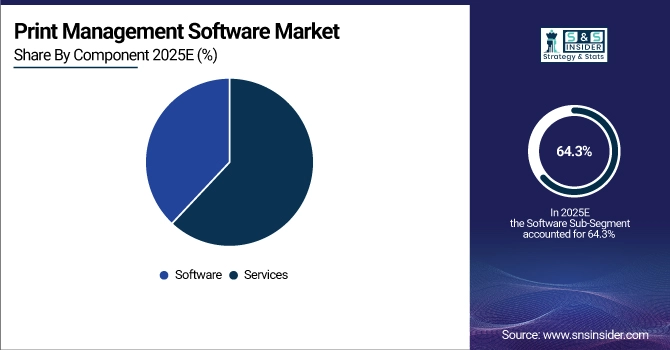
By Component: Software led with 64.3% share, while Services is the fastest-growing segment with CAGR of 17.4%.
-
By Deployment Mode: On-Premises led with 46.8% share, while Cloud-Based is the fastest-growing segment with CAGR of 18.6%.
-
By Solution Type: Print Tracking & Reporting led with 28.5% share, while Workflow Automation is the fastest-growing segment with CAGR of 19.2%.
-
By End User: Enterprises led with 41.7% share, while Small & Medium Enterprises (SMEs) are the fastest-growing segment with CAGR of 17.9%.
By Component: Software led, while Services is the fastest-growing segment
Software dominates the print management software market as it forms the core platform enabling print monitoring, cost allocation, security enforcement, and policy management. Large enterprises and public sector organizations rely heavily on software solutions to reduce printing costs, improve visibility, and ensure compliance. High scalability, integration with existing IT infrastructure, and continuous feature upgrades further strengthen adoption. Growing focus on sustainability, data security, and analytics-driven decision-making keeps software solutions central to print optimization strategies across multiple industry verticals.
Services are the fastest-growing component as organizations increasingly seek professional support for implementation, customization, integration, and ongoing management of print environments. Managed print services help reduce IT workload, improve uptime, and optimize device fleets. Rising adoption among SMEs and hybrid workplaces is driving demand for consulting, cloud migration, and support services. The growing complexity of print security, compliance requirements, and multi-vendor environments further accelerates reliance on service providers for end-to-end print management solutions.
By Deployment Mode: On-Premises led, while Cloud-Based is the fastest-growing segment
On-premises deployment dominates due to strong adoption by large enterprises and government organizations prioritizing data control, security, and regulatory compliance. These deployments offer full ownership of print infrastructure, customization flexibility, and seamless integration with internal systems. Industries handling sensitive documents, such as finance, healthcare, and public administration, prefer on-premises solutions to mitigate cybersecurity risks. Long-standing legacy systems and existing IT investments continue to support the dominance of on-premises print management deployments globally.
Cloud-based deployment is the fastest-growing segment driven by digital transformation, remote work adoption, and demand for scalable, cost-efficient solutions. Cloud platforms offer easy deployment, centralized monitoring, automatic updates, and lower upfront investment. SMEs and distributed enterprises increasingly prefer cloud-based print management to support hybrid workforces and multi-location operations. Enhanced cloud security, subscription pricing models, and seamless integration with SaaS ecosystems are accelerating adoption, particularly in fast-growing Asian and emerging markets.
By Solution Type: Print Tracking & Reporting led, while Workflow Automation is the fastest-growing segment
Print Tracking & Reporting dominates the solution segment as organizations prioritize visibility into printing behavior, device usage, and cost allocation. These solutions help enterprises identify inefficiencies, enforce printing policies, and support sustainability initiatives by reducing waste. High demand from cost-conscious enterprises and educational institutions supports widespread adoption. Detailed analytics, user-level reporting, and compliance auditing make print tracking tools a foundational component of print management strategies across sectors.
Workflow Automation is the fastest-growing solution type as organizations seek to digitize document-intensive processes and reduce manual intervention. Automation streamlines document routing, approvals, scanning, and archiving, improving productivity and operational efficiency. Growing integration with enterprise content management, ERP, and cloud collaboration platforms is boosting demand. As businesses transition toward paperless operations and digital workflows, workflow automation solutions are becoming a critical growth driver within print management ecosystems.
By End User: Enterprises led, while Small & Medium Enterprises are the fastest-growing segment
Enterprises dominate the market due to large print volumes, complex document workflows, and strong focus on cost control and security. Large organizations require advanced print governance, analytics, and centralized management across multiple locations. Their ability to invest in comprehensive software platforms and managed services reinforces market leadership. Compliance requirements, sustainability goals, and digital transformation initiatives further drive adoption of print management solutions among enterprise users worldwide.
Small & Medium Enterprises are the fastest-growing end-user segment as awareness of print cost optimization and security risks increases. Cloud-based and subscription-driven solutions have lowered entry barriers, enabling SMEs to adopt advanced print management tools without high capital investment. Growth is supported by expanding digitalization, remote work adoption, and the need for scalable document management. As SMEs focus on efficiency and cost reduction, demand for flexible print management solutions continues to rise rapidly.
Print Management Software Market Regional Analysis
North America Print Management Software Market Insights
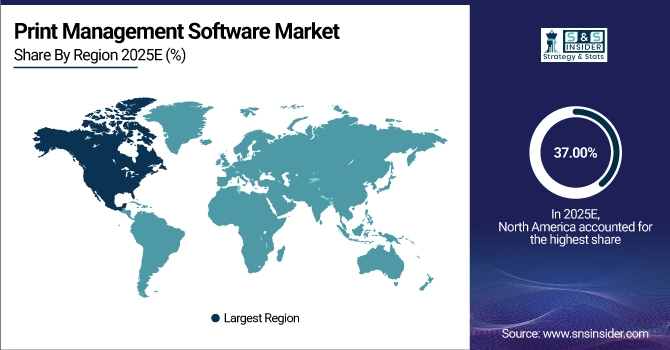
North America dominated the Print Management Software Market with a 37.00% share in 2025 due to early adoption of digital workplace solutions, high penetration of enterprise IT infrastructure, and strong presence of leading software vendors. Widespread focus on cost optimization, document security, and compliance requirements across large enterprises further reinforced regional market leadership.
Get Customized Report as per Your Business Requirement - Enquiry Now
Asia Pacific Print Management Software Market Insights
Asia Pacific is expected to grow at the fastest CAGR of about 16.02% from 2026–2033, driven by rapid digitalization of enterprises, expanding SME adoption, and increasing demand for cloud-based print management solutions. Rising awareness of print cost control, growing office automation, and accelerating IT investments across emerging economies support strong regional growth.
Europe Print Management Software Market Insights
Europe held a significant share in the Print Management Software Market in 2025, supported by strong adoption of digital document management, stringent data protection regulations such as GDPR, and widespread use of secure printing solutions across enterprises. Increasing focus on sustainability, print optimization, and cost control further strengthened Europe’s market position.
Middle East & Africa and Latin America Print Management Software Market Insights
The Middle East & Africa and Latin America together showed steady growth in the Print Management Software Market in 2025, driven by expanding enterprise digitalization, rising adoption of cloud-based IT solutions, and growing awareness of print cost management. Improving IT infrastructure, increasing SME participation, and gradual modernization of office environments supported regional market expansion.
Print Management Software Market Competitive Landscape:
PaperCut Software
PaperCut Software is a leading provider of print management solutions, widely used by enterprises, educational institutions, and public-sector organizations. The company specializes in secure printing, print cost control, and user authentication, helping organizations reduce waste and improve efficiency. PaperCut’s software supports multiple printer brands and integrates easily with existing IT environments. Its strong focus on sustainability, ease of deployment, and centralized print monitoring has contributed to its growing global adoption across diverse industry verticals.
-
April 2024, PaperCut launched PaperCut Hive, a fully cloud-managed print platform designed for distributed workforces and multi-vendor printer fleets.
HP Inc.
HP Inc. is a global technology leader offering comprehensive print management software alongside its extensive hardware portfolio. The company provides solutions that enhance print security, device management, and workflow automation for enterprises of all sizes. HP’s print management offerings integrate cloud-based services, analytics, and advanced security features to reduce operational costs and improve productivity. With a strong global presence and continuous innovation, HP Inc. plays a significant role in shaping modern managed print environments.
-
January 2025, HP enhanced its HP Print Control software (part of HP Wolf Security for Print) with AI-driven sustainability and cost optimization.
Xerox Corporation
Xerox Corporation is a well-established global provider of print and document management solutions, serving commercial, enterprise, and government customers worldwide. The company’s print management software focuses on workflow automation, secure printing, and intelligent document handling. Xerox leverages advanced analytics, cloud capabilities, and artificial intelligence to optimize print operations and reduce costs. Its strong emphasis on digital transformation and managed print services has positioned Xerox as a key player in the global print management software market.
-
November 2023, Xerox integrated advanced print management into its DocuShare content platform, launching DocuShare Print Manager with ESG (Environmental, Social, Governance) reporting.
Print Management Software Market Key Players
-
HP Inc.
-
Xerox Corporation
-
Ricoh Company Ltd.
-
Canon Inc.
-
Konica Minolta Inc.
-
Epson Corporation
-
Kyocera Document Solutions
-
Toshiba Tec Corporation
-
PrinterLogic
-
Y Soft Corporation
-
LRS Output Management
-
Kofax Inc.
-
uniFLOW (NT-ware)
-
Pharos Systems International
-
Equitrac (Nuvia)
-
Printix
-
MyQ Solution
-
FMAudit
| Report Attributes | Details |
|---|---|
| Market Size in 2025E | USD 2.73 Billion |
| Market Size by 2033 | USD 7.72 Billion |
| CAGR | CAGR of 13.97% From 2026 to 2033 |
| Base Year | 2025 |
| Forecast Period | 2026-2033 |
| Historical Data | 2022-2024 |
| Report Scope & Coverage | Market Size, Segments Analysis, Competitive Landscape, Regional Analysis, DROC & SWOT Analysis, Forecast Outlook |
| Key Segments | • By Component (Software, Services) • By Deployment Mode (Cloud-Based, On-Premises, Hybrid) • By Solution Type (Print Tracking & Reporting, Cost Control & Accounting, Device Management, Secure Printing, Workflow Automation) • By End User (Enterprises, Small & Medium Enterprises (SMEs), Educational Institutions, Healthcare Organizations, Government & Public Sector) |
| Regional Analysis/Coverage | North America (US, Canada), Europe (Germany, UK, France, Italy, Spain, Russia, Poland, Rest of Europe), Asia Pacific (China, India, Japan, South Korea, Australia, ASEAN Countries, Rest of Asia Pacific), Middle East & Africa (UAE, Saudi Arabia, Qatar, South Africa, Rest of Middle East & Africa), Latin America (Brazil, Argentina, Mexico, Colombia, Rest of Latin America). |
| Company Profiles | PaperCut Software, HP Inc., Xerox Corporation, Ricoh Company Ltd., Canon Inc., Konica Minolta Inc., Epson Corporation, Kyocera Document Solutions, Lexmark International, Toshiba Tec Corporation, PrinterLogic, Y Soft Corporation, LRS Output Management, Kofax Inc., uniFLOW (NT-ware), Pharos Systems International, Equitrac (Nuvia), Printix, MyQ Solution, FMAudit |

Frequently Asked Questions
The Print Management Software Market is expected to grow at a CAGR of 13.97% from 2026 to 2033, driven by cost control, security, and digital workplace adoption.
In 2025, the Print Management Software Market is valued at USD 2.73 billion, supported by enterprise demand for secure printing, workflow optimization, and sustainability initiatives.
Rising need to reduce printing costs, enhance document security, support hybrid work environments, and meet sustainability goals is the primary growth driver.
Software component, On-Premises deployment, Print Tracking & Reporting solutions, and Enterprises end-user segment dominated the Print Management Software Market during the forecast period.
North America dominated the Print Management Software Market in 2025 with a 37.00% share, driven by advanced IT infrastructure and early digital workplace adoption.
