
Probiotic Supplements Market Report Scope & Overview:
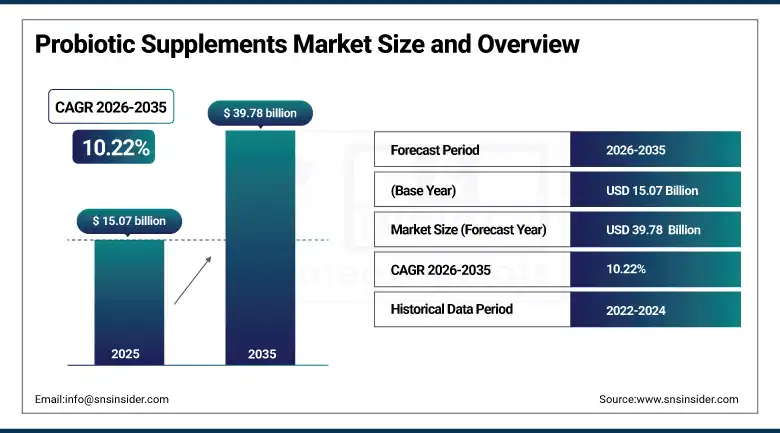
The probiotic supplements market was valued at USD 15.07 billion in 2025 and is expected to reach USD 39.78 billion by 2035, growing at a CAGR of 10.22% from 2026–2035.
The global probiotic supplements market is witnessing a sustained and broad-based expansion, driven by the convergence of heightened consumer awareness of gut microbiome science, the mainstream adoption of preventive healthcare behaviors following the COVID-19 pandemic, and the extraordinary proliferation of product formats and strain-specific formulations that are making probiotic supplementation accessible to consumer segments that previously had neither the awareness nor the product choice to engage with the category meaningfully. Scientific research into the gut-brain axis, the immunological functions of the intestinal microbiome, and the systemic health implications of dysbiosis is continuously expanding the body of evidence that positions probiotic supplementation as a credible, evidence-based health intervention rather than a legacy health-food trend, providing media, healthcare practitioners, and functional nutrition brands with a robust clinical communication platform from which to drive consumer consideration and adoption. The market’s growth is simultaneously being supported by the rapid expansion of direct-to-consumer digital health commerce, where subscription-based probiotic supplement brands, personalized microbiome testing services that recommend probiotic regimens based on individual stool analysis, and influencer-driven health and wellness content are collectively creating a digital demand generation ecosystem of unprecedented reach and personalization capability.
The September 2025 launch by Chr. Hansen of a transparency platform enabling consumers to verify strain origin, CFU count, and clinical backing through QR code scanning on packaging exemplifies the direction in which leading probiotic supplement companies are investing to build consumer trust and premium brand positioning in a market where ingredient quality validation is becoming a critical competitive differentiator as consumer sophistication and regulatory scrutiny of probiotic health claims continue to intensify simultaneously.
To Get more information On Probiotic Supplements Market - Request Free Sample Report
Probiotic Supplements Market Trends
-
Growing scientific validation of the gut-brain axis driving demand for probiotic formulations marketed for stress relief, sleep quality improvement, and cognitive performance support.
-
Accelerating adoption of personalised probiotic supplementation programmes enabled by direct-to-consumer microbiome testing kits that analyse stool samples to characterise individual gut microbiome composition and generate strain-specific supplementation recommendations, creating a recurring revenue model.
-
Rising consumer preference for shelf-stable, refrigeration-free probiotic supplement formats enabled by advanced microencapsulation technology and spore-forming bacterial strain selection, reducing the cold-chain logistics complexity.
-
Expanding male demographic adoption of probiotic supplements driven by content marketing targeting men’s health concerns including gut motility, athletic recovery, cardiovascular risk management, and immune resilience, progressively eroding the category’s historical orientation toward female consumers and broadening the addressable market for gender-specific probiotic formulation innovation.
-
Growing integration of probiotic strains into functional food and beverage products including fermented plant-based yoghurts, probiotic-fortified sports nutrition products, and gut health functional beverages whose convenient consumption format and familiar food positioning attract the significant consumer segment.
The U.S. Probiotic Supplements Market Outlook
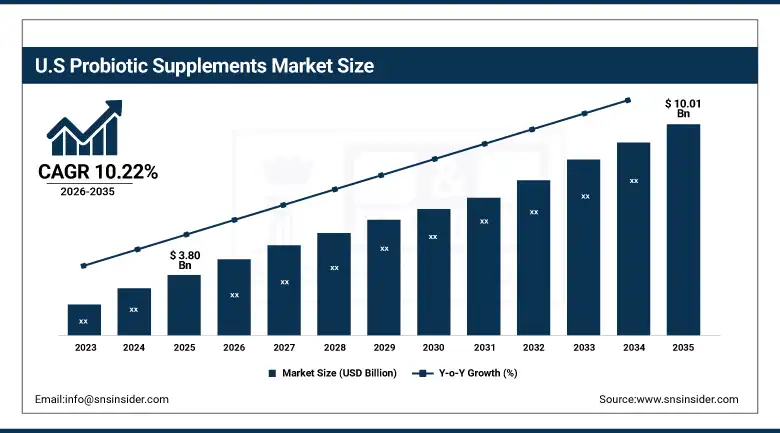
The U.S. probiotic supplements market was valued at approximately USD 3.80 billion in 2025 and is expected to reach approximately USD 10.01 billion by 2035, growing at a CAGR of 10.22% from 2026–2035.
The United States probiotic supplements market benefits from a uniquely favourable combination of high consumer health awareness, strong functional nutrition retail infrastructure, and a regulatory environment that, while not permitting specific disease treatment claims, allows substantiated structure and function claims that enable meaningful consumer health communication for well-characterised probiotic strains with clinical evidence backing. The pharmacy and drug store channel remains the dominant probiotic retail touchpoint for the mainstream U.S. consumer, with CVS, Walgreens, and Rite Aid devoting progressively expanding shelf space to probiotic supplement brands across capsule, gummy, and liquid formats that reflect the category’s transition from specialty health store product to mainstream pharmacy staple whose daily use consumers can access conveniently alongside their other routine health purchases. The direct-to-consumer digital commerce channel is the fastest-growing distribution pathway in the U.S. market, driven by subscription-based probiotic brands whose personalisation narratives, clinical evidence communication, and convenient home delivery models are converting health-motivated consumers away from retailer-mediated purchasing toward direct brand relationships that deliver superior lifetime customer value and data-enriched consumer insight.
Nature Made’s March 2025 expansion of its digestive health product line with new probiotic, prebiotic, and fibre formulations targeting daily gut support reflects the strategic priority that major U.S. supplement brands are placing on the probiotic category, as the clinical convergence of gut health with immune function, mental wellness, and metabolic health is creating a broadening consumer communication platform that extends probiotic supplement relevance across a growing proportion of the health supplement purchasing population.
Probiotic Supplements Market Segment Analysis
-
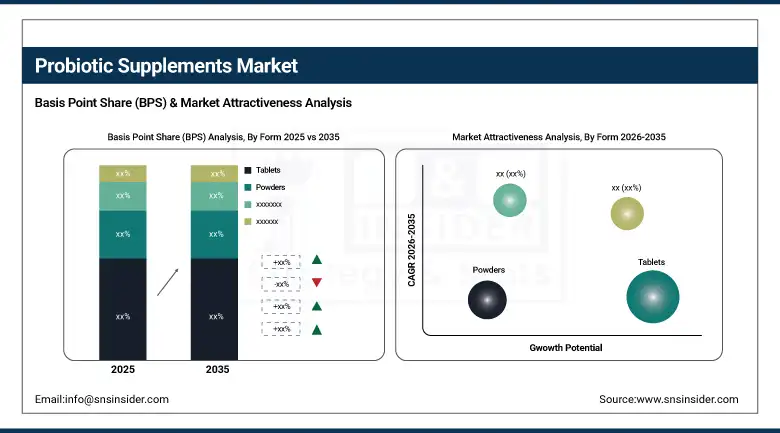
By form, tablets dominated the probiotic supplements market with the largest share in 2025; gummies are the fastest-growing form at a CAGR of approximately 12.50% through 2035.
-
By strain type, Lactobacillus dominated the probiotic supplements market with approximately 37% share in 2025; combined multi-strain formulations are the fastest-growing segment.
-
By application, digestive health dominated the probiotic supplements market with approximately 44% share in 2025; immune support is the fastest-growing application segment through 2035.
-
By end user, the unisex segment dominated the probiotic supplements market with approximately 61% share in 2025; the women’s segment is the fastest-growing end user category.
-
By distribution channel, pharmacies held the dominant share in 2025; online retail is the fastest-growing distribution channel at a CAGR of approximately 13.20% through 2035.
By form, tablets dominate, gummies grow fastest
Capsules and tablets retained their dominant position across the probiotic supplements market in 2025, anchored by their long-established status as the standard format for dietary supplement consumption across the North American, European, and Australian markets that collectively define the category’s largest consumption pools. The capsule and tablet format’s commercial advantages in probiotic supplementation include precision dosing of bacterial colony-forming units that consumers and clinicians can compare directly with clinical trial protocols, the ability to combine protective enteric coating or delayed-release capsule technology that shields probiotic organisms from stomach acid exposure during transit to the intestinal sites where they exert their effect, and the shelf stability that properly manufactured capsule formulations provide across standard retail storage conditions without cold chain logistics requirements when appropriate strain selection and microencapsulation technology are applied.
Gummies are the fastest-growing form segment at approximately 12.50% CAGR through 2035, propelled by the wider supplement industry’s gummy transformation that has demonstrated across multiple vitamin and mineral categories that the palatable, chewy, enjoyable format consistently drives higher consumer compliance, repeat purchase rates, and recommendation willingness relative to tablets and capsules whose consumption routine many consumers find insufficiently pleasant to maintain consistently across long supplementation periods.
By strain type, lactobacillus dominates, combined strains grow fastest
Lactobacillus retained the dominant strain position with approximately 37% of the probiotic supplements market in 2025, a leadership grounded in the most extensive and long-established body of clinical evidence supporting any probiotic genus, spanning landmark randomised controlled trials across irritable bowel syndrome, antibiotic-associated diarrhoea, traveller’s diarrhoea, vaginal microbiome health, and infant colic management that collectively provide the clinical substantiation foundation on which both consumer-facing health communication and healthcare practitioner recommendation rest with confidence.
Combined multi-strain formulations are the fastest-growing segment as the clinical evidence community progressively demonstrates that the cooperative activity of complementary Lactobacillus and Bifidobacterium strains occupying different ecological niches across the gastrointestinal tract provides broader coverage and more robust microbiome support than any single-strain intervention, translating a scientific rationale into consumer-facing ‘comprehensive microbiome support’ positioning that commands premium price points.
By application, digestive health dominates, immune support grows fastest
Digestive health retained the dominant application position with approximately 44% of the probiotic supplements market in 2025, reflecting the category’s foundational commercial positioning around gut function improvement that has built the broadest consumer awareness and the most accessible clinical communication narrative of any probiotic application area. The digestive health application’s enduring relevance across all age demographics, geographic markets, and distribution channels makes it the bedrock of the global probiotic supplement market whose volume and revenue scale provides the commercial foundation on which the entire product category has been built.
Immune support is the fastest-growing application driven by the COVID-19 pandemic’s permanent elevation of immune health as a mainstream consumer wellness priority and the growing scientific communication around the gut immune axis that positions microbiome-targeted probiotic supplementation as a direct immune resilience investment supported by increasingly credible clinical evidence from academic and industry-funded research programmes.
Regional analysis
|
Region |
Major Country |
Share within Region, 2025 (%) |
|---|---|---|
|
North America |
United States |
87.4% |
|
Europe |
Germany |
22.3% |
|
Asia Pacific |
China |
61.7% |
|
Middle East & Africa |
Saudi Arabia |
38.4% |
|
Latin America |
Brazil |
44.2% |
North America Probiotic Supplements Market Insights
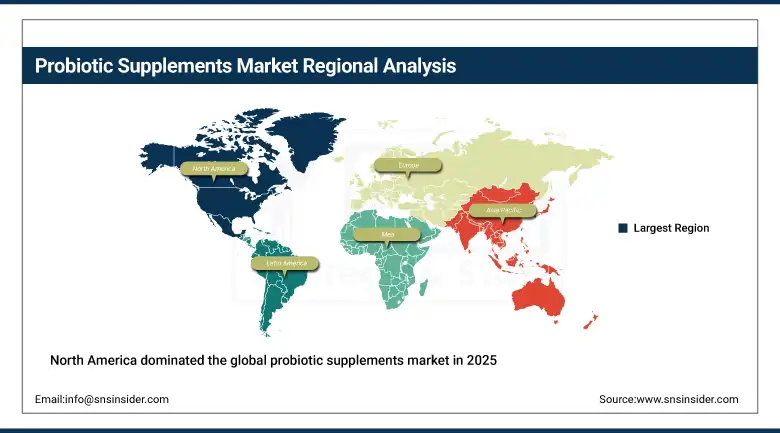
North America dominated the global probiotic supplements market in 2025 with the United States accounting for approximately 87.4% of North American revenues, reflecting the country’s deep consumer health supplement purchasing culture, well-developed functional nutrition retail infrastructure spanning natural food specialists through mainstream pharmacy chains, and the world’s most commercially sophisticated probiotic brand ecosystem whose investment in clinical research, consumer education, and product innovation drives category growth at rates that consistently exceed global averages. Canada contributes approximately 12.6% of North American probiotic supplement revenues through a health-conscious urban consumer base and a natural health products regulatory framework that provides an accessible pathway for clinically substantiated probiotic health claims that supports premium product positioning across the country’s natural and specialty food retail channels.
Get Customized Report as per Your Business Requirement - Enquiry Now
Europe Probiotic Supplements Market Insights
Europe is a sophisticated probiotic supplement market where the European Food Safety Authority’s rigorous health claim substantiation requirements have created a demanding regulatory environment that rewards probiotic companies with robust clinical evidence portfolios while limiting the communication flexibility of less well-documented product ranges. Germany accounts for approximately 22.3% of European probiotic supplement revenues as the region’s largest national market, with a health-conscious consumer population, strong pharmacy channel probiotic distribution, and a culture of supplement quality prioritization that supports premium pricing for clinically substantiated products from established supplement and pharmaceutical brands. The European market is also notable for its strong fermented food culture across German, Dutch, Scandinavian, and Eastern European markets whose traditional consumption of probiotic-rich foods including yoghurt, kefir, sauerkraut, and kimchi creates a high baseline microbiome health awareness that translates into strong receptivity to probiotic supplement communication.
Asia Pacific Probiotic Supplements Market Insights
Asia Pacific is the fastest-growing regional probiotic supplements market, driven by the extraordinary growth of health supplement consumption across China’s expanding middle class, Japan’s longstanding gut health supplement culture that is one of the world’s most mature, South Korea’s dynamic functional food and supplement innovation ecosystem, and the rapidly developing probiotic markets in India, Indonesia, Vietnam, and Thailand whose rising incomes, growing health awareness, and expanding pharmacy and e-commerce distribution infrastructure are creating the conditions for sustained high-growth probiotic supplement market development. China accounts for approximately 61.7% of Asia Pacific probiotic supplement revenues and represents one of the most consequential growth opportunities in global health supplements, as the country’s combination of massive consumer population, rapidly improving health literacy, government encouragement of preventive health investment, and fast-growing e-commerce health supplement distribution infrastructure creates a probiotic market development trajectory whose absolute scale and growth rate command the strategic attention of every major global probiotic supplement manufacturer.
Latin America and MEA Probiotic Supplements Market Insights
Latin America and the Middle East and Africa are growing probiotic supplement markets where rising urbanization, expanding middle-class disposable income for health investment, and growing pharmacy and digital commerce supplement distribution infrastructure are creating commercially meaningful probiotic supplement demand pools beyond the major developed market consumption centers. Brazil accounts for approximately 44.2% of Latin American probiotic supplement revenues through a large health supplement retail infrastructure in major cities, a growing health-conscious professional consumer demographic, and strong pharmacy channel supplement distribution that is progressively expanding probiotic product accessibility beyond the specialty natural food retail channel that historically served the category’s early adopters.
Saudi Arabia leads Middle East and Africa probiotic supplement revenues at approximately 38.4% of the regional total, driven by Vision 2030’s health and wellness economy development agenda, high purchasing power among urban Saudi consumers, and growing interest in preventive healthcare investment among the Kingdom’s young, educated population whose health supplement awareness is influenced by international digital health media.
Market dynamics
Growth drivers: Rising consumer awareness of gut microbiome science expanding probiotic supplementation rationale
The primary structural growth drivers for the probiotic supplements market are the democratization of gut microbiome science through mainstream media, digital health content, and clinician communication that is establishing probiotic supplementation as a credible, evidence-based preventive health practice across consumer populations that previously had neither the awareness nor the product accessibility to engage with the category meaningfully. The post-pandemic elevation of immune health as a mainstream consumer wellness priority has created a sustained incremental demand stream for probiotic supplements marketed for immune resilience that extends the category’s commercial rationale well beyond its traditional digestive health positioning and into the far larger immune health supplement category whose consumer base and willingness to pay premium prices for clinically validated products creates significant additional growth opportunity.
Restraints: Probiotic strain viability and shelf stability challenges creating quality consistency complications
A significant restraint on the probiotic supplements market is the technical challenge of maintaining probiotic strain viability through the full manufacturing, distribution, retail, and consumer storage chain, as bacterial organisms’ sensitivity to temperature, moisture, oxygen, and pH creates product quality consistency challenges that require sophisticated microencapsulation technology, appropriate packaging barrier properties, and cold chain or advanced shelf-stable formulation approaches that add cost and complexity to probiotic supplement development and distribution relative to standard dietary supplement categories.
Opportunities: Personalized microbiome testing enabling targeted probiotic recommendation creating premium segment
The personalized microbiome testing opportunity represents the most commercially exciting frontier in the probiotic supplement market, as the combination of increasingly accessible and affordable next-generation sequencing technology for consumer microbiome testing, AI-powered microbiome composition analysis platforms, and a growing database of strain-specific clinical evidence is enabling the development of genuinely individualized probiotic recommendation services that command premium subscription pricing and create powerful consumer engagement and loyalty through the personalization narrative that standardized off-the-shelf probiotic formulations fundamentally cannot replicate.
Recent developments
-
2025: Danone announced a strategic partnership 2025 to develop AI-powered personalized probiotic recommendation technology that analyses individual consumer health data to generate tailored probiotic supplementation guidance, positioning Danone at the frontier of digital health integration within its probiotic product portfolio and reinforcing the brand’s commitment to consumer-centric nutrition innovation.
-
2025: Nestlé launched a new line of probiotic supplements specifically targeting digestive health in September 2025, backed by clinical research conducted through its internal nutrition science research network, extending the company’s science-based probiotic positioning from its established infant nutrition probiotic portfolio into the adult digestive health supplement category.
-
2025: Chr. Hansen launched a consumer-facing transparency platform enabling probiotic supplement purchasers to verify strain origin, colony-forming unit count, and clinical evidence backing through QR code scanning on product packaging, providing a differentiated trust-building consumer communication tool for brands using Chr. Hansen probiotic ingredient strains.
Probiotic Supplements Market key players
-
Nestlé S.A.
-
Danone S.A.
-
Chr. Hansen Holding A/S
-
Kerry Group plc
-
IFF
-
Koninklijke DSM N.V.
-
BioGaia AB
-
Yakult Honsha Co., Ltd.
-
Probi AB
-
ADM
-
VSL Pharmaceuticals Inc.
-
Garden of Life LLC
-
Culturelle
-
Lallemand Inc.
-
Custom Probiotics Inc.
-
Amway Corporation
-
NOW Foods
-
Blackmores Limited
-
Jamieson Wellness Inc.
-
Solgar
Probiotic Supplements Market Report Scope:
| Report Attributes | Details |
|---|---|
| Market Size in 2025 | USD 15.07 billion |
| Market Size by 2035 | USD 39.78 Billion |
| CAGR | CAGR of 10.22% From 2026 to 2035 |
| Base Year | 2025 |
| Forecast Period | 2026-2035 |
| Historical Data | 2022-2024 |
| Report Scope & Coverage | Market Size, Segments Analysis, Competitive Landscape, Regional Analysis, DROC & SWOT Analysis, Forecast Outlook |
| Key Segments | • By Form (Tablets, Powders, Liquids, Gummies, Others) • By Strain Type (Lactobacillus, Bifidobacterium, Saccharomyces, Combined Strains, Others) • By Application (Digestive Health, Immune Support, Women’s Health, Mental Health, Cardiovascular Health, Others) • By End User (Unisex, Women, Men, Children) • By Distribution Channel (Pharmacies, Supermarkets, Online Retail, Others) |
| Regional Analysis/Coverage | North America (US, Canada), Europe (Germany, UK, France, Italy, Spain, Russia, Poland, Rest of Europe), Asia Pacific (China, India, Japan, South Korea, Australia, ASEAN Countries, Rest of Asia Pacific), Middle East & Africa (UAE, Saudi Arabia, Qatar, South Africa, Rest of Middle East & Africa), Latin America (Brazil, Argentina, Mexico, Colombia, Rest of Latin America). |
| Company Profiles | Nestlé S.A., Danone S.A., Chr. Hansen Holding A/S, Kerry Group plc, IFF, Koninklijke DSM N.V., BioGaia AB, Yakult Honsha Co., Ltd., Probi AB, ADM, VSL Pharmaceuticals Inc., Garden of Life LLC, Culturelle, Lallemand Inc., Custom Probiotics Inc., Amway Corporation, NOW Foods, Blackmores Limited, Jamieson Wellness Inc., Solgar |
Frequently Asked Questions
North America dominated the probiotic supplements market in 2025, with the United States as the leading national market within the region.
Capsules and tablets dominated with the largest revenue share in 2025.
: Rising consumer awareness of gut microbiome science expanding probiotic supplementation rationale beyond digestive health and post-pandemic elevation of immune health.
The probiotic supplements market was valued at USD 15.07 billion in 2025.
The probiotic supplements market is expected to grow at a CAGR of 10.22% from 2026 to 2035.
