
Xerostomia Therapeutics Market Report Scope & Overview:
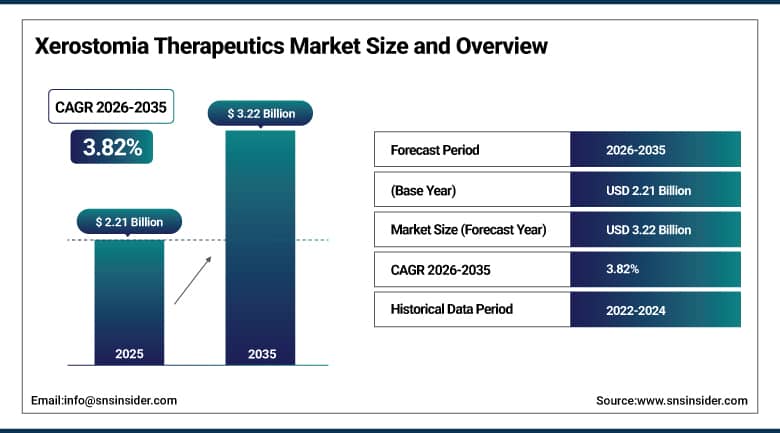
The Xerostomia Therapeutics Market was valued at USD 2.21 Billion in 2025 and is expected to reach USD 3.22 Billion by 2035, growing at a CAGR of 3.82% from 2026–2035.
Dry mouth, otherwise called xerostomia, is caused by decreased saliva flow and often seen in association with old age, adverse effects of medicines, health problems like diabetes and Sjögren’s disease, and cancer therapies like chemotherapy and radiotherapy. As per National Institutes of Health, xerostomia has been diagnosed in 10 percent to 15 percent of the world’s population, thus showing high demand for effective xerostomia treatment options. The market growth is further fueled by increasing number of cancer survivors. The U.S. National Cancer Institute reported 18.1 million cancer survivors in January 2022 with projections of 22.5 million cancer survivors in 2032 along with aging population with polypharmacy induced xerostomia.
The Centers for Disease Control and Prevention notes that over 1,110 medications are known to potentially cause dry mouth, and 50% of all adults in the United States take at least one prescription medication daily. Medication-induced xerostomia accounts for up to 21% of cases in specialized outpatient clinics and over 95% of the dry mouth burden in residential elderly care settings, according to recent clinical investigation.
To Get More Information On Xerostomia Therapeutics Market - Request Free Sample Report
Xerostomia Therapeutics Market Trends
-
Manufacturers are developing advanced saliva substitutes with pH-balanced formulations and bioactive ingredients to better replicate natural salivary function and improve patient comfort.
-
Combination therapies incorporating remineralizing and antibacterial agents are gaining adoption to enhance oral health while reducing complications associated with chronic dry mouth.
-
Rising medication use among aging populations is expanding the prevalence of xerostomia, driving sustained demand for effective therapeutic and supportive care solutions.
-
Increasing awareness of Sjögren's syndrome and other dry mouth-related conditions is supporting earlier diagnosis and improving treatment adoption across healthcare settings.
-
Regenerative medicine, including cell- and gene-based therapies targeting salivary gland restoration, is emerging as a promising long-term treatment approach for xerostomia.
The U.S. Xerostomia Therapeutics Market Outlook
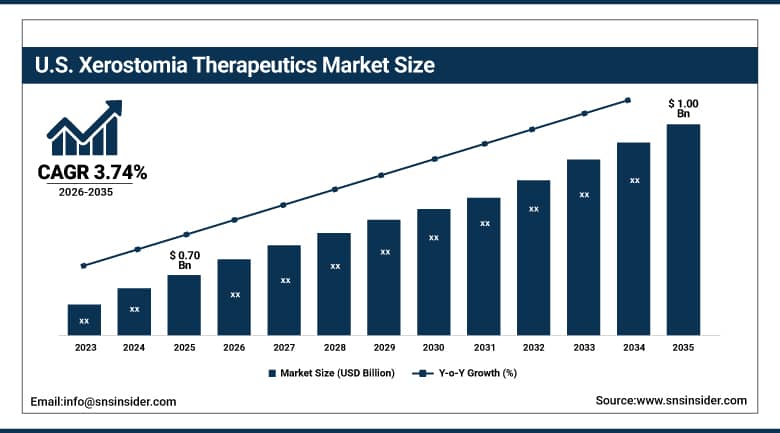
The U.S. Xerostomia Therapeutics Market was valued at approximately USD 0.70 Billion in 2025 and is expected to reach approximately USD 1.00 Billion by 2035, growing at a CAGR of approximately 3.74%.
The U.S. dominates the market of North America xerostomia therapies because of the presence of advanced healthcare services, significant healthcare spending, and large patient base because of high prevalence of chronic diseases and improvement in survival rate of cancer patients. The positive reimbursement policies, along with growing number of patients suffering from chronic disease and oncological xerostomia, further help maintain dominance of the U.S. market, while the initiatives by the government such as CDC’s National Oral Health Program, which spent 23 million USD in 2023 on expanding access to oral care products among poor regions, aid the market.
In December 2024, MeiraGTx Holdings plc received Regenerative Medicine Advanced Therapy designation from the FDA for AAV2-hAQP1, a gene therapy candidate targeting Grade 2/3 radiation-induced xerostomia. The designation reflects growing regulatory recognition of unmet need in radiation-induced dry mouth treatment and is expected to accelerate the candidate's path toward potential approval for patients with limited existing treatment options.
Xerostomia Therapeutics Market Segment Analysis
-
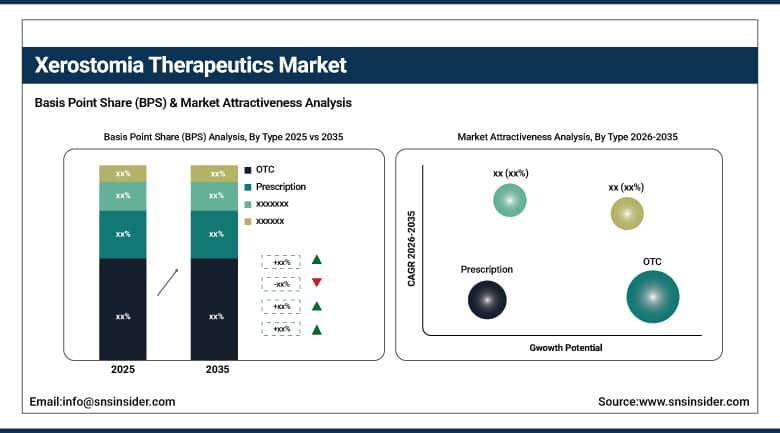
By Type, the OTC segment dominated the xerostomia therapeutics market with a 58% revenue share in 2025, and is expected to maintain strong growth throughout the forecast period.
-
By Product, the salivary stimulants segment dominated the xerostomia therapeutics market with a 36% revenue share in 2025, while the dentifrices segment is expected to register the fastest growth.
-
By Product Form, the mouthwashes / rinses segment dominated the xerostomia therapeutics market with a 34% revenue share in 2025, while the sprays segment is expected to register the fastest growth.
-
By Distribution Channel, the retail pharmacies segment dominated the xerostomia therapeutics market with a 49% revenue share in 2025, while the online pharmacies segment is expected to register the fastest growth.
By Type, OTC treatments dominate the market and grows fastest
The OTC market constituted 58% of the xerostomia therapeutics market in 2025 due to the availability of several over-the-counter products that are easily accessible without requiring a prescription, such as saliva substitutes, mouth moisturizing gels, mouthwashes, lozenges, and chewing gums. The use of drugs for other health conditions like antihypertensive drugs, antidepressants, and anticholinergic drugs increases the prevalence of xerostomia.
Increasing usage of prescription medications by the elderly population only adds fuel to the fire with the CDC stating that almost 85% of the people who are above 60 years old use prescription drugs and about 40% of the people in this age group use more than five different drugs. The recent development in OTC medicines like pH balanced mouthwashes and mucin based gels with composition similar to natural saliva proves beneficial for the category.
By Product, salivary stimulants dominate, dentifrices grow fastest
Salivary stimulants comprised 36% of the market in 2025, the largest product-based share, attributable to the segment's clinical effectiveness and alignment with the needs of a rapidly growing patient population. Sialogogues such as pilocarpine and cevimeline have been recommended to patients who have partial salivary function due to conditions such as Sjögren's syndrome, as well as patients undergoing radiotherapy treatment for head and neck cancer.
The growth rate of dentifrices is projected to be the fastest during the forecast period due to the increasing awareness about oral hygiene, increasing instances of tooth problems linked with xerostomia, and ongoing public health initiatives advocating the use of therapeutic oral care products. From 2020, there has been a 22% increase in oral health problems in Europe due to aging. There have been several public health initiatives to encourage people to use dentifrices that contain moisturizers and antibacterial agents.
Regional Analysis
|
Region |
Major Country |
Share within Region, 2025 (%) |
|---|---|---|
|
North America |
United States |
83.0% |
|
Europe |
Germany |
25.0% |
|
Asia Pacific |
China |
37.0% |
|
Latin America |
Brazil |
36.0% |
|
Middle East & Africa |
Saudi Arabia |
26.0% |
North America Xerostomia Therapeutics Market Insights
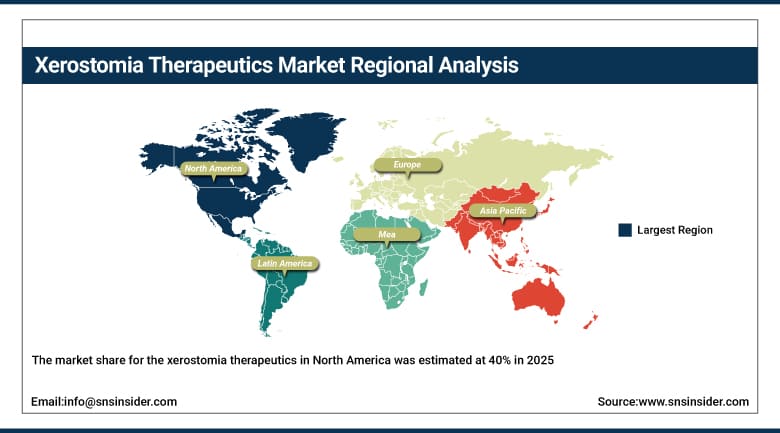
The market share for the xerostomia therapeutics in North America was estimated at 40% in 2025 because of its advanced healthcare system, large spending on healthcare services, and high number of patients because of the presence of many chronic diseases and cancer survivors. Awareness activities through various programs organized by Sjögren's Syndrome Foundation for the diagnosis of xerostomia have been a contributing factor towards the same.
Ongoing innovation, regulatory backing, and integration of novel treatment modalities across both OTC and prescription therapies are expected to help the U.S. market retain its regional leadership. Government initiatives, including the CDC's USD 23 million allocation to the National Oral Health Program in 2023, continue to expand access to dental hygiene products including therapeutic dentifrices among underserved communities.
Get Customized Report as Per Your Business Requirement - Enquiry Now
Europe Xerostomia Therapeutics Market Insights
The Europe region has seen a considerable revenue share of the global xerostomia therapeutic market, as countries like Germany, France, and the UK benefit from an advanced healthcare system, successful public health programs, and higher incidence of xerostomia-related disorders. The recent reforms and emphasis on salivary dysfunction have led to increased use of xerostomia drugs and artificial saliva solutions.
Early diagnosis and use of specialized treatment products have been emphasized in recent government-backed campaigns and revised policy from European health authorities, continuing to encourage regional market development. Germany leads regional demand, supported by strong domestic pharmaceutical manufacturing and healthcare infrastructure.
Asia Pacific Xerostomia Therapeutics Market Insights
The Asia-Pacific region is anticipated to have the highest CAGR of 4.33% during the forecast period, owing to the rise in health care spending, increase in the aging population, and prevalence of chronic diseases such as diabetes and cancer, which lead to dry mouth. China is the biggest country in this region due to large population and increasing awareness regarding dry mouth treatment methods.
The government's focus on bettering the results of oral health is a strong factor driving the market, in addition to the increasing use of radiotherapy and chemotherapy for cancer treatment. The Japanese Ministry of Health observed a 17 percent increase in the prevalence of xerostomia due to polypharmacy in elderly patients and consequently initiated subsidies for therapeutic dentifrices.
MEA & Latin America Xerostomia Therapeutics Market Insights
The Middle East and Africa constitute emerging markets for xerostomia drug development, led by Saudi Arabia due to consistent investments in healthcare infrastructure and increased recognition of oral care management issues. The United Arab Emirates is another region that holds significant potential, owing to increasing pharmaceutical distribution in the country.
Latin America, driven by the growth of Brazil, is moving along the same path of increasing use of xerostomia therapy due to greater access to health care and increasing awareness of chronic diseases management. However, both regions are smaller compared to North America, Europe, and Asia Pacific, yet steady investments into the health care infrastructure should lead to gradual growth of the market.
Market Dynamics
Growth Drivers: Polypharmacy and widespread prescription drug use raise xerostomia incidence
The increasing frequency of xerostomia is closely related to widespread prescription medication use, particularly among older adults who are more likely to be managing multiple chronic conditions simultaneously. The Centers for Disease Control and Prevention estimates that over 1,110 medications are known to potentially cause dry mouth, and 50% of all adults in the United States take at least one prescription medication daily.
Combining medications including anticholinergics, antidepressants, antihypertensives, and antineoplastics produces a synergistic effect that increases both the risk and severity of xerostomia. More than 40% of patients stop the use of anticholinergic drugs used for treatment of overactive bladder due to adverse effects of dry mouth, which affects from 16.9% to 53.7% of such patients. With the growth of elderly population globally, there will be an increased need for treatment of xerostomia, as 20.7% of the Indian population is expected to be aged above 60 years by 2050.
Restraints: Limited treatment effectiveness and side effects constrain broader adoption
Many current xerostomia treatments are associated with unpleasant side effects or provide only temporary relief, factors that can affect patient adherence and treatment satisfaction despite continued formulation advancement. Certain prescription medications intended to boost saliva production can cause side effects including gastrointestinal discomfort, sweating, or cardiovascular consequences, rendering them unsuitable for long-term use in certain patient populations.
Oral products used to treat xerostomia are often unable to mimic the multifaceted nature of saliva and thus can only offer temporary relief of symptoms while the patient continues to experience pain and dental problems. The lack of standard treatment protocols leaves both the doctor and the patient in a state of confusion while making it difficult to adopt current treatment options.
Opportunities: Regenerative medicine and next-generation formulations create growth potential
Advancing regenerative medicine approaches, including gene therapy and cell-based treatments targeting salivary gland function restoration, represent a substantial growth opportunity for the xerostomia therapeutics market. Regulatory recognition of unmet need in this therapeutic area, evidenced by the FDA's Regenerative Medicine Advanced Therapy designation for candidates addressing radiation-induced xerostomia, continues to accelerate development timelines for next-generation treatment approaches.
Further development in formulations, both in OTC and prescription segments, such as pH balanced or mucin based formulations that mimic the natural composition of the saliva, offers great potential to manufacturers able to take advantage of today’s existing gaps in treatments. With the increasing number of survivors around the world and growing awareness about xerostomia management, there is an ever-increasing demand for unique products.
Recent Developments:
-
2023: In October 2023, University of Wisconsin School of Medicine and Public Health researchers advanced a Phase I clinical trial for a regenerative medicine approach using interferon-gamma-primed autologous mesenchymal stromal cells targeting salivary gland restoration in radiation-induced xerostomia patients.
-
2024: In December 2024, MeiraGTx Holdings plc received FDA Regenerative Medicine Advanced Therapy designation for AAV2-hAQP1, a gene therapy candidate targeting Grade 2/3 radiation-induced xerostomia.
-
2025: In April 2025, the Sjögren's Foundation's annual Sjögren's Awareness Month campaign expanded public and healthcare professional education regarding xerostomia diagnosis and treatment options.
Xerostomia Therapeutics Market key players are:
-
Haleon plc
-
Colgate-Palmolive Company
-
Procter & Gamble Co.
-
Johnson & Johnson Services, Inc.
-
Sun Pharmaceutical Industries Ltd.
-
Teva Pharmaceutical Industries Ltd.
-
Hikma Pharmaceuticals PLC
-
Sanofi S.A.
-
Lupin Pharmaceuticals, Inc.
-
Pendopharm
-
OraCoat
-
MeiraGTx Holdings plc
-
Daiichi Sankyo Company, Limited
-
Advanz Pharma
-
K Pharmaceuticals, Inc.
-
Quest Products, LLC
-
Dentaid S.L.
-
Forward Science
-
GlaxoSmithKline plc
-
Church & Dwight Co., Inc.
Xerostomia Therapeutics Market Report Scope:
| Report Attributes | Details |
|---|---|
| Market Size in 2025 | USD 2.21 Billion |
| Market Size by 2035 | USD 3.22 Billion |
| CAGR | CAGR of 3.82% From 2026 to 2035 |
| Base Year | 2025 |
| Forecast Period | 2026-2035 |
| Historical Data | 2022-2024 |
| Report Scope & Coverage | Market Size, Segments Analysis, Competitive Landscape, Regional Analysis, DROC & SWOT Analysis, Forecast Outlook |
| Key Segments | • By Type (OTC, Prescription) • By Product (Salivary Substitutes, Salivary Stimulants, Dentifrices) • By Product Form (Sprays, Gels, Lozenges / Pastilles, Mouthwashes / Rinses, Others) • By Distribution Channel (Retail Pharmacies, Hospital Pharmacies, Online Pharmacies) |
| Regional Analysis/Coverage | North America (US, Canada), Europe (Germany, UK, France, Italy, Spain, Russia, Poland, Rest of Europe), Asia Pacific (China, India, Japan, South Korea, Australia, ASEAN Countries, Rest of Asia Pacific), Middle East & Africa (UAE, Saudi Arabia, Qatar, South Africa, Rest of Middle East & Africa), Latin America (Brazil, Argentina, Mexico, Colombia, Rest of Latin America). |
| Company Profiles | Haleon plc, Colgate-Palmolive Company, Procter & Gamble Co., Johnson & Johnson Services, Inc., Sun Pharmaceutical Industries Ltd., Teva Pharmaceutical Industries Ltd., Hikma Pharmaceuticals PLC, Sanofi S.A., Lupin Pharmaceuticals, Inc., Pendopharm, OraCoat, MeiraGTx Holdings plc, Daiichi Sankyo Company, Limited, Advanz Pharma, K Pharmaceuticals, Inc., Quest Products, LLC, Dentaid S.L., Forward Science, GlaxoSmithKline plc, Church & Dwight Co., Inc. |
Frequently Asked Questions
The Xerostomia Therapeutics Market was valued at USD 2.21 Billion in 2025.
Salivary Stimulants dominated with a 36% revenue share in 2025.
North America dominated the Xerostomia Therapeutics Market in 2025 with a 40% market share.
