
Quantum Computing-as-a-Service (QCaaS) Market Report Scope & Overview:
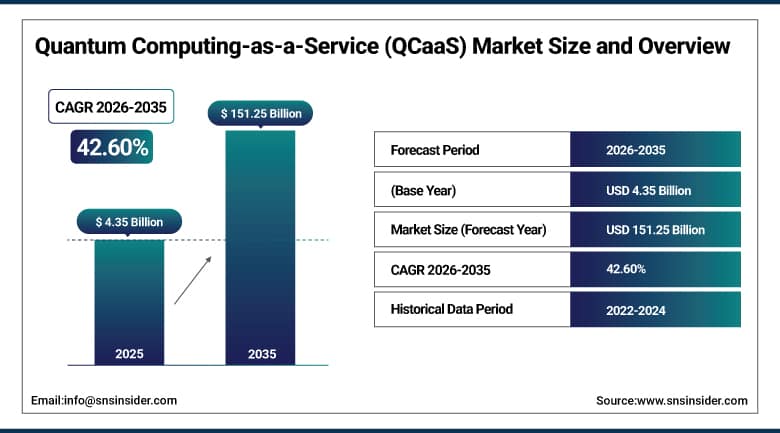
The Quantum Computing-as-a-Service (QCaaS) Market was valued at USD 4.35 Billion in 2025 and is expected to reach USD 151.25 Billion by 2035, growing at a CAGR of 42.60% from 2026 to 2035.
The Quantum Computing-as-a-Service (QCaaS) Market is experiencing rapid growth owing to the rising need for inexpensive quantum computing services without making any major infrastructure investments. Businesses are using QCaaS services to speed up research, optimize computation, and simulate efficiently in the fields of healthcare, finance, manufacturing, and logistics. Innovations in the areas of quantum hardware, cloud computing, and quantum software development have increased accessibility and scalability. Besides, growing government and technology company investment, increased hybrid quantum-classical computing implementation, and expanded usage in drug discovery, cryptography, finance, and optimization are contributing to the high growth of this global market.
Surging enterprise adoption of cloud-based quantum computing drove nearly 40% of global QCaaS deployments in 2025, led by finance, healthcare, and manufacturing applications, according to industry tracking data on live quantum computing deployments across these three leading sectors.
Market Size and Forecast
-
Market Size in 2026E: USD 6.20 Billion
-
Market Size by 2035: USD 151.25 Billion
-
CAGR: 42.60% from 2026 to 2035
-
Fastest Growing Region: Asia Pacific
-
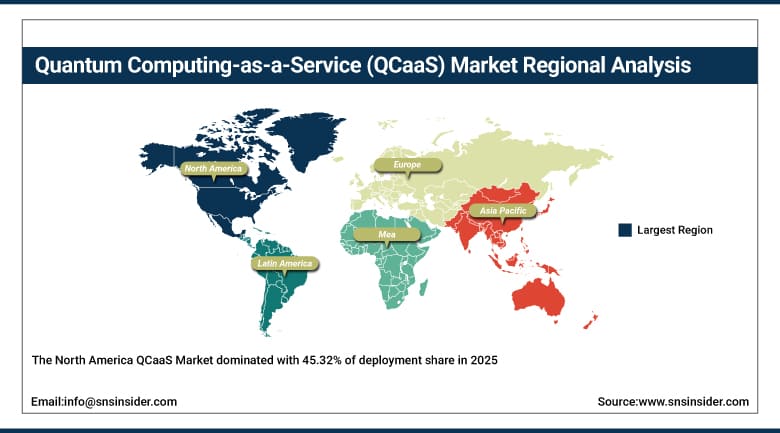
Largest Region: North America
To Get More Information On Quantum Computing-as-a-Service (QCaaS) Market - Request Free Sample Report
Quantum Computing-as-a-Service Market Trends
-
Increasing numbers of enterprises are adopting cloud-based quantum computing, boosting demand for scalable, on-demand QCaaS services.
-
Advanced quantum algorithms are being integrated by companies to address complex optimization, simulation, and cryptography problems.
-
Growing emphasis on R&D in healthcare, finance, and automotive applications is driving application-specific QCaaS solutions.
-
Subscription or per-use pricing models are making quantum computing affordable even for startups, SMEs, and academic institutions.
-
Tech providers, cloud platforms, and academic partners are teaming up to drive innovation and broader ecosystem growth.
U.S. Quantum Computing-as-a-Service Market Outlook
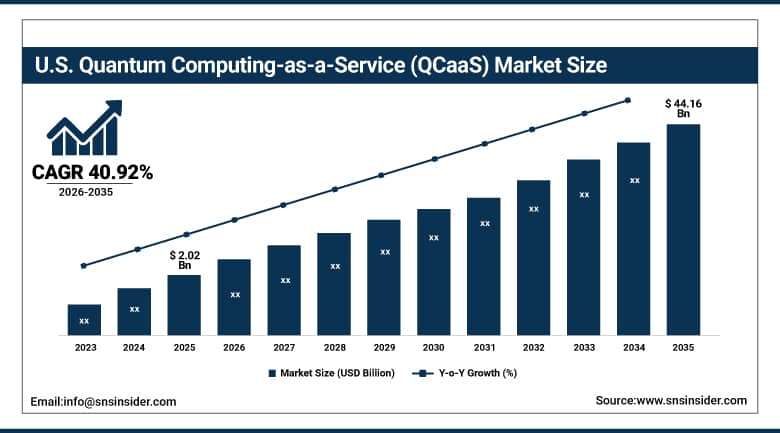
The U.S. QCaaS Market was valued at approximately USD 2.02 Billion in 2026 and is expected to reach approximately USD 44.16 Billion by 2035, growing at a CAGR of approximately 40.92%.
The U.S. market's growth is driven by enterprise adoption, cloud-based deployments, and investments in quantum hardware and software, particularly across IT, finance, and healthcare sectors. American technology companies have led much of the world's foundational quantum hardware and software development, and that head start, combined with deep capital markets willing to fund genuinely long-horizon quantum research, keeps the U.S. positioned as both the largest single national market and the primary innovation hub for QCaaS globally. High complexity and a limited skilled quantum computing workforce remain real challenges, affecting an estimated 35% of potential deployments worldwide, but American firms have generally been better positioned than most to absorb that talent constraint given the concentration of quantum research talent at U.S. universities and national laboratories.
IBM unveiled plans in June 2025 to build the world's first large-scale, fault-tolerant quantum computer at its new data center in Poughkeepsie, New York, a milestone that meaningfully advances the underlying hardware capability U.S. QCaaS providers can eventually offer to enterprise customers over the cloud.
Quantum Computing-as-a-Service Market Segment Analysis
-
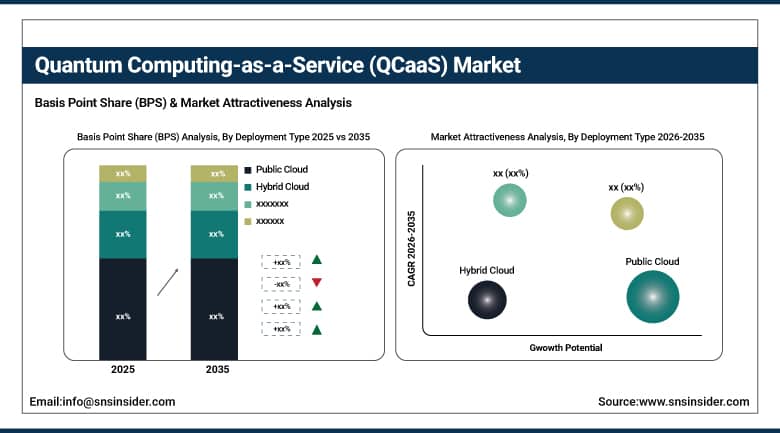
By Deployment Type, Public Cloud segment dominated the Quantum Computing-as-a-Service (QCaaS) Market in 2025 with 52% share; Hybrid Cloud segment is the fastest growing segment.
-
By Service Type, Quantum Hardware Access segment dominated the market in 2025 with 44% share; Quantum Software & Algorithms segment is the fastest growing segment.
-
By End User, IT & Telecom segment dominated the market in 2025 with 27% share; Healthcare & Life Sciences segment is the fastest growing segment.
-
By Industry Application, Optimization segment dominated the market in 2025 with 31% share; Drug Discovery segment is the fastest growing segment.
-
By Pricing Model, Subscription-Based segment dominated the market in 2025 with 58% share; Pay-per-Use segment is the fastest growing segment.
By Deployment Type, Public Cloud Dominates the QCaaS Market While Hybrid Cloud Emerges as the Fastest-Growing Deployment Type
Public Cloud dominates the Quantum Computing-as-a-Service (QCaaS) Market because it offers scalable and on-demand access to quantum computing capabilities without the need for quantum hardware investments by organizations. Public cloud allows users such as researchers, businesses, and software developers to experiment using quantum computing capabilities in a cost-effective manner. Availability, flexible pricing models, ease of integration with the classical cloud environment, and support from major cloud providers have made public cloud the largest deployment model.
Hybrid Cloud is the fastest-growing deployment type owing to increasing use of quantum computing applications by businesses along with the desire to maintain performance, security, and regulatory compliance requirements. In hybrid cloud deployments, sensitive applications and proprietary data stay within the organizational network while quantum computing capabilities of the cloud can be utilized for complex computing tasks.
By Service Type, Quantum Hardware Access Leads the QCaaS Market While Quantum Software & Algorithms Register the Fastest Growth
Quantum Hardware Access dominates the QCaaS Market due to the fact that most companies leverage cloud infrastructure to access quantum computers which are too costly and complicated to be owned and maintained. Through cloud-enabled access to hardware, businesses and educational and research organizations can conduct quantum experiments without having to make any substantial financial investment in the process. The growing accessibility of quantum hardware including superconducting, trapped-ion, and photonic quantum computers has resulted in hardware access becoming the most profitable service segment.
Quantum Software & Algorithms is the fastest-growing service type owing to the rising interest of companies in leveraging quantum computing in solving real-world problems. Increasing demand for software development kits, quantum programming frameworks, algorithms libraries and application development tools has been witnessed by market players. Investments in innovative quantum software and growing experimentation with quantum computers in enterprises have been boosting adoption of software and algorithms services.
By End User, IT & Telecom Dominates the QCaaS Market While Healthcare & Life Sciences Witness the Fastest Growth
IT & Telecom dominates the QCaaS Market because of extensive investments made in advanced computing, cybersecurity, networking, and advanced communications. The technology companies are among the first to adopt cloud quantum computing services for overcoming complex computational issues and innovation. The presence of strong research capacity, huge budgets in technology, and investments in quantum-ready platforms make the IT & telecom industry the largest end user of QCaaS services.
Healthcare & Life Sciences is the fastest-growing end-user segment owing to increasing adoption of quantum computing in the pharmaceutical, biotechnology, and healthcare industry for purposes such as molecular simulation, genomics, precision medicine, and drug development. It is evident that the quantum computing technique is capable of solving highly complicated biological issues in an effective manner compared to traditional computers.
By Industry Application, Optimization Dominates the QCaaS Market While Drug Discovery Emerges as the Fastest-Growing Application
Optimization dominates the QCaaS Market owing to the high commercial viability of optimization problems that are one of the most immediate uses of quantum computing. Firms in logistics, finance, manufacturing, telecommunications, and energy industries employ quantum algorithms for efficient allocation of resources, route optimization, and portfolio optimization. The wide scope of optimization applications in various industries has made it the biggest quantum computing application field.
Drug Discovery is the fastest-growing industry application as pharmaceutical and biotech firms start leveraging the power of quantum computing for faster molecular modeling and protein interaction analysis, and discovery of new drugs. Quantum algorithms hold significant promise in reducing the research period as well as in increasing simulation precision in complex chemical models. Growth in investments in the healthcare sector, increasing partnerships between quantum computing technology vendors and pharmaceutical firms, and demand for precision medicine are the major drivers behind the fast-paced market growth.
By Pricing Model, Subscription-Based Dominates the QCaaS Market While Pay-per-Use Records the Fastest Growth
Subscription-Based dominates the QCaaS Market because it providing access to Quantum Cloud Computing-as-a-Service (QCaaS). The reason for this leadership is due to predictable pricing, constant access to the platform, updating of the software, and scalability of the quantum computing capacity offered under recurring service contracts. The subscription pricing model is preferable for companies and academic and research organizations as an affordable tool for the experimentation and development of applications in quantum computing.
Pay-per-Use is the fastest-growing pricing model as organizations increasingly seek flexible access to quantum computing resources without long-term financial commitments. This model allows users to pay only for actual quantum processing time, making advanced computing more accessible for startups, researchers, and pilot projects. Growing experimentation with quantum applications, increasing demand for cost-efficient computing, and expanding availability of commercial quantum cloud services are accelerating adoption of pay-per-use pricing.
Regional Insights
| Region | Major Country | Share within Region, 2025 (%) |
|---|---|---|
| North America | United States | 82.55% |
| Europe | Germany | 24.35% |
| Asia Pacific | China | 32.60% |
| Middle East & Africa | UAE | 27.85% |
| Latin America | Brazil | 36.05% |
North America Quantum Computing-as-a-Service Market Insights
The North America QCaaS Market dominated with 45.32% of deployment share in 2025, to the adoption of IT & telecom, finance, and healthcare sectors within the region. The development of the market is propelled by increased spending on quantum technology, development of algorithms, hybrid quantum computing ecosystem, and collaborations with universities and research institutes in the United States and Canada, who together represent the highest quantum computing capabilities of the world.
About 82.55% of the regional revenue is contributed by the United States, due to its quantum hardware and software vendors, large amounts of venture capital invested in quantum technology startups, and government investment in quantum computing research. The additional demand for quantum computing in the region comes from Canada, which boasts of an impressive quantum computing research ecosystem and would maintain North America as the biggest market for QCaaS vendors.
Get Customized Report as Per Your Business Requirement - Enquiry Now
Europe Quantum Computing-as-a-Service Market Insights
Europe holds a meaningful share of the global QCaaS market, due to significant funding for quantum research programs backed by governments and quantum computing startups. The European Union has various programs that target quantum technology sovereignty that help finance the growth of quantum computing hardware and cloud infrastructure across the continent.
Germany leads the region in terms of demand generation with an approximate contribution of 24.35% to European revenue due to Germany’s industrial and research strength in quantum technology. The UK and France are major contributors to European demand in the region, and sustained investments in quantum technology sovereignty from Europe will fuel demand generation for QCaaS in the region.
Asia Pacific Quantum Computing-as-a-Service Market Insights
The Asia Pacific QCaaS market is fast-growing, at a CAGR of approximately 46.56% through 2035, due to rising demand in China, Japan, and India due to heavy investment in quantum computing from both governments and firms in these nations. Specifically, China has witnessed remarkable progress in the realm of quantum computing because of heavy investment in research on quantum computing technology which makes China a close contender to Western nations.
The leader in the Asia Pacific QCaaS market is China, which accounts for nearly 32.60% of the revenue generated in the region, owing to significant state-backed investments in quantum technology research. India and Japan add significant revenue too, particularly India with its growing IT sector and quantum research efforts.
MEA & Latin America Quantum Computing-as-a-Service Market Insights
The Middle East & Africa and Latin America remain considerably earlier in their QCaaS adoption curve than North America, Europe, or Asia Pacific, but both regions are seeing steady growth as government-led technology initiatives and university research partnerships continue expanding local access to cloud-based quantum computing resources.
The UAE leads Middle East & Africa demand at roughly 27.85% of regional revenue, supported by the country's ambitious technology diversification strategy and growing investment in advanced computing research. Saudi Arabia and South Africa contribute further regional demand through their own technology modernization programs. In Latin America, Brazil accounts for approximately 36.05% of regional revenue, with growing academic and enterprise interest continuing to anchor regional demand for QCaaS.
Growth Drivers: Rapid quantum hardware progress and rising enterprise interest
The QCaaS market growth is due to rising demand for cloud-based quantum computing across enterprises and research institutions worldwide. Rapid development of quantum processors, growing enterprise interest, and a surge in demand for solving complex problems are promoting market growth, and the annual installation of QCaaS offerings will exceed 2,500 enterprise projects by 2033 as complex problem solving in finance, healthcare, and manufacturing keeps exploiting these technologies at an accelerating pace.
Larger investments in quantum software, algorithms, and hybrid cloud infrastructure, coupled with tech provider-academia collaboration, are driving innovation and growth on a worldwide basis. As quantum hardware capability keeps improving, error rates keep declining, and qubit counts keep climbing, the range of genuinely commercially useful quantum applications keeps expanding, and that steady stream of hardware progress is exactly what's kept enterprise confidence in quantum computing's near-term commercial potential climbing rather than fading after years of largely experimental deployment.
Restraints: Talent shortages and high implementation complexity
High complexity and a limited skilled workforce hinder adoption, restricting growth and deployment of QCaaS solutions globally. Enterprises face genuine difficulty hiring and training staff members who can write quantum algorithms and operate quantum hardware, and the dearth of this kind of talent is especially pronounced in the developing world, where adoption is stifled by the near-total absence of quantum-trained computer scientists.
The challenges in the QCaaS market include high complexity and a lack of talented quantum computing professionals, affecting an estimated 35% of potential deployments worldwide. Slow deployment of world-class QCaaS solutions is further impeded by integration challenges with current IT infrastructure and regulatory compliance requirements, which together help explain why quantum computing adoption, while accelerating quickly at the enterprise research level, remains genuinely uneven when it comes to translating pilot projects into full production deployment.
Opportunities: Drug discovery and financial modeling applications
Opportunities are promising for the adoption of quantum cloud services in drug discovery, financial modeling, and advanced simulations, where classical computing genuinely struggles to model the complexity involved. More than 1,800 enterprise projects will use QCaaS by 2033, evidence of increasing dependence on quantum technology across pharmaceutical, biotech, and financial services organizations willing to invest in genuinely next-generation computational capability.
Growing emphasis on R&D in healthcare, finance, and automotive applications is driving application-specific QCaaS solutions that go well beyond generic quantum access toward purpose-built platforms optimized for particular industry use cases. Vendors that can demonstrate genuine, measurable ROI in these high-value application areas stand to capture meaningful share as quantum computing continues its transition from experimental research tool toward genuine commercial infrastructure.
Recent Developments:
-
2025: IBM unveiled plans to build the world's first large-scale, fault-tolerant quantum computer at its new data center in Poughkeepsie, New York, marking a significant milestone in quantum computing development.
-
2025: AWS Braket launched a 54-qubit superconducting quantum processor named Emerald, providing customers with higher fidelity gates and full square lattice connectivity for advanced quantum computations.
-
2025: Microsoft unveiled Majorana 1, the world's first quantum processor powered by topological qubits, marking a significant advancement in quantum computing technology.
Quantum Computing-as-a-Service (QCaaS) Market Key Players:
-
IBM Quantum
-
Amazon Web Services (AWS) – Braket
-
Microsoft Azure Quantum
-
D-Wave Quantum
-
IonQ
-
Rigetti Computing
-
Honeywell Quantum Solutions
-
Intel Corporation
-
Xanadu
-
PASQAL
-
PsiQuantum
-
Atos SE
-
Multiverse Computing
-
Strangeworks
-
Riverlane
-
Quantum Machines
-
Q-Ctrl
-
Qiskit
Quantum Computing-as-a-Service (QCaaS) Market Report Scope:
| Report Attributes | Details |
|---|---|
| Market Size in 2025 | USD 4.35 Billion |
| Market Size by 2035 | USD 151.25 Billion |
| CAGR | CAGR of 42.60% From 2026 to 2035 |
| Base Year | 2025 |
| Forecast Period | 2026-2035 |
| Historical Data | 2022-2024 |
| Report Scope & Coverage | Market Size, Segments Analysis, Competitive Landscape, Regional Analysis, DROC & SWOT Analysis, Forecast Outlook |
| Key Segments | • By Deployment Type (Public Cloud, Private Cloud, Hybrid Cloud) • By Service Type (Quantum Hardware Access, Quantum Software & Algorithms, Quantum Development Tools) • By End User / Industry (IT & Telecom, BFSI, Healthcare & Life Sciences, Automotive, Government & Defense, Academia & Research) • By Industry Application (Optimization, Simulation & Modeling, Cryptography & Security, Drug Discovery, Financial Modeling, Others) • By Pricing Model (Subscription-Based, Pay-per-Use, Enterprise Licensing) |
| Regional Analysis/Coverage | North America (US, Canada), Europe (Germany, UK, France, Italy, Spain, Russia, Poland, Rest of Europe), Asia Pacific (China, India, Japan, South Korea, Australia, ASEAN Countries, Rest of Asia Pacific), Middle East & Africa (UAE, Saudi Arabia, Qatar, South Africa, Rest of Middle East & Africa), Latin America (Brazil, Argentina, Mexico, Colombia, Rest of Latin America). |
| Company Profiles | IBM Quantum, Amazon Web Services (AWS) – Braket, Microsoft Azure Quantum, Google Quantum AI, D-Wave Quantum, IonQ, Rigetti Computing, Honeywell Quantum Solutions, Intel Corporation, Xanadu, PASQAL, PsiQuantum, Atos SE, QC Ware, Multiverse Computing, Strangeworks, Riverlane, Quantum Machines, Q-Ctrl, Qiskit |
Frequently Asked Questions
The Quantum Computing-as-a-Service Market is expected to grow at a CAGR of 42.60% from 2026 to 2035.
The Quantum Computing-as-a-Service Market was valued at USD 4.35 Billion in 2025.
The major growth factor is rapid development of quantum processors, growing enterprise interest, and rising demand for solving complex problems across finance, healthcare, and manufacturing.
The Public Cloud segment dominated the Quantum Computing-as-a-Service Market in 2025.
North America dominated the Quantum Computing-as-a-Service Market in 2025 with a 45.32% share of deployment revenue.
