
Red Meat Market Report Scope & Overview:
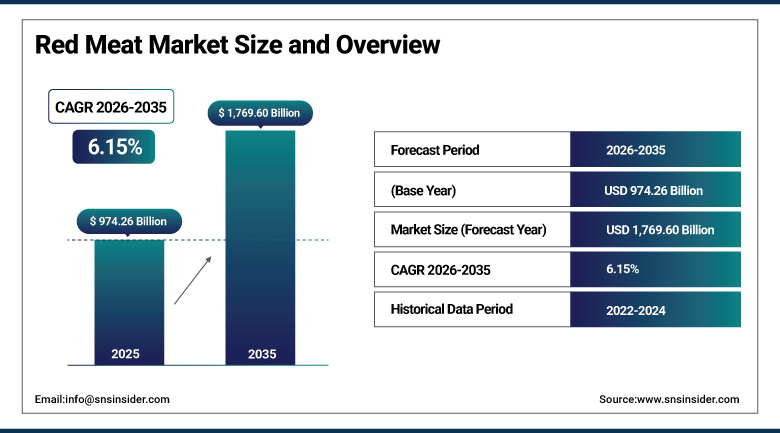
The Red Meat Market was valued at USD 974.26 Billion in 2025 and is expected to reach USD 1,769.60 Billion by 2035, growing at a CAGR of 6.15% from 2026-2035.
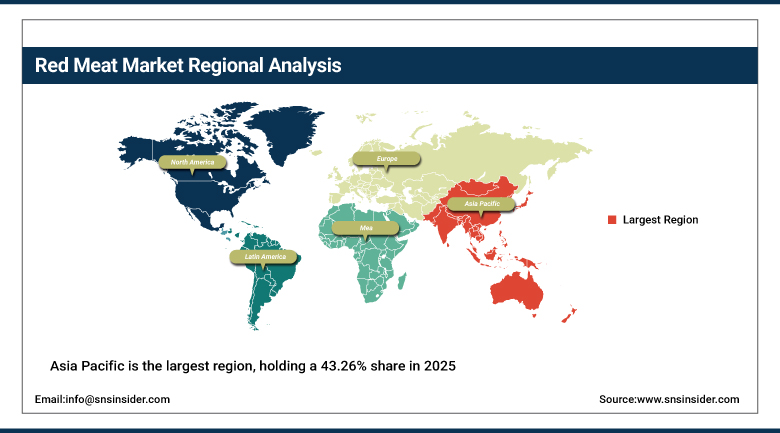
Rising protein demand in both developed and developing economies is pushing packers toward greater farm-to-shelf integration, as limited cattle availability and changing consumer purchasing channels reshape how red meat reaches households. The pig segment accounts for the biggest type share because pork comes with lower costs of production and shorter breeding time as compared to beef, which allows packers to increase their production more quickly than in beef production, while beef is the fastest-growing type due to its premium and grass-fed characteristics that attract more retail spending. In Asia Pacific, the regional share will be 43.26%, while North America, the fastest-growing region, will grow at a CAGR of nearly 7.14% between 2026 and 2035.
⮞In June 2025, Walmart opened its first owned-and-operated case-ready beef facility in Olathe, Kansas, packaging and distributing Angus cuts sourced from a dedicated supplier directly to stores across the Midwest rather than through third-party processors.
To Get more information On Red Meat Market - Request Free Sample Report
Red Meat Market Trends
-
Major retailers are building their own owned-and-operated beef processing facilities rather than relying solely on established packers.
-
Branded premium and grass-fed beef lines are expanding into mainstream big-box retail rather than remaining limited to specialty stores.
-
Packers are restructuring plant networks, closing underutilized capacity in regions facing the tightest cattle supplies while expanding elsewhere.
-
Cross-border trade disruptions tied to animal-health outbreaks and tariff safeguards continue reshaping which countries supply which import markets.
-
European slaughterhouse groups continue consolidating and divesting plants as regulators block some mergers on competition grounds.
U.S. Red Meat Market Outlook
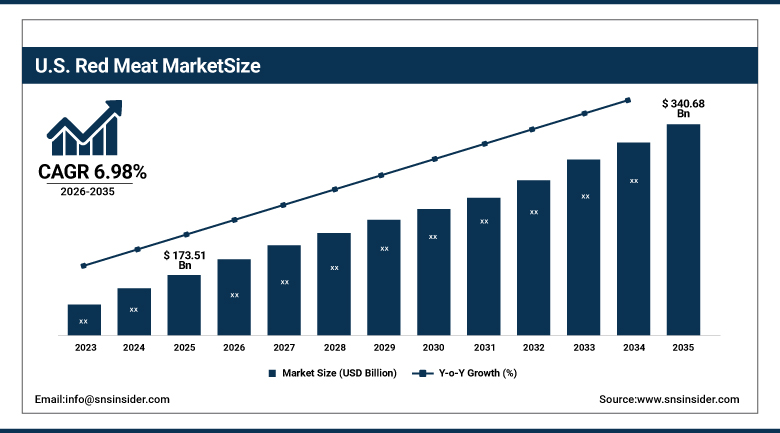
The U.S. Red Meat Market was valued at USD 173.51 Billion in 2025 and is expected to reach USD 340.68 Billion by 2035, growing at a CAGR of 6.98% from 2026-2035.
The U.S. Red Meat Market benefits from the country's concentration of large-scale beef and pork packers alongside a growing number of branded premium meat companies expanding into adjacent product categories nationwide. Tight cattle supplies driven by a multi-year drought and cross-border import restrictions continue pressuring packer margins and prompting capacity restructuring across the broader industry. Meat companies are also acquiring consumer brands to generate revenue outside commodity beef and pork production and to secure more stable income across the business cycle. Retailers all around the country are investing in own processing operations and direct sourcing strategies instead of third-party packers alone.
⮞In January 2026, Smithfield Foods agreed to acquire Nathan's Famous for USD 450 million, securing perpetual rights to the hot dog brand and extending the pork packer's branded product portfolio beyond its traditional fresh and packaged pork lines.
Red Meat Market Segment Analysis
-
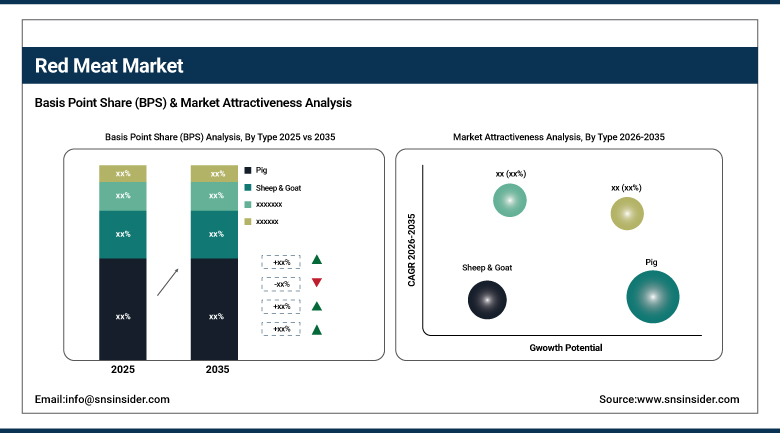
By Type, the Pig segment dominated the Red Meat Market with approximately 54.72% share in 2025, while the Beef segment is the fastest growing with a CAGR of approximately 6.84%.
-
By Distribution Channel, the B2B segment dominated the Red Meat Market with approximately 71.68% share in 2025, while the B2C segment is the fastest growing with a CAGR of approximately 7.23%.
-
By Product Form, the Fresh & Chilled segment dominated the Red Meat Market with approximately 58.34% share in 2025, while the Processed segment is the fastest growing with a CAGR of approximately 7.56%.
-
By End Use, the Household & Retail segment dominated the Red Meat Market with approximately 62.15% share in 2025, while the Food Service segment is the fastest growing with a CAGR of approximately 7.42%.
By Type, Pig Dominates the Red Meat Market and Beef Grows Fastest
Pig holds the largest type share because hogs reach market weight far faster than cattle, letting packers scale production and respond to demand shifts without the multi-year breeding cycles beef supply chains require. Retailers favor pork assortments because consistent hog supply keeps shelf pricing more stable than beef, which currently faces historically tight cattle inventories. Packers prioritize pork capacity investment because shorter production cycles let new plant investment reach full output within a single year rather than the several years cattle-dependent facilities require. That combination of production speed and supply stability keeps pig the dominant type category across retail and food service channels today.
Beef is growing fastest as branded premium and grass-fed positioning draws a growing share of retail spending even as overall cattle supply remains historically constrained. Retailers are increasingly dedicating shelf space to branded beef programs that command higher margins than commodity-grade cuts sold without a distinct label. Packers are responding by reconfiguring their plant networks, closing down excess capacity in the regions with the tightest supplies and investing in higher margin branded and value added beef lines. As premium branding continues to claim a bigger slice of beef retail spending across the country, the category is projected to expand faster than the broader type segment through 2035.
⮞In November 2026, Tyson Foods announced plans for a long-term partnership with Allied Beef Company, a consortium of American ranchers, to strengthen domestic cattle supply, and said it would move forward with fully reopening the second production shift at its Amarillo, Texas beef facility by summer 2027. The plan points to a gradual recovery in U.S. beef processing capacity as cattle supplies improve.
By Distribution Channel, B2B Dominates the Red Meat Market and B2C Grows Fastest
B2B distribution holds the largest channel share because food service operators, further processors and export buyers purchase red meat in volumes that retail-facing B2C channels cannot match on a per-transaction basis. Packers prioritize B2B relationships because long-term supply contracts with food service and processing customers provide more predictable volume than fragmented retail demand ever can. Export buyers increasingly negotiate direct B2B supply agreements specifically because tariff and quota changes can shift which countries remain cost-competitive suppliers within a single trading year. That combination of contracted volume and export demand keeps B2B the dominant distribution-channel category across the red meat market today.
B2C distribution is growing fastest as direct-to-consumer meat subscription brands and retailer-owned processing programs expand beyond specialty stores into mainstream big-box retail locations nationwide. Retailers are increasingly launching branded, traceable meat programs specifically to differentiate their fresh departments from competitors selling largely undifferentiated commodity cuts at similar price points. Direct-to-consumer brands continue expanding retail partnerships that place their products in thousands of additional store locations rather than relying solely on their own e-commerce channels. As more retailers launch owned or branded consumer meat programs across more markets, B2C is expected to keep growing faster than the broader distribution-channel category through 2035.
⮞In January 2026, direct-to-consumer meat and seafood brand ButcherBox began selling its grass-fed, grass-finished beef products in Target stores nationwide, expanding on its 2025 launch on Target's online marketplace. The move shows direct-to-consumer brands using large retail chains to reach shoppers beyond their subscription base.
By Product Form, Fresh & Chilled Dominates the Red Meat Market and Processed Grows Fastest
Fresh and chilled product form holds the largest share because consumers in most major markets still prefer unprocessed cuts for everyday home cooking over packaged or shelf-stable alternatives. Retailers dedicate the largest share of meat-department shelf space to fresh and chilled cuts because turnover rates remain highest in this category relative to frozen or processed alternatives. Packers prioritize fresh-chain logistics investment because maintaining cold-chain integrity from plant to shelf directly determines shelf life and the final product's perceived quality. That combination of consumer preference and retail shelf allocation keeps fresh and chilled the dominant product-form category across the red meat market today.
Processed red meat is growing fastest as convenience-oriented, ready-to-cook and packaged formats expand well beyond traditional deli counters into broader mainstream retail assortments. Packers are increasingly investing in advanced packaging technology specifically to extend shelf life while keeping processed products visually appealing on open retail shelves nationwide. Retailers favor processed formats because they command meaningfully higher per-pound margins than unprocessed cuts while still meeting rising consumer demand for quick, convenient meal preparation at home. As convenience-driven purchasing continues expanding steadily across more retail formats, processed red meat is expected to keep growing faster than the broader product-form category through 2035.
⮞In February 2026, Smithfield Foods began the approval process for a new packaged meats and fresh pork processing facility in Sioux Falls, South Dakota, with planned investment of up to USD 1.3 billion over three years and production expected to begin at the end of 2028. The plant would replace a facility more than 100 years old and add automated capacity for value-added packaged meats.
By End Use, Household & Retail Dominates the Red Meat Market and Food Service Grows Fastest
Household and retail end use holds the largest share because home cooking still remains the primary way most consumers prepare and eat red meat across both mature and developing markets worldwide. Retailers continue expanding branded and traceable meat programs specifically to capture a larger share of household grocery spending from shoppers seeking more differentiated fresh-meat options at everyday prices. Packers prioritize retail-ready packaging formats because household shoppers increasingly expect portion-controlled, clearly labeled cuts rather than butcher-counter-style bulk product. That combination of home-cooking demand and retail differentiation keeps household and retail the dominant end-use category across the red meat market today.
Food service is growing fastest as restaurant chains and quick-service operators expand premium and branded beef offerings to differentiate menus in an increasingly competitive, crowded dining market. Operators are increasingly securing direct supply agreements with packers specifically to guarantee consistent quality and avoid the price volatility that spot-market purchasing carries during tight-supply periods. Packers favor food service contracts because they typically carry higher per-pound margins than undifferentiated retail commodity sales across comparable cuts. As restaurant chains continue expanding branded beef menu offerings nationwide, food service is expected to keep growing noticeably faster than the broader end-use category through most of 2035.
⮞In January 2026, Joyce Farms launched Signature Angus Heritage Beef, a premium beef program designed for chefs and home consumers seeking consistent eating quality and reliable supply. The program targets restaurant buyers looking for dependable premium beef supply during a period of tight cattle availability.
Regional Analysis
|
Region |
Major Country |
Share within Region, 2025 (%) |
|---|---|---|
|
North America |
United States |
81.47 |
|
Europe |
Germany |
22.68 |
|
Asia Pacific |
China |
41.35 |
|
Latin America |
Brazil |
47.82 |
|
Middle East and Africa |
Saudi Arabia |
29.56 |
Asia Pacific Red Meat Market Insights
Asia Pacific is the largest region, holding a 43.26% share in 2025, a position built on China's enormous consumer base and its packers' rapidly expanding slaughtering and processing capacity. China supplies 41.35% of regional revenue, reflecting how a single national market continues to dominate regional demand even as neighboring countries' consumption grows. Cross-border beef trade flows into the region remain sensitive to animal-health restrictions and import-resumption decisions that can shift volumes between supplying countries within a single trading year. India and Australia contribute additional regional supply, both anchored by export-oriented processing capacity built specifically to serve China's large and still-growing import demand.
Import-policy shifts continue directly shaping which countries supply China's red meat demand, as resumptions and suspensions of specific trading partners' access can redirect substantial volumes within weeks. Local Chinese packers continue expanding slaughtering and packaged-meat capacity to reduce reliance on imported product for categories where local supply can scale quickly. Amid policy uncertainty, regional food service chains are increasingly looking to enter into direct import contracts instead of buying through intermediary traders, in an effort to secure more predictable supply. The regional trade patterns of Asia Pacific will likely keep changing throughout the remainder of the forecast period as China’s import policy continues to shift between supplier countries.
⮞In July 2026, China resumed imports of U.S. beef after a period of suspended access, reopening a trade channel that American exporters had been unable to use for an extended period.
Get Customized Report as per Your Business Requirement - Enquiry Now
North America Red Meat Market Insights
North America is the fastest-growing region, projected to expand at a CAGR of 7.14% from 2026 to 2035, as the United States' packers and retailers both invest directly in processing capacity despite historically tight cattle supplies. The United States supplies 81.47% of regional revenue, anchored by its concentration of large-scale beef and pork packing operations serving both local and export markets. Canada contributes additional regional beef supply, while Mexico's cattle exports to the United States remain subject to periodic animal-health-related restrictions. Packers across the region continue restructuring plant networks, closing underutilized beef capacity in the tightest-supply areas while expanding investment in pork and branded product lines.
Tight cattle supplies driven by a multi-year drought continue pressuring beef packer margins across the region, prompting some packers to close underutilized plants while others invest in automation to improve yields at existing facilities. Retailers are increasingly building owned processing capacity rather than depending exclusively on third-party packers for branded and private-label meat programs. Branded meat companies continue acquiring adjacent consumer product categories to diversify revenue beyond commodity beef and pork sales during a period of constrained cattle supply. As retailers and packers continue investing directly in capacity despite tight cattle supplies, North America is expected to keep growing faster than the broader regional category through 2035.
⮞In November 2025, Cargill stated it had no plans to close any of its primary U.S. beef processing plants and confirmed it was investing roughly ninety million dollars to improve automation and yields at its Fort Morgan, Colorado facility.
Europe Red Meat Market Insights
Europe's red meat market is anchored by large pork and beef processing groups headquartered in Germany, Denmark and the Netherlands that have built extensive slaughtering and deboning capacity over decades of consolidation. Germany supplies 22.68% of regional revenue, anchored by a concentration of large-scale pork processors serving both local retailers and export markets across the wider European Union. Regulatory scrutiny of further consolidation among Europe's largest meat groups continues shaping which mergers and plant transfers can proceed, with competition authorities blocking some proposed takeovers outright. Denmark and the Netherlands contribute additional demand through cooperative-owned processors exporting pork across both the EU and non-EU markets.
European processors are increasingly divesting individual plants to smaller or more specialized buyers after regulators block broader consolidation attempts between the region's largest meat groups outright. Cooperative-owned pork processors continue investing in new deboning and packaging capacity to handle rising member-farm deliveries without adding slaughter capacity that regulators might otherwise scrutinize closely. Specialized buyers acquiring divested plants are gradually reshaping Europe's processing landscape into a less concentrated structure than existed before recent competition rulings took effect. This combination of regulatory scrutiny and plant-level restructuring is expected to keep steadily reshaping Europe's processing landscape through most of the remaining forecast period.
⮞In April 2026, Vion Food Group agreed to sell its Waldkraiburg beef plant to Boeser Frischfleisch and its Crailsheim pork and beef facility to OSI Europe Foodworks, structuring both deals as share transactions that preserve existing employee contracts. The sales followed a regulator's earlier block of Vion's planned sale of the same sites to a larger competitor.
MEA & Latin America Red Meat Market Insights
The Middle East and Africa region remains a smaller red meat market, with Saudi Arabia accounting for the largest regional share on the strength of large government-backed import contracts that secure meat supply for its growing population. The United Arab Emirates adds demand through premium retail chains and food service operators serving residents and tourists. South Africa has the region's most developed cattle feedlot and beef processing industry, although foot-and-mouth disease outbreaks have periodically limited its beef exports. Halal certification requirements shape which exporting plants can supply Gulf buyers, and most countries in the region still import the majority of their red meat.
Latin America's demand is concentrated in Brazil, which accounts for the largest regional share as one of the world's largest cattle producers and beef exporters. Argentina adds export-oriented beef processing capacity, while Uruguay and Paraguay contribute further export-focused beef supply. Brazilian exporters such as MBRF, JBS and Minerva are securing long-term supply contracts with Middle East and Asian buyers. The EU–Mercosur agreement, if ratified, would expand the region's preferential access to European beef buyers through a reduced-tariff quota.
⮞In April 2026, MBRF, the company formed by the merger of Marfrig and BRF, expanded its supply agreement with Saudi Arabia's Salic to include beef for the first time, adding an annual provision of up to two hundred seventy thousand tonnes alongside a doubled poultry volume.
Market Dynamics
Growth Drivers: Retailer-owned processing and branded premium programs are lifting global demand
Major retailers are increasingly building owned processing capacity rather than depending exclusively on third-party packers, giving them more direct control over supply consistency and branded product positioning nationwide. Retailers that have opened owned facilities are reporting steadier supply during periods when third-party packer capacity has tightened industry-wide, even amid historically constrained cattle availability. Branded premium and grass-fed beef programs are simultaneously expanding from specialty stores into mainstream big-box retail, capturing shoppers willing to pay more for differentiated positioning and traceability. Together these shifts are widening the addressable red meat market across retail formats that previously offered only undifferentiated commodity cuts to price-sensitive shoppers.
A second important driver is steadily expanding meat distribution capability among specialty foodservice distributors, as established distributors acquire dedicated meat-processing businesses to serve restaurant and institutional customers more directly than before. Distributors are increasingly acquiring specialized meat-processing units specifically to control quality and supply consistency for food service customers rather than purchasing exclusively through intermediary packers. Food service operators are responding by securing more direct supply relationships that bypass traditional multi-layer distribution chains entirely. Distributors are continuing to develop dedicated meat processing capability and this driver is expected to steadily expand direct-supply arrangements across the broader food service channel going forward into 2035.
⮞In September 2025, Sysco acquired Fairfax Meadow, a meat-processing business, from Hilton Foods for approximately USD 73 million (GBP 54 million), adding dedicated meat-processing capability to its food service distribution network.
Restraints: Animal-health trade restrictions and tight cattle supplies are slowing broader expansion
Animal-health-related trade restrictions continue constraining cross-border red meat flows, since countries periodically suspend imports from trading partners facing disease outbreaks regardless of how established the trade relationship has been. Importing countries usually suspend shipments as soon as an outbreak is detected in a major supplying country, because protecting domestic herds takes priority over supply continuity. Exporters in affected countries struggle to redirect volume to alternative markets quickly enough to avoid significant revenue disruption during an extended suspension period. These disruptions weigh most heavily on cross-border cattle and live-animal trade, where health protocols are strictest and resumption processes can take months to complete.
Tight cattle supplies driven by a multi-year drought also constrain broader category expansion, since packers must compete for a historically small U.S. cattle herd while beef demand remains strong. Rebuilding the herd takes several years because heifers retained for breeding are not available for slaughter, which keeps cattle prices high in the near term. Smaller regional packers in particular struggle to secure consistent cattle volume when larger, better-capitalized competitors can offer premium prices for the same limited supply. Combined, these two factors remain the main restraints on market expansion.
⮞In May 2025, the U.S. Department of Agriculture suspended live cattle, bison and horse imports from Mexico after New World Screwworm detections spread roughly seven hundred miles closer to the U.S. border, with the suspension reviewed on a month-by-month basis.
Opportunities: New trade agreements and export-market access open new revenue paths
New trade agreements that expand duty-preferential access for red meat exporters are creating opportunities for established beef and pork producers to capture additional share in previously restricted import markets. Exporters that secure early access under newly ratified agreements are positioned to build buyer relationships before competitors from non-preferential countries can match equivalent pricing. Producers in major exporting countries are expanding slaughtering and processing capacity specifically to serve the additional volume new trade agreements are expected to unlock. Exporters in Brazil, Australia and the United States that meet each market's sanitary and halal requirements are best placed to use this new access.
A second opportunity lies in direct-to-consumer and retailer-owned branded meat programs, as more shoppers show willingness to pay a premium for traceable, differentiated red meat over undifferentiated commodity cuts. Retailers pursuing owned processing capacity are positioned to capture margin that previously went to third-party packers while also building stronger private-label brand loyalty. Direct-to-consumer brands are expanding retail partnerships that place their products in thousands of additional store locations rather than relying solely on subscription-based distribution. Over the next 10 years, companies that combine traceability marketing with growing retail distribution will win an increasing share of premium-oriented red meat spending.
⮞In January 2026, the European Union signed a trade agreement with Mercosur countries that caps annual beef imports from the bloc at ninety-nine thousand tonnes at a reduced tariff of 7.5%, though the agreement still requires European Parliament ratification before taking effect.
Recent Developments:
-
In March 2026, JBS USA broke ground on a USD 150 million expansion at its Cactus, Texas beef production facility, adding a new fabrication floor and an expanded ground beef room with completion expected by early 2027.
-
In November 2025, Tyson Foods announced it would close its beef processing plant in Lexington, Nebraska, citing mounting losses tied to the tightest U.S. cattle supplies since the 1950s, while shifting its Amarillo, Texas plant to a single production shift.
-
In January 2026, Danish Crown announced plans for a new pork deboning facility in Vejen, Denmark, with operations scheduled to begin in October 2026 to handle rising pig deliveries from member farmers.
-
In June 2026, China's General Administration of Customs confirmed that Australia's annual beef import quota had been filled, triggering a 55% out-of-quota tariff that effectively suspended preferential access under the two countries' free trade agreement for the remainder of the year.
Red Meat Market Key Players
-
JBS S.A.
-
Tyson Foods, Inc.
-
Cargill, Incorporated
-
Smithfield Foods, Inc.
-
WH Group Limited
-
Hormel Foods Corporation
-
National Beef Packing Company, LLC
-
MBRF S.A.
-
Danish Crown A/S
-
Vion Food Group
-
Premium Food Group (formerly Tönnies Group)
-
Seaboard Foods LLC
-
Hilton Foods Group plc
-
OSI Group, LLC
-
NH Foods Ltd.
-
CS Beef Packers LLC
-
Minerva Foods
-
Muyuan Foods Co., Ltd.
Red Meat Market Report Scope:
| Report Attributes | Details |
|---|---|
| Market Size in 2025 | USD 974.26 Billion |
| Market Size by 2035 | USD 1,769.60 Billion |
| CAGR | CAGR of 6.15% From 2026 to 2035 |
| Base Year | 2025 |
| Forecast Period | 2026-2035 |
| Historical Data | 2022-2024 |
| Report Scope & Coverage | Market Size, Segments Analysis, Competitive Landscape, Regional Analysis, DROC & SWOT Analysis, Forecast Outlook |
| Key Segments | • By Type (Beef, Pig, Sheep & Goat & Others) • By Product Form (Fresh & Chilled, Frozen & Processed) • By Distribution Channel (B2B & B2C) • By End Use (Household & Retail, Food Service & Food Processing Industry) |
| Regional Analysis/Coverage | North America (US, Canada), Europe (Germany, UK, France, Italy, Spain, Russia, Poland, Rest of Europe), Asia Pacific (China, India, Japan, South Korea, Australia, ASEAN Countries, Rest of Asia Pacific), Middle East & Africa (UAE, Saudi Arabia, Qatar, South Africa, Rest of Middle East & Africa), Latin America (Brazil, Argentina, Mexico, Colombia, Rest of Latin America). |
| Company Profiles | JBS S.A., Tyson Foods, Inc., Cargill, Incorporated, Smithfield Foods, Inc., WH Group Limited, Hormel Foods Corporation, National Beef Packing Company, LLC, MBRF S.A., Danish Crown A/S, Vion Food Group, Premium Food Group (formerly Tönnies Group), Seaboard Foods LLC, Hilton Foods Group plc, OSI Group, LLC, NH Foods Ltd., CS Beef Packers LLC, Minerva Foods, Muyuan Foods Co., Ltd. |

Frequently Asked Questions
The market includes JBS, Tyson Foods, Cargill, Smithfield Foods, WH Group, Hormel Foods, National Beef Packing, MBRF, Danish Crown, Vion Food Group, Premium Food Group, Seaboard Foods, Hilton Foods, OSI Group, CS Beef Packers, Minerva Foods, NH Foods and Muyuan Foods, among others.
The main opportunities lie in new trade agreements that expand preferential export-market access, and in direct-to-consumer and retailer-owned branded meat programs that command a premium over undifferentiated commodity cuts.
The key growth factor is retailers and distributors building owned processing capacity alongside expanding branded premium beef programs, even as overall cattle supply remains historically tight.
By type, the Pig segment dominated the market with approximately 54.72% share in 2025, supported by faster production cycles and more stable supply than cattle-dependent beef.
Asia Pacific dominated the market with approximately 43.26% share in 2025, supported by China's large consumer base, while North America is the fastest-growing region with a projected CAGR of approximately 7.14% from 2026 to 2035.
