
SaaS Management Market Report Scope & Overview:
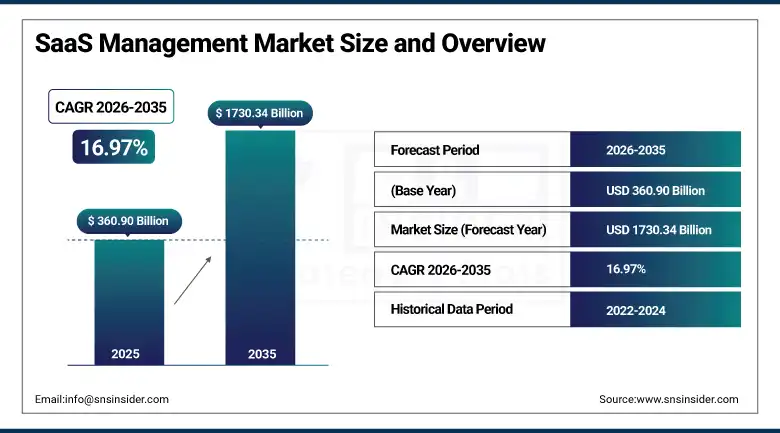
The SaaS Management Market was valued at USD 360.90 Billion in 2025 and is expected to reach USD 1730.34 Billion by 2035, growing at a CAGR of 16.97% from 2026 to 2035.
The SaaS Management Market is expected to grow at a robust pace owing to the fast-paced digital transformation witnessed in various industries, the rise in investments in cutting-edge technologies, and the high demand for cost-effective and scalable solutions that increase efficiency and productivity. The increased use of the solution in areas such as healthcare, manufacturing, banking and finance, retail, and government are expected to fuel adoption further. Regulations favoring the solution, high customer demands, and innovations from key vendors will further drive market growth.
In 2024, global SaaS management adoption surged by 41%, driven by digital transformation in healthcare, finance, and government sectors where 65% of enterprises implemented centralized platforms to govern cloud spend, enforce security policies, and automate application lifecycle management. According to IBM’s Cost of a Data Breach Report, the global average cost of a data breach reached approximately USD 4.88 million in 2024, highlighting the increasing financial and operational risks associated with inadequate cloud and SaaS governance.
Market Size and Forecast
-
Market Size in 2026E: USD 422.14 Billion
-
Market Size by 2035: USD 1730.34 Billion
-
CAGR: 16.97% from 2026 to 2035
-
Fastest Growing Region: Asia Pacific
-
Largest Region: North America
To Get more information On SaaS Management Market - Request Free Sample Report
SaaS Management Market Trends
-
Rising adoption of cloud-based applications and subscription software is driving the SaaS management market.
-
Growing need for visibility, governance, and optimization of SaaS portfolios is boosting market growth.
-
Expansion of remote work, hybrid workplaces, and digital transformation initiatives is fueling SaaS management platform deployment.
-
Increasing focus on license optimization, cost control, compliance, and shadow IT management is shaping adoption trends.
-
Advancements in AI-driven analytics, automated provisioning, and SaaS discovery tools are enhancing operational efficiency and security.
The U.S. SaaS Management Market Outlook
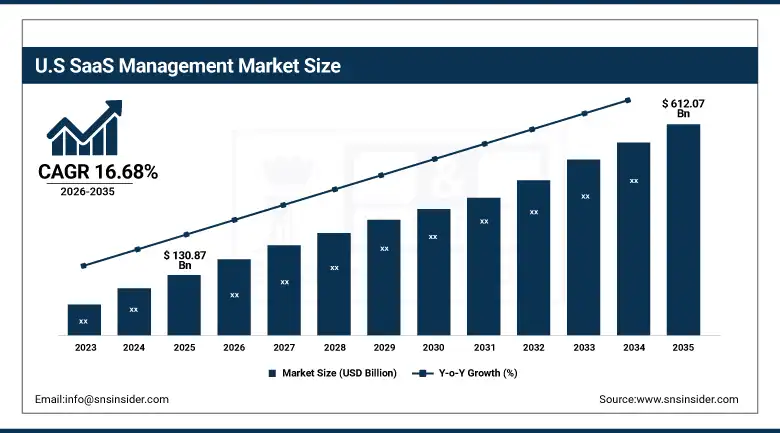
The U.S. SaaS Management Market was valued at USD 130.87 Billion in 2025 and is expected to reach USD 612.07 Billion by 2035, growing at a CAGR of 16.68% from 2026 to 2035.
Growth in the U.S. SaaS Management Market is driven by increasing digitalization across industries, rising investments in advanced technologies, and growing demand for scalable, efficient solutions that improve workflow and customer experience. Supportive government initiatives and continuous innovation by major players are also accelerating SaaS Management Market adoption.
SaaS Management Market Segment Analysis
-
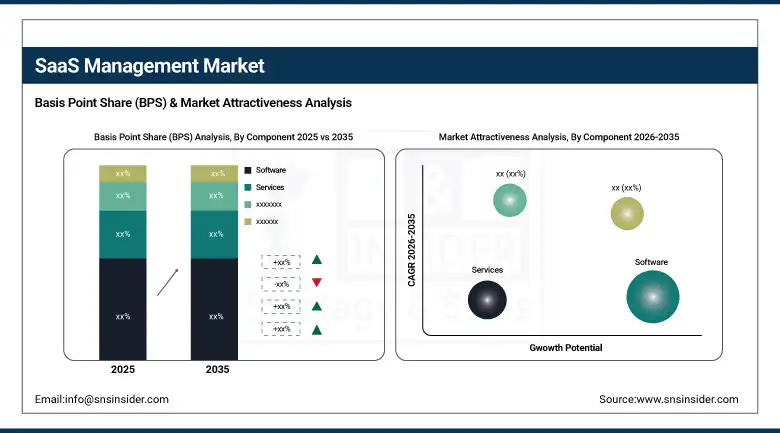
By Component, the software segment dominated the SaaS Management market in 2025, while the services segment is the fastest growing component during 2026 to 2035.
-
By Deployment Mode, Cloud-Based segment dominated the market in 2025 with 65.4% share; Cloud-Based segment is also the fastest growing segment with a CAGR of 20.7%.
-
By Organization Size, the large enterprises segment dominated the SaaS Management market in 2025, while the SME segment is the fastest growing during 2026 to 2035.
-
By Industry Vertical, the IT & telecommunications segment dominated the SaaS Management market with 34.6% share in 2025, while the healthcare & life sciences segment is the fastest growing with a CAGR of 20.5%.
By Component, software dominates the SaaS management market, while services is the fastest-growing segment
Software dominates the SaaS Management Market as it offers visibility, control, and monitoring of multiple cloud applications. Companies utilize software products to monitor the consumption of these programs, optimize them, and avoid any redundancy, which will ensure cost-efficiency and compliance requirements. The integration abilities, automation, and analysis capabilities offered by software are the factors that contribute to its adoption among businesses. Moreover, the recurring business model, scalability, and necessity in SaaS governance make software the most common element in both established and emerging markets of SaaS management.
Services are the fastest-growing segment because of the growing need for SaaS management services, consulting, and implementations. Enterprises are increasingly turning to services providers to handle issues of SaaS deployments, SaaS optimization, and SaaS security. The increasing adoption of SaaS and the complexity associated with managing multiple clouds are fueling growth in the Services Segment worldwide.
By Deployment Mode, cloud-based segment dominates the SaaS management market, while it is also the fastest-growing segment
The cloud-based segment dominates the market because of its versatility, scalability, and cost-effectiveness when compared to other conventional methods. Cloud-based applications are increasingly gaining preference due to features such as real-time data availability, easy integration with existing enterprise systems, and better collaboration within distributed logistics networks. This segment not only has the highest growth rate but is also characterized by the quick implementation process, remote functionality, automatic upgrades, and improved visibility among other benefits. Growing demand for scalable infrastructure, the incorporation of new technologies such as AI and IoT, global availability, and real-time visibility in the supply chain continues to fuel its momentum.
By Application, cost management & optimization dominates the market, while security & compliance management is the fastest-growing segment
Cost Management & Optimization dominates due to the rising costs of SaaS subscriptions and maximizing ROI. Through software applications, enterprises can track application usage, uncover unused licenses, combine subscriptions, and minimize wasteful spending. Extensive implementation in IT, telecom, BFSI, and retail industries adds to its dominance. Due to increasing cloud migration and multi-SaaS environments, enterprises continue focusing on cost optimization, making this application the leading driver of the overall SaaS Management Market.
Security & Compliance Management is the fastest-growing application segment owing to increased compliance requirements and stringent cyber-attacks. Software tools are helpful in enforcing security policies, tracking unauthorized access, and complying with different standards such as GDPR, HIPAA, and others. With increasing concerns around data breaches and compliance regulations, enterprises will continue focusing on security and compliance through SaaS management.
By End-User, IT & telecom dominates the market, while healthcare & life sciences is the fastest-growing segment.
IT & Telecom dominate the end-user segment as these sectors possess a complicated ecosystem of SaaS and high penetration of cloud applications. In such scenarios, there exists a need for effective SaaS management software that will allow optimization and cost-effectiveness, as well as provide security and compliance. The complex IT infrastructures and multi-departmental management in these organizations make them the most suitable end-users, thus contributing to their continuous leadership in the SaaS Management Market.
Healthcare & Life Sciences is the fastest-growing end-user segment due to increased digitization and cloud computing technologies. Health institutions such as hospitals and research laboratories need proper management of their SaaS applications for the protection of sensitive data and compliance with regulatory standards. This vertical will see high growth because of rapid deployment of SaaS applications, and stringent data security measures needed by hospitals in emerging and developed SaaS Markets.
Regional Analysis
|
Region |
Major Country |
Share within Region, 2025 (%) |
|---|---|---|
|
North America |
United States |
84.73% |
|
Europe |
Germany |
28.47% |
|
Asia Pacific |
China |
38.47% |
|
Middle East & Africa |
UAE |
22.84% |
|
Latin America |
Brazil |
43.84% |
North America SaaS Management Market Insights
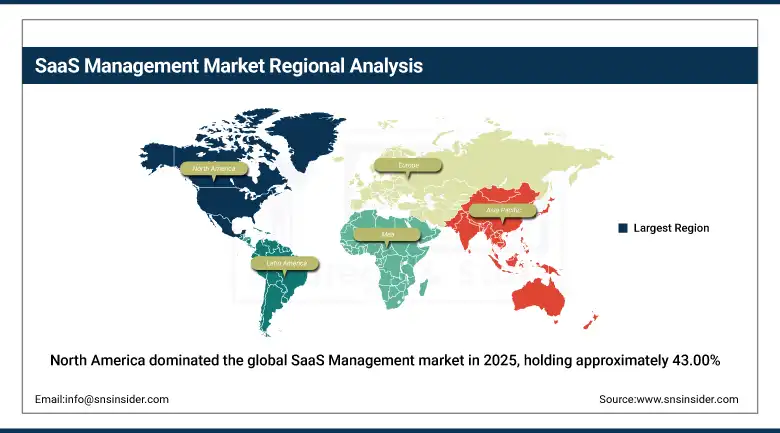
North America dominated the global SaaS Management market in 2025, holding approximately 43.00% of global revenues. The United States accounts for approximately 84.73% of regional revenue through the highest per-enterprise SaaS spending globally, the commercial concentration of major SaaS management platform vendors, and the enterprise governance culture whose FinOps, IT governance, and cybersecurity investment priorities create natural commercial alignment with SaaS management platform value propositions. Canada contributes supplementary demand through its large financial services, technology, and healthcare sectors whose SaaS portfolio complexity mirrors U.S. enterprise patterns at comparable governance investment intensity.
According to the U.S. Census Bureau, more than 90% of large enterprises use cloud-based services, significantly increasing the complexity of SaaS environments and driving demand for centralized visibility, cost optimization, and governance tools.
Get Customized Report as per Your Business Requirement - Enquiry Now
Europe SaaS Management Market Insights
Europe held a significant share of global SaaS Management revenues in 2025. GDPR's data processor oversight obligations that require enterprises to maintain comprehensive records of all SaaS applications processing EU resident personal data have created a regulatory compliance driver for SaaS application discovery and documentation that extends beyond cost optimisation into legal obligation. Germany, France, the United Kingdom, and the Netherlands are the leading national markets, each hosting large enterprise SaaS consumer sectors whose governance requirements create demand for SaaS management platforms with strong GDPR compliance documentation and EU data sovereignty capabilities.
The European Commission also reports that more than 75% of EU companies now use at least one form of cloud service, highlighting the widespread integration of cloud technologies into enterprise operations. These trends are increasing SaaS sprawl and complexity, thereby driving demand for SaaS management platforms across Europe.
Asia Pacific SaaS Management Market Insights
Asia Pacific is the fastest-growing regional SaaS Management market at approximately 19.58% CAGR through 2035, driven by rapid digital transformation investment across China, India, Japan, South Korea, and Southeast Asian markets whose enterprise SaaS adoption is growing at rates substantially above global averages. China accounts for approximately 38.47% of Asia Pacific revenues through the rapid SaaS adoption of its large technology and financial services enterprise sectors and its domestic SaaS platform ecosystem. India's large IT services sector, whose enterprise clients represent some of the world's most complex SaaS environments, creates substantial domestic SaaS management market demand from its own platform vendors.
According to China’s Ministry of Industry and Information Technology, China has more than 1.1 billion internet users, supporting one of the world’s largest and most active cloud ecosystems.
Similarly, India’s Ministry of Electronics and Information Technology reports that the country has over 800 million internet users, driving widespread enterprise cloud adoption across industries such as IT services, banking, retail, and manufacturing.
MEA & Latin America SaaS Management Market Insights
Middle East and Latin America are growing SaaS Management markets where accelerating enterprise cloud adoption, growing IT governance maturity, and expanding digital economy investment are creating initial and growing SaaS management platform demand. The UAE leads MEA revenues at approximately 22.84% of the regional total through its advanced enterprise cloud adoption, government digital transformation investment in cloud-delivered services, and concentration of multinational regional headquarters whose global SaaS portfolios require centrally managed governance platforms.
Brazil leads Latin American revenues at approximately 43.84% of the regional total through its large enterprise technology sector, rapidly growing cloud adoption rate, and the commercial presence of major SaaS platform vendors whose Latin American operations create regional market access for SaaS management solutions.
Market Dynamics
Growth Drivers: Increasing adoption of cloud-based applications and SaaS platforms is driving demand for SaaS management solutions globally
Enterprises worldwide are now adopting numerous SaaS solutions to boost their performance, collaboration efforts, and digital transformations. Manual management of these software applications may prove to be difficult, tedious, and expensive. The use of SaaS management tools makes it easy for firms to manage subscriptions, control costs, monitor usage, and comply with license policies. In addition, they offer useful information regarding ways to optimize costs and allocate resources. The rise in cloud computing services, remote working practices, and hybrid IT systems is only speeding up this process. Firms have realized that they must manage their SaaS solutions.
In 2024, enterprises used an average of 327 SaaS applications, driving a 40% increase in SaaS management adoption to monitor usage, reduce redundant spending by up to 25%, and ensure compliance with data and licensing regulations.
Restraints: Data security and privacy concerns restrict SaaS management platform adoption, especially in regulated and sensitive enterprise environments.
The incorporation of SaaS management into companies’ operations comes with data security, privacy, and compliance issues that may discourage its use. There may be fear that any sensitive data belonging to the company and customers may be compromised when stored and analyzed by a cloud-based solution. Sectors that have high regulatory standards, such as the health, financial, and government sectors, will be less likely to incorporate the use of SaaS management applications without proper security certificates. This makes the deployment of a SaaS management strategy more difficult in the market.
In 2024, 65% of enterprises in regulated sectors such as finance and healthcare cited data security and compliance risks as key barriers, slowing SaaS management platform adoption despite growing needs for cloud governance and visibility.
Opportunities: AI-powered SaaS governance and healthcare digital transformation are emerging as the highest-value growth opportunities for providers.
Autonomous SaaS governance systems that can continuously discover, assess, and remediate SaaS security and compliance issues without requiring human analyst intervention represent the commercial pinnacle of SaaS management platform development whose capability advances will define competitive differentiation in the market's next phase. The automation value proposition is particularly compelling for large enterprise customers whose SaaS portfolios are too large for manual governance at the granularity that comprehensive security and compliance assurance requires.
Healthcare's accelerating SaaS adoption, driven by the proliferation of telehealth platforms, clinical collaboration tools, and AI-powered diagnostic SaaS, creates the fastest-growing vertical SaaS management demand whose combination of regulatory compliance complexity under HIPAA and the sensitivity of patient data processed by clinical SaaS applications creates the most financially consequential SaaS governance requirement among major enterprise verticals.
Recent Developments:
-
2025: Zylo launched its SaaS Command Center providing CIOs and FinOps teams with real-time visibility into SaaS spend, usage, risk, and contract timelines across thousands of applications, with AI-powered anomaly detection generating average customer SaaS spend savings of 28% in the first year of platform deployment.
-
2024: BetterCloud introduced Autonomous SaaS Governance, AI-driven capability automatically enforcing security, compliance, and cost policies across Google Workspace, Microsoft 365, Slack, and Zoom without manual workflow execution, demonstrating AI-powered SaaS governance automation at production scale for Fortune 500 customers.
-
2024: Torii launched its expanded SaaS management intelligence suite with predictive contract renewal recommendations, automated vendor negotiation intelligence, and real-time shadow IT discovery, enabling IT teams to identify and govern previously unknown SaaS applications within hours of initial platform deployment.
SaaS Management Market Key Players are:
-
BetterCloud
-
Zylo
-
Torii
-
SailPoint Technologies
-
Productiv
-
CoreView
-
Blissfully
-
Cleanshelf
-
Snow Software
-
Flexera
-
G2 Track
-
LeanIX
-
Apptio
-
Binadox
-
CloudEagle
-
SaaSLicense
-
Intello
-
Vendr
-
Zluri
-
Okta
SaaS Management Market Report Scope:
| Report Attributes | Details |
|---|---|
| Market Size in 2025 | USD 360.90 Billion |
| Market Size by 2035 | USD 1,730.34 Billion |
| CAGR | CAGR of 16.97% From 2026 to 2035 |
| Base Year | 2025 |
| Forecast Period | 2026-2035 |
| Historical Data | 2022-2024 |
| Report Scope & Coverage | Market Size, Segments Analysis, Competitive Landscape, Regional Analysis, DROC & SWOT Analysis, Forecast Outlook |
| Key Segments | • By Component (Software, Services) • By Deployment Mode (Cloud-Based, On-Premise) • By Application (Cost Management & Optimization, Security & Compliance Management, License Management, Vendor Management, Performance & Usage Analytics) • By End-User (IT & Telecom, BFSI, Healthcare & Life Sciences, Retail & E-commerce, Manufacturing) |
| Regional Analysis/Coverage | North America (US, Canada), Europe (Germany, UK, France, Italy, Spain, Russia, Poland, Rest of Europe), Asia Pacific (China, India, Japan, South Korea, Australia, ASEAN Countries, Rest of Asia Pacific), Middle East & Africa (UAE, Saudi Arabia, Qatar, South Africa, Rest of Middle East & Africa), Latin America (Brazil, Argentina, Mexico, Colombia, Rest of Latin America). |
| Company Profiles | BetterCloud, Zylo, Torii, SailPoint Technologies, Productiv, CoreView, Blissfully, Cleanshelf, Snow Software, Flexera, G2 Track, LeanIX, Apptio, Binadox, CloudEagle, SaaSLicense, Intello, Vendr, Zluri, Okta |

Frequently Asked Questions
The SaaS Management Market is expected to grow at a CAGR of 16.97% from 2026 to 2035.
The SaaS Management Market was valued at USD 360.90 Billion in 2025.
Enterprise SaaS complexity, license waste reduction, compliance needs, and AI-driven governance are driving SaaS management platform market growth globally.
The IT & telecommunications segment dominated the SaaS Management Market with 34.6% share in 2025.
North America dominated the SaaS Management Market in 2025, holding approximately 43.00% of global revenues, with the United States accounting for approximately 84.73% of North American revenues.
