
Smart Tourism Market Report Scope & Overview:
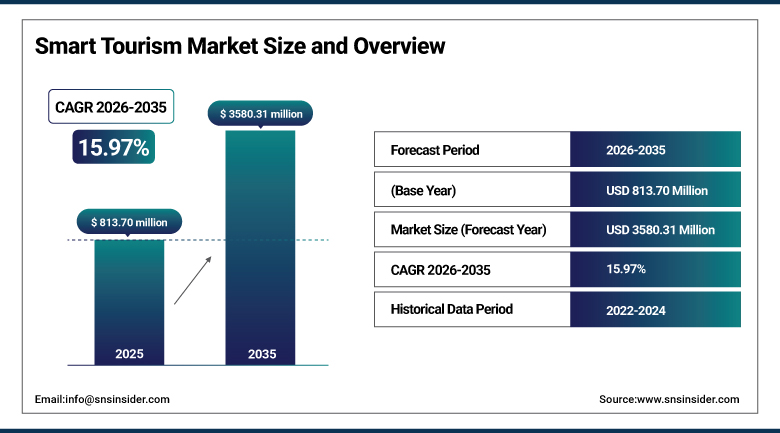
The Smart Tourism Market was valued at USD 813.70 Million in 2025 and is expected to reach USD 3,580.31 Million by 2035, growing at a CAGR of 15.97% from 2026–2035.
Smart Tourism Market is expected to expand at a rapid pace owing to the increasing use of technology in the travel and tourism industry, increasing demand for personalized travel experiences, and development of smart cities. Artificial Intelligence, Internet of Things (IoT), Big Data Analytics, and Cloud Computing are allowing real-time travel assistance, smart destination management, and smooth booking process. Governments and tourism boards are developing smart tourism infrastructure that provides improved engagement and safety for travelers. Furthermore, recovery of global tourism, widespread usage of smartphones, and increasing demand for connected and contactless travel services will drive the growth of the market.
78% of tourism stakeholders had already deployed IoT, AI, or big data tools by 2025, using them to power smart destinations that enhance personalization, safety, and satisfaction while accelerating global smart tourism adoption more broadly. That's a fast rate of adoption for an industry that wasn't especially known for its technology investment a decade ago.
Market Size and Forecast:
-
Market Size in 2026E: USD 943.65 Million
-
Market Size by 2035: USD 3,580.31 Million
-
CAGR: 15.97% from 2026 to 2035
-
Fastest Growing Region: Asia Pacific
-
Largest Region: North America
To Get more information Smart Tourism Market - Request Free Sample Report
Smart Tourism Market Trends:
-
IoT and AI adoption keeps rising as tourism operators chase both personalized traveler experiences and simple operational efficiency gains.
-
Big data analytics is increasingly used to understand real-time tourist behavior, helping destinations optimize crowd flow and resource allocation on the fly.
-
AR and VR deployment continues expanding, giving travelers immersive previews of cultural, historical, and entertainment experiences before or during their visit.
-
Mobile applications and connected devices keep gaining ground as the primary channel for booking, navigation, and general travel assistance.
-
Sustainable, eco-friendly tourism solutions are gaining traction, supported by smart monitoring and resource management tools that track environmental impact in real time.
U.S. Smart Tourism Market Outlook:
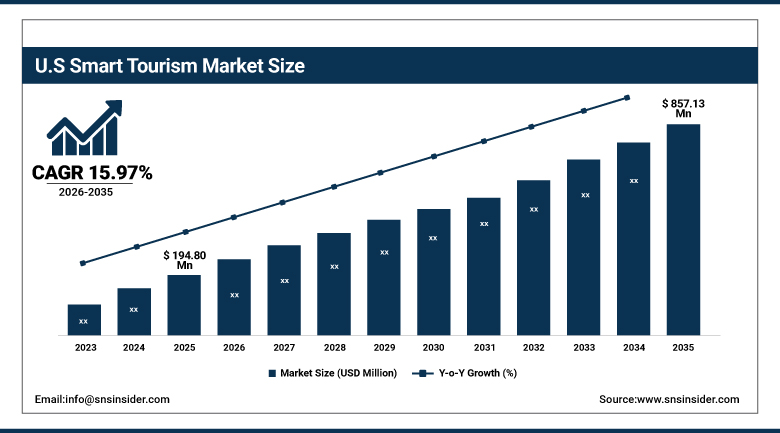
The U.S. Smart Tourism Market was valued at approximately USD 194.80 Million in 2025 and is expected to reach approximately USD 857.13 Million by 2035, growing at a CAGR of approximately 15.97%.
Growth in the U.S. market is being driven by rising adoption of AI, IoT, and mobile technology aimed at improving the traveler experience end to end. Growing demand for personalized services and seamless digital solutions, paired with genuine investment in connected infrastructure and data-driven tourism management, continues to push market expansion across the country.
Smart Tourism Market Segment Analysis:
-
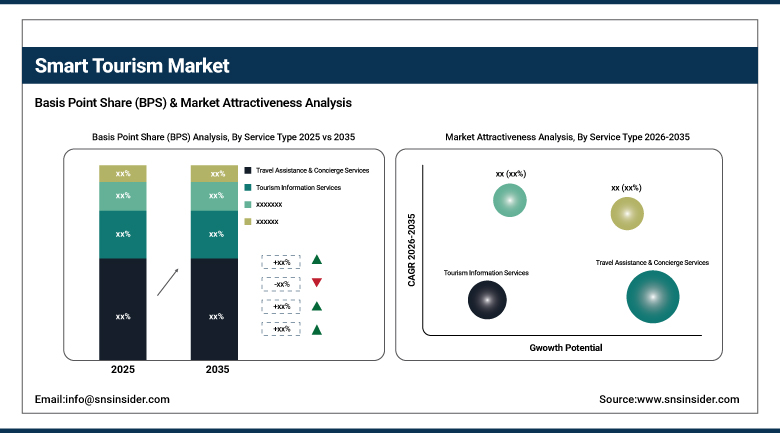
By Service Type: Travel Assistance & Concierge Services led with 36.8% share, while Location-Based Services is the fastest-growing segment with CAGR of 19.2%.
-
By Technology: Artificial Intelligence (AI) & Machine Learning led with 34.5% share, while Augmented Reality (AR) / Virtual Reality (VR) is the fastest-growing segment with CAGR of 21.0%.
-
By Application: Smart Hospitality & Accommodation led with 38.2% share, while Smart Attractions & Theme Parks is the fastest-growing segment with CAGR of 20.3%.
-
By End-User: Tourists / Travelers led with 42.1% share, while Government & Tourism Boards is the fastest-growing segment with CAGR of 18.7%.
By Service Type, Travel Assistance & Concierge Services segment dominates the Smart Tourism Market, Location-Based Services segment expected to grow fastest
The Travel Assistance & Concierge Services segment dominated the market because of growing demand for personalized experiences, real-time assistance, itinerary assistance, booking services, and premium travel experiences. Tourists are looking for convenient solutions that will ease their travel process and improve the overall experience. The increased use of digital travel platforms, apps, and AI-based travel assistants has helped boost the demand for concierge services. Increasing international tourism and growing demand for customized travel solutions have continued to fuel the dominance of the segment.
The Location-Based Services segment is the fastest growing because of the rising adoption of GPS-enabled services, apps, and navigation solutions within tourism. Tourists are increasingly turning to location-based services for local attractions, personalized recommendations, route optimization, and discovery of the surrounding areas. The use of artificial intelligence, geofencing, and mobile connectivity has enhanced the performance of services. The rising need for personalized and contextual travel experiences is driving adoption of location-based solutions within tourism.
By Technology, Artificial Intelligence (AI) & Machine Learning segment dominates the Smart Tourism Market, Augmented Reality (AR) / Virtual Reality (VR) segment expected to grow fastest
The Artificial Intelligence (AI) & Machine Learning segment dominated the market owing to increased deployment of intelligent systems for recommendations, prediction, automation, and behavior analysis. AI technology is an effective way for tourism companies to become more efficient, increase customer satisfaction levels, and offer customized services based on the interests of the travelers. Investments made by companies in digital transformation, smart travel platforms, and automated service delivery are responsible for the large-scale deployment of AI and machine learning technologies in the tourism industry.
The Augmented Reality (AR) / Virtual Reality (VR) segment is the fastest growing due to growing demand for immersive travel experiences, virtual destination exploration, and interactive tourism applications. With the help of such technologies as AR and VR, travelers can virtually experience the destinations before their trips as well as gain additional digital information about places that they visit. Increasing adoption of immersive technologies by hotels, museums, theme parks, and other tourism companies supports market growth.
By Application, Smart Hospitality & Accommodation segment dominates the Smart Tourism Market, Smart Attractions & Theme Parks segment expected to grow fastest
The Smart Hospitality & Accommodation segment dominated the market owing to growing use of technology in hotels and accommodation establishments to provide efficient and effective services to guests and customers. The use of technology allows automation in check-in process and provides personalized services and improved energy management along with better security system. Digital platform, IoT, and AI solutions are being used by hotels and hospitality companies to meet new demands of travelers.
The Smart Attractions & Theme Parks segment is the fastest growing due to the increasing investment in digital entertainment and engagement solutions. Attractions and theme parks are using AR, VR, mobile apps, and other smart ticketing solutions to improve their services for visitors as well as enhance their operational management. Increasing demand for immersive entertainment and attraction services, as well as better visitor engagement services, is leading to the adoption of such technologies.
By End-User, Tourists / Travelers segment dominates the Smart Tourism Market, Government & Tourism Boards segment expected to grow fastest
The Tourists / Travelers segment dominated the market because of the increasing popularity of digital travel solutions for trip planning, navigation, accommodation booking, and personalization purposes. Individuals tend to use smart tourism platforms to obtain real-time information, recommendations, and services. The rise in the availability of smartphones, the Internet, and demand for efficient traveling are promoting adoption of the solutions in the category. Expansion of online travel ecosystems and mobile tourism solutions is helping the category dominate the market.
The Government & Tourism Boards segment is the fastest growing because of growing investments in smart city projects, digital tourism infrastructure, and destination management solutions. Governments and tourism organizations are using smart tourism technologies to attract tourists and improve destinations’ offerings. Increasing interest in sustainable tourism, data-based decision-making, and digital marketing is promoting adoption in the category.
Regional Analysis:
|
Region |
Major Country |
Share within Region, 2025 (%) |
|---|---|---|
|
North America |
United States |
78.0% |
|
Europe |
Germany |
25.0% |
|
Asia Pacific |
China |
37.0% |
|
Latin America |
Brazil |
35.0% |
|
Middle East & Africa |
UAE |
27.0% |
North America Smart Tourism Market Insights
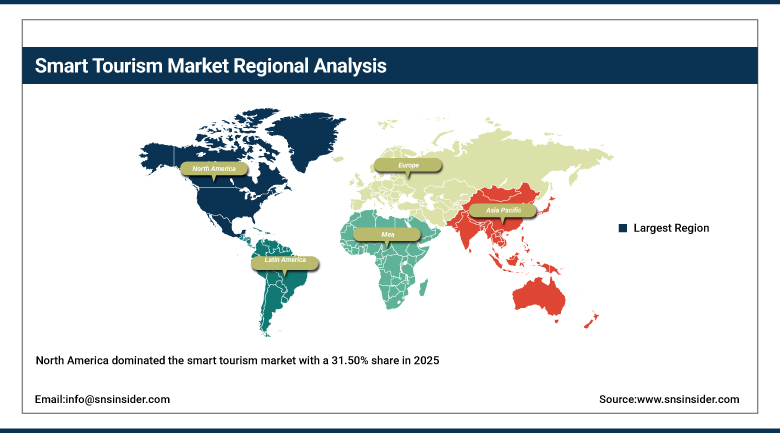
North America dominated the smart tourism market with a 31.50% share in 2025, owing to advanced digital infrastructure, high adoption of smart technologies, and a strong presence of leading travel service providers across the region. Widespread use of AI, IoT, and mobile applications to enhance tourist experiences continues reinforcing the region's market leadership.
The concentration of major booking platforms and technology companies headquartered in the U.S. continues to drive innovation that spreads outward to other regions. Canada contributes a smaller but consistent share of regional demand, aided by its own growing tourism technology infrastructure.
Get Customized Report as per Your Business Requirement - Enquiry Now
Asia Pacific Smart Tourism Market Insights
Asia Pacific is expected to grow at the fastest CAGR, at about 17.66% from 2026 to 2035, driven by rapid digitalization across the tourism sector, rising smartphone penetration, and growing adoption of AI-based travel solutions. An expanding middle-class population and rising international and domestic tourism continue accelerating regional market growth.
Government initiatives promoting smart city and tourism infrastructure development add further momentum, positioning Asia Pacific to keep outpacing every other region in growth rate through the forecast period.
Europe Smart Tourism Market Insights
Europe held a significant share of the market in 2025, supported by well-established tourism infrastructure, high adoption of digital travel solutions, and a strong presence of leading service providers across the continent. Government initiatives promoting smart city development continue to strengthen Europe's market position.
Growing integration of AI and IoT into tourism, alongside rising demand for personalized travel experiences, keeps building on top of that established infrastructure, positioning Europe as a technically sophisticated, if more measured, growth market relative to Asia Pacific and North America.
MEA & Latin America Smart Tourism Market Insights
The Middle East and Africa and Latin America together showed steady growth in the market in 2025, driven by increasing smartphone penetration, rising adoption of digital travel platforms, and expanding tourism infrastructure across the region. Growing international tourist arrivals continue contributing to improving market presence in both regions.
Government support for smart tourism initiatives, paired with rising interest in tech-enabled travel experiences, continues to shape how quickly both regions can close the gap with more established markets.
Market Dynamics:
Growth Drivers: Digital and IoT adoption sustains personalized, efficient tourism experiences
Investments into digital infrastructure, Internet of Things devices, artificial intelligence technology, and maintenance will become critical to implementing smart tourism solutions. Small and medium-size tourism businesses typically lack enough financial resources for investing in such technologies, while high prices and scarcity of technology become additional obstacles that prevent small and medium-size tourism organizations from adopting those technologies within developing countries.
68% of small and medium-size tourism organizations in developing countries chose not to implement smart technologies because of high expenses related to IoT and artificial intelligence technologies. Privacy issues constitute another obstacle because smart tourism depends on collecting personal data of tourists, and 64% of tourists were unwilling to use smart tourism solutions due to privacy and cybersecurity reasons.
Restraints: High implementation costs restrict adoption among smaller tourism operators
It will be essential to make significant investments in digital infrastructure, IoT equipment, AI-based technology, and maintenance in order to successfully apply smart tourism solutions. Small and medium-size tourism firms generally do not have sufficient funds to invest in such technologies, and high costs along with limited availability of technology serve as additional barriers preventing their adoption among emerging countries.
68% of small and medium-size tourism companies in emerging countries decided not to use smart technology due to high costs of IoT and AI-based solutions. Privacy concerns are another constraint since smart tourism is based on collecting the personal information of tourists, and 64% of tourists expressed their reluctance to use smart tourism solutions for the sake of their privacy and cybersecurity.
Opportunities: AR/VR and mobile platform expansion open substantial new growth avenues
Augmented reality/virtual reality technologies in tourism allow tourists to immerse themselves in the experience and even virtually visit attractions prior to or while visiting them. Travel planning through AI, which suggests individualized itineraries to users, is also increasing traveler engagement along with the development of smart cities where information about transport, tourist attractions, and accommodation facilities are integrated into the system and provide seamless experiences for travel.
72% of travel and tourism providers had adopted any of the three types of technology mentioned above by 2025, thus increasing traveler engagement and increasing the number of tech-savvy travelers by 40%. Mobile applications, digital payments, and online booking systems provide another area of opportunities, as 79% of companies developed these channels by 2025 and increased efficiency by 35%, reaching 50% more customers in emerging markets.
Recent Developments:
-
2023: In October 2023, Airbnb introduced Smart Categories and the AI Trip Assistant, transforming how users discover and book unique stays and experiences.
-
2024: In July 2024, Booking.com, a subsidiary of Booking Holdings, launched the Genius AI Travel Planner, a generative AI tool that creates personalized, multi-stop itineraries based on natural language prompts.
-
2025: In February 2025, Expedia Group unveiled the OneKey Smart Travel Graph, a unified identity and preference engine powering cross-brand personalization across Expedia, Vrbo, Hotels.com, and Orbitz.
Smart Tourism Market Key Players:
-
Booking Holdings Inc.
-
Expedia Group
-
Airbnb Inc.
-
Amadeus IT Group SA
-
Trip.com Group
-
Google Travel
-
Microsoft
-
Samsung SDS
-
Huawei Technologies
-
TUI Group
-
Travelport Worldwide Ltd.
-
Cisco Systems Inc.
-
Oracle Corporation
-
Accenture Travel Technology Services
-
NEC Corporation
-
Siemens Smart Infrastructure
-
Oyo
-
AccuWeather
Smart Tourism Market Report Scope:
| Report Attributes | Details |
|---|---|
| Market Size in 2025 | USD 813.70 Million |
| Market Size by 2035 | USD 3,580.31 Million |
| CAGR | CAGR of 15.97% From 2026 to 2035 |
| Base Year | 2025 |
| Forecast Period | 2026-2035 |
| Historical Data | 2022-2024 |
| Report Scope & Coverage | Market Size, Segments Analysis, Competitive Landscape, Regional Analysis, DROC & SWOT Analysis, Forecast Outlook |
| Key Segments | • By Service Type (Tourism Information Services, Travel Assistance & Concierge Services, Location-Based Services, Tour Planning & Recommendations, Security & Surveillance Services) • By Technology (Internet of Things (IoT), Artificial Intelligence (AI) & Machine Learning, Augmented Reality (AR) / Virtual Reality (VR), Big Data Analytics, Cloud Computing) • By Application (Smart Transportation, Smart Hospitality & Accommodation, Smart Attractions & Theme Parks, Smart Ticketing & Booking, Smart Tourism Management & Analytics) • By End-User (Tourists / Travelers, Tour Operators, Hotels & Resorts, Government & Tourism Boards, Transportation Providers) |
| Regional Analysis/Coverage | North America (US, Canada), Europe (Germany, UK, France, Italy, Spain, Russia, Poland, Rest of Europe), Asia Pacific (China, India, Japan, South Korea, Australia, ASEAN Countries, Rest of Asia Pacific), Middle East & Africa (UAE, Saudi Arabia, Qatar, South Africa, Rest of Middle East & Africa), Latin America (Brazil, Argentina, Mexico, Colombia, Rest of Latin America). |
| Company Profiles | Booking Holdings Inc., Expedia Group, Airbnb Inc., Amadeus IT Group SA, Sabre Corporation, Trip.com Group, Google Travel, Microsoft, Samsung SDS, Huawei Technologies, TUI Group, Travelport Worldwide Ltd., Cisco Systems Inc., IBM Corporation, Oracle Corporation, Accenture Travel Technology Services, NEC Corporation, Siemens Smart Infrastructure, Oyo, AccuWeather |

Frequently Asked Questions
The Smart Tourism Market is expected to grow at a CAGR of 15.97% from 2026 to 2035, driven by IoT, AI, and smart destination adoption.
The Smart Tourism Market was valued at USD 813.70 Million in 2025, supported by rising use of digital platforms, mobile applications, and connected tourism infrastructure.
Increasing adoption of IoT, AI, big data analytics, and mobile technology to deliver personalized, efficient, and seamless travel experiences is the primary growth driver.
Tourism Information Services segment dominated the Smart Tourism Market.
North America dominated the market in 2025 with a 31.50% share, driven by advanced digital infrastructure and high adoption of smart travel technolo
