
Space Tourism Market Report Scope & Overview:
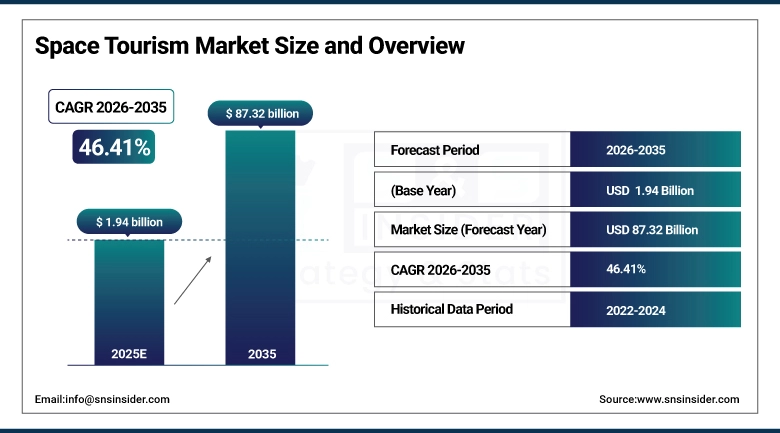
The Space Tourism Market was valued at USD 1.94 billion in 2025 and is expected to reach USD 87.32 billion by 2035, growing at a CAGR of 46.41% from 2026-2035.
Space Tourism Market is experiencing a growth spurt due to the increasing demand for unique experiences from high-net-worth individuals, the rise of technological advancements in the form of reusable rockets, and the growth of commercial space missions. The increasing investments from private players, the government, and the rise of media coverage are contributing factors for the growth of the Space Tourism Market. The rise of technological advancements, the development of orbital hotels, and the availability of suborbital flights are making space travel common.
For example, the Blue Origin NS‑21 flight on May 19, 2024, carried a 90‑year‑old traveler, demonstrating continued suborbital space tourism operations by private companies and highlighting the increasing flight activity and broadening appeal of space trips to diverse passengers.
SpaceX’s Starship fully‑reusable system completed multiple test flights in 2025, advancing next-generation launch capabilities that aim to reduce launch costs and increase flight frequency, further accelerating commercial space access and supporting growth in the space tourism and satellite deployment markets.
To Get more information on Space Tourism Market - Request Free Sample Report
Space Tourism Market Trends
-
Rising interest in commercial space travel and experiences is driving the space tourism market.
-
Growing investments by private aerospace companies are boosting market growth and enabling test flights and suborbital trips.
-
Expansion of luxury travel and high-net-worth consumer segments is fueling adoption.
-
Increasing focus on orbital, suborbital, and lunar tourism experiences is shaping market trends.
-
Advancements in reusable rocket technology, safety systems, and spacecraft design are enhancing feasibility and accessibility.
-
Rising media coverage and public awareness are supporting market expansion.
-
Collaborations between aerospace manufacturers, travel agencies, and government space programs are accelerating innovation and global adoption.
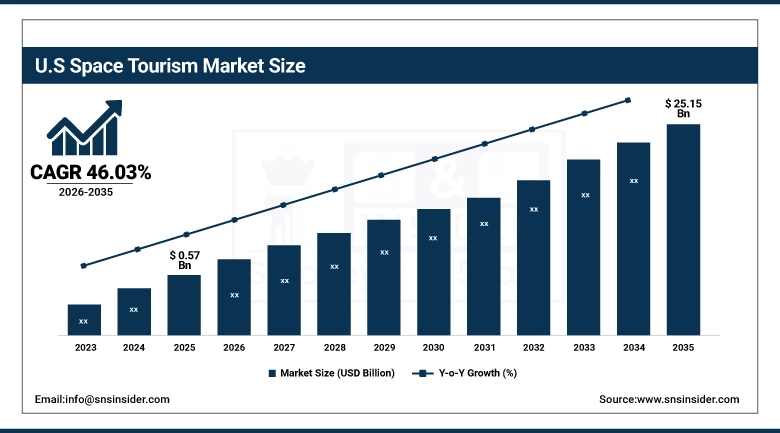
U.S. Space Tourism Market was valued at USD 0.57 billion in 2025 and is expected to reach USD 25.15 billion by 2035, growing at a CAGR of 46.03% from 2026-2035.
The U.S. Space Tourism Market is expanding because of the high demand for space tourism services by wealthy tourists, technological improvements in reusable spacecraft, increased commercial launches by companies like SpaceX and Blue Origin, and strong government-private sector collaborations for the growth of the market.
Market Growth Drivers: Rising demand for exclusive space experiences among high-net-worth individuals and adventure enthusiasts globally fuels rapid growth of space tourism market
The increasing trend of high net worth individuals who are eager to have unique and adventurous experiences is also contributing to the space tourism market. Companies such as SpaceX, Blue Origin, and Virgin Galactic are sending suborbital or orbital flights to space. These are attracting the attention of high net worth individuals who are willing to spend premium amounts to have unique experiences. Technological advancements are contributing to the space tourism market. Technological advancements are making space tourism activities safer and more reliable. Additionally, the media coverage being provided to the space tourism activities is creating an aspirational value for the space tourism market. The luxury tourism trends along with the technological advancements being made to the spacecraft are contributing to the space tourism market.
Virgin Galactic reports over 700 seat reservations for future spaceflights, with pricing for next-generation suborbital trips around USD 600,000 per seat, highlighting robust demand among affluent clients for exclusive and premium space experiences.
Market Restraints: High ticket prices and prohibitive operational costs are limiting widespread adoption of space tourism experiences globally
The space tourism industry is facing a challenge of restraints due to the high cost of the ticket prices. The high cost of operations is mainly due to the high-tech aircraft and staff needed. The high cost of operations can only be afforded by a handful of the richest people on the planet. This is a major restraint to the space tourism industry. Until the cost is reduced by mass production of technology or the government provides subsidies to the industry, this will still be a challenge to the market size of the industry. Affordability is still a major challenge to the space tourism industry.
Orbital space tourism with SpaceX/Axiom Space is estimated at around USD 55 million per seat for multi-day missions to the International Space Station, clearly limiting the customer base to ultra-high-net-worth individuals or organizations and illustrating the exclusivity and financial barrier of such experiences.
Market Opportunities: Growing public interest and media exposure of space missions are boosting commercial space tourism awareness and adoption worldwide
The public interest in space exploration activities, fueled by the popularity of space missions, participation of famous people, and media coverage of space activities on social media, is providing opportunities for the growth of the space tourism market. The global media attention to space activities can be used to attract wealthy tourists who are eager to have unique experiences. The viral marketing activities, simulations, and promotional campaigns are increasing public awareness of suborbital and orbital flights. The association with famous people, media agencies, and learning institutions is also fueling interest among target customers for space tourism services. The increased interest in human space travel activities and alien experiences is motivating people to take private space flights.
Space Tourism Market Segment Analysis
-
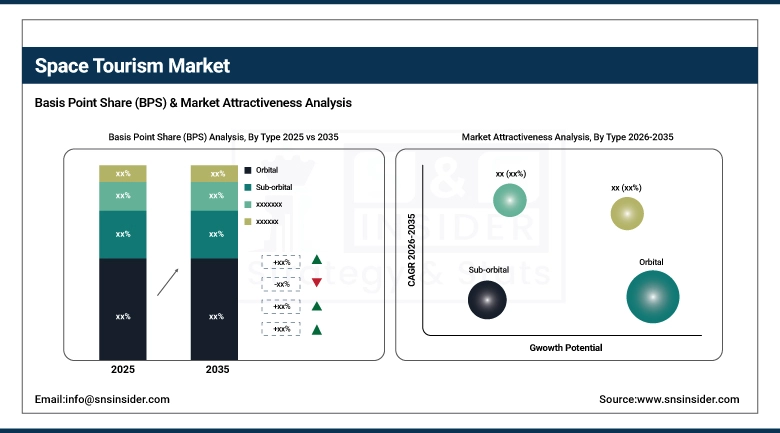
By Type, Orbital dominated the Space Tourism Market with ~49% share in 2025; Sub-orbital fastest growing (CAGR).
-
By HNW Community, 20M to 40M dominated the Space Tourism Market with ~44% share in 2025; More than 60M fastest growing (CAGR).
-
By Sales Channel, Launch Provider Direct dominated the Space Tourism Market with ~60% share in 2025; Third Party Partnerships fastest growing (CAGR).
-
By End Use, Commercial dominated the Space Tourism Market with ~51% share in 2025; Government fastest growing (CAGR).
By Type, Orbital segment dominates the Market, Sub-orbital segment expected to grow fastest
Orbital segment held the largest share in the Space Tourism Market in 2025 due to high revenue generation from multi-day stays, orbital flights, and luxury space experiences that cater to high-end tourists seeking immersive experiences. Advanced spacecraft capabilities, associations with commercial stations, and the increasing need for longer duration missions contributed to the dominance of the orbital segment.
Sub-orbit segment is anticipated to experience the fastest CAGR in the forecasted period of 2026-2035, driven by lower ticket prices, shorter trip lengths, and increased accessibility for adventure tourists. Advancements in rocket technology, fast turnaround times, and media coverage of high-profile spaceflights are helping drive demand for space tourism, with sub-orbit being the most popular option for first-time space travelers.
By HNW Community, 20M to 40M segment dominates the Market, More than 60M segment expected to grow fastest
20M to 40M segment dominated the Space Tourism Market in 2025 as they are a high-end customer segment who loves exclusive and adventurous experiences, and they are ready to spend premium dollars on their suborbital and orbital space tours, and with their increased awareness about space tourism, they are helping in high revenue generation, thus dominating the space tourism market.
More than 60M segment is expected to experience the fastest CAGR from 2026-2035 as more and more ultra-HNW individuals are entering the space tourism market, as they are interested in customized, luxurious, and longer-duration space tours, thus helping in increased adoption of space tourism.
By Sales Channel, Launch Provider Direct segment dominates the Market, Third-Party Partnerships segment expected to grow fastest
The Launch Provider Direct segment was the market leader in the Space Tourism Market in 2025. Companies like SpaceX and Blue Origin provide one-stop services to their customers with direct interaction. Direct sales ensure higher revenues for the company, better customer experience, and improved business operations.
The Third-Party Partnerships segment is projected to witness the highest CAGR growth rate during the forecast period of 2026-2035. This is due to the increasing number of partnerships between space tourism operators, travel agencies, and service providers. Partnerships enable companies to expand their market base, improve their services, lower their operating expenses, and serve new customer groups without investing heavily in infrastructure.
By End Use, Commercial segment dominates the Market, Government segment expected to grow fastest
The Commercial segment was the market leader in the Space Tourism Market in 2025, with companies like SpaceX and Blue Origin launching sub-orbital or orbital flights for high net worth individuals. The increasing demand for luxury services, media attention for these ventures, and the development of new technology for these commercial vehicles are all contributing to the market share for the Commercial segment.
The Government segment is expected to grow at the highest CAGR from 2026-2035 due to increased collaborations between countries for research missions, astronaut training missions, and prestige missions. Increased investments in space infrastructure, technology, and programs are creating a market opportunity for Government missions, thus increasing the market share for this segment.
Regional Analysis
North America Space Tourism Market Insights
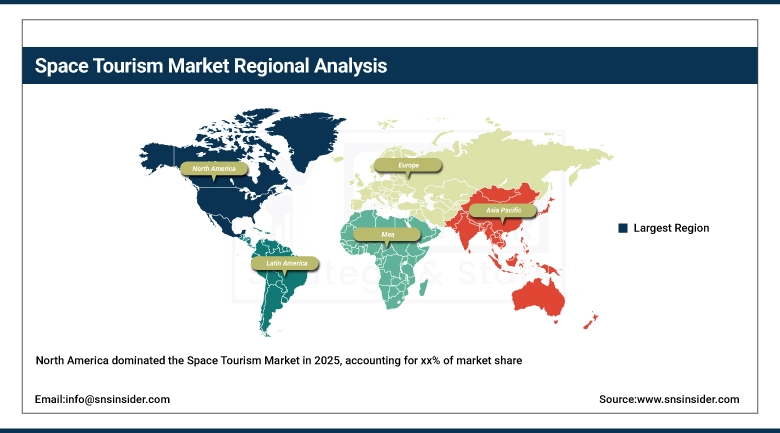
North America accounted for the largest share in the Space Tourism Market in 2025, followed by Asia-Pacific. This is because the region has major private space tourism companies like SpaceX, Blue Origin, and Virgin Galactic. Moreover, the region has better aerospace facilities, government support, and high discretionary spending by high-end customers. This has led to the growth of the market in the region. In addition, the region has better spaceports, workforce, and technology, which has contributed to the high market revenue share in the region.
Get Customized Report as per Your Business Requirement - Enquiry Now
Asia Pacific Space Tourism Market Insights
Asia Pacific segment is anticipated to register the fastest CAGR of about 48.34% during the forecast period of 2026-2035, driven by increased investments in space tourism by emerging players in China, India, and Japan. Increased interest in space tourism among high net worth individuals, as well as government-private partnerships, along with rapid development in spaceports, will boost space tourism in the Asia Pacific segment, resulting in a strong adoption rate and fastest revenue growth in the space tourism market.
Europe Space Tourism Market Insights
Europe, in the Space Tourism Market, is growing steadily with increasing investments from private players as well as collaborations with government space agencies. Countries such as Germany, France, and the UK are launching sophisticated spacecraft, spaceports, and orbital platforms. With increasing interest from high-net-worth individuals, technological advancements, and favorable government regulations, the region is launching commercial space missions, thereby contributing to the consistent revenue growth of the Space Tourism Market.
Middle East & Africa and Latin America Space Tourism Market Insights
Middle East & Africa in the Space Tourism Market is witnessing a steady growth in the region due to increased investments in space tourism infrastructure and collaborations between governments and international space tourism organizations. The region is witnessing a high demand for space tourism from high net-worth individuals.
Latin America in the Space Tourism Market is a new segment that is witnessing growth in the region due to increased interest in space tourism from high net-worth individuals and private aerospace organizations. The region is witnessing increased collaborations and investments in space tourism infrastructure.
Space Tourism Market Competitive Landscape:
Virgin Galactic
Virgin Galactic, founded in Mojave, California, is a commercial spaceflight company that specializes in space tourism, a concept known as suborbital spaceflight. The company specializes in the production of reusable spacecraft, VSS Unity, as well as the upcoming Delta Class, which are intended for the use of private individuals as well as researchers. The company focuses on the safety of its customers, the provision of a unique travel experience, as well as the commercialization of space travel.
-
2023: VSS Unity completed the “Galactic 04” commercial spaceflight on October 6, carrying six crew including private passengers, advancing routine suborbital space tourism.
-
2024: Completed “Galactic 07” on June 8, carrying private astronauts and research payloads; Unity’s final commercial flight precedes Delta Class vehicle introduction.
-
2025: Scaling operations in 2025 focus on building Delta Class vehicles for future tourism services; no specific flight announcements were made.
SpaceX
SpaceX is a leading aerospace manufacturer and space transport services company based in Hawthorne, California, founded by Elon Musk. The company is known for designing and manufacturing the Falcon and Starship lines of rockets, which are used for satellite launches, crew missions, and resupply of the International Space Station. SpaceX is a company that is taking a unique approach by merging innovations in reusable rockets with commercial and government spaceflight services. The company is also venturing into space tourism, private orbital, and deep space missions.
-
2024: Polaris Dawn private spaceflight launched September 10 with crew including Jared Isaacman, completing the first commercial spacewalk and deep orbit profile.
-
2025: Preparations began for Starship commercial space tourism flights, including vehicle development and mission concepts; no completed tourist flights officially announced yet.
Blue Origin
Blue Origin, a private aerospace manufacturer and space tourism company, was founded by Jeff Bezos and is based in Kent, Washington. It is known for its reusable vehicle called New Shepard, which is used for suborbital space tourism and research purposes. Blue Origin specializes in safe, accessible, and experiential space travel, with a focus on developing autonomous vehicles that will carry civilians, researchers, and astronauts beyond the Kármán line. Its main goal is to expand commercial spaceflight participation, diversity, and accessibility in space experiences.
-
2025: New Shepard NS‑31 carried an all-female crew including celebrities on April 14, advancing diversity in space tourism.
-
2025: NS‑32 launched May 31 with six paying passengers, continuing Blue Origin’s commercial space tourism program.
-
2025: On December 20, Michaela Benthaus, first wheelchair user in space, flew aboard New Shepard, highlighting accessibility in suborbital tourism.
Key Players
-
SpaceX
-
Virgin Galactic
-
Axiom Space, Inc.
-
Space Adventures
-
Airbus Group SE
-
The Boeing Company
-
Space Perspective
-
Orbital Assembly Corporation
-
Nanoracks
-
Zero 2 Infinity
-
Bigelow Aerospace
-
Voyager Space
-
ExPace
-
Galactic Suite Space Resort
-
SpaceCorridor
-
Space Explorers
-
PD AeroSpace
-
Starchaser Industries
| Report Attributes | Details |
|---|---|
| Market Size in 2025 | USD 1.94 Billion |
| Market Size by 2035 | USD 87.32 Billion |
| CAGR | CAGR of 46.41% From 2026 to 2035 |
| Base Year | 2025 |
| Forecast Period | 2026-2035 |
| Historical Data | 2022-2024 |
| Report Scope & Coverage | Market Size, Segments Analysis, Competitive Landscape, Regional Analysis, DROC & SWOT Analysis, Forecast Outlook |
| Key Segments | • By Type (Orbital, Sub-orbital, Others) • By End Use (Government, Commercial, Others) • By Sales Channel (Launch Provider Direct, Third-Party Partnerships, Online Travel Agencies (OTAs)) • By HNW Community Segment (20M to 40M, 40M to 60M, More than 60M) |
| Regional Analysis/Coverage | North America (US, Canada), Europe (Germany, UK, France, Italy, Spain, Russia, Poland, Rest of Europe), Asia Pacific (China, India, Japan, South Korea, Australia, ASEAN Countries, Rest of Asia Pacific), Middle East & Africa (UAE, Saudi Arabia, Qatar, South Africa, Rest of Middle East & Africa), Latin America (Brazil, Argentina, Mexico, Colombia, Rest of Latin America). |
| Company Profiles | SpaceX, Blue Origin, Virgin Galactic, Axiom Space, Inc., Space Adventures, Airbus Group SE, The Boeing Company, Space Perspective, Sierra Space, Orbital Assembly Corporation, Nanoracks, Zero 2 Infinity, Bigelow Aerospace, Voyager Space, ExPace, Galactic Suite Space Resort, SpaceCorridor, Space Explorers, PD AeroSpace, Starchaser Industries |
Frequently Asked Questions
North America dominated the Space Tourism Market in 2025.
The Orbital segment dominated the Space Tourism Market in 2025.
Rising demand for exclusive space experiences among high-net-worth individuals and adventure enthusiasts globally fuels rapid growth of space tourism market.
The Space Tourism Market was valued at USD 1.94 billion in 2025.
The Space Tourism Market is expected to grow at a CAGR of 46.41% from 2026 to 2035.
