
Sports Medicine Market Report Scope & Overview:
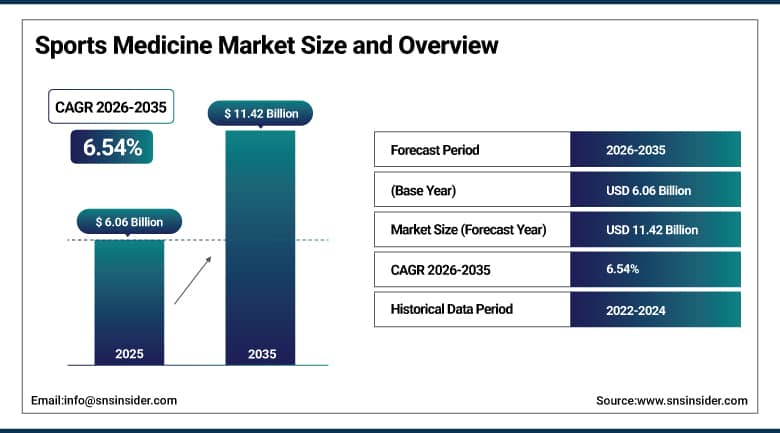
The Sports Medicine Market was valued at USD 6.06 Billion in 2025 and is expected to reach USD 11.42 Billion by 2035, growing at a CAGR of 6.54% from 2026 to 2035.
Sports medicine sits at the intersection of medical care, exercise science, and rehabilitation, aimed at preventing, diagnosing, and treating injuries while helping athletes, professional and recreational alike, get back to peak performance. Sports participation is genuinely enormous: more than 210 million Americans engage in some form of athletic activity every year, and the CDC tracks roughly 9 million sports-related injuries annually across every age group. That combination of scale and injury risk is what keeps demand for orthopedic implants, arthroscopy devices, biologics, and rehabilitation solutions climbing steadily, and technological advances including 3D printing, wearable monitoring devices, and regenerative medicine are giving clinicians considerably better tools for both diagnosis and personalized treatment planning than were available even a decade ago.
In 2024, Stryker Corporation unveiled its new arthroscopy and ligament repair equipment, which includes ergonomic design and digital guidance system. The Zimmer Biomet company, on the other hand, developed innovative minimally invasive implants and biologics for use by athletes and other active people around the world.
Market Size and Forecast
-
Market Size in 2026E: USD 6.46 Billion
-
Market Size by 2035: USD 11.42 Billion
-
CAGR: 6.54% from 2026 to 2035
-
Fastest Growing Region: Asia Pacific
-
Largest Region: North America
To Get More Information On Sports Medicine Market - Request Free Sample Report
Sports Medicine Market Trends
-
Growing prevalence of sports injuries is driving demand for preventive, diagnostic, and therapeutic sports medicine solutions.
-
Rising adoption of minimally invasive procedures, including arthroscopy and PRP injections, is favored for faster recovery.
-
Technological advancement in orthopedic implants, wearable sensors, and rehabilitation equipment is improving injury monitoring and recovery.
-
Expansion of the fitness and wellness industry is boosting demand for sports medicine services and products more broadly.
-
Integration of telemedicine and digital health, including remote monitoring and app-based rehabilitation, is enhancing patient accessibility.
The U.S. Sports Medicine Market Outlook
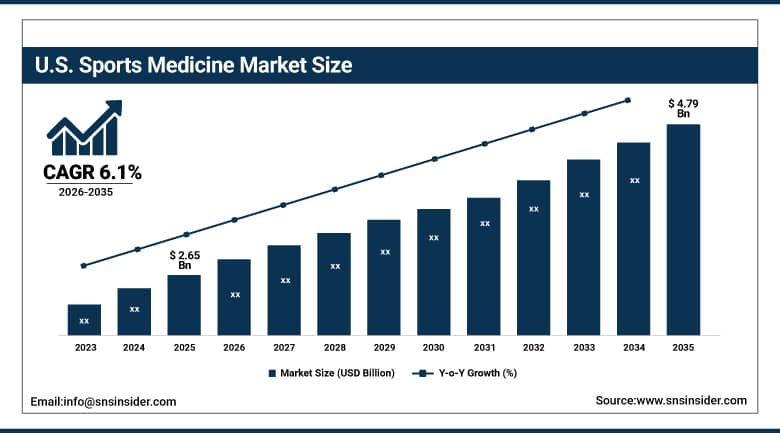
The U.S. Sports Medicine Market was valued at approximately USD 2.65 Billion in 2025 and is expected to reach approximately USD 4.79 Billion by 2035, growing at a CAGR of approximately 6.1%.
The U.S. market growth is fueled by the rise in participation in sports and fitness, the incidence of sports injuries, and the knowledge of injury prevention and treatment. Minimally invasive surgical technologies, regenerative medicine, and sports health wearables are helping boost this trend, while the growing demand for orthopedic implants, arthroscopic surgical instruments, and physical therapy products, along with higher spending on healthcare, are further aiding the growth prospects of the market in the United States.
Recent statistics show a 67% rise in sports injuries among Americans aged 65 or more from 2012 to 2021, based on statistics by the Centers for Disease Control and Prevention, with projections showing that there will be an additional increase of 123% in sports injuries by 2040, a pattern which far exceeds the expected increase of 7.9% in orthopedic surgeons.
Sports Medicine Market Segmentation Analysis
-
By Product, the body reconstruction & repair segment dominated the sports medicine market with a 43% share in 2025, while the accessories segment is the fastest growing.
-
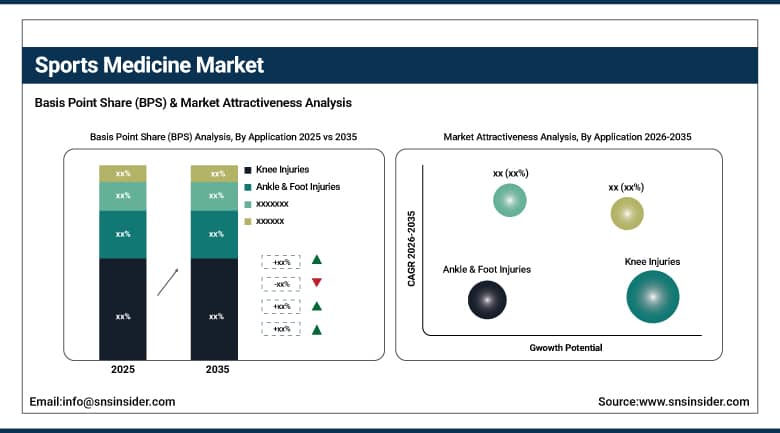
By Application, the knee injuries segment dominated the sports medicine market with a 36% share in 2025, while the ankle & foot injuries segment is the fastest growing.
-
By End Use: hospitals dominated the market with approximately 41% share in 2025, while home healthcare is projected to be the fastest-growing segment during the forecast period.
-
By Distribution Channel: direct sales dominated the market with approximately 38% share in 2025, while online sales are expected to register the fastest growth during the forecast period.
By Application, knee injuries dominate, ankle & foot injuries grow fastest
In 2025, injuries to knees will account for the main source of growth in the sports medicine market by accounting for the highest market share of 36%. The increasing incidences of knee issues that result from high impact exercises have led to an increase in demand for various solutions that include minimally invasive procedures like dry needling to surgical procedures like arthroscopy, making it the leading segment in all regions covered by this study.
Ankle and foot injuries are projected to experience the most rapid growth, attributed to the rising popularity of sports and exercise, which naturally increases the risk of ankle and foot injury across both recreational and competitive athletes. Technological innovations in addition to research and development work by major corporations have been driving this trend forward in the expansion of the market within this particular field of applications.
By Product, body reconstruction & repair dominates, accessories grows fastest
Body reconstruction and repair took the lead among all products in 2025, taking up 43% share of sales due to high adoption rates of surgical tools aimed at the repair of fractures and ligaments as well as due to increasing popularity of minimally invasive surgery. Due to the high number of accidental injuries that require medical help every year, demand for such products remains on the high level and is likely to ensure the market leadership of this product group.
Accessories are poised for the fastest growth, driven by the escalating popularity of PRICE therapy, protection, rest, ice, compression, and elevation, for immediate injury management. As athletes and active individuals prioritize injury prevention and self-care, demand for bandages, tapes, and other essential accessories is expected to climb significantly, particularly as recreational sports participation keeps expanding across both developed and emerging markets and self-care becomes a bigger part of everyday injury management.
Regional Analysis
|
Region |
Major Country |
Share within Region, 2025 (%) |
|---|---|---|
|
North America |
United States |
80.0% |
|
Europe |
Germany |
30.0% |
|
Asia Pacific |
China |
38.0% |
|
Middle East & Africa |
Saudi Arabia |
29.0% |
|
Latin America |
Brazil |
42.0% |
North America Sports Medicine Market Insights
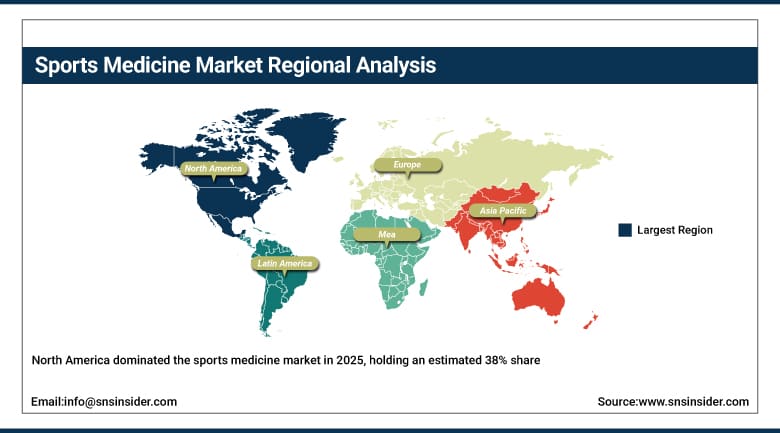
North America dominated the sports medicine market in 2025, holding an estimated 38% share, driven by rising sports participation, increasing prevalence of musculoskeletal injuries, and high adoption of advanced medical technologies. The region benefits from robust healthcare infrastructure, widespread insurance coverage, and a growing focus on preventive care and rehabilitation, with strong investment in orthopedic devices and minimally invasive surgical techniques accelerating growth further across the region's largest healthcare markets.
America is the dominant force in the North American market for sports medicine because of the highly advanced health-care sector, presence of many professional and non-professional players, and fast integration of modern surgical and rehabilitation tools into the sector. Sports infrastructure, orthopedic clinics, and innovative treatment solutions, along with the presence of high disposable income and solid regulatory framework, help the country remain the top contributor to the sports medicine revenue generation in North America.
Get Customized Report as Per Your Business Requirement - Enquiry Now
Europe Sports Medicine Market Insights
Europe shows steady growth in the sports medicine market, supported by high sports participation rates, advanced healthcare infrastructure, and rising adoption of minimally invasive surgeries and rehabilitation therapies. The region benefits from increasing awareness of injury prevention, performance optimization, and orthopedic care solutions, and that combination of infrastructure and awareness continues to support consistent market expansion across the continent's largest national healthcare systems, from Germany through to the UK and France.
The German sports medicine market leads the European region, contributing about 30% to the total sports medicine revenues of Europe, as a result of its well-developed healthcare system and its active sports culture in addition to the presence of advanced technology in sports medicine. The continuous government support for the development of sports venues, orthopedics, and rehab centers, along with increased awareness of injury prevention, ensures Germany as the biggest market for Europe's sports medicine industry.
Asia Pacific Sports Medicine Market Insights
The Asia-Pacific region is the fastest-growing market for sports medicine, expected to witness growth at a CAGR close to 8.5% up until 2035, owing to increasing engagement in sports activities, growing disposable incomes, and increasing healthcare infrastructure within the region. The increasing incidence of sports injuries along with increasing awareness about rehabilitation services will fuel the demand in the rapidly growing healthcare infrastructures of the region, from major cities of China to urban areas of India.
Being the dominant player in the sports medicine market within the Asia Pacific, China makes up 38% of the entire regional revenue due to the increase in sports culture in the country, efforts made by the government in encouraging physical activities, and higher disposable income levels in the country. With increasing numbers of injuries among young and professional athletes, there is high demand for orthopedic instruments and rehabilitation, and minimally invasive surgeries along with the use of imaging technology is increasingly being adopted in hospitals.
MEA & Latin America Sports Medicine Market Insights
The Middle East and Africa sports medicine market shows moderate growth, with countries including Saudi Arabia and the UAE investing in sports infrastructure and advanced rehabilitation centers. Also playing a role in driving the adoption is the emergence of a sports culture and an increase in health investments in Africa, as Saudi Arabia accounts for 29% of MEA revenue due to increased health and sports investment by the government.
Latin America is also following the trend of modest growth led by Brazil and Mexico, with increased sports participation, injuries, and public health campaigns sponsored by governments fueling demand, which accounts for about 42% of regional revenues. Heightened focus on prevention of diseases, physiotherapy and orthopedics is fueling market expansion in both regions throughout the forecast period, eventually reducing the gap with other more mature markets around the world.
Growth Drivers: Rising sports participation and technological advancement in treatment
Growing interest in sports and active lifestyles among an aging population, combined with technological advancement, is increasing the need for sports medicine solutions. 3D printing, wearable devices, and biologics are helping personalize treatment plans and monitor athletes' health and performance in real time, while minimally invasive surgical techniques, imaging technology, and regenerative medicine continue improving both diagnosis and treatment of sports injuries across every level of athletic participation, from weekend recreational athletes to elite professionals competing at the highest levels of their sport.
The growing number of older individuals who remain physically active is one of the factors behind increasing musculoskeletal problems and the requirement for more sports medicine interventions. The most recent statistics have shown a 67% rise in cases of sports-related injuries among people aged 65 years and above in America from 2012 until 2021. Moreover, these figures are expected to rise by another 123% by 2040, which significantly outweighs the forecasted 7.9% growth in the number of orthopedic surgeons.
Restraints: High treatment costs and intense competitive pressure
However, specialized sports medicine facilities, medical innovations, and treatment methods can become really costly, which makes it difficult for patients who are cost-sensitive and for small healthcare organizations to gain access to such facilities and methods due to high costs. The high level of competition in the field with the involvement of medical organizations, equipment producers, drug companies, and other specialized service providers leads to substantial pricing pressures.
New technologies such as regenerative medicine, orthopedic implants, wearables, and rehabilitative equipment are emerging fast, making the differentiation of products and services ever more difficult in the highly competitive marketplace. Small competitors might really find it hard to compete against well-established brands that can afford to spend money on their research, marketing activities, and partnerships, thus creating an environment which is tough to operate in for companies in the overall industry of sports medicine.
Opportunities: Expanding preventive care and aging active populations
The trend toward preventive healthcare and injury prevention strategies, including strength training, conditioning programs, and biomechanical analysis, is driving meaningful new demand for sports medicine solutions well beyond traditional post-injury treatment. The increasing number of individuals around the world interested in engaging in various sports and the realization that specialized treatment can be helpful in enabling them to be active has caused the scope of sports medicine to grow far beyond just professional athletes and into general preventative care for the general populace.
The increased awareness of health among individuals provides an avenue for sports medicine to benefit not just elite athletes but the general active population. Another area where there is the exploration of alternative methods is in the management of pain that has conventionally been done using drugs with the associated negative side effects and addiction issues.
Recent Developments:
-
2024: Stryker launched updated arthroscopy and ligament repair devices, featuring enhanced ergonomics, precision instrumentation, and integrated digital guidance systems for improved surgical accuracy.
-
2024: Zimmer Biomet introduced advanced minimally invasive implants and biologic products, improving treatment options for athletes and active patients worldwide.
-
2024: Smith & Nephew unveiled new arthroscopic instruments and soft tissue repair technologies, designed to optimize performance and safety in sports-related procedures.
-
2024: Medtronic launched next-generation ligament repair systems and rehabilitation devices, integrating digital monitoring and patient-specific treatment planning.
Sports Medicine Market key players are:
-
Zimmer Biomet Holdings, Inc.
-
CONMED Corporation
-
DePuy Synthes (Johnson & Johnson)
-
Enovis Corporation
-
DJO Global, Inc.
-
Breg, Inc.
-
Ossur hf
-
Bioventus Inc.
-
Exactech, Inc.
-
Active Implants LLC
-
Acumed LLC
-
Anika Therapeutics, Inc.
-
Orthofix Medical Inc.
-
Globus Medical, Inc.
-
Aesculap, Inc.
-
LimaCorporate S.p.A.
-
Medtronic plc
Sports Medicine Market Report Scope :
| Report Attributes | Details |
|---|---|
| Market Size in 2025 | USD 6.06 Billion |
| Market Size by 2035 | USD 11.42 Billion |
| CAGR | CAGR of 6.54% From 2026 to 2035 |
| Base Year | 2025 |
| Forecast Period | 2026-2035 |
| Historical Data | 2022-2024 |
| Report Scope & Coverage | Market Size, Segments Analysis, Competitive Landscape, Regional Analysis, DROC & SWOT Analysis, Forecast Outlook |
| Key Segments | • By Product (Body Monitoring and Evaluation Devices, Body Support & Recovery Products, Body Reconstruction & Repair, Accessories) • By Application (Shoulder Injuries, Knee Injuries, Back & Spine Injuries, Ankle & Foot Injuries, Hip Injuries, Elbow & Wrist Injuries, Other Injuries) • By End Use (Hospitals, Sports Clinics, Home Healthcare, Fitness Centers, Rehabilitation Centers) • By Distribution Channel (Direct Sales, Online Sales, Retail Sales, Wholesale, Distributors) |
| Regional Analysis/Coverage | North America (US, Canada), Europe (Germany, UK, France, Italy, Spain, Russia, Poland, Rest of Europe), Asia Pacific (China, India, Japan, South Korea, Australia, ASEAN Countries, Rest of Asia Pacific), Middle East & Africa (UAE, Saudi Arabia, Qatar, South Africa, Rest of Middle East & Africa), Latin America (Brazil, Argentina, Mexico, Colombia, Rest of Latin America). |
| Company Profiles | Stryker Corporation, Zimmer Biomet Holdings, Inc., Smith & Nephew plc, Arthrex, Inc., CONMED Corporation, DePuy Synthes (Johnson & Johnson), Enovis Corporation, DJO Global, Inc., Breg, Inc., Össur hf, Bioventus Inc., Exactech, Inc., Active Implants LLC, Acumed LLC, Anika Therapeutics, Inc., Orthofix Medical Inc., Globus Medical, Inc., Aesculap, Inc., LimaCorporate S.p.A., Medtronic plc |
Frequently Asked Questions
The Sports Medicine Market is expected to grow at a CAGR of 6.54% from 2026 to 2035.
The Sports Medicine Market is projected to reach USD 11.42 Billion by 2035.
The body reconstruction & repair segment led the sports medicine market, accounting for 43% share in 2025.
