
Tahini Market Report Scope & Overview:
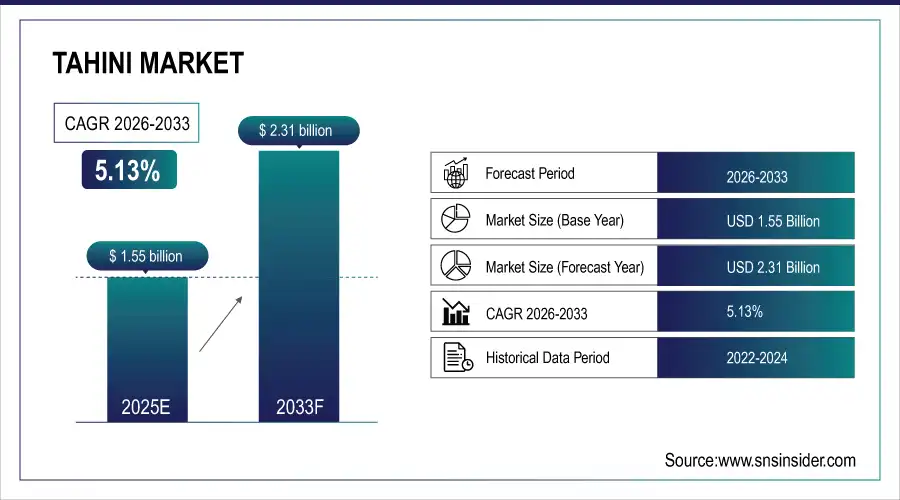
The Tahini Market Size is valued at USD 1.55 Billion in 2025E and is projected to reach USD 2.31 Billion by 2033, growing at a CAGR of 5.13% during the forecast period 2026–2033.
The Tahini Market analysis report delivers comprehensive insights into evolving product developments, usage patterns and channel expansion. Increasing preference for natural sesame-based foods, wider incorporation in culinary and bakery preparations and rising health-focused consumption continue to accelerate market uptake throughout the forecast period.
Tahini consumption exceeded 1.9 million tons in 2025, supported by rising demand for sesame spreads and expanding use in snacks, sauces, and bakery products.
Market Size and Forecast:
-
Market Size in 2025: USD 1.55 Billion
-
Market Size by 2033: USD 2.31 Billion
-
CAGR: 5.13% from 2026 to 2033
-
Base Year: 2025
-
Forecast Period: 2026–2033
-
Historical Data: 2022–2024
To Get more information On Tahini Market - Request Free Sample Report
Tahini Market Trends:
-
Rising demand for clean-label and minimally processed sesame products is shaping innovation in tahini formulations.
-
Expanding integration of tahini in gourmet snacks, fusion cuisines, and premium bakery items is boosting product visibility globally.
-
Health-driven consumer behavior is increasing interest in protein-rich, plant-based spreads such as tahini.
-
Growing collaborations between food brands and Mediterranean/HORECA chains are accelerating tahini-based menu innovations.
-
Online sales of tahini are rising rapidly due to recipe-focused content, digital groceries, and specialty e-commerce platforms.
-
Introduction of flavored tahini variants such as chocolate, roasted, and spicy blends is attracting younger and experimental consumers.
U.S. Tahini Market Insights:
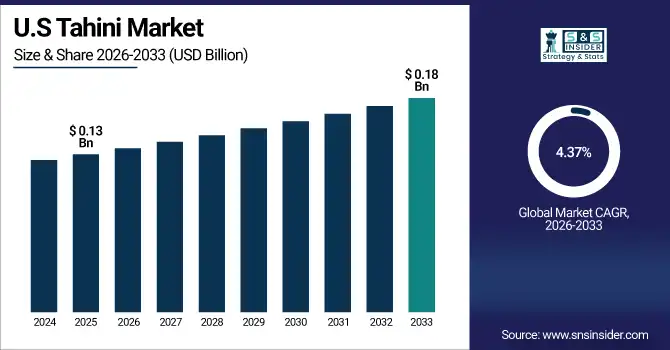
The U.S. Tahini Market is projected to grow from USD 0.13 Billion in 2025E to USD 0.18 Billion by 2033, at a CAGR of 4.37%. Growth is supported by rising demand for plant-based foods, expanding Mediterranean cuisine adoption, and strong retail and e-commerce availability of premium tahini products.
Tahini Market Growth Drivers:
-
Growing shift toward plant-based, nutrient-dense foods is driving stronger demand for versatile sesame-based tahini products.
Growing shift toward plant-based, nutrient-rich diets is a key driver of Tahini Market growth. Increasing consumer awareness of health and wellness benefits has led to higher demand for sesame-based spreads and ingredients. Expanding adoption of vegan and clean-label foods, combined with growing integration of tahini in bakery, snacks and sauces, is boosting market penetration. Brands are leveraging this trend through innovative flavors, convenient packaging, and e-commerce availability to attract health-conscious and experimental consumers.
Tahini sales increased 5.4% in 2025, fueled by rising demand for plant-based spreads and health-focused food products.
Tahini Market Restraints:
-
Volatile sesame seed prices and limited raw material availability are restricting consistent growth of the Tahini Market.
Volatile sesame seed prices and limited raw material availability are key restraints for the Tahini Market. Fluctuating agricultural yields and supply chain disruptions can increase production costs, impacting pricing and profit margins. Limited access to high-quality sesame also constrains manufacturers’ ability to meet growing demand. Combined with seasonal variations and geopolitical factors affecting trade, these challenges hinder consistent market growth and force brands to balance affordability, quality and supply reliability strategies.
Tahini Market Opportunities:
-
Expanding popularity of plant-based diets and functional foods offers opportunities for innovative tahini products and applications.
Rising popularity of plant-based diets and functional foods presents a significant opportunity for Tahini Market expansion. Consumers are increasingly seeking nutrient-dense, natural, and versatile ingredients, driving demand for tahini across spreads, sauces, bakery, and snacks. Innovative product developments such as flavored tahini, organic variants, and convenient packaging enhance appeal. Meanwhile, digital marketing, e-commerce platforms, and recipe-driven content are expanding consumer reach, enabling brands to capture loyalty and increase market penetration globally.
Plant-based tahini products accounted for 22% of new spreads and sauces launches in 2025, driven by rising health-conscious consumer demand.
Tahini Market Segmentation Analysis:
-
By Product Type, Paste held the largest market share of 46.75% in 2025, while Sauces & Spreads is expected to grow at the fastest CAGR of 6.12% during 2026–2033.
-
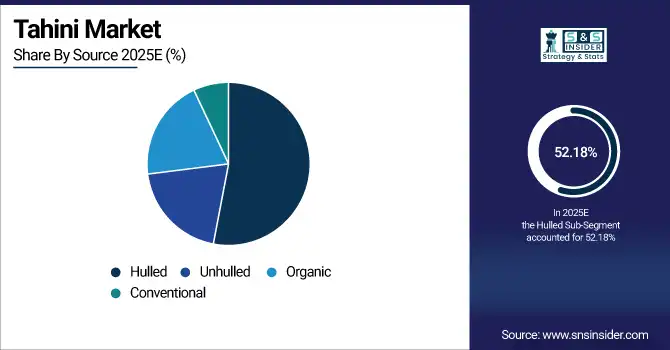
By Source, Hulled dominated with a 52.18% share in 2025, while Organic is projected to expand at the fastest CAGR of 7.05% during the forecast period.
-
By Application, Food & Beverages accounted for the highest market share of 39.62% in 2025, while Bakery & Confectionery is anticipated to record the fastest CAGR of 6.23% through 2026–2033.
-
By Distribution Channel, Supermarkets/Hypermarkets held the largest share of 44.87% in 2025, while Online Retail is expected to grow at the fastest CAGR of 7.14% during 2026–2033.
By Product Type, Paste Dominates While Sauces & Spreads Expand Rapidly:
Paste segment dominated the market due to its extensive use in traditional Middle Eastern cuisine, strong household familiarity and versatility across dips, dressings, bakery recipes and retail packaged foods. Its smooth texture and wide acceptance in both commercial and home kitchens strengthen its leadership. In 2025, paste-based tahini consumption exceeded 920,000 tons.
Sauces & Spreads is the fastest growing segment as consumers increasingly adopt tahini-infused condiments, fusion spreads and ready-to-use sauce formats. Rising experimentation in cuisines and the trend toward healthier, sesame-based flavor enhancers are accelerating adoption. In 2025, tahini sauce and spread demand exceeded 340,000 tons.
By Source, Hulled Tahini Dominates While Organic Tahini Expands Rapidly:
Hulled segment dominated the market due to its milder flavor, smoother consistency and stronger acceptance in international cuisines. Food manufacturers prefer hulled varieties for packaged dips, confectionery and bakery applications, reinforcing its leading position. In 2025, hulled tahini production surpassed 1.1 million tons.
Organic is the fastest growing segment as consumers increasingly shift toward clean-label, chemical-free sesame products. Expanding organic farming acreage and rising premium food consumption are accelerating its growth. In 2025, organic tahini demand reached 280,000 tons, reflecting growing adoption across health-focused markets.
By Application, Food & Beverages Dominate While Bakery & Confectionery Expand Rapidly:
Food & Beverages segment dominated the market as tahini remains a core ingredient in traditional foods such as hummus, sauces, marinades and ready-to-eat meals. Its growing use in packaged ethnic foods and restaurant chains reinforces its leadership. In 2025, food & beverage applications accounted for over 960,000 tons of tahini usage.
Bakery & confectionery is the fastest growing segment due to rising demand for sesame-infused pastries, halva-inspired sweets, tahini cookies and artisan baked goods. Product innovation by premium bakeries and snack brands continues to fuel expansion. In 2025, bakery and confectionery applications reached 350,000 tons of consumption.
By Distribution Channel, Supermarkets/Hypermarkets Dominate While Online Retail Expands Rapidly:
Supermarkets/Hypermarkets segment dominated the market as they offer wide product assortments, strong brand visibility and consumer trust for food purchases. Established shelf placement, frequent promotions and rising penetration of international food sections support their leading role. In 2025, supermarket and hypermarket sales of tahini surpassed 510 million units.
Online retail is the fastest growing segment driven by digital grocery adoption, rising preference for specialty ethnic products and influence of recipe-driven food exploration. E-commerce platforms enable greater brand exposure and convenient access to artisanal and organic tahini brands. In 2025, online tahini sales exceeded 145 million units.
Tahini Market Regional Analysis:
Middle East and Africa Tahini Market Insights:
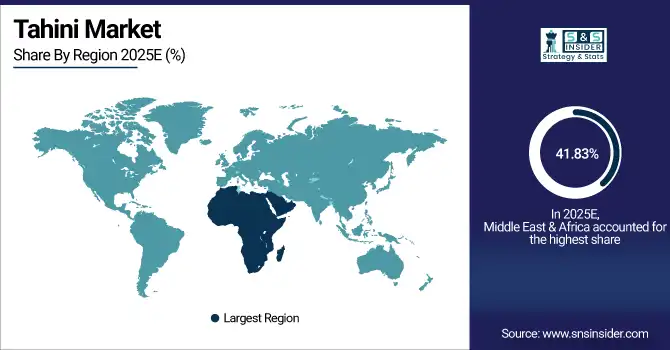
The Middle East & Africa Tahini Market dominated with a 41.83% share, driven by longstanding culinary reliance on sesame-based foods and strong domestic production. Rising urban consumption, expanding retail penetration and increased use of tahini in packaged snacks and ready meals further strengthen its lead. Major markets such as Saudi Arabia, the UAE, Egypt, Lebanon, and South Africa continue to support innovation, processing capacity, and export growth, reinforcing the region’s dominance.
Get Customized Report as per Your Business Requirement - Enquiry Now
Saudi Arabia Tahini Market Insights:
Saudi Arabia’s Tahini Market is driven by strong traditional consumption, rising demand for packaged Middle Eastern foods and expanding modern retail channels. Growing health awareness, premium tahini variants and increasing influence of restaurant chains enhance market growth, positioning Saudi Arabia as a key contributor to regional tahini demand.
Asia-Pacific Tahini Market Insights:
The Asia-Pacific Tahini Market is the fastest-growing region, projected to expand at a CAGR of 6.67% during 2026–2033. Growth is fueled by rising health consciousness, increasing preference for plant-based foods, and expanding adoption of Middle Eastern flavors in China, Japan, India, and Australia. Rapid e-commerce penetration, recipe-driven digital content, and premium tahini innovations are boosting uptake. Strengthening regional food processing capabilities and growing demand for clean-label ingredients further enhance APAC’s market momentum.
China Tahini Market Insights:
China’s Tahini Market is driven by rising health awareness, expanding demand for plant-based foods, and growing interest in Middle Eastern and fusion cuisines. Strong e-commerce penetration, recipe-based digital engagement, and increasing availability of premium tahini products support market expansion. China plays a pivotal role in APAC’s accelerating tahini adoption.
North America Tahini Market Insights:
The North America Tahini Market is expanding due to rising consumer interest in plant-based nutrition, clean-label ingredients, and Mediterranean-inspired foods. Growing popularity of hummus, sesame-based sauces, and functional snacks is accelerating adoption across the U.S. and Canada. Strong digital grocery channels, recipe-driven social media engagement, and wider availability of premium and organic tahini varieties are boosting market penetration. Innovation in flavor profiles and convenient packaging continues to reinforce North America’s growing market influence.
U.S. Tahini Market Insights:
The U.S. Tahini Market is increasingly shaped by the rise of clean-label eating, celebrity chef influence and growing visibility of Mediterranean cuisine. Digital grocery platforms, recipe-driven personalization and premium sesame innovations are redefining consumer engagement, while collaborations with health-focused brands and limited-edition flavors amplify nation market momentum.
Europe Tahini Market Insights:
The Europe Tahini Market is driven by a strong culinary heritage and widespread adoption of Mediterranean and Middle Eastern cuisines. Countries such as France, Italy, Germany and the UK are shaping product trends and driving consumer awareness. Increasing preference for organic and premium sesame products, growing use in bakery, snacks, and ready-to-eat meals, and a competitive retail environment with high consumer purchasing power continue to strengthen Europe’s market growth.
France Tahini Market Insights:
France is a key market in the European Tahini landscape, with growing demand for premium and organic sesame products. Expansion is driven by rising interest in Mediterranean cuisine, health-focused eating, and innovative ready-to-use tahini offerings. Digital grocery platforms and recipe-driven engagement are further enhancing France’s influence in the tahini market.
Latin America Tahini Market Insights:
The Latin America Tahini Market is gradually expanding due to rising urbanization and increasing awareness of plant-based, healthy foods. Growth is supported by emerging production in Brazil, Mexico, and Argentina, along with expanding retail availability. E-commerce adoption, recipe-driven marketing, and premium product launches are accelerating regional tahini consumption.
Tahini Market Competitive Landscape:
Haitoglou Bros, founded in 1924 in Thessaloniki, Greece, has evolved from a small family halva producer into one of Europe’s largest sesame-processing companies. They operate a massive facility producing tahini, halva, sesame-based products and confectionery. Their dominance stems from combining traditional stone-ground methods with modern quality standards, extensive export networks and diversified product lines. By catering to both retail and bakery sectors, Haitoglou maintains a strong presence in Europe and tahini markets.
-
In March 2025, Haitoglou Bros launched a range of flavored tahini spreads including cocoa, honey, and orange, alongside portion-sized sesame snack bars. These products target health-conscious and flavor-seeking consumers, expanding the brand’s portfolio beyond traditional tahini and halva.
Halwani Bros, established in 1950 in Jeddah, Saudi Arabia, began as a family business producing traditional halawa tahinia. Over the decades, it has become a major food-manufacturing and distribution company, expanding into tahini, halva, sweets, dairy, and processed foods. Its dominance comes from strong brand recognition across the Middle East, consistent product quality, and a wide distribution network in supermarkets and traditional retail. Diversification and modern production methods ensure its sustained leadership in the tahini market.
-
In June 2025, Halwani Bros expanded its tahini manufacturing capacity by 20%, introducing modern packaging and scaling production to meet growing regional and international demand, reinforcing its leadership in Middle East and North African markets.
Al Wadi Al Akhdar, founded in 1979 in Beirut, Lebanon, is an internationally recognized brand with a presence in more than 25 countries. Known for a broad portfolio including tahini, halva, canned vegetables, and Middle Eastern staples, the company has become a trusted name for authentic Levantine cuisine. Their dominance is due to combining culinary heritage with wide geographic reach, diverse product offerings, and catering to both diaspora and consumers exploring Mediterranean flavors.
-
In September 2025, Al Wadi Al Akhdar launched a premium stone-ground tahini for gourmet and specialty European retailers. Featuring authentic Middle Eastern flavors and high-quality ingredients, the product strengthens the brand’s appeal among health-focused consumers.
Tahini Market Key Players:
Some of the Tahini Market Companies are:
- Haitoglou Bros
- Halwani Bros
- Al Wadi Al Akhdar
- Prince Tahina Ltd.
- Dipasa USA Inc.
- El Rashidi El Mizan
- Kevala
- SunButter Foods (SunButter®)
- Sesajal S.A. de C.V.
- Mounir Bissat Factories
- Carwari International Pty Ltd
- Soom Foods
- Arrowhead Mills
- Sunshine International Foods, Inc.
- O. Ghandour & Sons
- Achva / Joyva (sometimes Joyva Corporation)
- Ziyad Brothers Importing
- Seed + Mill
- Baron's International Kitchen
- Oasis Mediterranean Cuisine
| Report Attributes | Details |
|---|---|
| Market Size in 2025E | USD 1.55 Billion |
| Market Size by 2033 | USD 2.31 Billion |
| CAGR | CAGR of 5.13% From 2026 to 2033 |
| Base Year | 2025E |
| Forecast Period | 2026-2033 |
| Historical Data | 2022-2024 |
| Report Scope & Coverage | Market Size, Segments Analysis, Competitive Landscape, Regional Analysis, DROC & SWOT Analysis, Forecast Outlook |
| Key Segments | • By Product Type (Paste, Sauces & Spreads, Halva, Dips, Others) • By Source (Hulled, Unhulled, Organic, Conventional) • By Application (Food & Beverages, Bakery & Confectionery, Dressings & Sauces, HORECA, Household, Others) • By Distribution Channel (Supermarkets/Hypermarkets, Specialty Stores, Online Retail, Convenience Stores, Others) |
| Regional Analysis/Coverage | North America (US, Canada), Europe (Germany, UK, France, Italy, Spain, Russia, Poland, Rest of Europe), Asia Pacific (China, India, Japan, South Korea, Australia, ASEAN Countries, Rest of Asia Pacific), Middle East & Africa (UAE, Saudi Arabia, Qatar, South Africa, Rest of Middle East & Africa), Latin America (Brazil, Argentina, Mexico, Colombia, Rest of Latin America). |
| Company Profiles | Haitoglou Bros, Halwani Bros, Al Wadi Al Akhdar, Prince Tahina Ltd., Dipasa USA Inc., El Rashidi El Mizan, Kevala, SunButter Foods (SunButter®), Sesajal S.A. de C.V., Mounir Bissat Factories, Carwari International Pty Ltd, Soom Foods, Arrowhead Mills, Sunshine International Foods, Inc., O. Ghandour & Sons, Achva / Joyva, Ziyad Brothers Importing, Seed + Mill, Baron’s International Kitchen, Oasis Mediterranean Cuisine |

Frequently Asked Questions
Middle East & Africa dominated with a 41.83% share in 2025, while Asia-Pacific is the fastest-growing region, expected to expand at a CAGR of 6.67% during 2026–2033.
Paste dominated with consumption exceeding 920,000 tons in 2025, while Sauces & Spreads is the fastest-growing segment, reaching 340,000 tons.
Growth is driven by rising demand for plant-based foods, bakery and snack adoption, clean-label awareness, and Mediterranean cuisine integration.
The market is valued at USD 1.55 Billion in 2025E and is projected to reach USD 2.31 Billion by 2033.
The Tahini Market is expected to grow at a CAGR of 5.13% during 2026–2033.
