
Telematics Control Unit Market Report Scope & Overview:
The Telematics Control Unit Market was valued at USD 18.03 billion in 2025 and is expected to reach USD 52.02 billion by 2035, growing at a CAGR of 11.20% from 2026–2035.
Telematics Control Unit Market in the Global market is experiencing rapid growth due to an increase in the number of connected cars, an increase in ADAS applications, and the growing demand for technologies that offer real-time communication in vehicles. Telematics control units are essential components that ensure connectivity in the vehicle, navigation, remote diagnostic services, entertainment services, fleet management, and other emergency services in passenger cars and commercial vehicles.
Moreover, the advancements made in 5G technology, the increase in electric vehicles, as well as governmental regulations in relation to vehicle safety and eCall systems, have become significant drivers of the market. Cooperation between automobile makers, telecom companies, and cloud computing technologies has been instrumental in improving telematics solutions globally.
In 2026, It has been reported by Automotive Telematics Connectivity that increased usage of artificial intelligence and 5G technology based TCUs is expected in the global automotive market due to software-defined cars and autonomous vehicles.

To Get More Information On Telematics Control Unit Market - Request Free Sample Report
Telematics Control Unit Market Trends
-
The automotive OEMs have started using 5G-powered TCUs for real-time connectivity and connected mobility. The high demand for autonomous driving and V2X technologies will result in migration from LTE to 5G networking.
-
Vehicles are shifting toward software-defined systems supported by OTA updates and cloud platforms. TCUs are enabling advanced digital features and connected in-car experiences.
-
Telematics powered by AI and edge computing help in offering better predictive maintenance, driver behavior analysis, and fleet performance optimization. This also lowers latency in operations.
-
The increase in the adoption of electric vehicles has increased the need for TCUs equipped with battery monitoring features. EV makers are using telematics to provide smart mobility.
-
The automotive industry is improving its cybersecurity systems related to telematics. The industry follows standards such as UNECE WP.29 and ISO/SAE 21434 to keep connected cars secure.
-
Telematics helps fleet managers optimize routes, track fuel usage, and manage drivers. Fleet digitization is driving TCU sales worldwide.
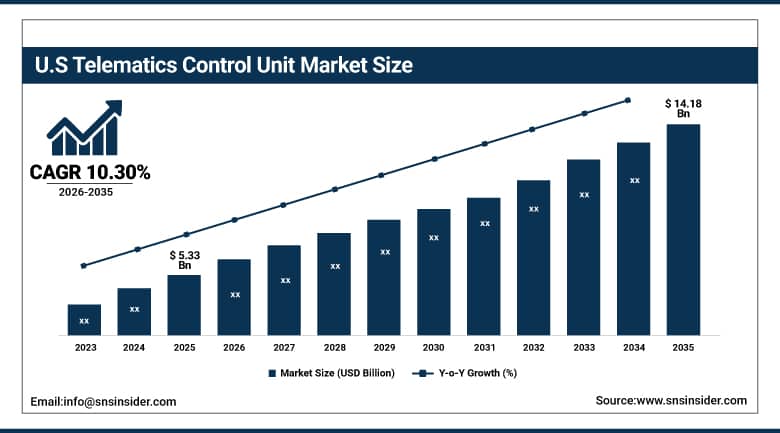
The United States Telematics Control Unit Market was valued at USD 5.33 Billion in 2025 and it is expected to reach USD 14.18 Billion by 2035, growing at a CAGR of 10.30% over the forecast period of 2026–2035.
United States Telematics Control Unit Market is one of the leading connected vehicle markets globally due to high adoption of advanced automotive technologies, increasing penetration of electric and connected vehicles, and strong presence of major automotive OEMs and telecom infrastructure providers. Moreover, rising investments in autonomous driving technologies, smart mobility platforms, and 5G connectivity are expected to support market growth in the coming years.
As far as consumer preferences and industry adoption are concerned, increasing demand for vehicle connectivity, real-time diagnostics, navigation systems, fleet management, and advanced safety solutions is expected to drive the U.S. telematics control unit market.
In 2026, U.S. automotive connectivity industry reports highlighted rising demand for AI-enabled and 5G-integrated telematics control units due to SDVs, OTA updates, and intelligent transportation technologies.
Telematics Control Unit Market Segment Highlights
-
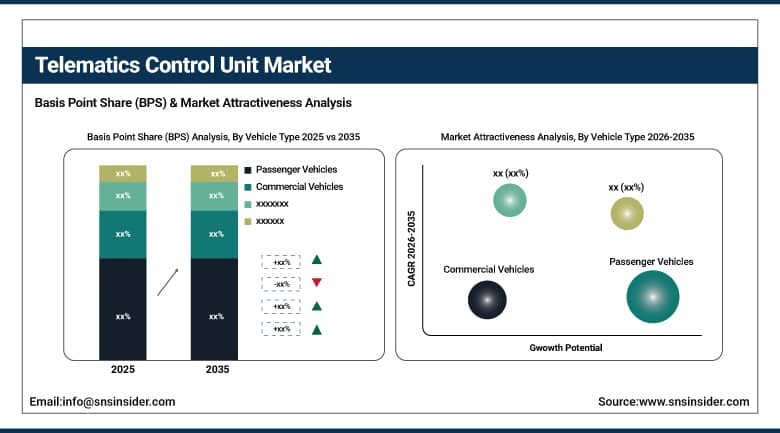
By Vehicle Type, Passenger Vehicles dominated the Telematics Control Unit Market with 63.20% share in 2025 and it is also fastest growing (CAGR).
-
By Application, Safety and Security dominated the Telematics Control Unit Market with 27.40% share in 2025; Insurance Telematics fastest growing (CAGR).
-
By Deployment, OEM-Installed dominated the Telematics Control Unit Market with 72.40% share in 2025 and it is also fastest growing (CAGR).
-
By Connectivity Type, Cellular (LTE, 5G) dominated the Telematics Control Unit Market with 74.30% share in 2025 and it is also fastest growing (CAGR).
By Vehicle Type, Passenger Vehicles segment dominates the Telematics Control Unit Market and is also expected to grow fastest.
Passenger Vehicles dominated the Telematics Control Unit Market in 2025 due to rising production of connected cars, growing consumer demand for infotainment and navigation systems, and increasing integration of advanced safety technologies. Growing adoption of real-time vehicle monitoring and connected mobility solutions also contributed significantly to segment dominance.
The segment is expected to grow at the fastest CAGR from 2026–2035 owing to increasing electric vehicle adoption, expansion of 5G connectivity, and rising deployment of software-defined vehicles. Strong OEM investments in autonomous driving technologies, cloud-connected services, and smart mobility platforms are further expected to accelerate market growth globally.
By Application, Safety and Security segment dominates the Telematics Control Unit Market, while Insurance Telematics segment is expected to grow fastest.
Safety and Security segment dominated the Telematics Control Unit Market in 2025 due to increasing adoption of connected safety systems, emergency calling features, vehicle tracking, theft prevention technologies, and government regulations supporting advanced driver safety and real-time monitoring solutions across passenger and commercial vehicles globally.
Insurance Telematics segment is expected to grow at the fastest CAGR from 2026–2035 owing to rising usage-based insurance models, increasing adoption of driver behavior monitoring solutions, and growing demand from insurers for real-time vehicle data analytics to improve risk assessment, premium pricing accuracy, fraud detection, and customer engagement services.
By Deployment, OEM-Installed segment dominates the Telematics Control Unit Market and is also expected to grow fastest.
OEM-Installed segment led the global market of Telematics Control Units in 2025 owing to rising integration of connected car technology by automotive OEMs. The growing need for telematics installed by factory manufacturers, advanced safety systems, infotainment solutions, and compliance with emergency call system regulations played a key role in the success of the segment.
OEM-Installed segment is expected to grow the highest growth rate during the forecast period due to high adoption rates of SDVs, 5G and EVs in the automotive industry. With advancements in software-defined vehicles, 5G technology, and electric cars, automobile manufacturers are increasingly using telematics control units with AI and cloud connectivity options.
By Connectivity Type, Cellular (LTE, 5G) segment dominates the Telematics Control Unit Market and is also expected to grow fastest.
Cellular (LTE, 5G) dominated the Telematics Control Unit Market in 2025 due to widespread adoption of connected vehicles, increasing demand for real-time navigation, vehicle diagnostics, infotainment, and emergency communication services. Strong global telecom infrastructure development and growing integration of embedded connectivity solutions by automotive OEMs further supported the segment’s market dominance.
Cellular (LTE, 5G) segment is also expected to grow at the fastest CAGR from 2026–2035 owing to rapid deployment of 5G networks, rising adoption of autonomous and software-defined vehicles, and increasing demand for high-speed, low-latency vehicle communication technologies. Growing investments in V2X communication, smart transportation infrastructure, and cloud-connected mobility platforms are further accelerating segment growth globally.
Telematics Control Unit Market Regional Analysis:
|
Region |
Major Country |
Share (%) |
|---|---|---|
|
North America |
United States |
34.20% |
|
Europe |
Germany |
24.10% |
|
Asia Pacific |
China |
29.40% |
|
Middle East & Africa |
UAE |
5.20% |
|
Latin America |
Brazil |
7.10% |
North America Telematics Control Unit Market Insights
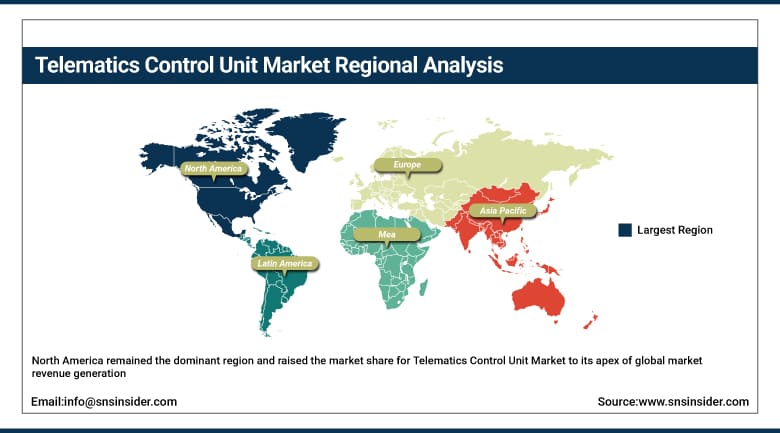
North America remained the dominant region and raised the market share for Telematics Control Unit Market to its apex of global market revenue generation, owing to high adoption of connected vehicles, strong telecom infrastructure, and increasing integration of advanced automotive technologies. Other factors contributing to market growth include rising demand for electric vehicles, expansion of autonomous driving technologies, and increasing deployment of real-time fleet management and vehicle diagnostics systems. Growing investments in smart transportation infrastructure and software-defined vehicle platforms are also supporting market expansion.
In terms of regional performance, the highest performance was demonstrated by the United States, which had strong automotive production capabilities, increasing penetration of connected mobility solutions, and rising adoption of AI-enabled telematics systems across passenger and commercial vehicles.
The U.S. automotive connectivity industry highlights increasing demand for 5G-enabled telematics control units, cloud-based vehicle communication systems, and advanced driver assistance technologies, supporting sustained market demand for connected and software-defined vehicles.
Get Customized Report as Per Your Business Requirement - Enquiry Now
Asia Pacific Telematics Control Unit Market Insights
The Asia Pacific region will show the fastest growth rate during the forecast period owing to rising vehicle production, increasing electric vehicle adoption, and rapid expansion of connected mobility infrastructure. Some of the countries contributing to the growth of the market include China, India, Japan, South Korea, and Singapore, wherein China and India will be significant contributors. Expanding 5G infrastructure, rapid urbanization, and increasing investments in intelligent transportation systems will be key drivers for the market.
Government support for EV adoption, increasing digital connectivity, and rising investments in smart city infrastructure are fueling market growth. Automotive technology companies and telecom providers across Asia are expanding connected vehicle ecosystems, while increasing consumer demand for advanced infotainment and safety systems is accelerating regional market growth.
Europe Telematics Control Unit Market Insights
Europe region had a substantial share of the total revenue generated by the global Telematics Control Unit Market, owing to strong automotive manufacturing capabilities and early adoption of connected vehicle technologies. The region houses major economies including Germany, France, the UK, and Italy that contribute significantly to the total revenue. Germany and France are notable in generating significant demand due to the presence of leading automotive OEMs and advanced mobility infrastructure.
Growing implementation of vehicle safety regulations, rising adoption of electric vehicles, and increasing integration of advanced telematics platforms are among the key factors responsible for driving market growth.
Middle East & Africa and Latin America Telematics Control Unit Market Insights
The Middle East & Africa (MEA) region is witnessing steady growth in the Telematics Control Unit Market, driven by increasing investments in smart transportation infrastructure, rising connected vehicle adoption, and growing demand for fleet management solutions. Countries such as the UAE, Saudi Arabia, and South Africa are leading adoption due to expansion of digital mobility services and increasing deployment of commercial vehicle telematics systems. Rising government focus on smart city development is further supporting market expansion.
The Latin America region is witnessing consistent growth in the market, with Brazil and Mexico at the forefront of demand in the region. Key drivers of growth in the region include increased use of vehicle connectivity, high demand for fleet management systems, and higher adoption of automotive technology. Other key drivers of growth in the region include infrastructure development in the telecommunications industry and demand for commercial vehicle connectivity services.
Telematics Control Unit Market Growth Drivers:
-
Rising demand for connected vehicles and real-time vehicle data analytics driving telematics adoption globally
Adoption of vehicles that are connected, electric, and software-defined has significantly fueled the global adoption of telematics control units (TCUs) within the automobile industry. OEMs have incorporated TCUs in their products to enable vehicle tracking, diagnostics, navigation, and entertainment systems. Consumer interests in smart mobility and stringent safety and emergency vehicle communication regulations are expected to increase the use of TCUs. With the advent of 5G connectivity networks and automotive cloud platforms, the TCU connectivity performance will be enhanced.
By 2026, TCUs will see higher adoption due to rising demand for connected cars and real-time vehicle data analytics. With 5G, EVs, and SDVs, advanced applications such as live tracking, remote diagnostics, infotainment, and smart mobility services will become more widely enabled.
Telematics Control Unit Market Restraints:
-
Data privacy concerns and cyber security risks restricting large-scale telematics adoption
Increasing connectivity in automobiles comes with substantial risks related to cyber security, privacy issues, and attacks on telematic devices. The TCUs always exchange confidential information from the car or the user, which exposes them to cyber-attacks and unauthorized access. Data protection and automotive cyber security regulations further complicate the adoption of TCU technology by mandating strict adherence to rules. Misuse of the location and driving data is another major concern for the consumer.
Telematics Control Unit Market Opportunities:
-
Integration of 5G, AI, and V2X technologies creating next-generation telematics solutions
Fast-paced development in emerging technologies like 5G, AI, and vehicle-to-everything (V2X) has enabled excellent prospects for sophisticated TCUs solutions. Sophisticated telematics devices enable low latency, predictive analytics, autonomous driving capabilities, and more. TCUs have become popular among the automobile industry owing to their incorporation of intelligent technology such as edge computing. The latest technological development has generated numerous opportunities for revenue generation by automobile manufacturers and telecom operators in the global telematics market.
In 2026, Automotive OEMs are now utilizing intelligent TCUs equipped with edge computing technology, cloud connectivity, and artificial intelligence. The growing smart city infrastructure and V2X communication technology offer revenue possibilities for automotive and telecom sectors.
Recent Developments
-
2026: OEMs from Robert Bosch GmbH emphasize secure communication, OTA updates, and the standardization of ISO/SAE 21434 cyber security standards. The telematics technology offered by Robert Bosch GmbH is enhanced with software technology to guarantee security.
-
2025: Qualcomm Technologies OEMs enhance LTE technologies using 5G TCUs to enable fast connectivity, V2X features, and autonomous driving capabilities. Qualcomm introduces automotive processors for future software-defined and connected cars.
-
2024: Continental AG introduction of embedded connectivity in newer models, promoting more adoption of TCUs for navigation, diagnostics, infotainment, and emergency call services. Continental adds to its telematics portfolio to help OEMs build connected mobility solutions.
Telematics Control Unit Market Key Players
-
Continental AG
-
Robert Bosch GmbH
-
LG Electronics
-
Harman International
-
Denso Corporation
-
Valeo SA
-
Visteon Corporation
-
Marelli Holdings Co., Ltd.
-
Ficosa International
-
Huawei Technologies
-
Panasonic Holdings Corporation
-
Hyundai Mobis
-
Qualcomm Technologies
-
NXP Semiconductors
-
Infineon Technologies
-
Sierra Wireless
-
Telit Communications
-
CalAmp
-
Peiker Acustic GmbH & Co. KG
-
Flaircomm Microelectronics
Telematics Control Unit Market Report Scope:
| Report Attributes | Details |
|---|---|
| Market Size in 2025 | USD 18.03 Billion |
| Market Size by 2035 | USD 52.02 Billion |
| CAGR | CAGR of 11.20% From 2026 to 2035 |
| Base Year | 2025 |
| Forecast Period | 2026-2035 |
| Historical Data | 2022-2024 |
| Report Scope & Coverage | Market Size, Segments Analysis, Competitive Landscape, Regional Analysis, DROC & SWOT Analysis, Forecast Outlook |
| Key Segments | • By Vehicle Type (Passenger Vehicles, Commercial Vehicles, Off-Highway Vehicles) • By Application (Information and Navigation, Safety and Security, Fleet/Asset Management, Insurance Telematics, Infotainment System, Others) • By Deployment (OEM-Installed, Aftermarket Installed) • By Connectivity Type (Cellular (LTE, 5G), Satellite, Dedicated Short-Range Communication (DSRC)) |
| Regional Analysis/Coverage | North America (US, Canada), Europe (Germany, UK, France, Italy, Spain, Russia, Poland, Rest of Europe), Asia Pacific (China, India, Japan, South Korea, Australia, ASEAN Countries, Rest of Asia Pacific), Middle East & Africa (UAE, Saudi Arabia, Qatar, South Africa, Rest of Middle East & Africa), Latin America (Brazil, Argentina, Mexico, Colombia, Rest of Latin America). |
| Company Profiles | Continental AG, Robert Bosch GmbH, LG Electronics, Harman International, Denso Corporation, Valeo SA, Visteon Corporation, Marelli Holdings Co., Ltd., Ficosa International, Huawei Technologies, Panasonic Holdings Corporation, Hyundai Mobis, Qualcomm Technologies, NXP Semiconductors, Infineon Technologies, Sierra Wireless, Telit Communications, CalAmp, Peiker Acustic GmbH & Co. KG, Flaircomm Microelectronics. |
Frequently Asked Questions
North America dominated the Telematics Control Unit Market in 2025.
The Passenger Vehicles segment dominated the Telematics Control Unit Market in 2025.
Rising demand for connected vehicles, real-time vehicle data analytics, and increasing adoption of 5G, EVs, and software-defined vehicles are the major growth drivers.
The Telematics Control Unit Market was valued at USD 18.03 billion in 2025.
The Telematics Control Unit Market is expected to grow at a CAGR of 11.20% from 2026 to 2035.
