
Thermoform Packaging Market Report Scope & Overview:
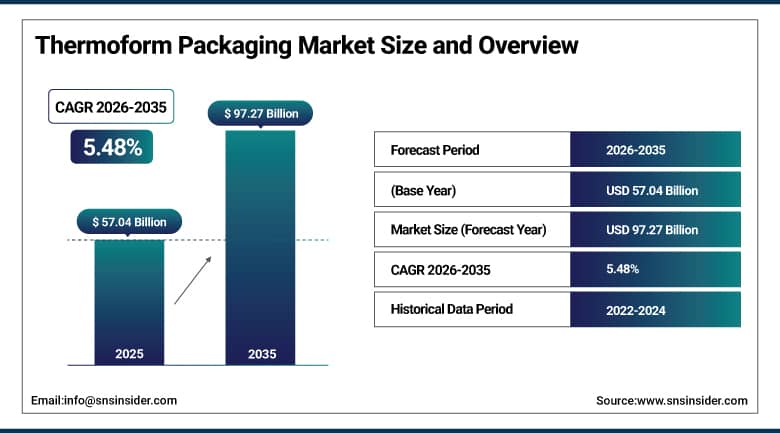
The Thermoform Packaging Market was valued at USD 57.04 Billion in 2025 and is expected to reach USD 97.27 Billion by 2035, growing at a CAGR of 5.48% from 2026 to 2035.
The thermoform packaging market is growing as the packaged food brands, contract manufacturers, and pharmaceutical companies are converging on thermoforming as a way to cut material use without sacrificing shelf appeal, and that convergence is largely what is pushing this market forward. A tray that once needed three layers of rigid plastic can now often be produced from a single recyclable PET or PP sheet, thanks to advances in mono-material barrier coatings. Retailers are pushing suppliers toward this kind of lightweighting too, partly for cost reasons and partly to hit their own packaging-waste targets. Add in the steady climb of ready-to-eat and single-serve formats across grocery chains, plus tighter blister-pack requirements in pharmaceuticals, and demand for thermoformed trays, clamshells, and blister packs keeps climbing across both mature and emerging retail markets.
In February 2026, Sonoco Products Company opened a new thermoforming line at its Waynesboro, Virginia facility dedicated to recyclable PET trays for fresh food, aimed at replacing multi-material barrier trays across grocery private-label programs.
To Get More Information On Thermoform Packaging Market - Request Free Sample Report
Thermoform Packaging Market Trends
- Mono-material PET and PP trays are replacing multilayer barrier structures as recyclers push back on mixed plastics.
- Blister pack designs for pharmaceuticals are shrinking in plastic content while still meeting child-resistant and tamper-evident rules.
- Skin packaging is gaining ground in fresh meat and seafood aisles for its shelf appeal and reduced material use.
- Automated thermoforming lines with inline vision-based quality checks are cutting scrap rates at high-volume converters.
- Retailers' private-label programs are pushing converters toward faster changeover tooling for shorter production runs.
U.S. Thermoform Packaging Market Outlook
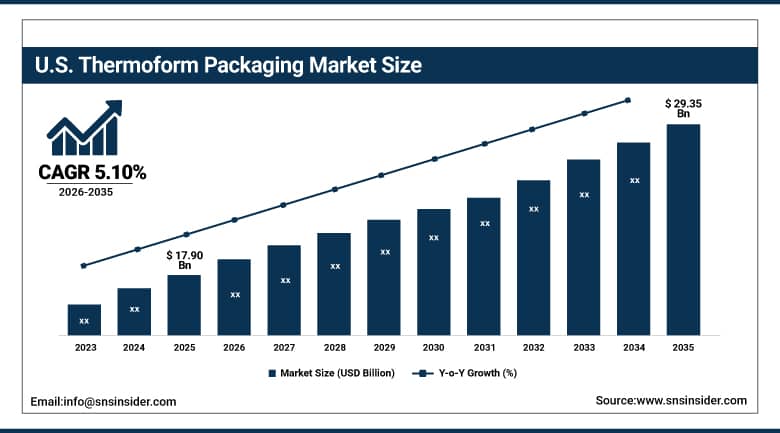
The U.S. Thermoform Packaging Market was valued at USD 17.90 Billion in 2025 and is projected to reach USD 29.35 Billion by 2035, growing at a CAGR of 5.10% during 2026-2035.
Growth in the U.S. is tied closely to how fast grocery chains convert their meat, seafood, and produce sections to thermoformed trays instead of older foam-and-film combinations. Foodservice chains are doing something similar with clamshells for prepared meals, which has kept converters busy even as raw material costs have stayed volatile. On the pharmaceutical side, blister packaging demand keeps rising alongside prescription volumes and the industry's continued shift toward unit-dose dispensing in hospitals and long-term care facilities. States adopting extended producer responsibility rules for packaging are also nudging brand owners toward PET and PP formats that actually get picked up by curbside recycling programs, which is reshaping material choices faster than in past cycles.
In September 2025, Placon Corporation expanded its Elkhorn, Wisconsin thermoforming plant with new capacity for post-consumer recycled PET clamshells, supplying produce and bakery packaging to major U.S. grocery retailers.
Thermoform Packaging Market Segment Analysis
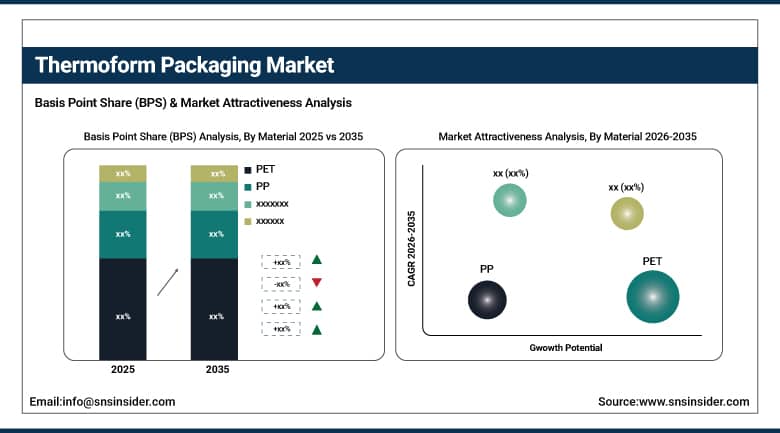
- By Material, PET segment dominated the Thermoform Packaging Market in 2025 with 44% share, while PP segment is the fastest-growing segment.
- By Product Type, Blister Packaging segment dominated the market in 2025 with 34% share, while Skin Packaging segment is the fastest-growing segment.
- By End-Use Industry, Food & Beverage segment dominated the market in 2025 with 48% share, while Pharmaceuticals & Healthcare segment is the fastest-growing segment.
- By Heat Seal Coating, Water-Based segment dominated the market in 2025 with 52% share, while Hot Melt-Based segment is the fastest-growing segment.
By Material, PET leads the thermoform packaging market while PP gains ground fastest
PET's clarity and food-contact approvals are hard to beat, which is largely why it holds the largest share of the Thermoform Packaging Market. Converters favor it for retail trays and clamshells where shoppers want to see the product before buying, and its compatibility with existing recycling streams gives brand owners an easier sustainability story than PVC or PS can offer. Established resin supply chains and decades of thermoforming know-how around PET also keep conversion costs lower than newer bio-based alternatives, which matters when margins in packaged food are already thin.
PP is gaining ground quickly, mostly because it tolerates heat better than PET without needing extra barrier layers - a real advantage for microwaveable meal trays and hot-fill applications. Its chemical resistance also suits pharmaceutical blister components that need to survive sterilization processes. As more converters retool lines to handle PP's different forming temperatures, the material is showing up in categories that used to default to PET almost automatically.
By Product Type, blister packaging dominates while skin packaging emerges as the fastest-growing format
Blister packaging leads the market largely on the strength of pharmaceutical demand - unit-dose tablets and capsules essentially require it for the child-resistant, tamper-evident dispensing that regulators expect worldwide. Consumer goods brands have also leaned on blister formats for small hardware, batteries, and electronics accessories, where the format doubles as both protection and a retail hang-tag. That dual role, protecting the product while helping sell it, is difficult to replace with any other packaging type.
Skin packaging's growth is coming largely from fresh meat and seafood counters, where a tightly molded film against the product looks more premium on the shelf than a loose tray wrap while using less material per unit. Processors like that it locks in juices and reduces leakage during transport. As grocery chains chase both sustainability metrics and shelf appeal at the same time, skin packs are winning out over older overwrap methods.
By End-Use Industry, food & beverage dominates while pharmaceuticals & healthcare registers the fastest growth
Food & beverage accounts for roughly half the market, which is not surprising given how much of a modern grocery store - produce, deli, bakery, meat, ready meals - now moves through thermoformed trays and clamshells at some point. Extending shelf life without added preservatives is a big part of the appeal, and thermoforming, done well, achieves that better than many flexible-film alternatives. The category's sheer scale also means even modest packaging-efficiency gains translate into large material savings for major food manufacturers.
Pharmaceuticals & healthcare is climbing quickly as prescription volumes rise and hospitals move further toward unit-dose dispensing to reduce medication errors. Blister packs and thermoformed trays for diagnostic kits and surgical instruments are both part of this growth, and neither trend is easing off given aging populations across most major markets. Stricter serialization and anti-counterfeiting requirements in pharmaceutical packaging are adding another reason for manufacturers to invest in more sophisticated thermoforming equipment.
By Heat Seal Coating, water-based dominates while hot melt-based registers the fastest growth
Water-Based heat seal coatings dominate mainly because they sidestep the VOC emissions and regulatory complications that come with solvent-based alternatives, while still delivering seal strength good enough for most food and consumer packaging applications. Food safety regulators across North America and Europe have been tightening limits on solvent residues in food-contact packaging, which has pushed converters toward water-based systems almost by default over the past several years.
Hot Melt-Based coatings are catching on fastest in e-commerce and shipping-adjacent packaging, where a strong, quick-setting seal matters more than the modest cost premium over water-based systems. They also hold up better in cold-chain applications, which is relevant given how much frozen and refrigerated packaged food now moves through thermoformed trays. Converters serving meal-kit and grocery-delivery brands have been among the earliest adopters of this coating type.
Regional Insights
|
Region |
Country |
Share (2025) |
|
North America |
United States |
84.30% |
|
Asia Pacific |
China |
29.40% |
|
Europe |
Germany |
26.80% |
|
Middle East & Africa |
UAE |
18.60% |
|
Latin America |
Brazil |
25.90% |
North America Thermoform Packaging Market Insights
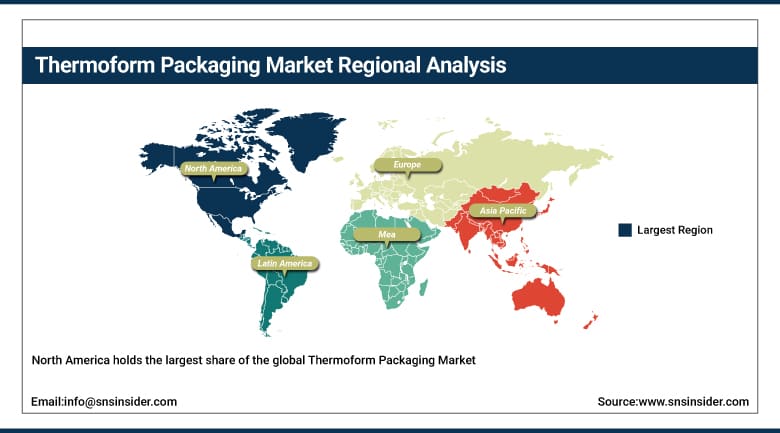
North America holds the largest share of the global Thermoform Packaging Market, and that is mostly a function of scale - an enormous packaged food industry, a deep pharmaceutical manufacturing base, and a grocery retail infrastructure that has standardized around thermoformed trays for decades. What is changing now is less about volume growth and more about material substitution, as state-level packaging laws push brand owners toward recyclable PET and PP over older PVC and PS formats. Canada's own extended producer responsibility rules are following a similar trajectory, keeping converters on both sides of the border focused on comparable material transitions.
The United States accounts for approximately 84.30% of the North American market, a reflection of its packaged food manufacturing scale and pharmaceutical blister-pack demand. Canada's growth is more modest but steady, tied to its own EPR-driven shift toward recyclable formats and a smaller but expanding ready-meal retail segment.
Get Customized Report as Per Your Business Requirement - Enquiry Now
Europe Thermoform Packaging Market Insights
Europe's thermoform packaging market sits in an interesting spot - demand is steady rather than fast-growing, but regulatory pressure is reshaping what gets manufactured almost every year. The EU's packaging and packaging waste regulation is forcing converters to hit recyclability targets that older PVC and PS-based formats simply cannot meet, so the real story in Europe right now is conversion, not expansion. Fresh food retail modernization in France and pharmaceutical packaging demand in Germany are both keeping volumes healthy even as material specifications continue shifting.
Germany leads the European market with a 26.80% share, supported by its advanced packaging manufacturing base and strict sustainability compliance standards. France and the United Kingdom follow, with France's growth tied to fresh food retail expansion and the UK's driven by pharmaceutical packaging and established convenience retail distribution.
Asia Pacific Thermoform Packaging Market Insights
Asia Pacific is set to grow faster than any other region through 2035, and the drivers here look different from those in the West - it is less about material substitution and more about retail modernization itself. As organized supermarket chains expand into cities that previously relied on wet markets and informal retail, thermoformed packaging becomes the default rather than an upgrade. China's enormous food processing base and India's fast-growing packaged food sector are both central to this shift, and rising middle-class incomes across the region are accelerating adoption of pre-packaged, portion-controlled formats that were uncommon a decade ago.
China holds close to 29.40% of the regional market, underpinned by its scale in food processing and export-oriented pharmaceutical manufacturing. India is growing at a noticeably faster pace than China within the region, driven by rapid organized retail expansion and rising pharmaceutical output, while Japan and South Korea continue contributing through their established electronics and healthcare packaging sectors.
Middle East & Africa and Latin America Thermoform Packaging Market Insights
The Middle East & Africa region is growing off a smaller base, largely on the back of retail modernization across the Gulf states and rising imports of packaged food and pharmaceuticals. Latin America's growth looks similar in shape, driven by expanding food processing capacity in Brazil and Mexico and a gradual shift toward organized retail in cities where informal markets still dominate grocery shopping.
The UAE leads the Middle East & Africa market with an 18.60% share, supported by its role as a regional distribution hub for packaged food and pharmaceuticals. Brazil represents 25.90% of the Latin American market, reflecting its large food processing base, while Mexico contributes through its growing pharmaceutical manufacturing sector and expanding organized retail footprint.
Growth Drivers: Retail Modernization and Material Substitution Fueling Market Growth
Two forces are doing most of the work behind this market's growth: retail modernization in emerging economies, which is turning thermoformed trays and clamshells into the default packaging format as organized supermarkets replace informal retail, and material substitution in mature markets, where brand owners are swapping PVC and PS for recyclable PET and PP under regulatory and consumer pressure. Both dynamics are pushing volumes upward, even though the underlying reasons differ sharply by region.
Pharmaceutical demand adds a third, steadier layer of growth on top of these two, since unit-dose blister packaging is not discretionary in most healthcare systems, so that segment tends to hold up even when broader consumer spending softens.
Restraints: Resin Price Volatility and Recyclability Gaps Limiting Market Expansion
Resin prices for PET, PP, and PS have been anything but stable over the past few years, and that volatility makes it difficult for converters to lock in long-term pricing with retail and pharmaceutical customers. On top of that, a meaningful share of thermoformed packaging, particularly multilayer barrier structures and PVC-based blister packs, still is not accepted in most curbside recycling programs, which puts converters in a difficult spot as extended producer responsibility fees increasingly get tied to recyclability.
Smaller converters are feeling this pressure more acutely, since retooling lines for mono-material formats requires capital that larger players can absorb more easily. This is compressing margins for regional manufacturers even as overall market volumes continue growing.
Opportunities: Recyclable Mono-Material Formats and Smart Packaging Creating New Growth Avenues
The clearest opportunity right now lies in mono-material PET and PP formats that can actually clear existing recycling infrastructure without brand owners having to wait for new collection systems to catch up. Converters who get ahead on barrier-coating technology that maintains shelf life without multilayer structures stand to win share as retailers tighten their own packaging specifications.
There is also room to grow in smart packaging, such as freshness indicators and QR-coded traceability built into thermoformed trays, particularly for premium meat, seafood, and pharmaceutical applications where buyers are willing to pay for that added information. Partnerships between converters and material science firms developing bio-based or chemically recyclable resins could open up entirely new categories over the next several years.
Recent Developments
- 2026: Sonoco Products Company opened a new thermoforming line at its Waynesboro, Virginia facility dedicated to recyclable PET trays for fresh food packaging.
- 2025: Placon Corporation expanded capacity at its Elkhorn, Wisconsin plant to produce post-consumer recycled PET clamshells for grocery retail.
- 2025: Amcor plc introduced a mono-material PP tray range designed to replace multilayer barrier trays across European fresh food retail.
- 2025: Anchor Packaging LLC launched a new line of recyclable PET hinged-lid containers for prepared foods, aimed at grocery deli and foodservice channels seeking curbside-recyclable takeout packaging.
Thermoform Packaging Companies are:
- Amcor plc
- Sonoco Products Company
- Sealed Air Corporation
- Placon Corporation
- Anchor Packaging LLC
- D&W Fine Pack LLC
- Dart Container Corporation
- Pactiv Evergreen Inc.
- Genpak LLC
- Winpak Ltd.
- Constantia Flexibles Group GmbH
- Coveris Holdings S.A.
- Smurfit Westrock plc
- Sabert Corporation
- Silgan Holdings Inc.
- Tekni-Plex Inc.
- Klöckner Pentaplast Group
- Huhtamaki Oyj
- ProAmpac LLC
- Crown Holdings Inc.
Thermoform Packaging Market Report Scope :
| Report Attributes | Details |
|---|---|
| Market Size in 2025 | USD 57.04 Billion |
| Market Size by 2035 | USD 97.27 Billion |
| CAGR | CAGR of 5.48% From 2026 to 2035 |
| Base Year | 2025 |
| Forecast Period | 2026-2035 |
| Historical Data | 2022-2024 |
| Report Scope & Coverage | Market Size, Segments Analysis, Competitive Landscape, Regional Analysis, DROC & SWOT Analysis, Forecast Outlook |
| Key Segments | • By Material (PET, PVC, PS, PP, PE, Others) • By Product Type (Blister Packaging, Clamshell Packaging, Skin Packaging, Trays & Lids, Containers, Others) • By End-Use Industry (Food & Beverage, Pharmaceuticals & Healthcare, Consumer Goods, Electronics, Others) • By Heat Seal Coating (Water-Based, Solvent-Based, Hot Melt-Based) |
| Regional Analysis/Coverage | North America (US, Canada), Europe (Germany, UK, France, Italy, Spain, Russia, Poland, Rest of Europe), Asia Pacific (China, India, Japan, South Korea, Australia, ASEAN Countries, Rest of Asia Pacific), Middle East & Africa (UAE, Saudi Arabia, Qatar, South Africa, Rest of Middle East & Africa), Latin America (Brazil, Argentina, Mexico, Colombia, Rest of Latin America). |
| Company Profiles | Amcor plc, Sonoco Products Company, Sealed Air Corporation, Placon Corporation, Anchor Packaging LLC, D&W Fine Pack LLC, Dart Container Corporation, Pactiv Evergreen Inc., Genpak LLC, Winpak Ltd., Constantia Flexibles Group GmbH, Coveris Holdings S.A., Smurfit Westrock plc, Sabert Corporation, Silgan Holdings Inc., Tekni-Plex Inc., Klöckner Pentaplast Group, Huhtamaki Oyj, ProAmpac LLC, Crown Holdings Inc. |

Frequently Asked Questions
Key players include Amcor plc, Placon Corporation, Sonoco Products Company, Sealed Air Corporation, and Anchor Packaging LLC, among others.
Key opportunities include recyclable thermoform packaging development, rising demand for lightweight formats, and increasing adoption across food, pharmaceutical, and consumer goods applications.
The market is driven by retail modernization in emerging economies, material substitution toward recyclable PET and PP, and steady pharmaceutical blister-pack demand.
The PET segment dominated the Thermoform Packaging Market in 2025.
The North America region dominated the Thermoform Packaging Market in 2025, accounting for approximately 36% of global market share.
