
Traffic Management Market Report Scope & Overview:
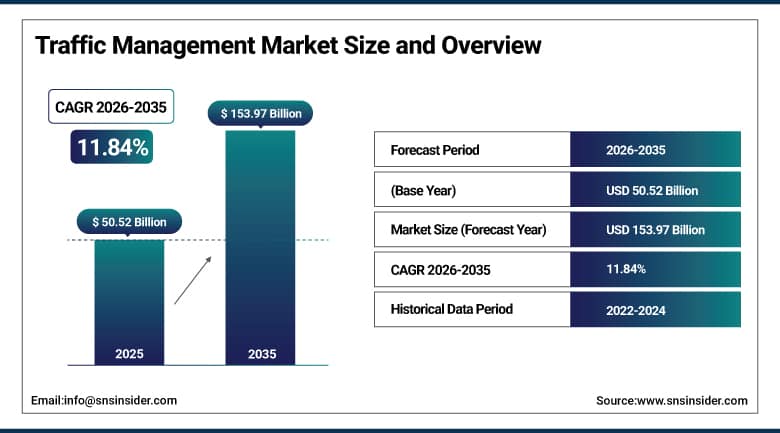
The Traffic Management Market was valued at USD 50.52 billion in 2025 and is expected to reach USD 153.97 billion by 2035, growing at a CAGR of 11.84% from 2026-2035.
The Traffic Management Market is witnessing rapid growth because of increasing urbanization, increasing traffic congestion, and increasing demand for efficient and intelligent transportation infrastructure. There have been increasing investments in the development of smart traffic management systems by governments and transportation authorities in order to manage traffic, decrease traffic congestion, increase road safety, and optimize transportation networks. Furthermore, there has been the increasing adoption of IoT-enabled sensors, connected vehicles, traffic analytics using AI, intelligent traffic lights, and real-time monitoring systems which is contributing to the growth of the market. Increased modernization of infrastructure, smart city projects, and increased intelligent transportation system developments are some of the other factors that are fueling the demand in the market.
ITU notes that increasing urbanization creates challenges such as traffic congestion, requiring adaptive urban-management strategies.
To Get More Information On Traffic Management Market - Request Free Sample Report
Traffic Management Market Trends:
-
Rising urbanization and increasing traffic congestion are driving demand for advanced traffic management solutions that improve mobility, reduce delays, and optimize road capacity.
-
Increasing adoption of artificial intelligence and machine learning is enabling predictive congestion management, automated incident detection, and dynamic traffic signal optimization.
-
Growing deployment of IoT sensors, connected cameras, and real-time analytics is enhancing traffic monitoring, incident response, and transportation network visibility.
-
Increasing smart city investments are accelerating deployment of intelligent traffic systems integrating monitoring, signal control, enforcement, and multimodal transportation management.
U.S. Traffic Management Market Outlook:
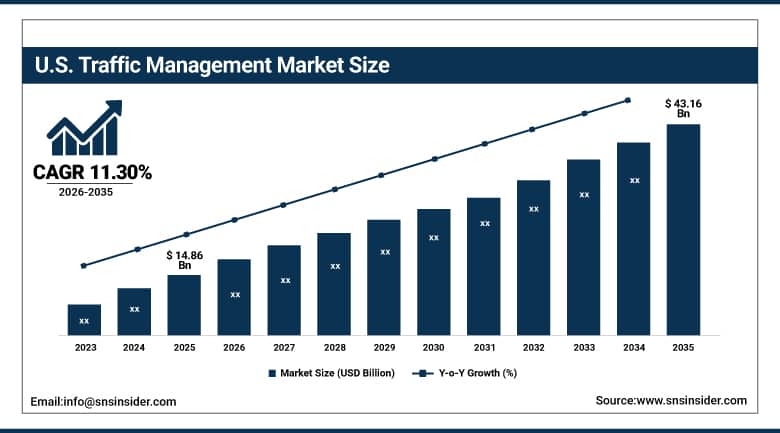
The U.S. Traffic Management Market was valued at USD 14.86 billion in 2025 and is expected to reach USD 43.16 billion by 2035, growing at a CAGR of 11.30% from 2026-2035.
The U.S. Traffic Management Market is witnessing rapid growth because of urbanization, traffic congestion, and the demand for an efficient transport infrastructure. Efforts made by governments towards the development of smart cities and intelligent transport systems have helped in the implementation of advanced traffic management systems for the purpose of real-time monitoring, traffic control, incident management, and congestion management. Apart from this, increased usage of connected vehicles, IoT-enabled sensors, artificial intelligence for traffic management, and adaptive traffic signals is helping in managing traffic and ensuring safety on roads. Growing investments in the upgrading of transport infrastructure and smart mobility solutions have aided the growth of the market. The need for traffic management solutions to improve efficiency and sustainability is helping the market grow in the US.
FHWA identifies congestion as a major transportation challenge and supports deployment of intelligent transportation systems (ITS) to improve traffic operations, reliability, and mobility.
Traffic Management Market Segment Analysis:
-
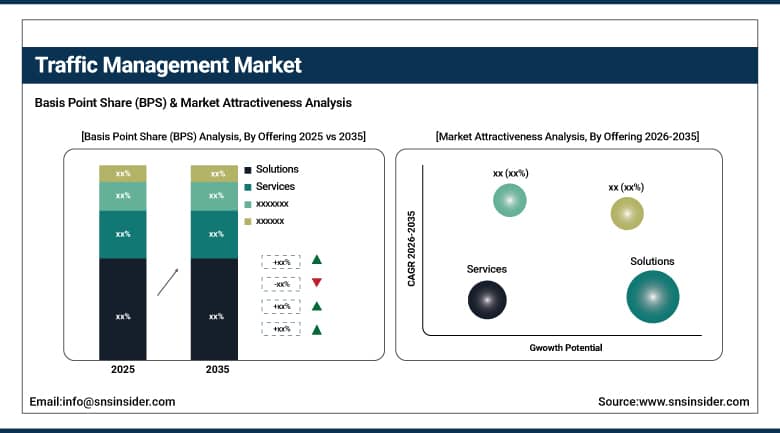
By Offering, Solutions dominate the Traffic Management Market with 71% share in 2025; Services are expected to grow at the fastest CAGR of 12.50% from 2026–2035.
-
By Area of Application, Urban dominates the Traffic Management Market with 56% share in 2025; Rural is expected to grow at the fastest CAGR of 12.99% from 2026–2035.
-
By End User, Government dominates the Traffic Management Market with 79% share in 2025; Private is expected to grow at the fastest CAGR of 12.62% from 2026–2035.
By Offering, Solutions dominates the Traffic Management Market, Services grows fastest.
Solutions segment dominated the Traffic Management Market with the highest revenue share of about 71% in 2025 As a result of the extensive implementation of systems for traffic monitoring, management, control, enforcement, and toll management. Such solutions assist in improving traffic flow, road safety, and overall operations. Increased urbanization, growing congestion, smart cities, and infrastructure improvement contribute to the high adoption of traffic management solutions.
Services segment is expected to grow at the fastest CAGR of 12.50% from 2026-2035 due to rising needs for system integration, consultation, maintenance, technical assistance, and managed traffic operations. The more advanced the traffic infrastructure gets, the more need there is for specialized knowledge to manage it. Investment in smart cities, infrastructure that is connected, and constant technology updates are driving even more need for traffic management services.
By Area of Application, Urban dominates the Traffic Management Market, Rural grows fastest.
Urban segment dominated the Traffic Management Market with the highest revenue share of about 56% in 2025 Owing to the high population density, rising number of vehicles, congestions and complicated traffic networks. Urban cities need efficient traffic monitoring and control systems to enhance road safety and mobility. Fast urban growth, smart cities, infrastructure developments and demands for transportation increase the use of urban traffic management systems.
Rural segment is expected to grow at the fastest CAGR of 12.99% from 2026-2035 This is due to increased investments in rural roads infrastructure and intelligent traffic systems. Road safety and accessibility are improved by governments in underdeveloped regions. Increased development of connected infrastructure, upgrading of highways, increased vehicular movements, and deployment of traffic management systems are aiding the growth of rural markets.
By End User, Government dominates the Traffic Management Market, Private grows fastest.
Government segment dominated the Traffic Management Market with the highest revenue share of about 79% in 2025 due to its core role in handling roads, transport infrastructure, traffic management, and mobility systems. The government carries out huge investments in traffic management and monitoring infrastructure. Smart city, road improvements, traffic management, and safety programs have been driving the adoption of traffic management technologies by the government.
Private segment is expected to grow at the fastest CAGR of 12.62% from 2026-2035 due to rising private investments in transportation infrastructures, transportation services, and transportation technology. Traffic analytics, monitoring, and optimization are becoming common among private sector entities. Rising public-private partnership programs, infrastructure connectivity, and efficient transportation management needs drive this trend.
Regional Analysis:
|
Region |
Major Country |
Share within Region, 2025 (%) |
|---|---|---|
|
North America |
United States |
78.0% |
|
Europe |
Germany |
22.5% |
|
Asia Pacific |
China |
37.5% |
|
Middle East & Africa |
UAE |
20.0% |
|
Latin America |
Brazil |
42.0% |
North America Traffic Management Market Insights
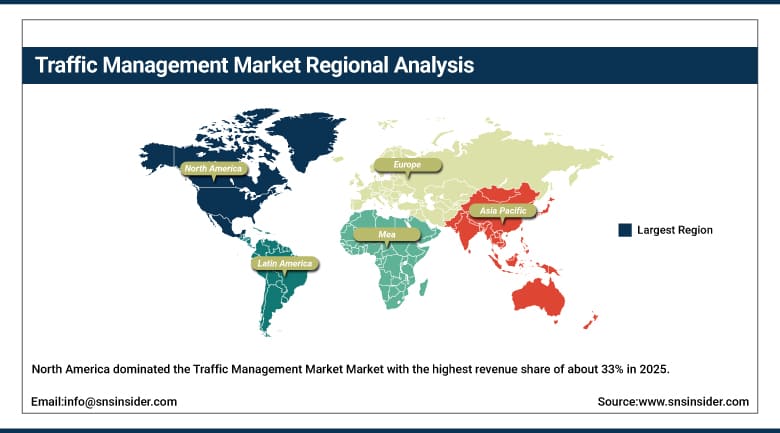
North America dominated the Traffic Management Market Market with the highest revenue share of about 33% in 2025, backed by state-of-the-art transportation infrastructure, extensive use of intelligent traffic control systems, and significant spending on smart mobility. Increasing urban congestion, safety programs implemented by the government, real-time traffic monitoring, and usage of connected transport solutions add to the market growth drivers. Availability of major technology vendors helps the region consolidate its dominant position.
The U.S. Traffic Management Market accounted for a market share of 78.0%, It is supported by state-of-the-art transportation infrastructure, application of intelligent transportation systems on a wide scale, and government investments in traffic management technology. The rise in urban traffic congestion, road safety considerations, and the use of real-time traffic monitoring systems are the main factors behind the increased demand for this product.
Get Customized Report as Per Your Business Requirement - Enquiry Now
Europe Traffic Management Market Insights
Europe’s traffic management market is underpinned by robust transportation infrastructure, intelligent transportation systems, and substantial government investment in safe and sustainable transportation. The rise in urban congestion, smart traffic lights, and real-time monitoring technology is fueling demand. European smart city projects, connected mobility solutions, and emphasis on emission reductions and transport efficiency are additional factors aiding regional market growth.
The Germany Traffic Management Market accounted for a market share of 22.5%, Backed by state-of-the-art road infrastructure, widespread use of intelligent transport systems, and government commitment to sustainable mobility. Urban traffic congestion and the need for efficient mobility are driving the implementation of smart traffic management systems. Connected cars, real-time monitoring, road safety, and digital transport infrastructure provide further strength to the German market growth.
Asia Pacific Traffic Management Market Insights
Asia Pacific is expected to grow at the fastest CAGR of about 12.50% from 2026–2035, triggered by urbanization, growing traffic congestion, increasing road infrastructure, and intelligent transportation system implementations. Growing investment in smart city projects, connected mobility, traffic management systems, and digital transportation infrastructure is driving the implementation. Government interventions and demand for efficient and safe transportation are aiding market growth in the region.
The China Traffic Management Market accounted for a market share of 37.5%, facilitated by the speed of urbanization, development of road networks, and rise in traffic congestion in large cities. Investment in intelligent city infrastructures, ITS (intelligent transport systems), and traffic management systems is leading to quicker adoption. The government’s support for digital transportation, connected mobility, road safety, and traffic management systems helps to drive the market in China.
Middle East & Africa and Latin America Traffic Management Market Insights
The Middle East & Africa and Latin America traffic management markets are Driven by fast urbanization, development of road infrastructure, and rising traffic congestion. Smart city initiatives, intelligent transport systems, and traffic monitoring technologies have led to the uptake of this technology. Initiatives by the government on road safety and public transport modernization, along with the deployment of connected technologies, also create opportunities for the growth of this region's market.
The UAE Traffic Management Market accounted for a market share of 20.0%, This is backed by rapid urbanization, well-developed transport infrastructure, and substantial investment in smart city solutions. The rising need to move people around efficiently and the rise in number of vehicles is fueling the uptake of intelligent traffic systems. Digital government campaigns, connected transport schemes, real-time tracking, and road safety campaigns boost market growth in the UAE.
Growth Drivers: Increasing urbanization and traffic congestion are accelerating demand for advanced traffic management solutions
Rapid urbanization, rising vehicle ownership, and increasing movement of people and goods are intensifying congestion across major metropolitan areas. Traditional traffic control systems have found themselves facing difficulty with changing traffic conditions, heavy vehicle traffic, and intricate road networks. As such, transport agencies are developing intelligent traffic management systems capable of monitoring traffic flow in real time and making changes to traffic lights, detecting congestion, and managing traffic as a result. AI, IoT sensors, video cameras, and real-time data analysis are among those tools which are becoming increasingly common to solve this problem. According to industry experts, urban congestion, smart city developments, and real-time traffic optimization are among the most influential factors behind this development.
Restraints: High deployment costs and complex integration with legacy infrastructure can limit market adoption
The implementation of advanced traffic management systems often requires substantial investment in sensors, cameras, traffic controllers, communication networks, software platforms, and roadside infrastructure. In some cases, the municipalities will have to upgrade their existing system or even integrate new technologies with existing traffic control devices; and this might pose some problems during the process of implementation. It is especially true in the case of small cities and transportation organizations that have limited budgets in terms of infrastructure development. Furthermore, in most large-scale implementations, there is a need for collaboration among different parties such as government organizations, technology companies, telecommunication companies, and many others. This leads to increasing complexity and additional costs in implementation.
Opportunities: Integration of AI, predictive analytics, and adaptive traffic control is creating significant growth opportunities
The increasing integration of artificial intelligence and machine learning presents substantial opportunities for traffic management providers. These AI-based tools have the capability to assess the live traffic situation, detect congestion patterns, forecast incidents, optimize signal timings, and provide suggestions for traffic control. In addition, the adaptive control of traffic signals is also possible using AI-based tools, which can help in adjusting traffic lights according to the flow of traffic, and this can be done without depending on fixed timing plans. In addition to this, predictive models can also be used for forecasting the problem of congestion in advance. Some latest studies emphasize the application of AI in the areas of congestion prediction, accident risk assessment, and so forth.
Recent Developments:
-
2026 : Kapsch TrafficCom AG expanded its traffic management operations in new york through two new contracts with the new york state department of transportation, valued at usd 6.3 million over three years, to improve driver safety and incident response.
-
2026 : SWARCO AG showcased AI-based traffic control and intelligent transportation solutions at Intertraffic Amsterdam 2026, highlighting adaptive traffic management, digital mobility technologies, and solutions designed to improve traffic flow.
-
2026 : Kapsch TrafficCom AG selected TomTom N.V.’s real-time traffic data and analytics to strengthen its next-generation EcoTrafiX platform and enhance global intelligent traffic management capabilities.
-
2025 : Kapsch TrafficCom AG advanced Sweden’s national ÖTS3 traffic signal project with its EcoTrafiX solution, upgrading the Swedish Transport Administration’s ability to control and monitor approximately 360 traffic signals nationwide.
Traffic Management Market key players are:
-
Siemens Mobility
-
SWARCO AG
-
Kapsch TrafficCom AG
-
Thales Group
-
Cisco Systems, Inc.
-
IBM Corporation
-
Mundys S.p.A.
-
Q-Free ASA
-
Cubic Transportation Systems
-
Teledyne FLIR LLC
-
Econolite Group, Inc.
-
TransCore
-
TomTom N.V.
-
Indra Sistemas, S.A.
-
PTV Group
-
Huawei Technologies Co., Ltd.
-
ST Engineering
-
Miovision Technologies Inc.
-
Iteris, Inc.
-
Rekor Systems, Inc.
Traffic Management Market Report Scope:
| Report Attributes | Details |
|---|---|
| Market Size in 2025 | USD 50.52 Billion |
| Market Size by 2035 | USD 153.97 Billion |
| CAGR | CAGR of 11.84% From 2026 to 2035 |
| Base Year | 2025 |
| Forecast Period | 2026-2035 |
| Historical Data | 2022-2024 |
| Report Scope & Coverage | Market Size, Segments Analysis, Competitive Landscape, Regional Analysis, DROC & SWOT Analysis, Forecast Outlook |
| Key Segments | • By Offering (Solutions, Services) • By Area of Application (Urban, Inter-Urban, Rural) • By End User (Government, Private) |
| Regional Analysis/Coverage | North America (US, Canada), Europe (Germany, UK, France, Italy, Spain, Russia, Poland, Rest of Europe), Asia Pacific (China, India, Japan, South Korea, Australia, ASEAN Countries, Rest of Asia Pacific), Middle East & Africa (UAE, Saudi Arabia, Qatar, South Africa, Rest of Middle East & Africa), Latin America (Brazil, Argentina, Mexico, Colombia, Rest of Latin America). |
| Company Profiles | Siemens Mobility, SWARCO AG, Kapsch TrafficCom AG, Thales Group, Cisco Systems, Inc., IBM Corporation, Mundys S.p.A., Q-Free ASA, Cubic Transportation Systems, Teledyne FLIR LLC, Econolite Group, Inc., TransCore, TomTom N.V., Indra Sistemas, S.A., PTV Group, Huawei Technologies Co., Ltd., ST Engineering, Miovision Technologies Inc., Iteris, Inc., and Rekor Systems, Inc. |

Frequently Asked Questions
Key players in the Traffic Management Market include Siemens Mobility, SWARCO AG, Kapsch TrafficCom AG, Thales Group, and Cubic Transportation Systems, among others.
Key opportunities in the Traffic Management Market include expansion of smart city initiatives, increasing deployment of intelligent transportation systems, and growing investment in connected infrastructure and traffic monitoring solutions.
The market is driven by increasing urbanization and traffic congestion, along with rising government investments in smart transportation infrastructure, intelligent traffic systems, and road safety solutions.
The Solutions segment dominated the Traffic Management Market, accounting for approximately 71.00% market share.
The North America region dominated the Traffic Management Market in 2025 with a 32.50% share, driven by high firearm sales and strong defense procurement.
