
Transaction Monitoring Market Report Scope & Overview:
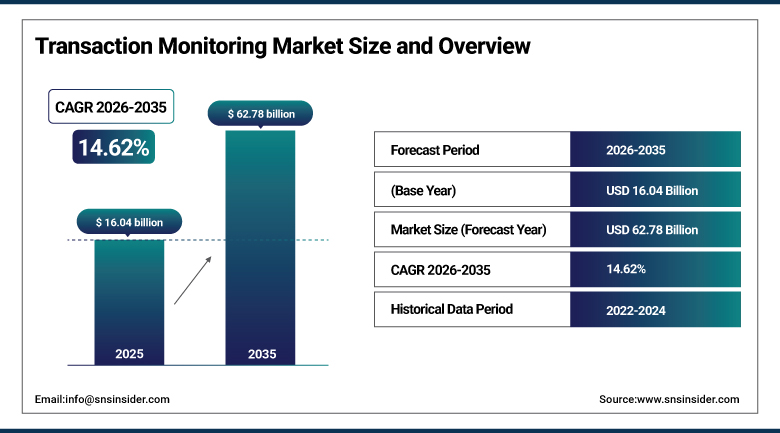
The Transaction Monitoring Market was valued at USD 16.04 Billion in 2025 and is expected to reach USD 62.78 Billion by 2035, growing at a CAGR of 14.62% from 2026 to 2035.
Transaction monitoring has quietly become one of the more mission-critical layers of infrastructure inside any bank or payment company, mostly because digital payments, cross-border transfers, and account-to-account transactions keep multiplying in both volume and complexity. At its core, the technology watches transaction flows as they happen, applies a mix of rule-based logic and machine-learning models to spot anything that looks off, and routes suspicious activity to a human investigator before it can quietly turn into a fraud loss or, worse, a regulatory finding. What really cemented the category's importance, though, is regulation: statutes enforced by FinCEN in the U.S., the EU's AMLD framework, and comparable bodies across Asia Pacific have effectively turned continuous surveillance into table stakes rather than a nice-to-have, and examiners now expect banks, payment processors, and fintechs alike to show up with auditable, defensible monitoring programs, not just good intentions.
In 2025, the U.S. transaction monitoring market grew by roughly 42% year-over-year as artificial intelligence adoption accelerated sharply across the banking sector, helping financial institutions cut fraud losses by an estimated 35% while securing more than 1.2 trillion digital transactions annually across retail banking, card networks, and real-time payment rails.
Market Size and Forecast:
-
Market Size in 2026E: USD 18.39 Billion
-
Market Size by 2035: USD 62.78 Billion
-
CAGR: 14.62% from 2026 to 2035
-
Fastest Growing Region: Asia Pacific
-
Largest Region: North America
To Get more information Transaction Monitoring Market - Request Free Sample Report
Transaction Monitoring Market Trends:
-
AI and machine learning are getting noticeably better at catching unusual transaction patterns in real time, and that's finally starting to cut down the analyst hours lost chasing false positives.
-
Regulators around the world keep tightening anti-money laundering and counter-terrorism financing rules, and banks and fintechs are responding with more sophisticated, audit-ready compliance platforms.
-
Cloud-based deployment keeps picking up momentum, largely because it gives institutions infrastructure that can scale with transaction volume rather than needing a fresh capital outlay every time volumes climb.
-
Big data analytics is letting vendors correlate signals across channels far more effectively, which is helping both flag suspicious activity sooner and ease the false-positive rates that have frustrated compliance teams for years.
-
The use case is spreading well beyond traditional banking, too, with fintech, insurance, and payment-processing firms increasingly adopting the same monitoring tools as digital transaction volumes climb across financial services broadly.
U.S. Transaction Monitoring Market Outlook:
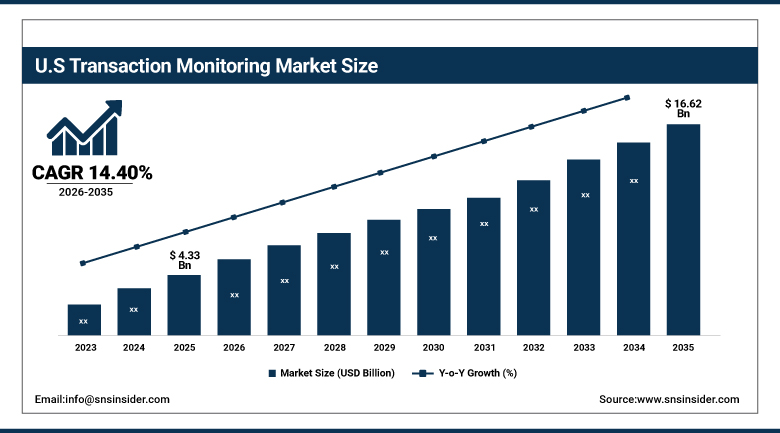
The U.S. Transaction Monitoring Market was valued at approximately USD 4.33 Billion in 2025 and is expected to reach approximately USD 16.62 Billion by 2035, growing at a CAGR of approximately 14.40%.
It's not much of a surprise that the United States is the single largest national market for transaction monitoring solutions worldwide, given the sheer scale of its banking and payments infrastructure and the examination standards set under the Bank Secrecy Act and FinCEN's anti-money laundering guidance. U.S. banks, credit unions, and money-service businesses go through some of the most rigorous AML examination cycles anywhere, and scrutiny from the OCC, the Federal Reserve, and state banking regulators keeps intensifying rather than easing. Meanwhile, rapid growth in mobile payments, instant-payment rails such as FedNow and RTP, and embedded fintech partnerships has widened the surface area regulators expect institutions to monitor.
NICE Actimize has continued strengthening its position in the U.S. market through its X-Sight Transaction Monitoring platform, which layers a generative-AI investigation assistant on top of core AML and fraud detection workflows, meaningfully speeding up case resolution for bank compliance teams managing rising alert volumes across retail and commercial banking channels.
Transaction Monitoring Market Segment Analysis:
-
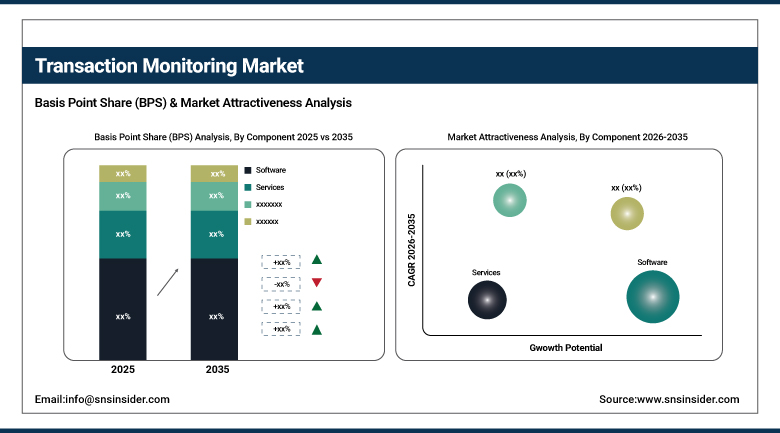
By Component, the Software segment dominated the transaction monitoring market with 62.5% share in 2025, while Services is the fastest growing component segment.
-
By Deployment Mode, the Cloud-Based segment dominated the transaction monitoring market with 58.3% share in 2025, while Hybrid is the fastest growing deployment mode.
-
By Application, the Anti-Money Laundering (AML) Compliance segment dominated the transaction monitoring market with 41.6% share in 2025, while Fraud Detection & Prevention is the fastest growing application.
-
By End User, the BFSI segment dominated the transaction monitoring market with 49.3% share in 2025, while Telecom & IT is the fastest growing end-user segment.
By Component, Software segment dominates the Transaction Monitoring Market, Services segment expected to grow fastest
The Software segment dominated the Transaction Monitoring Market in 2025 because of rising demand for automated transaction screening, real-time transaction monitoring, risk scoring, and compliance solutions. Financial institutions are adopting sophisticated software products that can detect suspicious activities and minimize false positive. With the help of artificial intelligence, machine learning and advanced analytics, transaction monitoring has become efficient. Digital payment volume and financial regulation act as driving forces behind the rising demand for transaction monitoring software products.
The Services segment is the fastest growing because of rising demand for implementation, consulting, integration, training, and managed services relating to transaction monitoring solutions. Organizations need professional services for deploying custom transaction monitoring solutions. Due to rising complexities in detecting financial crimes, increased regulatory pressures and digitization process, businesses are now ready to invest in professional services.
By Deployment Mode, Cloud-Based segment dominates the Transaction Monitoring Market, Hybrid segment expected to grow fastest
The Cloud-Based segment dominated the Transaction Monitoring Market in 2025 due to their scalable nature, reduced costs of infrastructure, and ability to offer real-time monitoring at different places. The Cloud-based deployment helps financial institutions process transactions effectively, utilize sophisticated analytics tools, and update security features. Adoption of digital banking, cloud computing, and remote financial services has boosted the demand for cloud-based transaction monitoring tools. Continued flexibility and fast deployment will help the segment maintain their dominant position.
The Hybrid segment is the fastest growing owing to the rising need for deployments that have the features of cloud flexibility along with on-premise security and regulation. Organizations dealing with sensitive transaction data are implementing hybrid solutions, which helps them fulfill compliance needs and leverage the power of cloud-based analytics and scalability. Increasing concerns about cybersecurity, data privacy, and operational resiliency have encouraged organizations to adopt hybrid architecture.
By Application, Anti-Money Laundering (AML) Compliance segment dominates the Transaction Monitoring Market, Fraud Detection & Prevention segment expected to grow fastest
The Anti-Money Laundering (AML) Compliance segment dominated the Transaction Monitoring Market in 2025 owing to strict regulations from all around the globe to control money laundering and other financial crimes. Financial companies require advanced transaction monitoring tools that can help them in detecting suspicious transactions, automate compliance reporting, and minimize regulatory risks. The increasing number of transactions, growth in digital banking services, and changing compliance requirements are expected to fuel the adoption of transaction monitoring solutions in this segment.
The Fraud Detection & Prevention segment is the fastest growing owing to the growing trend of digital payments and online banking, and advanced cyber-crimes. Advanced transaction monitoring solutions that use AI and machine learning technologies are used by organizations for detecting fraud in real time. Increased financial loss because of cyber-crimes, growing e-commerce activities, and increased need for proactive security measures are some of the factors that will accelerate demand for fraud detection & prevention solutions.
By End User, BFSI segment dominates the Transaction Monitoring Market, Telecom & IT segment expected to grow fastest
The BFSI segment dominated the Transaction Monitoring Market in 2025 owing to the high transaction volume, regulatory compliance requirements, and rising vulnerability to financial crimes. It is essential for banks, insurance companies, and financial institutions to implement continuous transaction monitoring systems to prevent any form of fraudulent activities or financial crimes. With the increase in digital banking and financial transactions, there has been a significant rise in the need for transaction monitoring solutions in the BFSI sector.
The Telecom & IT segment is the fastest growing owing to the growth in digital transactions, mobile payment services, cloud platform adoption, and rising concerns regarding cybersecurity. It becomes essential for telecommunication companies and technology providers to use the transaction monitoring systems to prevent any fraudulent activity and safeguard the customer's information from cyber-attacks.
Regional Analysis:
|
Region |
Major Country |
Share within Region, 2025 (%) |
|---|---|---|
|
North America |
United States |
83.50% |
|
Europe |
United Kingdom |
26.80% |
|
Asia Pacific |
China |
28.75% |
|
Middle East & Africa |
UAE |
34.20% |
|
Latin America |
Brazil |
41.85% |
North America Transaction Monitoring Market Insights
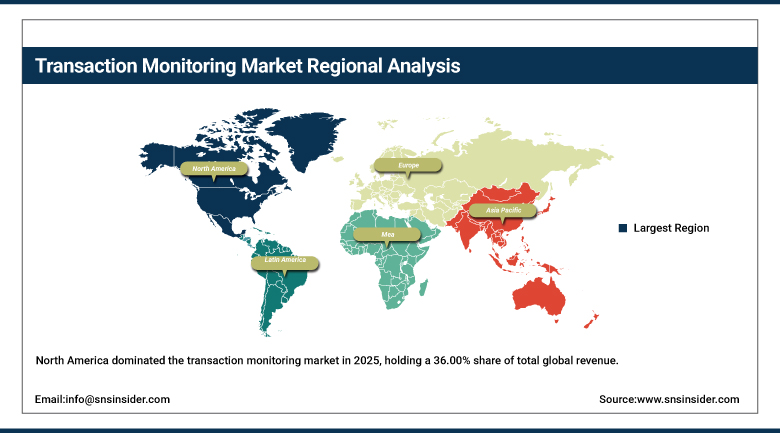
North America dominated the transaction monitoring market in 2025, holding a 36.00% share of total global revenue. That leadership rests on a fairly familiar combination of factors: advanced banking infrastructure, a stringent regulatory environment, and early, widespread adoption of both AI-based and rule-based monitoring systems. Deep fintech integration, high cybersecurity awareness across financial institutions, and long-established compliance frameworks under the Bank Secrecy Act and FinCEN guidance have all reinforced that lead, and the sheer scale of daily transaction volume moving through U.S. and Canadian financial institutions keeps North America the largest addressable market for monitoring vendors anywhere in the world.
The United States alone accounts for roughly 83.50% of regional revenue, which tracks with its outsized banking sector, extensive card-payment infrastructure, and the compliance burden that comes with federal and state-level AML examination regimes. Canada adds further regional demand through FINTRAC's reporting requirements and a banking sector that has been quick to adopt AI-driven monitoring tools of its own.
Get Customized Report as per Your Business Requirement - Enquiry Now
Europe Transaction Monitoring Market Insights
Europe held a significant share of the transaction monitoring market in 2025, built on a foundation of well-established financial institutions, rigorous regulatory frameworks including the EU's Anti-Money Laundering Directives and GDPR's data-handling requirements, and steadily rising adoption of AI-based monitoring platforms across the region's banking sector. Continuous investment in compliance technology, risk-management infrastructure, and digital banking modernization across the region's major economies has kept demand for sophisticated monitoring solutions on a firmly upward path.
The United Kingdom leads regional demand at roughly 26.80% of European revenue, thanks in large part to London's position as a global financial hub and the Financial Conduct Authority's fairly active enforcement of AML obligations. Germany, France, and the Nordic countries all contribute substantial additional demand, and harmonized EU-level AML directives are pushing institutions across the bloc toward broadly comparable monitoring standards.
Asia Pacific Transaction Monitoring Market Insights
Asia Pacific is on track to be the fastest-growing regional market for transaction monitoring through 2035, expanding at a CAGR of approximately 15.99%. Rapid digital banking adoption, expanding financial-services penetration, and increasingly intense regulatory focus on anti-money laundering and fraud prevention across the region's major economies are all pulling in the same direction. Rising investment in AI-enabled monitoring technology, growing fintech penetration, and the sheer pace of digital-payment adoption across China, India, and Southeast Asia are keeping regional growth well ahead of the global average.
China is the largest country-level market within the region, accounting for roughly 28.75% of regional revenue, supported by the scale of its digital-payment ecosystem and tightening oversight from national financial regulators.
MEA & Latin America Transaction Monitoring Market Insights
The Middle East & Africa and Latin America both posted steady growth in the transaction monitoring market in 2025, helped along by expanding banking and fintech sectors, rising adoption of digital-payment solutions, and a growing awareness among regulators of fraud and money-laundering risk in both regions. Government-led modernization initiatives and increasing investment in financial infrastructure are gradually narrowing the gap between these emerging markets and the more mature monitoring adopters in North America and Europe.
The UAE leads Middle East & Africa demand at roughly 34.20% of regional revenue, supported by the Central Bank of the UAE's tightening AML supervision and the country's clear ambition to position itself as a regional financial hub. Saudi Arabia and South Africa add further regional demand through their own financial-modernization programs. Over in Latin America, Brazil accounts for approximately 41.85% of regional revenue, and the Central Bank of Brazil's compliance requirements, together with the country's fast-growing instant-payment ecosystem, Pix, are driving rising demand for real-time transaction surveillance across the region's banking sector.
Market Dynamics:
Growth Drivers: Tightening AML regulation and surging digital payment volumes
Governments and financial regulators around the world just keep tightening anti-money laundering and counter-terrorism financing rules, and that's forcing banks, fintechs, and other financial-service providers to maintain increasingly sophisticated transaction surveillance and reporting capability whether they'd prefer to spend the budget elsewhere or not. Non-compliance carries real financial and reputational consequences, so institutions have responded by pouring money into systems that can track suspicious transactions, flag anomalies, and generate regulatory reports without excessive manual intervention.
Rising cross-border financial activity and growing scrutiny of high-risk transaction corridors are only adding to this pressure, and in 2025 roughly 81% of banking and fintech firms prioritized advanced transaction monitoring investment specifically to close tightening AML compliance gaps and steer clear of the multimillion-dollar regulatory penalties that have become depressingly common across major markets.
At the same time, the explosive growth of digital wallets, online payments, and e-commerce transaction volumes is exposing financial institutions to meaningfully higher fraud and money-laundering risk, which adds a second driver working in the same direction.
Restraints: High implementation costs and a shortage of skilled compliance talent
Deploying a modern transaction monitoring platform takes real upfront investment in software, infrastructure, and integration work, and legacy core-banking systems have a way of making that integration considerably more complex and costly than vendors' sales materials tend to let on. Ongoing maintenance, periodic model tuning, and a steady stream of compliance-driven updates add further recurring cost on top of the initial deployment, and smaller banks and credit unions often simply lack the capital or in-house technical expertise to implement these systems well.
A related constraint is the shortage of qualified analysts, data scientists, and compliance professionals who can actually interpret alerts, tune detection rules, and respond effectively when something suspicious surfaces. Without that expertise on hand, institutions risk elevated false-positive rates, delayed investigations, and slower regulatory reporting, all of which chip away at the practical effectiveness of even a well-designed monitoring system.
Opportunities: AI-driven analytics and expanding cloud-based adoption
The deepening integration of artificial intelligence, machine learning, and big data analytics into transaction monitoring platforms is a genuinely substantial opportunity for vendors that can meaningfully improve detection accuracy while cutting the false-positive rates that have burdened compliance teams for years. These technologies let institutions analyze far larger volumes of transaction and customer-behavior data, catch subtle anomalies that a human analyst would likely miss, and support faster, better-informed investigative decisions. An estimated 77% of financial institutions were already leveraging AI, machine learning, or big data analytics within their monitoring programs in 2025, and vendors that keep pushing detection accuracy and false-positive reduction further are well placed to capture disproportionate share as institutions consolidate around fewer, more capable platforms.
Growing demand for cloud-based deployment is a second meaningful opportunity, particularly for extending monitoring capability into small and mid-sized institutions and emerging markets that have historically lacked the capital for on-premises infrastructure. Cloud platforms lower the barrier to entry considerably, letting institutions access advanced monitoring tools without a major upfront capital expenditure, while still benefiting from regular updates and a stronger baseline of cybersecurity. With roughly 74% of banks and fintech firms having already adopted cloud-based monitoring in 2025, vendors with mature, compliant cloud offerings are well positioned to keep capturing adoption across banking markets that are still fairly early in their monitoring-technology journey.
Recent Developments:
-
2025: NICE Actimize launched X-Sight Transaction Monitoring, adding a generative-AI investigation assistant that helps automate AML and fraud case resolution for bank compliance teams.
-
2024: ACI Worldwide introduced ReDAP, a next-generation transaction monitoring platform purpose-built for round-the-clock instant-payment rails including FedNow, RTP, SEPA Instant, UPI, and Pix.
-
2023: BAE Systems Digital Intelligence enhanced its Net Reveal platform with graph-based transaction monitoring capability, enabling entity resolution and network analysis for complex money-laundering schemes.
Transaction Monitoring Market key players are:
-
ACI Worldwide Inc.
-
BAE Systems plc
-
NICE Actimize
-
FICO (Fair Isaac Corporation)
-
SAS Institute Inc.
-
Oracle Corporation
-
Experian
-
LexisNexis Risk Solutions
-
Fiserv Inc.
-
FIS (Fidelity National Information Services)
-
Dixtior
-
TransUnion
-
Wolters Kluwer
-
Temenos AG
-
Nelito Systems
-
Tata Consultancy Services (TCS)
-
Workfusion
-
Napier AI Ltd
-
ComplyAdvantage Ltd
-
Feedzai Inc.
Transaction Monitoring Market Report Scope:
| Report Attributes | Details |
|---|---|
| Market Size in 2025 | USD 16.04 Billion |
| Market Size by 2035 | USD 62.78 Billion |
| CAGR | CAGR of 14.62% From 2026 to 2035 |
| Base Year | 2025 |
| Forecast Period | 2026-2035 |
| Historical Data | 2022-2024 |
| Report Scope & Coverage | Market Size, Segments Analysis, Competitive Landscape, Regional Analysis, DROC & SWOT Analysis, Forecast Outlook |
| Key Segments | • By Component (Software, Services) • By Deployment Mode (Cloud-Based, On-Premises, Hybrid) • By Application (Fraud Detection & Prevention, Anti-Money Laundering (AML) Compliance, Risk & Compliance Management, Sanctions Screening, Suspicious Activity Reporting) • By End-User (BFSI (Banks, Financial Institutions), Insurance Companies, Retail & E-commerce, Telecom & IT, Government & Regulatory Authorities) |
| Regional Analysis/Coverage | North America (US, Canada), Europe (Germany, UK, France, Italy, Spain, Russia, Poland, Rest of Europe), Asia Pacific (China, India, Japan, South Korea, Australia, ASEAN Countries, Rest of Asia Pacific), Middle East & Africa (UAE, Saudi Arabia, Qatar, South Africa, Rest of Middle East & Africa), Latin America (Brazil, Argentina, Mexico, Colombia, Rest of Latin America). |
| Company Profiles | ACI Worldwide Inc., BAE Systems plc, NICE Actimize, FICO (Fair Isaac Corporation), SAS Institute Inc., Oracle Corporation, Experian, LexisNexis Risk Solutions, Fiserv Inc., FIS (Fidelity National Information Services), Dixtior, TransUnion, Wolters Kluwer, Temenos AG, Nelito Systems, Tata Consultancy Services (TCS), Workfusion, Napier AI Ltd, ComplyAdvantage Ltd, Feedzai Inc. |
Frequently Asked Questions
The Transaction Monitoring Market is expected to grow at a CAGR of 14.62% from 2026 to 2035.
The Transaction Monitoring Market was valued at USD 16.04 Billion in 2025.
The major growth factor is tightening anti-money laundering and fraud-detection regulation, combined with rapid growth in digital payment and e-commerce transaction volumes.
The Anti-Money Laundering (AML) Compliance segment dominated the Transaction Monitoring Market with a 41.6% share in 2025.
