
Transformer Oil Market Report Scope & Overview:
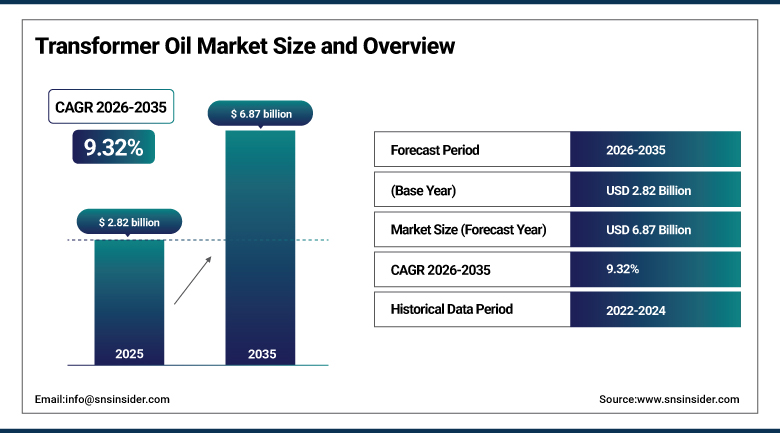
The Transformer Oil Market was valued at USD 2.82 Billion in 2025 and is expected to reach USD 6.87 Billion by 2035, growing at a CAGR of 9.32% from 2026 to 2035.
The transformer oil acts as an insulating fluid in electrical transformers. There are three main purposes of the transformer oil while running through the transformer. Firstly, it functions as an insulating medium for the high-voltage coils of the transformer as well as the space existing between the coils and the transformer's walls. Secondly, the transformer oil assists in the dissipation of heat from the transformer's copper coils and steel cores to the transformer walls. Third, it prevents arcing.
The global transformer oil market is being structurally reshaped by three simultaneous investment forces. The energy transition requires massive new transmission infrastructure and distribution transformers to electrify transport and heating sectors. Ageing transformer fleet replacement in North America, Europe, and Japan is generating large procurement volumes as 30 to 50-year-old assets reach end-of-life. Rapid electrification of developing economies is creating first-time transformer oil procurement at scale as rural and industrial electrification programmes expand.
Nynas AB, the largest manufacturer of naphthenic base oils and transformer oils in the world, unveiled its bio-based ester transformer oil known as Nytro Bio 300X in 2025. This product was classified under IEC 62770 as a vegetable-based fluid with a dielectric strength of 800 volts per millimeter and a flash point exceeding 300°C.
Market Size and Forecast
-
Market Size in 2026E: USD 3.08 Billion
-
Market Size by 2035: USD 6.87 Billion
-
CAGR: 9.32% from 2026 to 2035
-
Fastest Growing Region: Asia Pacific
-
Largest Region: Asia Pacific
To Get more information Transformer Oil Market - Request Free Sample Report
Transformer Oil Market Trends
-
Bio-based ester transformer oils are gaining adoption due to biodegradability requirements in environmentally sensitive transformer installations.
-
Online monitoring and AI-based dissolved gas analysis are enabling predictive transformer oil maintenance and optimized service scheduling.
-
Ultra-high voltage transmission expansion in China and India is increasing demand for high-performance dielectric transformer oils.
-
Renewable energy infrastructure is creating new transformer oil applications in wind, solar, and grid interconnection systems.
-
Oil reclamation and reconditioning services are expanding as cost-effective and sustainable alternatives to full transformer oil replacement.
The U.S. Transformer Oil Market Outlook
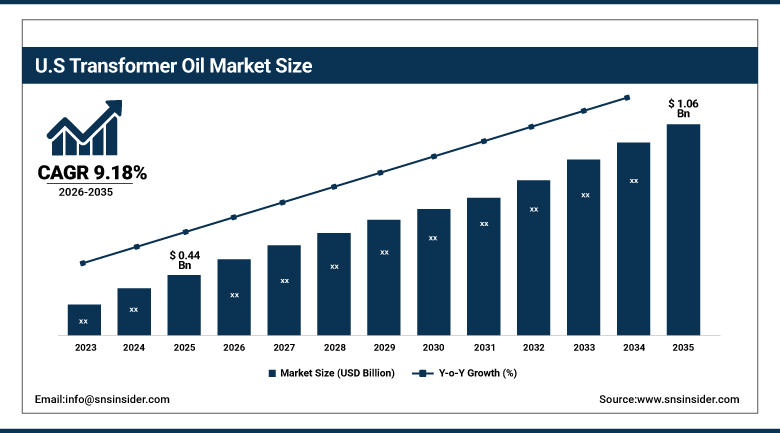
The U.S. transformer oil market was valued at approximately USD 0.44 Billion in 2025 and is expected to reach approximately USD 1.06 Billion by 2035, growing at a CAGR of approximately 9.18%.
The American Society of Civil Engineers indicates that the U.S. electricity network infrastructure has received inadequate investments in terms of transformer procurement. Modernizing the grid infrastructure would be essential for integrating renewable energy sources, electrifying industries, and achieving climate resiliency. This will increase the demand for transformers in the coming years. Consumption of transformer oil will grow along with such initiatives. There are a few companies like ExxonMobil, Chevron, and specialty producers who offer domestically sourced transformer oils. The use of bio-based ester oil is increasing.
The ability of Cargill to expand the production capacity of the BiO+ FR3 bio-based transformer fluid was done in 2025 in order to respond to increased demand for biodegradable fire-resistant insulating oils. The usage of the FR3 fluid has been increasing in urban substations as well as indoor transformer setups. It has been used in compliance with the environmental regulations set by the various utility companies in the United States. There are about 650,000 transformer installations globally.
Transformer Oil Market Segment Analysis
-
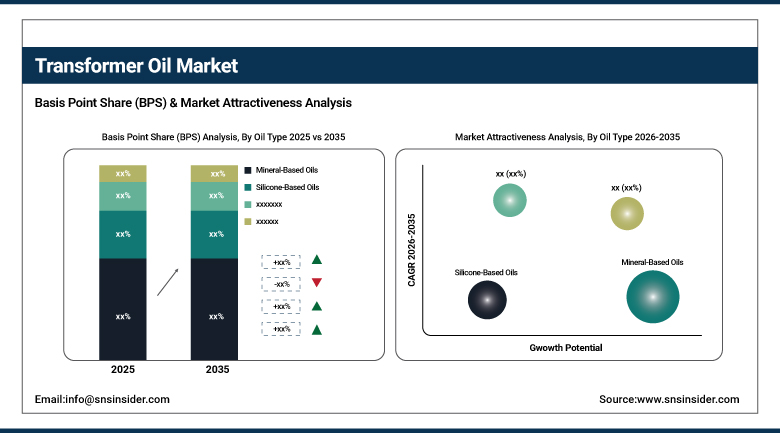
By Oil Type, the mineral-based oils segment dominated the market in 2025, while the bio-based ester oils segment is the fastest growing oil type during 2026 to 2035.
-
By Transformer Rating, the 100 MVA to 500 MVA segment dominated the market with 41.68% share in 2025, while the above 800 MVA segment is the fastest growing with a CAGR of 9.76% during 2026 to 2035.
-
By Application, the transformer application segment dominated the market with 68.34% share in 2025, while the reactor segment is the fastest growing application with a CAGR of 9.87%.
-
By End Use, the utilities segment dominated the market with 54.72% share in 2025, while the industrial segment is the fastest growing end use with a CAGR of 9.45% during 2026 to 2035.
By Oil Type, mineral-based oils dominate, bio-based ester oils grow fastest
Mineral-based transformer oils retained the dominant market position in 2025, representing the established and insulating fluid chemistry whose naphthenic and paraffinic base oil formulations have served the global transformer. Their commercial dominance is self-reinforcing: the vast majority of the world's installed transformer capacity was designed and filled with mineral oil, creating an enormous maintenance and top-up demand that sustains mineral oil market volume regardless of new installation specification trends. Mineral oil's competitive pricing, well-understood performance characteristics, and globally extensive supply chain give it structural advantages that bio-based alternatives cannot displace within any reasonable commercial timeframe.
Bio-based ester oils are growing fastest, driven by the combination of regulatory pressure on mineral oil in environmentally sensitive installations, the documented superior fire safety of high-flash-point ester fluids over mineral oil, and the growing corporate ESG commitments of utilities and industrial operators that make biodegradable fluid specification a sustainability reporting advantage.
By Application, transformers dominate, reactors grow fastest
Transformer applications accounted for 68.34% of transformer oil market revenue in 2025. This dominance reflects the fundamental role of power and distribution transformers as the primary consumers of electrical insulating fluid. The transformer fleet's massive scale, with tens of millions of transformers installed globally across voltage classes creates a structurally substantial and relatively stable demand base whose volume grows with new installation and is sustained by maintenance top-up and periodic oil change requirements.
Reactors are growing fastest with a CAGR of 9.87%, driven by the growing deployment of shunt reactors, series reactors, and current-limiting reactors in smart grid infrastructure, high-voltage DC transmission systems, and renewable energy integration substations whose reactive power management requirements create growing fluid-filled reactor procurement.
Regional Analysis
|
Region |
Major Country |
Share within Region, 2025 (%) |
|---|---|---|
|
Asia Pacific |
China |
46.28% |
|
North America |
United States |
82.47% |
|
Europe |
Germany |
28.47% |
|
Middle East & Africa |
Saudi Arabia |
22.84% |
|
Latin America |
Brazil |
43.84% |
North America Transformer Oil Market Insights
North America accounted for around 17.84% of global transformer oil revenue in 2025. The United States contributed about 82.47% of regional demand. Market growth is driven by an ageing transformer fleet requiring replacement cycles. More transformers are being installed because of federal infrastructure spending on grid modernization projects. An increase in renewable energy generation through wind and solar power has also driven more transformer installation. Canada contributes demand from grid improvement as well as increased transmission of hydroelectric power to the US.
Europe Transformer Oil Market Insights
Europe held approximately 16.84% of global Transformer Oil revenues in 2025. The European Union's renewable energy targets under the REPowerEU programme, the comprehensive grid interconnection investment required to enable cross-border renewable energy balancing across the EU energy union, and the replacement of ageing national transmission and distribution infrastructure. Germany accounts for approximately 28.47% of European revenues through its Energiewende grid transformation programme, its large industrial transformer installed base, and the commercial presence of leading transformer oil producers and conditioners whose German operations serve both domestic and export markets.
Asia Pacific Transformer Oil Market Insights
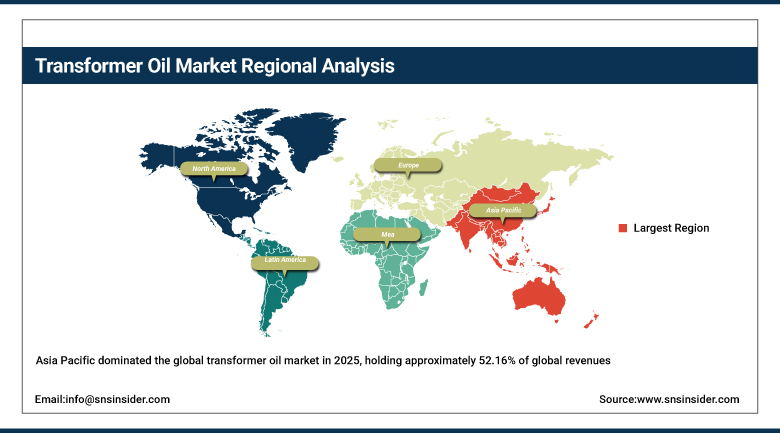
Asia Pacific dominated the global transformer oil market in 2025, holding approximately 52.16% of global revenues. China accounts for approximately 46.28% of Asia Pacific revenues through the power grid expansion and modernisation programme, whose investment in ultra-high-voltage AC and DC transmission infrastructure, smart grid distribution system upgrades, and renewable energy integration substations requires transformer oil procurement. India is growing rapidly as its government's commitment to universal rural electrification, its ambitious solar and wind capacity addition targets, and its major transmission infrastructure investment under the Revamped Distribution Sector Scheme create large-scale transformer procurement whose oil requirements are growing proportionately.
Get Customized Report as per Your Business Requirement - Enquiry Now
MEA & Latin America Transformer Oil Market Insights
Middle East and Latin America are growing transformer oil markets where rapid electrification expansion, energy infrastructure investment under national development programmes, and renewable energy capacity addition are creating strong demand for transformer oil procurement. Saudi Arabia leads MEA revenues at approximately 22.84% of the regional total through its NEOM and Vision 2030 infrastructure development programmes.
Brazil leads Latin American revenues at approximately 43.84% of the regional total through its large hydropower infrastructure, growing solar and wind energy installed base, and the national electrification investment of its Eletrobras system whose distribution network expansion creates consistent transformer procurement.
Market Dynamics
Growth Drivers: Global electricity demand growth and large-scale energy transition investments are driving structural transformer oil demand.
The International Energy Agency documented that global electricity demand grew by 4.3% in 2025, one of the fastest annual growth rates in two decades, and projects continued above-historical-average demand growth through 2035 as electrification of transport, heating, and industrial processes accelerates. Each percentage point of electricity demand growth requires proportional expansion of generation, transmission, and distribution capacity, all of which consume transformer oil through new equipment installation and maintenance of the existing fleet.
The energy transition adds a structural demand multiplier on top of this baseline growth, as renewable energy's geographic remoteness from load centres requires long-distance transmission infrastructure, its variable output requires reactive power management equipment, and its distributed generation profile requires densification of distribution transformer networks that collectively increase the transformer installed base per unit of electricity consumed.
Restraints: Environmental disposal regulations and longer transformer lifespans are limiting transformer oil market volume growth.
Environmental regulations governing the storage, handling, and disposal of used mineral transformer oil are progressively tightening across OECD markets, adding compliance cost and procedural complexity to transformer oil maintenance operations that moderate the volume and frequency of oil change activities. The introduction of high-quality mineral oil formulations and improved transformer designs that extend oil service life through better moisture control, oxidation inhibition, and reduced thermal cycling has progressively extended the intervals between oil top-up and full oil change requirements, reducing the per-transformer annual oil consumption that the maintenance market generates.
These efficiency improvements are commercially beneficial to transformer operators but moderate the volume growth of the maintenance oil market whose per-unit oil consumption is declining even as the installed transformer population grows.
Opportunities: Bio-based ester oils and digital condition monitoring platforms are creating growth opportunities for transformer oil producers.
The commercial opportunity in bio-based ester transformer oils is differentiated from the commodity mineral oil market by its premium pricing, growing regulatory mandate drivers, and the progressive development of utility procurement standards that specify ester fluid in new transformer installations at environmentally sensitive locations. Each utility that adopts a corporate policy of specifying ester fluid for all new urban substation transformers commits to decades of higher-value oil procurement for that installation segment, creating recurring premium revenue that grows with the utility's capital investment programme.
Online dissolved gas analysis and oil condition monitoring service platforms that provide continuous transformer health intelligence through cloud-connected oil sensors represent a recurring service revenue model adjacent to the product market whose development is creating new commercial relationships between oil producers, transformer operators, and digital service providers.
Recent Developments:
-
2025: Nynas AB launched its Nytro Bio 300X bio-based ester transformer oil achieving IEC 62770 vegetable-based fluid classification with 800 V/mm dielectric breakdown strength and flash point above 300 degrees Celsius.
-
2025: Cargill expanded U.S. production capacity for its BiO+ FR3 natural ester insulating fluid, responding to growing utility demand for biodegradable transformer fluid.
-
2024: Shell PLC launched its Diala S4 ZX-I ultra-low sulfur naphthenic transformer oil for the Asian utility market, formulated to meet increasingly stringent transformer insulation system requirements at UHV operating voltages.
Transformer Oil Market Key Players are:
-
Nynas AB
-
ExxonMobil Corporation
-
Shell PLC
-
Chevron Corporation
-
TotalEnergies SE
-
APAR Industries Ltd.
-
Ergon Refining Inc.
-
Cargill Incorporated (FR3 Fluid)
-
PetroChina Company Ltd.
-
Repsol SA
-
SINOPEC Group (China Petroleum & Chemical Corporation)
-
Phillips 66
-
Neste Oyj
-
Gandhar Oil Refinery India Ltd.
-
Savita Oil Technologies Ltd.
-
Valvoline Inc.
-
Agip/ENI SpA
-
Fuchs Petrolub SE
-
Calumet Specialty Products Partners LP
-
Hydrodec Group PLC
Transformer Oil Market Report Scope:
| Report Attributes | Details |
|---|---|
| Market Size in 2025 | USD 2.82 Billion |
| Market Size by 2035 | USD 6.87 Billion |
| CAGR | CAGR of 9.32% From 2026 to 2035 |
| Base Year | 2025 |
| Forecast Period | 2026-2035 |
| Historical Data | 2022-2024 |
| Report Scope & Coverage | Market Size, Segments Analysis, Competitive Landscape, Regional Analysis, DROC & SWOT Analysis, Forecast Outlook |
| Key Segments | • By Oil Type (Mineral-Based Oils, Silicone-Based Oils, Bio-Based Ester Oils) • By Transformer Rating (Up to 100 MVA, 100 MVA to 500 MVA, 500 MVA to 800 MVA, Above 800 MVA) • By Application (Transformer, Reactor, Switchgear, Capacitor, Others) • By End Use (Utilities, Industrial, Commercial, Railways) |
| Regional Analysis/Coverage | North America (US, Canada), Europe (Germany, UK, France, Italy, Spain, Russia, Poland, Rest of Europe), Asia Pacific (China, India, Japan, South Korea, Australia, ASEAN Countries, Rest of Asia Pacific), Middle East & Africa (UAE, Saudi Arabia, Qatar, South Africa, Rest of Middle East & Africa), Latin America (Brazil, Argentina, Mexico, Colombia, Rest of Latin America). |
| Company Profiles | Nynas AB, ExxonMobil Corporation, Shell PLC, Chevron Corporation, TotalEnergies SE, APAR Industries Ltd., Ergon Refining Inc., Cargill Incorporated (FR3 Fluid), PetroChina Company Ltd., Repsol SA, SINOPEC Group (China Petroleum & Chemical Corporation), Phillips 66, Neste Oyj, Gandhar Oil Refinery India Ltd., Savita Oil Technologies Ltd., Valvoline Inc., Agip/ENI SpA, Fuchs Petrolub SE, Calumet Specialty Products Partners LP, Hydrodec Group PLC |
Frequently Asked Questions
The transformer oil market is expected to grow at a CAGR of 9.32% from 2026 to 2035.
The transformer oil market was valued at USD 2.82 Billion in 2025.
Rising electricity demand, renewable energy grid integration, and electrification in developing economies are driving transformer oil market growth.
The transformer application segment dominated the market with 68.34% share in 2025.
Asia Pacific dominated the transformer oil market in 2025, holding approximately 52.16% of global revenues.
