
Unified Endpoint Management Market Report Scope & Overview:
The Unified Endpoint Management Market Size was valued at USD 6.16 Billion in 2025E and is expected to reach USD 27.63 Billion by 2033 and grow at a CAGR of 20.65% over the forecast period 2026-2033.
The Unified Endpoint Management Market analysis, driven by the rising adoption of mobile and remote workforces, increasing BYOD (Bring Your Own Device) practices, and the need for centralized endpoint security and compliance. Growing cyber threats and regulatory requirements compel organizations to manage and secure all devices under a single platform. According to study, approximately 58% of organizations allow employees to use personal devices for work, increasing endpoint management needs.
Market Size and Forecast:
-
Market Size in 2025: USD 6.16 Billion
-
Market Size by 2033: USD 27.63 Billion
-
CAGR: 20.65% from 2026 to 2033
-
Base Year: 2025
-
Forecast Period: 2026–2033
-
Historical Data: 2022–2024

To Get more information On Unified Endpoint Management Market - Request Free Sample Report
Unified Endpoint Management Market Trends:
-
Remote work adoption drives centralized management of endpoints across global organizations.
-
BYOD policies increase demand for secure, compliant unified endpoint management solutions.
-
Cloud-based UEM deployments are rapidly growing for scalable enterprise endpoint management.
-
AI integration enables predictive monitoring and automated endpoint security operations efficiently.
-
Real-time analytics improves decision-making and operational efficiency in endpoint management.
-
Increasing digital transformation initiatives accelerate adoption of intelligent UEM platforms worldwide.
The U.S. Unified Endpoint Management Market size was USD 1.65 Billion in 2025E and is expected to reach USD 7.27 Billion by 2033, growing at a CAGR of 20.41% over the forecast period of 2026-2033, driven by advanced IT infrastructure, high enterprise mobility, widespread cloud-based adoption, and strong focus on cybersecurity, compliance, and centralized management of desktops, laptops, mobile, and IoT endpoints.

Unified Endpoint Management Market Growth Drivers:
-
Empowering Remote Workforces Through Unified Endpoint Management Solutions Worldwide
The increasing prevalence of remote work and flexible workplace policies is a key driver for Unified Endpoint Management Market. Organizations now need to manage, monitor, and secure devices used both on-premises and remotely, including laptops, smartphones, tablets, and IoT devices. UEM platforms provide a centralized system to enforce security policies, control access, and ensure compliance across all endpoints. The trend is amplified by BYOD (Bring Your Own Device) practices, which require robust endpoint management to prevent security breaches and data leaks.
On average, organizations manage ~150–200 endpoints per IT administrator using UEM platforms.
Unified Endpoint Management Market Restraints:
-
High Implementation Complexity and Cost Challenges Slowing UEM Adoption Growth
Deploying and managing Unified Endpoint Management solutions can be technically complex and costly, especially for small and medium enterprises (SMEs). Integration with existing IT infrastructure, multi-OS support, and policy customization require specialized expertise. Additionally, organizations may face high upfront licensing fees, training costs, and maintenance expenses. This complexity and investment can slow adoption, particularly among budget-constrained businesses, acting as a restraint to rapid UEM market growth.
Unified Endpoint Management Market Opportunities:
-
AI and Analytics Integration Unlocks Predictive Endpoint Management Potential Globally
The integration of artificial intelligence (AI) and analytics into Unified Endpoint Management platforms presents a significant growth opportunity. AI-enabled UEM can proactively detect anomalies, predict device failures, and automate routine IT tasks like patch management and compliance reporting. Real-time analytics provides actionable insights for IT teams, improving endpoint security, operational efficiency, and decision-making. As enterprises increasingly adopt AI-driven tools, vendors that offer intelligent, automated UEM solutions can capture a larger market share and differentiate themselves from traditional offerings.
Vendors offering AI-driven UEM solutions achieve ~15–20% higher adoption rates than traditional platforms.
Unified Endpoint Management Market Segmentation Analysis:
-
By Component: In 2025, Software led the market with a share of 65.20%, while Services is the fastest-growing segment with a CAGR of 21.26%.
-
By Deployment: In 2025, Large Enterprise led the market with a share of 70.02%, while SME is the fastest-growing segment with a CAGR of 23.16%.
-
By Application: In 2025, Endpoint Management Integration led the market with a share of 35.60%, while Data Protection is the fastest-growing segment with a CAGR of 22.34%.
-
By Operating System: In 2025, Windows led the market with a share of 40.26%, while Android is the fastest-growing segment with a CAGR of 23.40%.
-
By End-user: In 2025, IT & Telecommunications led the market with a share of 25.10%, while Healthcare is the fastest-growing segment with a CAGR of 22.84%.
By Component, Software Lead Market and Services Fastest Growth
The Software lead the market in 2025, due to the widespread adoption of software-driven endpoint management solutions. Software platforms enable centralized management, security, and compliance across desktops, laptops, mobile devices, and IoT endpoints, making them essential for enterprises of all sizes.
Meanwhile, Services represent the fastest-growing segment, driven by increasing demand for professional consulting, implementation, and managed services that support deployment, optimization, and continuous monitoring of UEM solutions across organizations globally.

By Deployment, Large Enterprise Lead Market and SME Fastest Growth
The Large Enterprise lead the market in 2025, due to their extensive IT infrastructure and the need to manage, monitor, and secure thousands of endpoints across multiple locations. These organizations prioritize centralized management and compliance, making UEM solutions essential for operational efficiency.
Meanwhile, SMEs are the fastest-growing segment, driven by increasing digital transformation initiatives, remote work adoption, and the growing need for cost-effective, scalable endpoint management solutions that enhance security, productivity, and IT efficiency.
By Application, Endpoint Management Integration Lead Market and Data Protection Fastest Growth
The Endpoint Management Integration leads the market in 2025, due to as organizations prioritize centralized control, monitoring, and management of all endpoints across desktops, laptops, mobile devices, and IoT systems. This integration ensures operational efficiency, compliance, and security across enterprises.
Meanwhile, Data Protection is the fastest-growing segment, driven by rising cybersecurity threats, stringent regulatory requirements, and the increasing need for organizations to safeguard sensitive data, prevent breaches, and ensure secure access across all managed endpoints.
By Operating System, Windows Lead Market and Android Fastest Growth
The Windows leads the market in 2025, driven by its extensive adoption across enterprise desktops and laptops worldwide. Enterprises rely on unified endpoint management solutions to efficiently manage Windows endpoints, ensuring security, compliance, and seamless operations.
Meanwhile, Android represents the fastest-growing segment, fueled by the rapid proliferation of mobile devices, increasing BYOD adoption, and the need for enterprises to secure and monitor Android smartphones and tablets. This growth reflects the expanding mobile workforce and rising demand for mobile endpoint management solutions.
By End-user, IT & Telecommunications Lead Market and Healthcare Fastest Growth
The IT & Telecommunications leads the market in 2025, due to extensive endpoint deployment, high digital infrastructure, and the critical need for centralized management, security, and compliance across multiple devices.
Meanwhile, Healthcare is the fastest-growing segment, driven by increasing digitalization, remote patient care, strict regulatory compliance, and the growing adoption of mobile and IoT devices in hospitals and clinics. Unified Endpoint Management solutions help healthcare organizations enhance security, streamline operations, and ensure data protection across all endpoints.
Unified Endpoint Management Market Regional Analysis:
North America Unified Endpoint Management Market Insights:
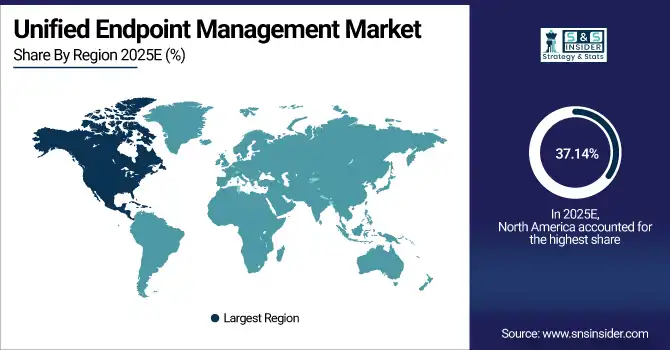
The North America dominated the Unified Endpoint Management Market in 2025E, with over 37.14% revenue share, driven by high adoption of advanced IT infrastructure and digital workplace solutions. Enterprises rely on UEM platforms to manage a growing number of endpoints, including desktops, laptops, mobile devices, and IoT systems, ensuring centralized security, compliance, and operational efficiency. The region’s focus on cloud-based deployments, AI-driven analytics, and proactive cybersecurity measures further strengthens market leadership. Continuous investments in endpoint management technologies and growing demand for integrated solutions sustain North America’s position as the largest revenue-generating market globally.
Get Customized Report as per Your Business Requirement - Enquiry Now
U.S. Unified Endpoint Management Market Insights
The U.S. and Canada dominate the Unified Endpoint Management (UEM) market due to mature IT ecosystems, extensive enterprise digitalization, and growing demand for centralized endpoint security. Widespread use of cloud-based solutions, AI-driven analytics, and proactive cybersecurity practices further reinforce the region’s leading position.
Asia Pacific Unified Endpoint Management Market Insights:
The Asia-Pacific region is expected to have the fastest-growing CAGR 22.04%, due to increasing enterprise mobility, remote work adoption, and the proliferation of connected devices. Rising awareness of endpoint security, regulatory compliance requirements, and the need for centralized management across desktops, mobile devices, and IoT systems are driving UEM adoption. Cloud-based deployments and AI-enabled management solutions are gaining traction, particularly among SMEs and large enterprises seeking cost-efficient, scalable solutions. Expanding digital infrastructure and government-led technology initiatives further strengthen the region’s position as the fastest-growing UEM market globally.
China and India Unified Endpoint Management Market Insights
China and India are driving growth in the Unified Endpoint Management (UEM) market due to rapid digital transformation, increasing enterprise mobility, widespread adoption of mobile devices, and rising demand for secure, centralized endpoint management. Expanding IT infrastructure and growing awareness of cybersecurity further fuel market growth.
Europe Unified Endpoint Management Market Insights
The Europe Unified Endpoint Management Market is well-established, due to high enterprise IT maturity and widespread adoption of digital workplace solutions. Organizations are increasingly implementing unified endpoint management platforms to manage, monitor, and secure diverse endpoints, including desktops, laptops, mobile devices, and IoT systems, ensuring compliance with stringent data protection regulations. The region also shows growing interest in cloud-based UEM deployments and AI-enabled analytics for real-time monitoring and operational efficiency. Strong focus on cybersecurity, digital transformation initiatives, and enterprise mobility sustains Europe’s steady growth in the unified endpoint management market.
Germany and U.K. Unified Endpoint Management Market Insights
The Germany and the U.K. are witnessing growth in the Unified Endpoint Management market due to high digital workplace adoption, stringent data protection regulations, and increasing enterprise demand for centralized endpoint security. Cloud-based deployments and AI-enabled management solutions further drive market expansion in these countries.
Latin America (LATAM) and Middle East & Africa (MEA) Unified Endpoint Management Market Insights
The Latin America (LATAM) and Middle East & Africa (MEA) Unified Endpoint Management Market are emerging regions showing steady growth driven by increasing digitalization, enterprise mobility, and rising adoption of mobile and IoT devices. Organizations in these regions are gradually implementing UEM solutions to ensure centralized endpoint management, security, and regulatory compliance across desktops, laptops, and mobile devices. Cloud-based deployments and cost-effective managed services are gaining traction, particularly among SMEs, while growing awareness of cybersecurity threats and operational efficiency needs further supports UEM adoption across LATAM and MEA markets.
Unified Endpoint Management Market Competitive Landscape:
SOTI’s UEM solution, SOTI MobiControl, specializes in managing mobile and IoT devices across diverse operating systems. The platform offers device tracking, remote troubleshooting, security policy enforcement, and real-time analytics for enterprise mobility management. By integrating edge devices and IoT hardware, SOTI enables organizations to streamline operations, reduce downtime, and maintain compliance. Its focus on automation, security, and scalability positions it as a preferred UEM provider in emerging and mature markets.
-
In August 2025, SOTI Inc. Partnered with Advantech Co., Ltd. to embed SOTI MobiControl and XSight into Advantech’s IoT/edge hardware, enabling unified device management across Android, iOS, Windows and Linux
Jamf focuses exclusively on Apple device management, providing comprehensive UEM solutions for macOS, iOS, iPadOS, and tvOS endpoints. The platform emphasizes security, automation, and real-time monitoring, enabling enterprises to manage devices, enforce compliance, and optimize workflows. Jamf’s integration with AI and next-gen APIs enhances operational efficiency and scalability. Its focus on the education, healthcare, and corporate sectors has strengthened adoption, positioning Jamf as a leader in Apple-centric UEM solutions.
-
In October 2025, Jamf Holding Corp Introduced a next‑gen API ecosystem, AI capabilities and automated OS updates at its annual user conference, enhancing Apple‑device management scalability and flexibility.
VMware’s UEM platform, Workspace ONE, focuses on providing a unified endpoint management experience across desktops, mobile devices, and IoT endpoints. The company emphasizes cloud-native deployments, AI-driven automation, and real-time monitoring, enabling enterprises to secure, manage, and optimize all endpoints from a single console. VMware’s partnerships and integrations with leading platforms enhance hybrid work solutions, driving adoption among large enterprises seeking scalable, compliant, and efficient endpoint management solutions globally.
-
In June 2023, VMware, Inc Partnered with Google LLC Workspace for hybrid‑work UEM support, and achieved Android Enterprise Gold‑partner status for Workspace ONE Unified Endpoint Management.
Unified Endpoint Management Market Key Players:
Some of the Unified Endpoint Management Market Companies are:
-
Microsoft Corporation
-
VMware, Inc.
-
IBM Corporation
-
Ivanti, Inc.
-
BlackBerry Limited
-
Citrix Systems, Inc.
-
Sophos Group plc
-
SOTI Inc.
-
Jamf Holding Corp.
-
Matrix42 GmbH
-
Zoho Corporation Pvt. Ltd.
-
42Gears Mobility Systems Pvt. Ltd.
-
Mitsogo Inc.
-
Cisco Systems, Inc.
-
Broadcom Inc.
-
Symantec Corporation
-
Trend Micro Incorporated
-
Kaspersky Lab
-
Absolute Software Corporation
-
Baramundi Software AG
| Report Attributes | Details |
|---|---|
| Market Size in 2025E | USD 6.16 Billion |
| Market Size by 2033 | USD 27.63 Billion |
| CAGR | CAGR of 20.65% From 2026 to 2033 |
| Base Year | 2025E |
| Forecast Period | 2026-2033 |
| Historical Data | 2022-2024 |
| Report Scope & Coverage | Market Size, Segments Analysis, Competitive Landscape, Regional Analysis, DROC & SWOT Analysis, Forecast Outlook |
| Key Segments | • By Component (Software, Services) • By Deployment (Large enterprise, SME) • By Application (Endpoint management integration, Desktop management modernization, Data protection, Real-time reporting and monitoring, Others) • By Operating System (Android, MacOS, Windows, iOS, Chrome, Linux) • By End-user (BFSI, IT & telecommunications, Healthcare, Government, Education, Retail, Manufacturing, Media & entertainment, Transportation & logistics) |
| Regional Analysis/Coverage | North America (US, Canada), Europe (Germany, UK, France, Italy, Spain, Russia, Poland, Rest of Europe), Asia Pacific (China, India, Japan, South Korea, Australia, ASEAN Countries, Rest of Asia Pacific), Middle East & Africa (UAE, Saudi Arabia, Qatar, South Africa, Rest of Middle East & Africa), Latin America (Brazil, Argentina, Mexico, Colombia, Rest of Latin America). |
| Company Profiles | Microsoft Corporation, VMware, Inc., IBM Corporation, Ivanti, Inc., BlackBerry Limited, Citrix Systems, Inc., Sophos Group plc, SOTI Inc., Jamf Holding Corp., Matrix42 GmbH, Zoho Corporation Pvt. Ltd., 42Gears Mobility Systems Pvt. Ltd., Mitsogo Inc., Cisco Systems, Inc., Broadcom Inc., Symantec Corporation, Trend Micro Incorporated, Kaspersky Lab, Absolute Software Corporation, Baramundi Software AG, and Others. |

Frequently Asked Questions
North America dominated the Unified Endpoint Management Market in 2025.
The Software segment dominated the Unified Endpoint Management Market.
The major growth factor of the Unified Endpoint Management (UEM) Market is the rising adoption of mobile and remote workforces, combined with the increasing implementation of BYOD (Bring Your Own Device) policies.
The Unified Endpoint Management Market size was USD 6.16 billion in 2025 and is expected to reach USD 27.63 billion by 2033.
The Unified Endpoint Management Market is expected to grow at a CAGR of 20.65% during 2026-2033.
