
Vacuum Valve Market Report Scope & Overview:
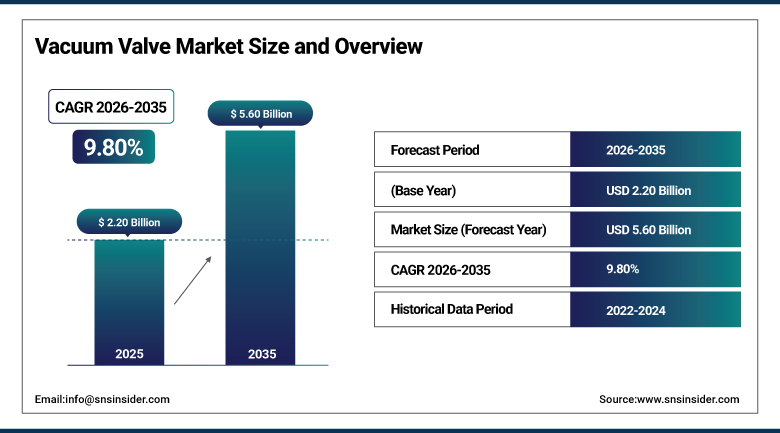
The Vacuum Valve Market was valued at USD 2.20 Billion in 2025 and is expected to reach USD 5.60 Billion by 2035, growing at a CAGR of 9.80% from 2026-2035.
The Vacuum Valve Market is witnessing significant growth owing to the rising requirement for vacuum-controlled environments in industries including the manufacturing of semiconductors, pharmaceuticals, chemicals, aerospace, research labs, and others. Vacuum valves are used for controlling the process of gas isolation and flow in vacuum systems. This market is receiving a significant boost owing to the rising number of semiconductor fabrication plants and electronics manufacturing companies. Furthermore, increased production of pharmaceutical products, increasing research activities, and investments in coating and material processing technologies are contributing towards market growth. The development of new technological capabilities of vacuum valves such as automation, tight leakage, corrosion resistance, and remote monitoring is assisting in developing better vacuum control systems.
Baker Hughes agreed in June 2025 to acquire Continental Disc Corporation, a specialist provider of pressure management solutions including rupture discs and pressure and vacuum relief valves, adding these capabilities directly to Baker Hughes' existing valve portfolio.
To Get more information Vacuum Valve Market - Request Free Sample Report
Vacuum Valve Market Trends
- Rapid expansion of semiconductor fabrication capacity for 2nm node production and AI-driven chip architecture driving precision valve demand
- Growing integration of IoT-enabled smart valve technology offering real-time health analytics and predictive maintenance capability
- Rising demand for very high vacuum-rated valves across sensitive semiconductor and analytical instrumentation applications
- Increasing miniaturization of vacuum valve components supporting compact semiconductor and aerospace system designs
- Growing adoption of high-purity stainless steel and specialty alloy construction ensuring ultra-high vacuum integrity for chip production
- Continued industry consolidation as diversified equipment manufacturers acquire specialized vacuum and pressure-control technology providers
U.S. Vacuum Valve Market Outlook
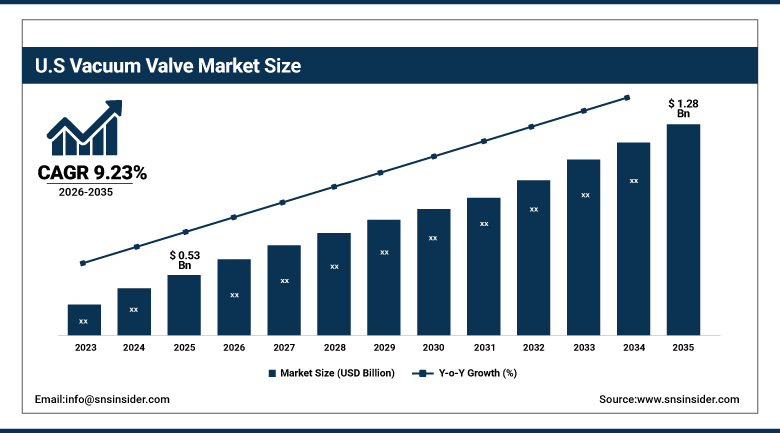
The U.S. Vacuum Valve Market was valued at approximately USD 0.53 Billion in 2025 and is expected to reach approximately USD 1.28 Billion by 2035, growing at a CAGR of approximately 9.23% from 2026-2035.
U.S. Vacuum Valve Market has been experiencing robust growth owing to high demand from the semiconductor industry, pharmaceutical, aerospace, chemical processing, and scientific research sectors where there is an acute requirement for precision and efficient vacuum control. There is a growing demand for vacuum valves as a result of increasing infrastructure for the fabrication and advanced packaging of semiconductors in the U.S. Increasing demand for pharmaceutical and biotechnology products and investments in laboratory and scientific research infrastructure is adding to the demand. Besides, the adoption of automated vacuum systems and advanced processing equipment and technologies is driving innovations in the design of valves for better performance.
Edwards Vacuum advanced preparations for its new dry vacuum pump manufacturing facility in Genesee County, New York, strengthening the U.S. semiconductor vacuum-equipment supply chain and supporting domestic demand for advanced vacuum components.
Vacuum Valve Market Segment Analysis
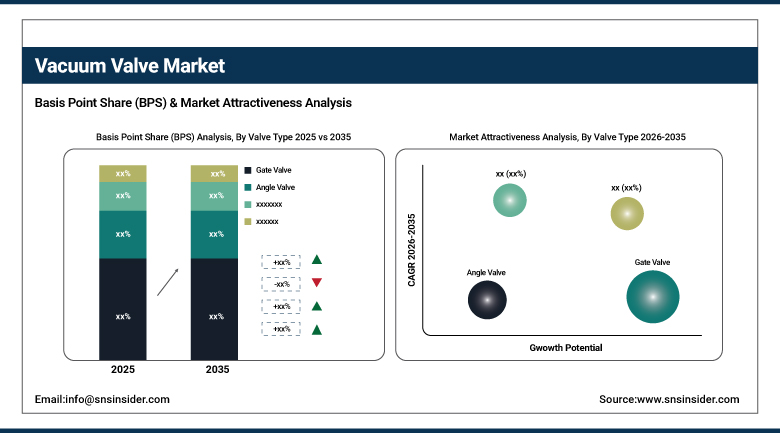
- By Valve Type, the Gate Valve segment dominated the Vacuum Valve Market with approximately 30.00% share in 2025, while the Angle Valve segment is the fastest growing with a CAGR of approximately 10.60%.
- By Pressure Range, the High Vacuum segment dominated the Vacuum Valve Market with approximately 44.60% share in 2025, while the Very High Vacuum segment is the fastest growing with a CAGR of approximately 11.40%.
- By Material, the Stainless Steel segment dominated the Vacuum Valve Market with approximately 68.20% share in 2025, while the Aluminum segment is the fastest growing with a CAGR of approximately 9.80%.
- By End User, the Semiconductor segment dominated the Vacuum Valve Market with approximately 42.40% share in 2025, while the Pharmaceuticals segment is the fastest growing with a CAGR of approximately 10.80%.
By Valve Type, Gate Valve dominates, Angle Valve grows fastest
The gate valves continue to be the most commonly used valve type for all applications that require accurate control of the flow, even in tough industrial environments such as oil and gas industries, water treatment, power generation, and chemical plants. The straight line flow path ensures minimum losses with reliable flow isolation under high temperature and high pressure. Standard installation practices, readily available materials, and the ability to use in large diameter pipes also add to its popularity, especially in operations where sealing, durability, and service life are the key requirements.
The angle valves are becoming more popular because of their smaller size and the efficiency in flow control. Because of the design, there is no need to change the direction of the flow in other pipeline elements, which simplifies the system. There is an increasing number of cases of angle valve use in special devices like semiconductor manufacturing equipment, HVAC systems, and industrial process equipment.
By Pressure Range, High Vacuum dominates, Very High Vacuum grows fastest
High vacuum-rated valves continue to serve the broadest range of industrial, semiconductor, laboratory, and research applications, offering a practical balance between vacuum performance, sealing reliability, operating durability, and manufacturing cost. Their established design characteristics support consistent pressure control across mainstream vacuum processes without requiring the specialized engineering associated with higher vacuum classes. As manufacturers prioritize dependable performance and cost-effective equipment configurations, high vacuum valves remain widely incorporated into semiconductor processing systems, coating equipment, analytical instruments, and industrial vacuum installations where reliable vacuum integrity is essential.
Very high vacuum valves are expanding fastest as sensitive semiconductor manufacturing, advanced research, particle physics, aerospace, and analytical instrumentation applications increasingly require exceptional leak integrity, low outgassing, and stringent contamination control. These environments demand highly engineered valve designs capable of maintaining extremely low pressures under demanding operating conditions while minimizing particle generation and material-related contamination. Growing investments in advanced semiconductor nodes, scientific research infrastructure, and precision analytical systems are therefore supporting increased adoption of very high vacuum valves where conventional high-vacuum solutions may not provide the required performance.
By Material, Stainless Steel dominates, Aluminum grows fastest
The use of stainless steel continues to be the most preferred construction material for vacuum valves in view of its corrosion resistance, mechanical strength, dimensional stability, and compatibility with harsh vacuum conditions. Its capacity to resist thermal shocks, chemical effects, and cleaning processes make it more suitable for fabrication of semiconductors, pharmaceutical products, laboratory equipment, and industrial vacuum valves. Availability and extensive experience in its fabrication, along with high purity capabilities, make stainless steel the most suitable material wherever cleanliness, long-term durability, and consistent vacuum integrity become performance requirements.
The construction material of aluminum is becoming increasingly popular owing to efforts made by the manufacturers in developing light valve constructions that will be suitable for aerospace test chambers, portable laboratory instruments, research equipment, and mobile vacuum systems, among others. The reason for this is that it has a good ratio of mechanical strength to weight, thus making equipment easy to handle, small in size, and reduces the loads on structural supports.
Regional Analysis
|
Region |
Major Country |
Share within Region, 2025 (%) |
|
Asia Pacific |
China |
43.60% |
|
North America |
United States |
78.60% |
|
Europe |
Germany |
27.20% |
|
Latin America |
Brazil |
33.60% |
|
Middle East & Africa |
UAE |
29.80% |
Asia Pacific Vacuum Valve Market Insights
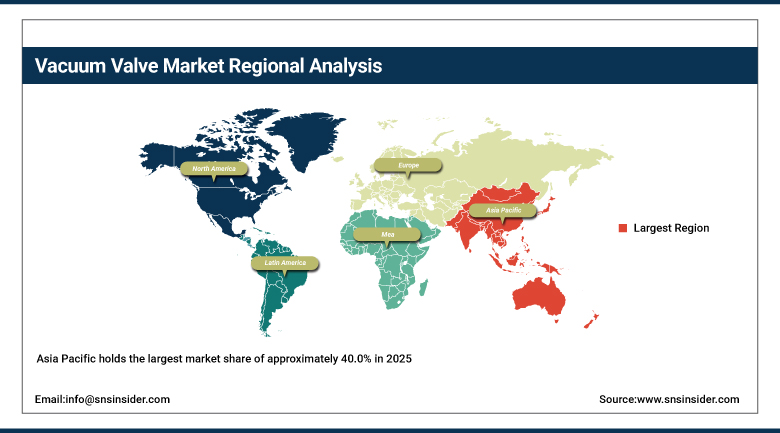
Asia Pacific holds the largest market share of approximately 40.0% in 2025 and is also expected to register the fastest CAGR of approximately 9.10% from 2026 to 2035, anchored by Taiwan and South Korea's concentration of leading-edge semiconductor fabrication facilities and China's aggressive domestic chip manufacturing expansion under national self-sufficiency initiatives. TSMC's continued capital expenditure on advanced node capacity, alongside similar investment from Samsung and SK Hynix, sustains persistent demand for precision vacuum valve components across the region's fabrication equipment supply chain.
Japan contributes deep application engineering expertise through established vacuum technology manufacturers, while China's domestic semiconductor equipment localization drive continues to expand regional vacuum valve production capacity independent of Western and Japanese suppliers.
Get Customized Report as per Your Business Requirement - Enquiry Now
North America Vacuum Valve Market Insights
North America is also a major market for vacuum valves, aided by considerable investments in semiconductor fabrication made possible via the CHIPS Act that are increasing the capabilities of chip manufacturing in the domestic market in several states. The United States provides the bulk of the demand within the region, owing to the presence of semiconductor equipment manufacturers, fabricators, aerospace, and research facilities.
Demand from Canada and Mexico is secondary, coming from industrial manufacturing, semiconductor-related operations, instrumentation, and special processing applications. There is a considerable amount of cross-border manufacturing and trade that further bolsters the supply chains of vacuum technology in the region.
Europe Vacuum Valve Market Insights
Europe represents a significant vacuum valve market, supported by established semiconductor, pharmaceutical, chemical processing, and advanced manufacturing industries. Germany, France, the Netherlands, and Italy contribute substantial demand through strong industrial capabilities, precision engineering expertise, and research infrastructure. Investments in semiconductor fabrication, cleanroom technologies, and advanced manufacturing are further increasing requirements for high-performance vacuum control equipment across the region.
Germany accounts for a major share of European demand, supported by its strong semiconductor equipment, automotive, chemical, and industrial manufacturing base. The Netherlands contributes through advanced semiconductor equipment and research activities, while France and Italy support demand across aerospace, pharmaceuticals, scientific instrumentation, and industrial processing. Europe’s emphasis on technological innovation and energy-efficient equipment further supports market development.
MEA & Latin America Vacuum Valve Market Insights
The Middle East and Africa region reflects growing demand for vacuum valves, supported by expanding pharmaceutical manufacturing, chemical processing, healthcare infrastructure, research capabilities, and industrial diversification initiatives across key Gulf economies. The UAE is emerging as an important demand center as investments in pharmaceutical production, advanced laboratories, and research infrastructure increase the adoption of specialized vacuum equipment. Saudi Arabia and other Gulf markets are also contributing to regional development through industrial expansion, localized manufacturing initiatives, and investments in advanced processing facilities requiring reliable vacuum control technologies.
Latin America is led by Brazil, where expanding pharmaceutical manufacturing, chemical processing, food production, research activities, and industrial modernization continue to support gradual development of the vacuum valve market. Growing investments in production capacity and laboratory infrastructure are creating additional requirements for reliable vacuum systems across specialized applications. Mexico and Argentina contribute smaller but relatively steady demand, supported by pharmaceutical, chemical, industrial, and research activities. Increasing adoption of modern processing equipment and efforts to improve manufacturing efficiency are expected to sustain regional demand for vacuum valve solutions.
Market Dynamics
Growth Drivers: Semiconductor expansion and biomedical instrumentation demand fueling adoption
Surging demand for vacuum valves in semiconductor manufacturing represents the principal driver of market growth, as the industry's continued push toward smaller process nodes and higher chip density requires increasingly precise and reliable vacuum environment control at every fabrication stage.
Expanding biomedical instrumentation and pharmaceutical manufacturing activity represents a second significant driver, as sterile processing, freeze-drying, and analytical instrumentation applications continue to broaden demand well beyond the semiconductor industry's traditional dominance of the category.
Restraints: High installation costs and slow emerging-market adoption limiting broader penetration
Initial investment costs and subsequent maintenance needs for installing the vacuum valves constitute real constraints, especially in the case of small-scale producers and researchers who must consider these expenses in relation to other capital considerations.
Lack of awareness and low adoption rates in developing countries contribute to yet another constraint as the small-scale manufacturers in those countries continue to use old and inaccurate valves compared to their Internet of Things counterparts.
Opportunities: Renewable energy applications and smart valve technology opening new growth avenues
Heightened emphasis on renewable energy and sustainability presents a genuine growth opportunity, as solar panel manufacturing and other clean energy production processes increasingly depend on vacuum deposition and processing technology requiring precision valve components.
Smart, IoT-integrated valve technology represents a further opportunity, as manufacturers developing real-time health analytics and predictive maintenance capability are positioned to capture premium pricing from fabrication customers seeking reduced unplanned downtime.
Recent Developments:
- 2025: VAT Group continued expanding its semiconductor-grade vacuum valve production capacity to meet rising demand tied to global fabrication capacity expansion across multiple leading chipmakers.
- 2025: Pfeiffer Vacuum Technology continued advancing IoT-integrated smart valve technology offering predictive maintenance capability for fabrication equipment manufacturers seeking reduced unplanned downtime.
- 2025: ULVAC continued expanding its very high vacuum valve product line to serve growing demand from advanced semiconductor node production and analytical instrumentation customers across Asia.
Vacuum Valve Market Key Players are:
- VAT Group AG
- MKS Instruments, Inc.
- ULVAC, Inc.
- Pfeiffer Vacuum Technology AG
- Agilent Technologies, Inc.
- Busch Vacuum Solutions
- SMC Corporation
- CDK, Inc.
- HVA LLC
- V-TEX
- Baker Hughes Company
- Continental Disc Corporation
- Kurt J. Lesker Company
- Nor-Cal Products, Inc.
- VACOM Vakuum Komponenten & Messtechnik GmbH
- Leybold GmbH
- Edwards Vacuum LLC
- Presys, Inc.
- Vacom (VAT Group)
- Swagelok Company
Vacuum Valve Market Report Scope:
| Report Attributes | Details |
|---|---|
| Market Size in 2025 | USD 2.20 Billion |
| Market Size by 2035 | USD 5.60 Billion |
| CAGR | CAGR of 9.80% From 2026 to 2035 |
| Base Year | 2025 |
| Forecast Period | 2026-2035 |
| Historical Data | 2022-2024 |
| Report Scope & Coverage | Market Size, Segments Analysis, Competitive Landscape, Regional Analysis, DROC & SWOT Analysis, Forecast Outlook |
| Key Segments | • By Valve Type (Gate Valve, Angle Valve, Diaphragm Valve, Ball Valve, Butterfly Valve, Others) • By Pressure Range (Low-to-Medium, High Vacuum, Very High Vacuum) • By Material (Stainless Steel, Aluminum, Others) • By End User (Semiconductor, Pharmaceuticals, Chemical Processing, Aerospace, Research Laboratories, Others) |
| Regional Analysis/Coverage | North America (US, Canada), Europe (Germany, UK, France, Italy, Spain, Russia, Poland, Rest of Europe), Asia Pacific (China, India, Japan, South Korea, Australia, ASEAN Countries, Rest of Asia Pacific), Middle East & Africa (UAE, Saudi Arabia, Qatar, South Africa, Rest of Middle East & Africa), Latin America (Brazil, Argentina, Mexico, Colombia, Rest of Latin America). |
| Company Profiles | VAT Group AG; MKS Instruments, Inc.; ULVAC, Inc.; Pfeiffer Vacuum Technology AG; Agilent Technologies, Inc.; Busch Vacuum Solutions; SMC Corporation; CDK, Inc.; HVA LLC; V-TEX; Baker Hughes Company; Continental Disc Corporation; Kurt J. Lesker Company; Nor-Cal Products, Inc.; VACOM Vakuum Komponenten & Messtechnik GmbH; Leybold GmbH; Edwards Vacuum LLC; Presys, Inc.; Vacom (VAT Group); Swagelok Company. |
Frequently Asked Questions
Leading companies include VAT Group AG, MKS Instruments, Inc., ULVAC, Inc., Pfeiffer Vacuum Technology AG, and Agilent Technologies, Inc., among other major vacuum technology manufacturers.
Opportunities include heightened emphasis on renewable energy applications requiring vacuum deposition technology and smart, IoT-integrated valve technology offering predictive maintenance capability.
Growth is driven by surging demand for vacuum valves in semiconductor manufacturing and expanding biomedical and pharmaceutical instrumentation activity.
