
Cryogenic Valve Market Report Scope & Overview:
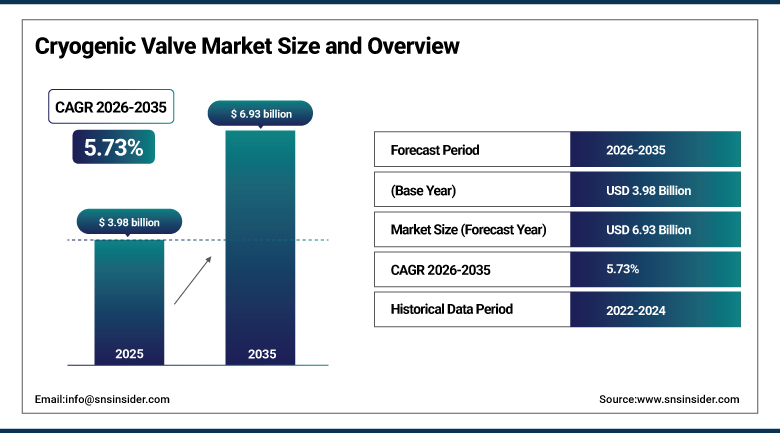
The Cryogenic Valve Market was valued at USD 3.98 billion in 2025 and is expected to reach USD 6.93 billion by 2035, growing at a CAGR of 5.73% from 2026–2035.
The cryogenic valve market is witnessing steady growth in the global market owing to rising LNG infrastructure development. Increasing demand for industrial gases is boosting adoption. Expanding energy and power generation projects are supporting market expansion. Manufacturers are focusing on advanced low-temperature valve technologies. Rising need for safe and efficient gas handling systems is driving innovation. Increasing use in oil & gas and chemical industries is further accelerating market adoption.
As indicated by the US Department of Energy Hydrogen Program and IEA Global Hydrogen Review 2025, hydrogen production across the globe hit 95 million tons, while the amount of low emission hydrogen made up less than 1 percent of total production. According to the IEA LNG Market Report 2025, global liquefied natural gas trade was above 400 billion cubic meters, which required cryogenic equipment functioning at temperatures below −150°C.
To Get more information Cryogenic Valve Market - Request Free Sample Report
Cryogenic Valve Market Trends
-
-
The growth in the construction of LNG infrastructure is resulting in an increased requirement for cryogenic valves in liquefying, storing and worldwide transportation of energy.
-
The increase in the international trade of natural gas is leading to the adoption of advanced cryogenic valves in the international energy chain.
-
Automation in the industry is leading to the incorporation of smart cryogenic valves into digitalized systems.
-
The growth in Industry 4.0 technology is leading to the use of intelligent valve systems due to automation in manufacturing and processing industries.
-
The development of automated gas handling systems is enhancing the control of flow rate and advanced cryogenic valve uses.
-
Clean energy and LNG project investments are leading to innovation and implementation of cryogenic valve technology.
-
U.S. Cryogenic Valve Market Outlook
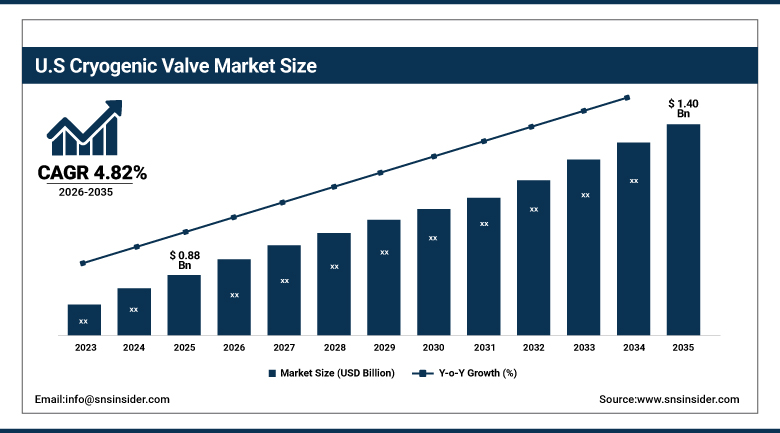
The U.S. Cryogenic Valve Market was valued at USD 0.88 billion in 2025 and is expected to reach around USD 1.40 billion by 2035, growing at a CAGR of 4.82% from 2026–2035.
The U.S. cryogenic valve market is expanding steadily owing to strong LNG infrastructure development. Increasing demand for industrial gases is supporting market growth. Rising investments in oil and gas processing are driving adoption across systems. Growth in power generation and chemical industries is further accelerating demand. Manufacturers are focusing on high-performance low-temperature valve designs. Increasing use in energy transport and storage applications is strengthening market penetration.
According to EIA Infrastructure Outlook for 2025 and DOE Hydrogen Program Updates, there are over 1,600 miles of hydrogen pipelines and over 3,000 hydrogen refueling stations and industrial handling facilities in operation that facilitate the cryogenic and low temperature gas systems. As per the U.S. Department of Transportation’s Pipeline and Hazardous Materials Safety Administration, 65% and above of all new capacities in liquefied natural gas exports are cryogenic storage and transfer systems that demand unique valve technologies.
Cryogenic Valve Market Segment Analysis
-
By Gas, LNG dominated the market with 48.50% share in 2025; while oxygen is the fastest growing segment with CAGR of 9.99% during 2026 to 2035.
-
By Type, ball valve dominated the market with 42.35% share in 2025; while globe valve is the fastest growing segment with CAGR of 9.42% during 2026 to 2035.
-
By Application, tanks & cold boxes dominated the market with 54.65% share in 2025; while transfer lines is the fastest growing segment with CAGR of 8.42% during 2026 to 2035.
-
By End-user, oil & gas dominated the market with 44.60% share in 2025; while power generation is the fastest growing segment with CAGR of 8.87% during 2026 to 2035.
By Gas, LNG dominated the cryogenic valve market, while oxygen is the fastest growing segment.
The LNG segment led the cryogenic valve market by earning the dominated revenue share in 2025. The dominance is attributed to the presence of extensive LNG production, storage, and transportation systems globally. The growing demand for clean energy sources has propelled the usage of LNG. The growing expansion of LNG terminals and cross-border transportation is also aiding the development of valves. The high demand for effective cryogenic control systems during liquefaction and regasification processes is aiding its leading position in the market.
The Oxygen segment is likely to register the fastest CAGR between 2026 and 2035 owing to the increasing demand for oxygen in the fields of healthcare, metallurgy, and industrial gases. The growing demand for oxygen in steel fabrication and healthcare procedures is aiding its rapid adoption. The growing expansion of production facilities for industrial gases is aiding the growth. The technological developments in cryogenic storage and transportation systems have increased efficiency.
By Type, ball valve dominated the cryogenic valve market, while globe valve is the fastest growing segment.
Ball Valve segment was dominant in the cryogenic valve market, contributing the largest share in terms of revenues in 2025. Ball Valves are dominant due to their effective sealing ability along with reliable shut-off performances in extreme cold conditions. They offer low pressure drop along with increased durability in LNG and industrial gas processes. The increased usage in the Oil and Gas sector, along with the cryogenic storage infrastructure, increases the leadership in the global market demand.
Globe Valve segment is projected to witness the fastest CAGR during the forecast period, 2026–2035, owing to the growing need for controlling precise flow in cryogenic valves. Globe valves are extensively used in the transfer lines as well as process control systems where there is a requirement of precise throttling. The increased usage in the infrastructure of LNG, along with the industrial gases, increases the adoption rate.
By Application, tanks & cold boxes dominated the cryogenic valve market, while transfer lines is the fastest growing segment.
Tank & Cold Box segment accounted for the dominated market share by generating the highest revenues in the cryogenic valve market in 2025. This market segment has been leading because of the wide application of cryogenic storage tanks in liquefied natural gas terminals and industrial gas plants that require valves with excellent performance at ultra-low temperatures. High demand for the storage infrastructure and insulation systems is anticipated to bolster the dominance of the segment in the coming years.
Transfer Line segment is projected to grow at the fastest CAGR between 2026 and 2035 owing to growing transfer of liquid gases through industrial piping systems. Growing demand for liquefied natural gas and pipelines carrying gases is likely to drive the need for advanced flow control systems. Growing need for effective transportation system is likely to propel the demand for cryogenic valves. Advanced technology in insulating and durable valves is likely to aid the rapid growth.
By End-user, oil & gas dominated the cryogenic valve market, while power generation is the fastest growing segment.
The Oil & Gas category emerged as the most dominant in terms of the cryogenic valve market's revenue share in 2025 owing to large-scale LNG production, transportation, and storage processes. The growing requirement for cryogenic flow control systems owing to rising exploration and refining activities supports the segment's dominance. Moreover, increasing pipeline construction and offshore activities boost the market dominance of this segment.
The Power Generation category will witness the fastest CAGR between 2026 and 2035 owing to the rising installation of LNG-based power plants. Growing preference for cleaner fuels is increasing the demand for cryogenic systems. Growth in gas-fired power plants boosts the demand for cryogenic valves. Increased investments in energy transition and grid upgrades support the market's growth.
Regional Analysis
|
Region |
Major Country |
Share within Region, 2025(%) |
|---|---|---|
|
North America |
United States |
79.20% |
|
Europe |
Germany |
26.80% |
|
Asia Pacific |
China |
38.60% |
|
Middle East & Africa |
UAE |
17.40% |
|
Latin America |
Brazil |
44.30% |
North America Cryogenic Valve Market Insights.
North America cryogenic valve market accounts for a strong share in 2025, driven by LNG infrastructure and industrial gas demand. The region benefits from advanced energy production and storage systems. Increasing oil and gas exploration activities are strengthening adoption of cryogenic valves. Expansion of LNG terminals and pipeline networks is further supporting market growth. Strong technological capabilities and safety standards reinforce the region’s leading position in the market.
According to the Hydrogen Program Plan by the U.S. Department of Energy and the FERC LNG Infrastructure, North America is home to more than 120 million tonnes per year of LNG export capacity in 2025, where the U.S. has the largest share of LNG exports globally. According to the PHMSA, cryogenic systems are required for LNG transportation and storage at temperatures below −162°C, leading to the widespread adoption of cryogenic valves in all federally mandated LNG plants.
Europe Cryogenic Valve Market Insights.
Europe cryogenic valve market is characterized by stable growth driven by strong industrial gas demand and energy transition initiatives. Key countries include Germany, France, United Kingdom, and Italy. Increasing focus on hydrogen and LNG infrastructure is supporting adoption of cryogenic valves. Growth in chemical and petrochemical industries is further driving market expansion. Strict safety and emission regulations are encouraging use of advanced valve technologies across industrial applications.
As per the Hydrogen Strategy from the European Commission and ENTSOG (European Network of Transmission System Operators for Gas), the European Union aims at installing 40 GW capacity of electrolyzes by 2030 that use renewable hydrogen, where the majority of hydrogen infrastructure projects, exceeding 60%, include cryogenic storage and liquefaction plants for the year 2025. Natural gas is the source that constitutes more than 20% of the EU final energy use, hence the need for significant LNG imports and regasification plants in 25+ terminals.
Asia Pacific Cryogenic Valve Market Insights.
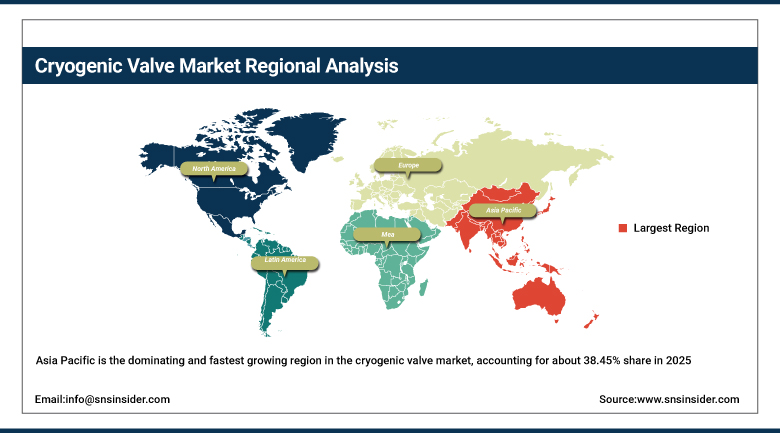
Asia Pacific is the dominating and fastest growing region in the cryogenic valve market, accounting for about 38.45% share in 2025 and expected to grow at the highest CAGR of 7.07% during 2026–2035 due to rapid industrialization. Expanding LNG import and export infrastructure is driving strong demand. Rising energy consumption in China, India, Japan, and South Korea is boosting adoption. Growth in metallurgy and chemical industries is further supporting market expansion. Increasing investments in gas-based power generation are accelerating regional market growth.
According to U.S. Geological Survey Mineral Commodity Summaries 2025 and the International Energy Agency Gas Market Report 2025, Asia Pacific will account for more than 45% of the world’s natural gas demand increase, with the volume of LNG trade transactions crossing 400 billion cubic meters per annum. According to the International Group of Liquefied Natural Gas Importers 2025, Asia is home to more than 70% of the world’s LNG import capacity, while China, Japan, and South Korea collectively consume more than 60% of the world’s LNG demand.
Get Customized Report as per Your Business Requirement - Enquiry Now
Middle East & Africa and Latin America Cryogenic Valve Market Insights.
The Middle East & Africa along with Latin America regions are witnessing steady growth driven by expanding oil and gas exploration activities. Key countries include UAE, Saudi Arabia, Brazil, and Mexico. Increasing LNG production and export projects are supporting market demand. Growth in petrochemical industries is further boosting adoption of cryogenic valves. Rising infrastructure investments in energy transport systems are strengthening regional market development.
In accordance with the IEA Global Energy Review 2025 and the OPEC Annual Statistical Bulletin 2025, the Middle East has more than 30% of world crude oil production, while Latin America has about 8-9%, and Africa has 7-10% owing to their high demand for upstream and LNG infrastructure. As stated by the EIA natural gas statistics, the amount of LNG trade was more than 400 billion cubic meters recently, which was being done with increased capacity for liquefaction in Qatar, Nigeria, and Brazil.
Market Dynamics
Growth Drivers: Rising LNG infrastructure expansion driving strong demand for cryogenic valve systems globally across energy sector
Fast development in LNG facilities is leading to an increase in the demand for cryogenic valves in the energy sector throughout the world. The growth in the construction of LNG facilities for liquefaction, storage, and transportation calls for advanced valves which can handle the low temperatures associated with LNG. An increase in international natural gas trade is also contributing towards the use of cryogenic valves. Increased investments in LNG are also leading to their greater use.
According to the Energy Information Administration of the U.S., by 2025, the capacity of liquefied natural gas export from the United States surpassed 120 billion cubic feet per day through expansion at terminals. As per the GIIGNL yearly report, in excess of 40 countries are currently importing liquefied natural gas. This implies that the adoption of cryogenic infrastructural systems has become common. The expansion in LNG infrastructure is creating a direct need for cryogenic valves.
Restraints: Technical challenges and operational risks reducing efficiency and slowing cryogenic valve market adoption
Cryogenic valves have to function in extremely low-temperature conditions, making the process of performance quite challenging from a technical point of view. Material fragility and leakages are some of the issues that make the process of performance even more difficult. Maintenance needs cause inefficiency in the system. Unavailability of skilled manpower makes it difficult for proper handling of the valves. Safety considerations also make the process complicated.
Opportunities: Rising industrial automation and advanced gas handling systems enabling new growth potential in cryogenic valve applications
The growing trend of industrial automation will present many lucrative opportunities for intelligent cryogenic valves. The use of digital technology in monitoring and controlling the operations is making the process more efficient. The development of automated gas handling systems will facilitate the application of valves. The expansion of intelligent manufacturing units will require the installation of valves that control the flow of fluids. Investment in Industry 4.0 technologies will boost the innovation.
In accordance with ISO and industrial safety automation standards, more than 70% of large-scale gas plants use automatic control systems for regulating pressure and temperature. According to the Department of Energy, USA, the level of adoption of industrial automation in gas handling systems is above 65% in developed countries. This can help in deploying cryogenic valves with higher performance in the industry.
Recent Developments
-
2026: Emerson Electric Co. launched Fisher IC2 cryogenic valve for LNG and hydrogen, reducing leakage and improving energy efficiency.
-
2025: Baker Hughes Company expanded energy technology portfolio including LNG, carbon capture, and industrial digital solutions globally.
-
2025: Crane Company acquired Baker Hughes Precision Sensors and Instrumentation business, expanding industrial measurement and flow control technology capabilities globally.
-
2024: IMI plc focused on precision valve innovation and automation solutions supporting decarbonization and industrial efficiency initiatives.
Cooling Fabrics Market Key Players are:
-
Emerson Electric Co.
-
Flowserve Corporation
-
Baker Hughes Company
-
IMI plc
-
Velan Inc.
-
KITZ Corporation
-
Crane Company
-
Curtiss-Wright Corporation
-
KSB SE & Co. KGaA
-
SAMSON AG
-
Parker Hannifin Corporation
-
Metso Corporation
-
Larsen & Toubro Valves Limited
-
Neway Valve (Suzhou Neway Valve Co., Ltd.)
-
CIRCOR International, Inc.
-
Bray International, Inc.
-
Pentair plc
-
Cryostar
-
HEROSE GmbH
-
AVK Holding A/S
Cryogenic Valve Market Report Scope:
| Report Attributes | Details |
|---|---|
| Market Size in 2025 | USD 3.98 Billion |
| Market Size by 2035 | USD 6.93 Billion |
| CAGR | CAGR of 5.73% From 2026 to 2035 |
| Base Year | 2025 |
| Forecast Period | 2026-2035 |
| Historical Data | 2022-2024 |
| Report Scope & Coverage | Market Size, Segments Analysis, Competitive Landscape, Regional Analysis, DROC & SWOT Analysis, Forecast Outlook |
| Key Segments | • By Gas: LNG, Oxygen, Nitrogen, Others • By Type: Globe Valve, Gate Valve, Ball Valve, Check Valve, Others • By Application: Tanks & Cold Boxes, Transfer Lines, Manifolds & Gas Trains • By End-user: Oil & Gas, Metallurgy, Power Generation, Chemical & Petrochemical, Marine, Others |
| Regional Analysis/Coverage | North America (US, Canada), Europe (Germany, UK, France, Italy, Spain, Russia, Poland, Rest of Europe), Asia Pacific (China, India, Japan, South Korea, Australia, ASEAN Countries, Rest of Asia Pacific), Middle East & Africa (UAE, Saudi Arabia, Qatar, South Africa, Rest of Middle East & Africa), Latin America (Brazil, Argentina, Mexico, Colombia, Rest of Latin America). |
| Company Profiles | Emerson Electric Co., Flowserve Corporation, Baker Hughes Company, IMI plc, Velan Inc., KITZ Corporation, Crane Company, Curtiss-Wright Corporation, KSB SE & Co. KGaA, SAMSON AG, Parker Hannifin Corporation, Metso Corporation, Larsen & Toubro Valves Limited, Neway Valve (Suzhou Neway Valve Co., Ltd.), CIRCOR International, Inc., Bray International, Inc., Pentair plc, Cryostar, HEROSE GmbH, AVK Holding A/S |

Frequently Asked Questions
The LNG segment dominated the market in 2025 due to extensive global LNG production, storage, transportation infrastructure, and rising clean energy demand.
The Major growth factors include LNG infrastructure development, rising industrial gas demand, expansion of energy and power projects, hydrogen investments, and increasing need for safe low temperature gas handling systems globally.
The cryogenic valve market was valued at USD 3.98 billion in 2025.
The cryogenic valve market is expected to grow at a CAGR of 5.73% from 2026 to 2035.
