
Transcatheter Mitral Valve Market Report Scope & Overview:
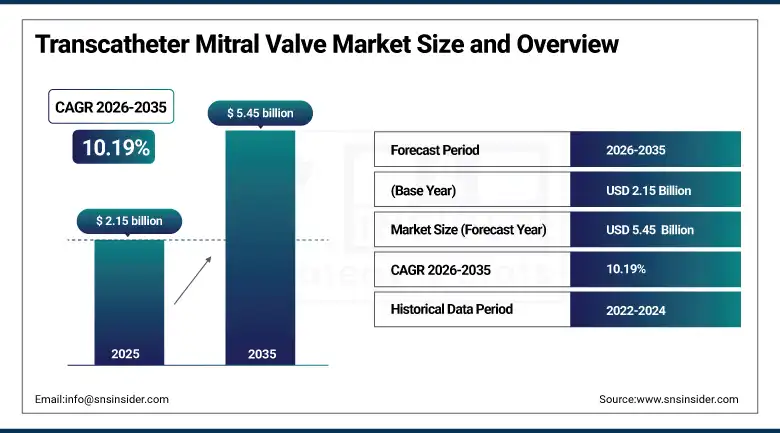
The transcatheter mitral valve market was valued at USD 2.15 billion in 2025 and is expected to reach USD 5.45 billion by 2035, growing at a CAGR of 10.19% from 2026–2035.
Transcatheter mitral valve interventions represent one of the most rapidly advancing frontiers in interventional cardiology, addressing the enormous unmet clinical need of mitral regurgitation patients who are ineligible for or at high risk from conventional open-heart surgical mitral valve repair or replacement due to age, comorbidity, or prior cardiac surgery. Mitral regurgitation, the retrograde leakage of blood from the left ventricle into the left atrium during systolic contraction through a structurally incompetent or functionally impaired mitral valve, affects an estimated 24 million people globally and is the world's most common valvular heart disease by prevalence, yet historically only a fraction of those with clinically significant mitral regurgitation received definitive surgical correction because the risk-benefit calculation of open mitral surgery was unfavorable for the majority of older, frailer patients who comprise the condition's predominant demographic.
The ESC and ACC/AHA updated valve disease management guidelines' inclusion of transcatheter mitral valve repair as a Class IIa recommendation for symptomatic severe mitral regurgitation patients with prohibitive or high surgical risk marks the clinical legitimization of catheter-based mitral intervention that is translating into systematic patient referral pathways and reimbursement framework development across major healthcare systems, providing the commercial foundation for the market's next growth phase.
Market Size and Forecast
-
Market Size in 2026E: USD 2.369 Billion
-
Market Size by 2035: USD 5.45 Billion
-
CAGR: 10.19% from 2026 to 2035
-
Fastest Growing Region: Asia Pacific
-
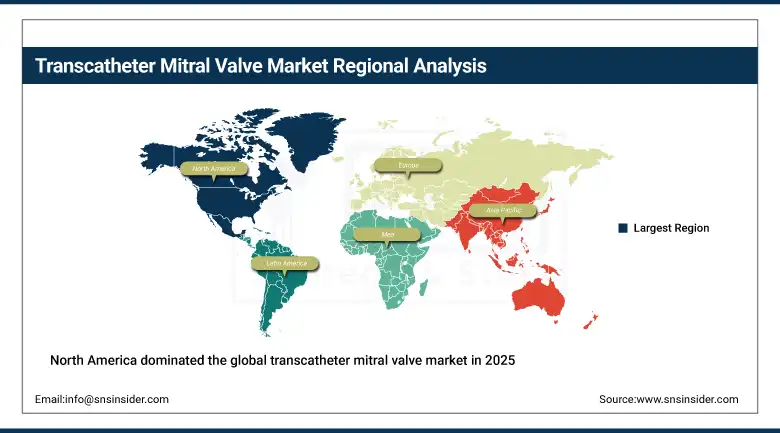
Largest Region: North America
To Get more information On Transcatheter Mitral Valve Market - Request Free Sample Report
Transcatheter Mitral Valve Market Trends
-
Rapid development of next-generation transcatheter mitral valve replacement platforms designed specifically for native mitral anatomy rather than relying on TAVR valve technologies repurposed for mitral application, with platforms including Medtronic Intrepid, Tendyne, and Cardiovalve incorporating dedicated anchor mechanisms, annular conformability features, and optimized valve hemodynamics for the anatomically challenging native mitral landing zone.
-
Growing adoption of transseptal delivery approaches over transapical access for transcatheter mitral interventions, driven by operator training familiarity, avoidance of apical incision and general anesthesia requirements, and accumulating evidence that transseptal access achieves equivalent procedural success to transapical at substantially lower procedural complexity and patient risk in appropriate anatomy cases.
-
Increasing integration of advanced three-dimensional echocardiographic guidance, cardiac CT planning, and fusion imaging platforms that overlay pre-procedural CT anatomy onto real-time fluoroscopic images during catheter delivery, improving device positioning accuracy and reducing procedure duration and radiation exposure in complex mitral anatomy cases.
-
Expanding clinical trial activity across both repair and replacement device categories, with over 1,200 active clinical trials focused on mitral repair and replacement globally in 2025, reflecting the intensity of competition among device developers seeking FDA and CE approval for next-generation platforms that can address patient populations inadequately served by current repair and early replacement technologies.
-
Rising physician training programme investment from Abbott and Edwards Lifesciences as procedural volume growth for MitraClip and PASCAL requires continuous expansion of the trained interventional cardiologist and cardiac surgery specialist base capable of performing transseptal mitral interventions safely at high-volume structural heart programme centers.
The U.S. Transcatheter Mitral Valve Market Outlook
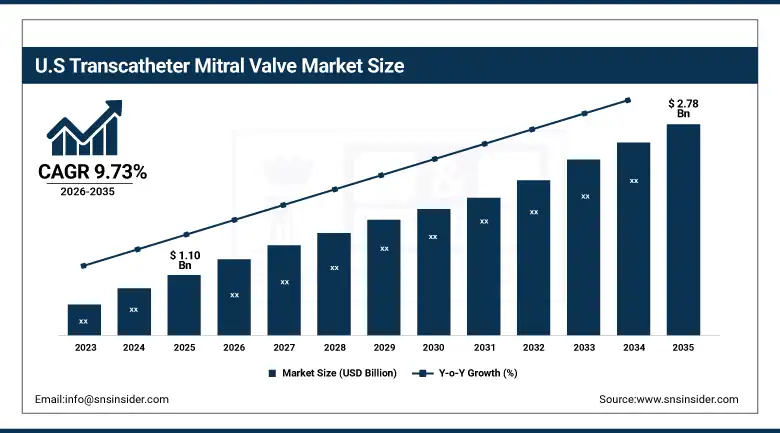
The U.S. Transcatheter Mitral Valve Market was valued at approximately USD 1.10 billion in 2025 and is expected to reach approximately USD 2.78 billion by 2035, growing at a CAGR of 9.73%, driven by the world's largest structural heart disease patient population, comprehensive CMS reimbursement for MitraClip and PASCAL procedures in approved indications, over 1,200 active clinical trials generating evidence for patient selection and device performance optimization, and the concentration of leading transcatheter mitral valve innovators including Abbott, Edwards Lifesciences, and Medtronic whose U.S. headquarters sustain a globally dominant structural heart device development ecosystem.
The United States leads the global transcatheter mitral valve market through the combination of the most extensive high-volume structural heart center programme network, with nearly 65% of high-volume cardiac centers having implemented novel transseptal methods for mitral intervention by 2025, the most comprehensive FDA approval and reimbursement frameworks for transcatheter mitral valve procedures, and the most active clinical investigation programme generating the evidence base that guides patient selection and device technology evaluation globally.
CMS's National Coverage Determination for transcatheter mitral valve repair requiring procedures to be performed at hospitals participating in a national registry for post-market surveillance represents the quality oversight framework that simultaneously ensures systematic outcome monitoring and sustains reimbursement certainty for the high-volume structural heart programmes whose procedural investment in training, imaging infrastructure, and heart team development is justified by the assured reimbursement that national coverage provides.
Transcatheter Mitral Valve Market Segment Analysis
-
By Product Type, transcatheter mitral valve repair devices dominated with approximately 54.88% in 2025 as the more clinically mature segment with established commercial market presence and reimbursement frameworks in major markets. Transcatheter mitral valve replacement devices are the fastest-growing at a CAGR of 12.45% as next-generation platforms advance through pivotal clinical trials toward commercial approval.
-
By Approach, transseptal dominated as the most widely adopted delivery approach due to avoidance of apical ventriculotomy, compatibility with conscious sedation, and broad physician training familiarity with transseptal catheterization technique from atrial fibrillation ablation programmes. Transapical remains important for specific anatomical situations where transseptal navigation is challenging.
-
By Valve Type, Bioprosthetic Valves dominated through their established safety profile, avoidance of long-term anticoagulation requirements, and the durability improvements achieved through current-generation tissue preparation and anti-calcification treatments; Mechanical valve options are being explored in replacement devices for younger patient populations where bioprosthetic durability limitations over 15 to 20 years are a clinical concern.
-
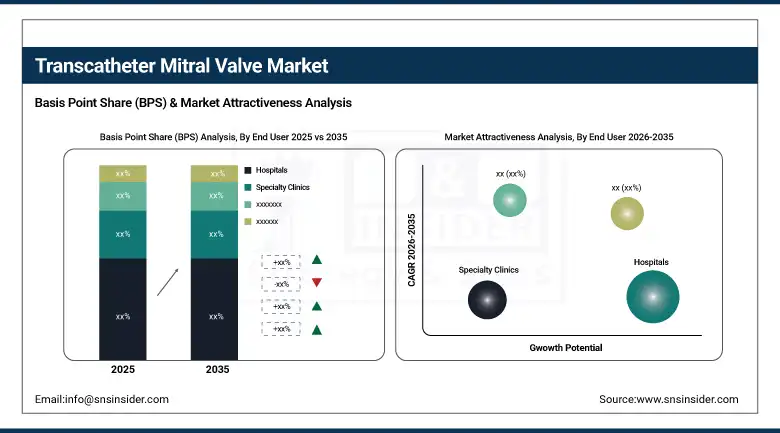
By End User, Hospitals held the majority share of 74.42% in 2025 as the exclusive setting for transcatheter mitral procedures requiring cardiac catheterization laboratory or hybrid operating room infrastructure, specialized heart team collaboration, and intensive care unit backup; Ambulatory Surgical Centers are the fastest-growing at a CAGR of 14.25% as simplified procedures and improved patient selection enable same-day discharge in appropriate low-risk cases.
By Product Type, repair devices dominate, replacement devices are expected to grow fastest
Transcatheter Mitral Valve Repair Devices retained the dominant product position with approximately 54.88% of the Transcatheter Mitral Valve Market in 2025, reflecting the clinical maturity advantage of the MitraClip leaflet approximation technique that has accumulated over a decade of commercial experience, established a large trained operator base, generated multiple high-quality randomized clinical trial and registry datasets, and achieved national reimbursement coverage in the United States, European markets, Japan, and Australia that provides the commercial certainty necessary to justify structural heart programme investment in repair procedure capability. The COAPT trial's demonstration of significant mortality reduction, hospitalization reduction, and quality of life improvement in functional mitral regurgitation patients receiving MitraClip therapy compared with optimal medical therapy alone established the mortality benefit evidence that elevated catheter-based mitral repair from a palliative intervention to a life-saving therapy in carefully selected functional MR patients, transforming the market's clinical positioning and commercial growth trajectory.
Transcatheter Mitral Valve Replacement Devices are the fastest-growing segment at a CAGR of 12.45% through 2035, reflecting the large and unaddressed patient population with severely diseased native mitral anatomy or failed surgical repair rings who are not anatomically suitable for leaflet approximation repair techniques and who currently have no transcatheter alternative to the high-risk open surgical revision procedures that their clinical condition would require. The Tendyne system's FDA approval for patients with failed surgical mitral bioprostheses and severe anatomical features precluding repair has established the first commercial transcatheter mitral replacement foothold in the United States, while Medtronic's Intrepid APOLLO trial's enrolment of over 2,500 patients with native mitral regurgitation is advancing the most ambitious transcatheter native mitral replacement programme toward the pivotal data that could unlock the largest remaining segment of the transcatheter mitral valve addressable market.
By End User, hospitals dominate, ASCs are expected to grow fastest
Hospitals retained the dominant end user position with approximately 74.42% of the Transcatheter Mitral Valve Market in 2025, as the technical complexity, equipment requirements, and clinical risk profile of current transcatheter mitral procedures mandates performance in hospital settings with access to cardiac catheterization laboratory or hybrid operating room imaging infrastructure, anesthesiology support, cardiac surgery backup for procedural emergencies, and cardiac intensive care unit capability for post-procedure haemodynamic management. The heart team model required by transcatheter valve intervention guidelines, where interventional cardiologists, cardiac surgeons, echocardiographers, and structural heart nurses collaborate in patient selection, procedural planning, and post-procedure management, is inherently anchored in the hospital-based multidisciplinary infrastructure that provides all necessary specialist expertise in a coordinated programme framework.
Ambulatory Surgical Centers are the fastest-growing end user at a CAGR of 14.25% through 2035, as the progressive simplification of transcatheter mitral repair procedures through transseptal approach standardization, improved device delivery systems reducing manipulation complexity, and growing operator experience enabling shorter procedure duration and more predictable outcomes is creating the conditions under which appropriately selected low-risk patients can be treated in outpatient structural heart programme settings with same-day discharge, substantially reducing the per-procedure cost and expanding procedure accessibility beyond the limited capacity of inpatient structural heart programme catheterization laboratory schedules.
Regional Analysis
|
Region |
Major Country |
Share within Region, 2025 (%) |
|---|---|---|
|
North America |
United States |
86.4% |
|
Europe |
Germany |
27.5% |
|
Asia Pacific |
Japan |
36.8% |
|
Middle East & Africa |
Saudi Arabia |
28.7% |
|
Latin America |
Brazil |
44.3% |
North America Transcatheter Mitral Valve Market Insights
North America dominated the global transcatheter mitral valve market in 2025, with the United States accounting for approximately 86.4% of North American revenues as the market where the transcatheter mitral valve repair category was pioneered, where the most active clinical investigation programme is underway, and where the most comprehensive commercial reimbursement for approved indications sustains a large and growing annual procedure volume. The U.S. structural heart programme ecosystem encompasses hundreds of high-volume centres whose investment in echocardiographic guidance capability, interventional cardiologist and cardiac surgeon team training, and catheterisation laboratory scheduling dedicated to structural heart procedures creates the clinical infrastructure that sustains commercial procedure volume growth above demographic ageing alone.
Get Customized Report as per Your Business Requirement - Enquiry Now
Europe Transcatheter Mitral Valve Market Insights
Europe is a technically advanced transcatheter mitral valve market where the CE mark regulatory pathway has enabled earlier commercial availability of transcatheter mitral devices relative to their FDA approval timelines, allowing European structural heart programmes to develop clinical experience with next-generation devices during their pivotal trial phases. Germany accounts for approximately 27.5% of European transcatheter mitral valve revenues through its combination of the EU's largest structural heart programme concentration, the German Heart Centre system's role as a global clinical innovation hub, and the statutory health insurance system's coverage of MitraClip and PASCAL procedures in patients meeting guideline criteria. France, Italy, the United Kingdom, and the Netherlands represent additional significant European markets where structural heart programme development has reached the volume and expertise levels that support active transcatheter mitral valve procedure programmes.
Asia Pacific Transcatheter Mitral Valve Market Insights
Asia Pacific is the fastest-growing transcatheter mitral valve market, driven by the large unaddressed mitral regurgitation patient population across the region's ageing demographics, rapidly expanding structural heart programme capability in Japan, South Korea, China, and Singapore, and the progressive commercialization of MitraClip and PASCAL in Asian markets following regulatory approvals and reimbursement framework development that is enabling procedure volume growth from a currently low penetration base relative to disease prevalence. Japan accounts for approximately 36.8% of Asia Pacific revenues through its leading structural heart programme infrastructure in major university hospitals, PMDA approval of transcatheter mitral repair devices, and Japan's universal health insurance coverage framework supporting procedure reimbursement for approved indications.
Middle East and Africa & Latin America Transcatheter Mitral Valve Market Insights
Middle East and Africa and Latin America are developing transcatheter mitral valve markets where a combination of growing structural heart programme capability at leading academic cardiac centres, increasing recognition of the large unaddressed mitral regurgitation burden in ageing populations, and progressive commercial market development by Abbott and Edwards Lifesciences are creating initial procedural volumes that will scale as reimbursement frameworks develop and trained operator availability expands. Saudi Arabia leads MEA transcatheter mitral valve revenues at approximately 28.7% of regional revenues through its advanced cardiac surgical and interventional programmes at King Faisal Specialist Hospital and major Riyadh and Jeddah cardiac centres. Brazil leads Latin American revenues at approximately 44.3% through its well-developed cardiology subspecialty infrastructure at major Sao Paulo academic hospitals.
Market Dynamics
Growth Drivers: Large unaddressed mitral regurgitation patient population combined with clinical trial evidence establishing mortality and quality of life benefits driving systematic patient identification and referral to transcatheter programmes
The primary structural growth drivers for the Transcatheter Mitral Valve Market are the extraordinary scale of the unaddressed mitral regurgitation patient population, estimated at over 24 million people globally with clinically significant mitral regurgitation of whom a substantial proportion with moderate to severe symptoms have historically not received definitive valve intervention because open surgical risk was deemed prohibitive relative to expected benefit in elderly and high-comorbidity patients, combined with the accumulating clinical trial evidence that transcatheter mitral repair significantly reduces mortality, heart failure hospitalization, and symptom burden in well-selected functional mitral regurgitation patients whose prognosis with optimal medical therapy alone was substantially worse than the post-MitraClip COAPT trial outcomes demonstrated.
Restraints: Complex anatomical selection criteria limiting the proportion of mitral regurgitation patients suitable for current transcatheter repair approaches, absence of long-term durability data for transcatheter repair in younger patients
A significant restraint on the Transcatheter Mitral Valve Market is the stringent anatomical selection criteria for current transcatheter mitral repair devices, where mitral valve anatomy with excessive leaflet prolapse, complex calcification patterns, rheumatic valve changes, or annular dimensions outside device sizing ranges precludes MitraClip or PASCAL eligibility and identifies patients who require either transcatheter replacement or conventional surgery for definitive management. This anatomical exclusion factor limits the proportion of all mitral regurgitation patients who can be treated with currently approved transcatheter repair devices to approximately 40 to 60% of the high-surgical-risk mitral regurgitation population depending on centre-specific anatomy screening criteria, constraining market penetration below the full theoretical addressable patient population.
Opportunities: Next-generation replacement platforms expanding the treatable patient population, indication expansion from high-surgical-risk to intermediate-risk patients following pivotal trial completion
The anticipated approval of next-generation transcatheter mitral valve replacement devices including the Medtronic Intrepid, Edwards EVOQUE, and competing platforms for native mitral regurgitation following their ongoing pivotal randomized controlled trials represents the most commercially significant potential market expansion event in the transcatheter mitral valve market, as replacement devices address the anatomically ineligible patient population excluded from current repair devices while simultaneously providing a definitive haemodynamic correction in patients where repair provides only partial correction. The potential indication expansion of transcatheter mitral repair from its current high-surgical-risk positioning toward intermediate and lower surgical risk patients, following the precedent established in TAVR where PARTNER 2 and SURTAVI trials demonstrated TAVR equivalence to surgery in intermediate-risk patients, could multiply the addressable commercial patient population by three to five times above the current high-risk indication base.
Recent Developments:
-
June 2025: Medtronic advanced its APOLLO clinical trial evaluating the Intrepid TMVR device, enrolling over 2,500 patients with severe symptomatic mitral regurgitation at centres across North America and Europe, representing the largest transcatheter mitral valve replacement pivotal trial ever conducted and the most important near-term clinical programme for the replacement segment's commercial approval.
-
2025: Abbott announced continued strong global MitraClip and PASCAL procedure volume growth, driven by systematic structural heart programme development, increasing cardiologist awareness of functional mitral regurgitation treatment guidelines, and clinical outcomes data from expanded post-market registries demonstrating real-world outcomes consistent with COAPT trial results across broader patient populations.
-
2025: Edwards Lifesciences advanced its CLASP pivotal trial programme for the EVOQUE transcatheter tricuspid valve replacement system and continued expanding its transcatheter mitral platform portfolio beyond the PASCAL Precision repair system toward replacement technologies addressing the large tricuspid and mitral replacement opportunity.
Transcatheter Mitral Valve Market Key Players are:
-
Abbott Laboratories
-
Edwards Lifesciences Corporation
-
Medtronic plc
-
Cardiovalve Ltd.
-
Caisson Interventional LLC
-
4C Medical Technologies
-
Neovasc Inc. (Tiara)
-
Mitralign Inc.
-
Valtech Cardio Ltd. (ARTO)
-
Bmeye B.V.
-
Boston Scientific Corporation
-
NeoChord Inc.
-
Colibri Heart Valve LLC
-
Tendyne Holdings
-
Highlife SAS
-
Polares Medical SA
-
Navigate Cardiac Structures Inc.
-
PolyCor
-
MitraQ Pty Ltd.
-
Duroplast Extrusions Pvt. Ltd.
Transcatheter Mitral Valve Market Report Scope:
| Report Attributes | Details |
|---|---|
| Market Size in 2025 | USD 2.15 Billion |
| Market Size by 2035 | USD 5.45 Billion |
| CAGR | CAGR of 10.19% From 2026 to 2035 |
| Base Year | 2025 |
| Forecast Period | 2026-2035 |
| Historical Data | 2022-2024 |
| Report Scope & Coverage | Market Size, Segments Analysis, Competitive Landscape, Regional Analysis, DROC & SWOT Analysis, Forecast Outlook |
| Key Segments | • By Product Type (Transcatheter Mitral Valve Repair Devices, Transcatheter Mitral Valve Replacement Devices) • By Valve Type (Bioprosthetic Valves, Mechanical Valves), By Approach (Transseptal, Transapical, Transatrial) • By End User (Hospitals, Ambulatory Surgical Centers, Specialty Clinics) • By Distribution Channel (Hospital Pharmacies, Online Pharmacies, Others) |
| Regional Analysis/Coverage | North America (US, Canada), Europe (Germany, UK, France, Italy, Spain, Russia, Poland, Rest of Europe), Asia Pacific (China, India, Japan, South Korea, Australia, ASEAN Countries, Rest of Asia Pacific), Middle East & Africa (UAE, Saudi Arabia, Qatar, South Africa, Rest of Middle East & Africa), Latin America (Brazil, Argentina, Mexico, Colombia, Rest of Latin America). |
| Company Profiles | Abbott Laboratories, Edwards Lifesciences Corporation, Medtronic plc, Cardiovalve Ltd., Caisson Interventional LLC, 4C Medical Technologies, Neovasc Inc. (Tiara), Mitralign Inc., Valtech Cardio Ltd. (ARTO), Bmeye B.V., Boston Scientific Corporation, NeoChord Inc., Colibri Heart Valve LLC, Tendyne Holdings, HighLife SAS, Polares Medical SA, Navigate Cardiac Structures Inc., PolyCor, MitraQ Pty Ltd., Duroplast Extrusions Pvt. Ltd. |

Frequently Asked Questions
North America dominated with the United States as the global leader in transcatheter mitral valve procedure volume and commercial market development.
Transcatheter Mitral Valve Repair Devices dominated with approximately 54.88% of revenues in 2025.
A large untreated mitral regurgitation patient population and positive COAPT trial outcomes are driving referrals toward transcatheter mitral procedures.
The Transcatheter Mitral Valve Market was valued at USD 2.15 billion in 2025.
The Transcatheter Mitral Valve Market is expected to grow at a CAGR of 10.19% from 2026 to 2035
